Qué momento. Qué emocionante y emotivo ver a Yeison López llorando de la alegría junto a su madre, su hermano y su padre. Gracias, Yeison. #ColombiaEnParís2024 🇨🇴
@CamargoFelipe1@JonSteinsson@R2Rsquared 1) is a crucial part of the NK paradigm, but 2) is not. High unemployment can cause lower wages, marginal costs, and inflation. This is different from saying that unemployment is the main source of movements in marginal costs and inflation. See also https://t.co/RciDTGNIqw
Ah, the smell of never-ending macro debates in the air.
Today's edition: the Phillips curve (PC).
There are two notions of PC:
[1] statistical; and
[2] theoretical.
One can plainly see the statistical PC in the data. Sometimes. For example https://t.co/qusdc0ur97
@CamargoFelipe1@JonSteinsson@R2Rsquared That expression results from two "assumptions": 1) Inflation is the present value of real marginal costs 2) These are proportional to the unemployment/output gap. If 1) is correct and 2) is not, you can still have inflation going down without a negative output gap.
@ricco_giovanni@FT Nice thread. Let me disagree about the diagnostic. We can find 5 papers for each question you pose, each with a different answer. So empirical macro doesn't lack answers; it lacks consensus: the only honest answer to every question is "it depends."
@IvanWerning But in his view, it was the byproduct of info. frictions resulting in different perceptions of prices. In your model, the disagreement is fundamental, driven by differences between firms' production inputs and HH's consumption basket, and propagates both real and nominal shocks.
@IvanWerning Interesting paper! Your discussion on disagreement reminded me of Friedman's presidential address, where he argued that the disagreement between households and firms was a source of non-neutrality.
@t_holden@pontus_rendahl It depends on the model you have in mind. In the standard NKM, the relationship between inflation and real marginal costs is "structural." However, the NKPC relating inflation to output only arises in equilibrium.
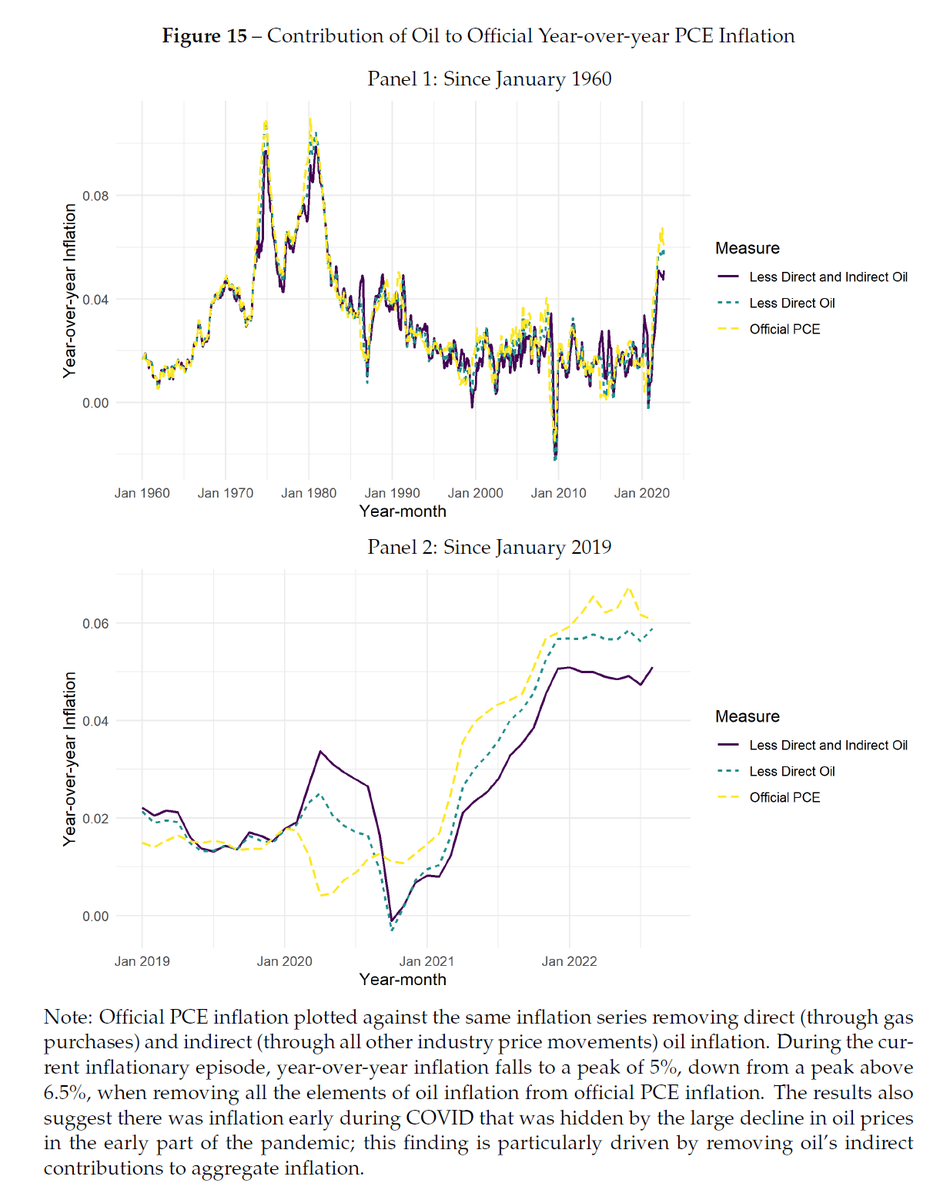
@pontus_rendahl I wonder about the usefulness of "core" measures after considering all these indirect effects. For example, energy shocks increase workers' living costs which may, in turn, demand higher wages, leading to an increase in marginal costs and inflation in "non-core" sectors.
@mfariacastro I use Drawboard PDF with my Surface for reading and annotating. It works really well with the Surface pen and you can save and edit pdfs afterwards. I haven’t tried it while teaching with Zoom but I guess you could just share screen and draw in real time.






![dandolfa's tweet photo. Ah, the smell of never-ending macro debates in the air.
Today's edition: the Phillips curve (PC).
There are two notions of PC:
[1] statistical; and
[2] theoretical.
One can plainly see the statistical PC in the data. Sometimes. For example https://t.co/qusdc0ur97 https://t.co/VkOyTWw4wP](https://pbs.twimg.com/media/F3nehbqX0AELMna.png)