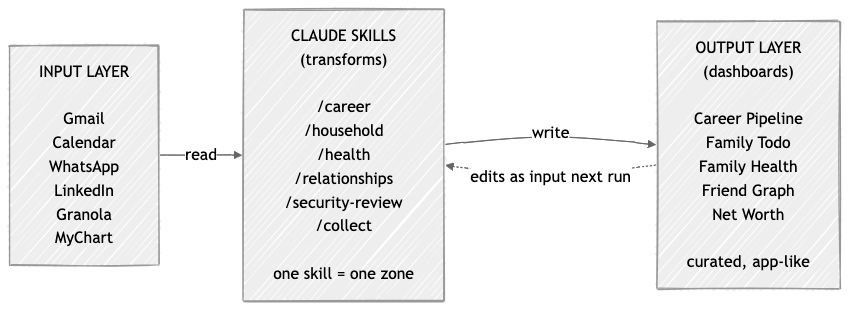
My personal knowledge graph: an INPUT layer (Gmail / calendar / WhatsApp) and an OUTPUT layer (Career Pipeline + Family Todo). Claude skills are the transforms.
A dbt-style medallion architecture for personal data.
Here's why this is the only PKM design that survives AI agents.
@JqOnly @sidewalkco Same shape in my personal-OS. Stage 7 has 4 deterministic gates before publish: text matches, button enabled, share-safety clean, counter > 0. OS defines the Handoff Boundary, LLM produces inside it. Without those contracts, the skill works 80% of the time.
@Wattenberger This generalizes past code. My personal-OS has the same shape: one skill per vault zone (Career, Family, Health), each with bespoke editor + bespoke substrate. The skill that owns the zone makes the substrate worth editing. What does this look like in your sandbox?
The 'specs in YAML' framing on HN reverses what works in my Claude skills. The spec is prose the model executes; YAML is identity + tunables (name, paths, defaults). Conflate them and you lose prose's expressivity AND config's stability.
git has tracked Co-Authored-By trailers for years. VS Code finally autopopulating them with the LLM author is obvious in retrospect. Every Stage M auto-commit in my personal-OS lands with `Co-Authored-By: Claude opus-4-7[1m]`. What else are we leaving on the floor?
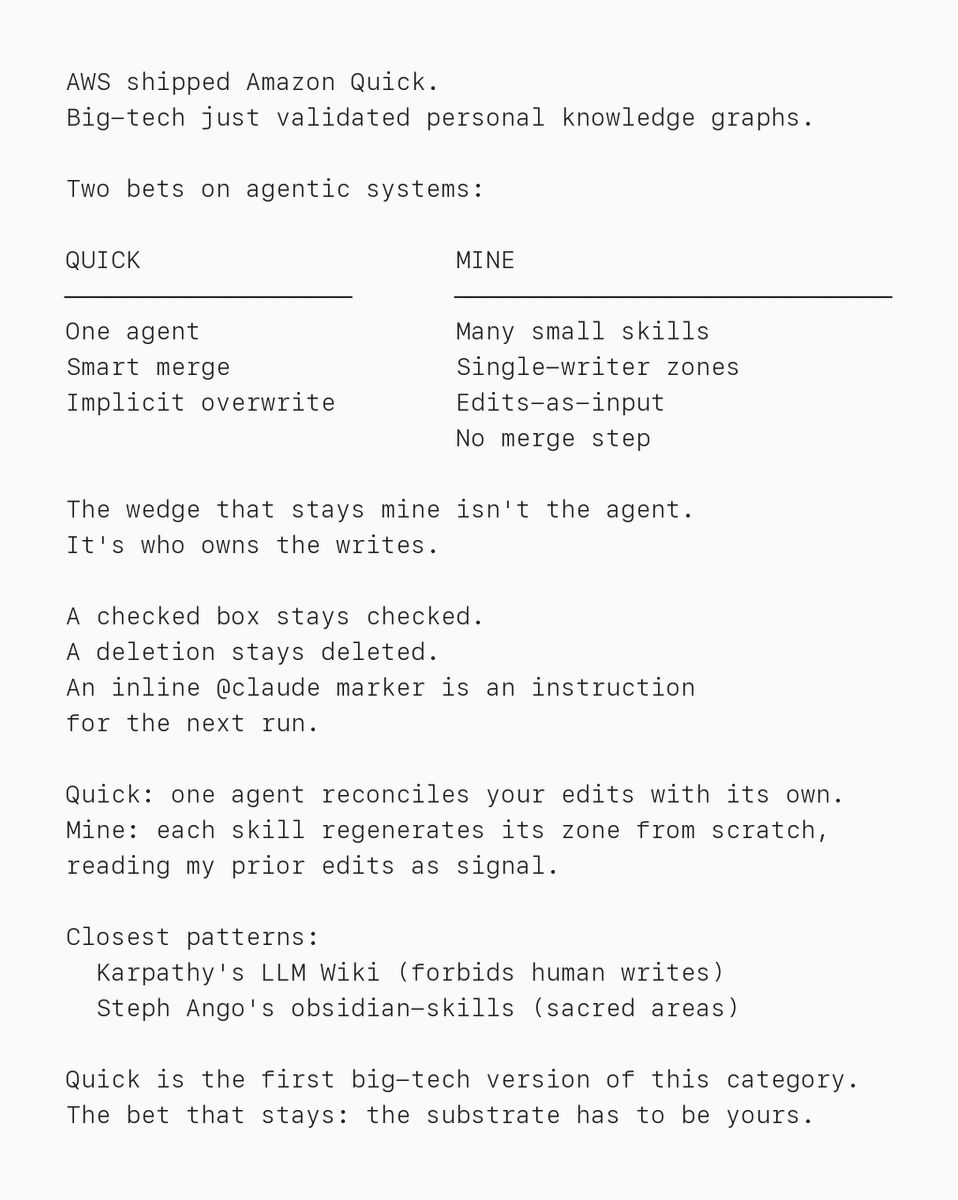
@ApplyWiseAi Fragmentation isn't recall. Vectors solve that. It's a write problem. Single-writer per zone: exactly one skill writes Career, exactly one Family Todo. Cross-zone updates are explicit handoffs in config. "Two agents fight over one note" goes away.
@shreyasmakes Did this. 25 skills now. Three surprises: (1) the chassis matters more than any single skill, uniform Stage M is what makes self-learning compound; (2) single-writer per file beats per-directory for personal data; (3) hooks beat memorization for system contracts.
@web3nomad totally agree! and the output layer is both - they're md files (I use @obsdmd) so I can click checkboxes and tag @claude to do things but I also have apps on top that read those files and add a UI layer, features, etc.
My personal knowledge graph: an INPUT layer (Gmail / calendar / WhatsApp) and an OUTPUT layer (Career Pipeline + Family Todo). Claude skills are the transforms.
A dbt-style medallion architecture for personal data.
Here's why this is the only PKM design that survives AI agents.
Open Q for anyone building this kind of system: when should an agent re-surface something I deleted weeks ago?
My current heuristic is "never unless an input explicitly contradicts the prior delete." Probably wrong in the long tail.
The fix: don't lock me out, don't merge.
I edit the output freely. The agent regenerates everything from scratch, reading my prior output (with my edits) as input.
A checked box is signal. An @claude marker is an instruction. A deletion stays deleted.
Most "AI second brain" tools fall into one of two failure modes:
(a) lock you out of the agent's output, or
(b) try to merge with your edits and corrupt them.
You can see this play out today in Cursor, Kiro, and even VS Code's strict-mode debate.
Introducing Share from Anywhere for Traces
A set of skills for sharing to directly from any supported agent to @tracesdotcom. Available for all 9 supported agents.
This small add-on has improved how we work with agents as a team. Here's how it works: