LOVART 🔥: GPT Image 2.6 is now live in Lovart's design agent, so you can change one detail of an image with a single line.
> Lovart's examples: a closed shop turned open, an ice cream switched to mango, a sign rewritten, one line per edit.
> OpenAI's model comes in two versions, both listed in Lovart's agent. Flare can make an image in as little as six seconds at low quality, and Sunburst keeps images more consistent across edits at medium or high quality.
https://t.co/wsYNPXwGDM
GPT Image 2.6 is live on Lovart.
Closed shop? Open.
Wrong flavor? Mango.
Pizza too hot? Change the sign.
One line per edit. Up to 31 days of unlimited generations when you upgrade.
Bodylang is an open-source 3D body that plays out your day. Tell it what you ate or did, and a minute-by-minute physiology model shows the effect on your organs.
For people curious about what food, sleep, a workout or a cold does inside the body.
→ You type in plain words, your LLM logs it with tools such as log_food, and the model recalculates the whole day
→ Ask mode answers in steps, moving the camera to each organ and the clock to each moment
→ Sources at the bottom right show whether a number came from the model, the LLM, the USDA food table or you
It runs on your computer with Node and pnpm, on a ChatGPT or Claude subscription or a Claude API key, and has been tested only on a Mac. It shows estimates for a typical body, isn't medical advice and can't diagnose anything. MIT license.
Repo: https://t.co/mynJB2szKs
https://t.co/mynJB2szKs
GROK 🔥: Grok Bot is preparing to let each user bring their own bot into Slack.
> You connect your bot to Slack individually and trigger it from there: DM it or @mention it, and it answers with the same plugins, context and memories it uses in the Grok Bot app.
> The feature is expected in the 1.1.0 build of the macOS app.
https://t.co/NYFPpOg64k
OPENAI 🔥: dots can now log in for you, using the sign-in codes that arrive in your connected inbox.
> When a code is needed, you decide whether your dot may use it just this once or always fill it in.
> More sign-in improvements are on the way.
https://t.co/j37NW2SyeO
Voyager released vork, a headless 3D and VFX engine where a coding agent writes the scene, renders it, looks at the image and revises the code. There is no editor to drive.
For people who want an AI agent to make 3D shots or add effects to real footage.
→ Scenes are JSON, or Python and TypeScript through the SDKs
→ Examples include a million-bird flock, a black hole and a glowing object placed on a real desk
→ The README gives a prompt to paste: run vork init, read vork help, render a preview and inspect the image
Rendering needs an Apple Silicon Mac or an NVIDIA GPU with ray tracing support. It is source-available, not open source, and free during the research preview, including for commercial work. Without prior written permission, you can't sell, rent, license, relicense or sublicense vork or a modified version, distribute a modified version, or offer either as a hosted or managed service where others submit scenes, code or jobs to be rendered. The license covers this version only; later versions may come under different terms, including paid terms.
Repo: https://t.co/mtdXXQkA7Q
https://t.co/mtdXXQkA7Q
Apple's Xcode plugin is now in Claude Code's official plugin directory, so Claude Code can build, run and test your Xcode project and render SwiftUI previews.
For iOS and Mac developers who already use Claude Code.
→ Build, run and test your schemes, then read the build logs and diagnostics
→ Render SwiftUI previews and drive simulators and devices
→ Search Apple developer documentation
Install with /plugin install xcode@claude-plugins-official. The listing names Apple Inc. as the author. The plugin loads from Xcode through an xcrun command, so you need Xcode on your Mac, and Claude Code shows that command and asks you to accept it first.
Repo: https://t.co/1diJc413r6
https://t.co/1diJc413r6
ANTHROPIC 🔥: Not officially announced yet, but according to TestingCatalog, Anthropic is working on a collaborative mode for Claude Code Projects.
> As TestingCatalog describes it, recent activity on the Projects page summarises the latest threads, and a project-level overview shows scheduled tasks and threads.
> TestingCatalog adds that Anthropic is also working on invites for Duet and on merging Claude organisations into one for Enterprise.
> TestingCatalog gives no release date and doesn't say which plans will get it.
https://t.co/0Cy7qpiUnQ
Anthropic is working on a collaborative mode for Claude Code Projects.
> Recent activity on the Projects page summarises the latest threads.
> "We don't have multiplayer yet," shared Lydia Hallie from Anthropic yesterday.
Yet 👀
@Zhen4u5q fal's offer page says limits don't add up, and videos you make signed out count toward your signed-in limit. So a free account gives you 4 a day in total, not 3 plus 4. The page doesn't say how signed-out use is tracked.
FAL 🔥: You can make up to 3 FLUX 3 Max videos a day with no login or credits until Monday, November 9 at 12 PM PST.
> It generates video from text, images or keyframes, up to 15 seconds per video at 720p with sound. A free fal account raises the daily limit to 4, and a card-verified account to 5.
> All your free videos come back 24 hours after your first one, not at midnight, and videos you make signed out count toward your signed-in limit.
> Free videos work in the FLUX 3 Max playground and the fal sandbox, and in fal Agent once you sign in. API requests are billed as usual, and other generations are billed per second of video once your free videos run out or the offer ends. At 720p the price is $0.0425 per second at 75% off until November 7, against a list price of $0.17.
https://t.co/a3LFPHImI6
Free FLUX 3 Max generations are available on fal through November 9.
Generate videos from text or images, up to 15 seconds at 720p.
No login or credits required. Additional free generations are available for signed-in and verified users.
Try it now: https://t.co/TdOLrNOhGu
Yes, that is the question to test. Google's example says it keeps the model's identity and each garment's cut, drape and back details consistent across a virtual try-on, and edits can swap a product or background or change the lighting. We haven't run it ourselves, and the parts we cited don't cover logos or materials.
GOOGLE 🔥: Google released Gemini Omni 1.2 Flash, its updated video model, with clips up to 15 seconds, multi-turn editing and a price 30% below Omni 1.1, at $0.07 per second for 720p video.
> You can set any length from 3 to 15 seconds and guide a clip with character, product or style images, motion clips up to three seconds and audio cues. In Google's example, one model photo and front-and-back shots of three outfits become a 15-second virtual try-on sequence that keeps the model's identity and each garment's cut, drape and back details consistent.
> Editing runs turn by turn on the same clip, swapping a product or background, changing the lighting or weather, or switching the aspect ratio instead of starting over. Google's way to keep costs down is to draft at 360p or 720p, fix a detail with a follow-up edit, then upscale the best result to 1080p or 4K.
> It is rolling out across Google Cloud, Flow, Google Vids, Google Ads, Google AI Studio and the Gemini API, and is generally available on the Gemini API and Gemini for business. In Google Vids on desktop, anyone with a Google account or Workspace subscription can create up to 3 videos a month at no cost, and the Gemini app is rolling out to all Google AI subscribers, with 15-second clips for Ultra. Google says it is still improving fast sports action, rapid script changes and complex physics.
https://t.co/hErCRHXEqf
Meet Gemini Omni 1.2 Flash, our updated video generation model from @GoogleDeepMind 🎬
Get stronger consistency, more creative control, and faster, more cost-effective video creation at scale:
⚡ Fast & 30% lower cost: Draft at 360p or 720p ($0.07/s) and upscale to 1080p or 4K
⏱️ Longer clips: Generate and edit videos up to 15s, or pick any exact length from 3s to 15s
💬 Edit in conversation: Swap backgrounds, subjects, or lighting turn by turn without starting over from scratch
🗣️ More natural speech: Create fluid, multi-speaker dialogue with clearer lip-sync
🎬 More controllable shots: Direct continuous camera moves with fewer jump cuts
See these updates in action ↓
@PublicAI_ The README only has numbers for Sonnet 5.5, nothing on Opus or Fable. The page itself is built by the bundled CLI though, the model just writes the Markdown draft.
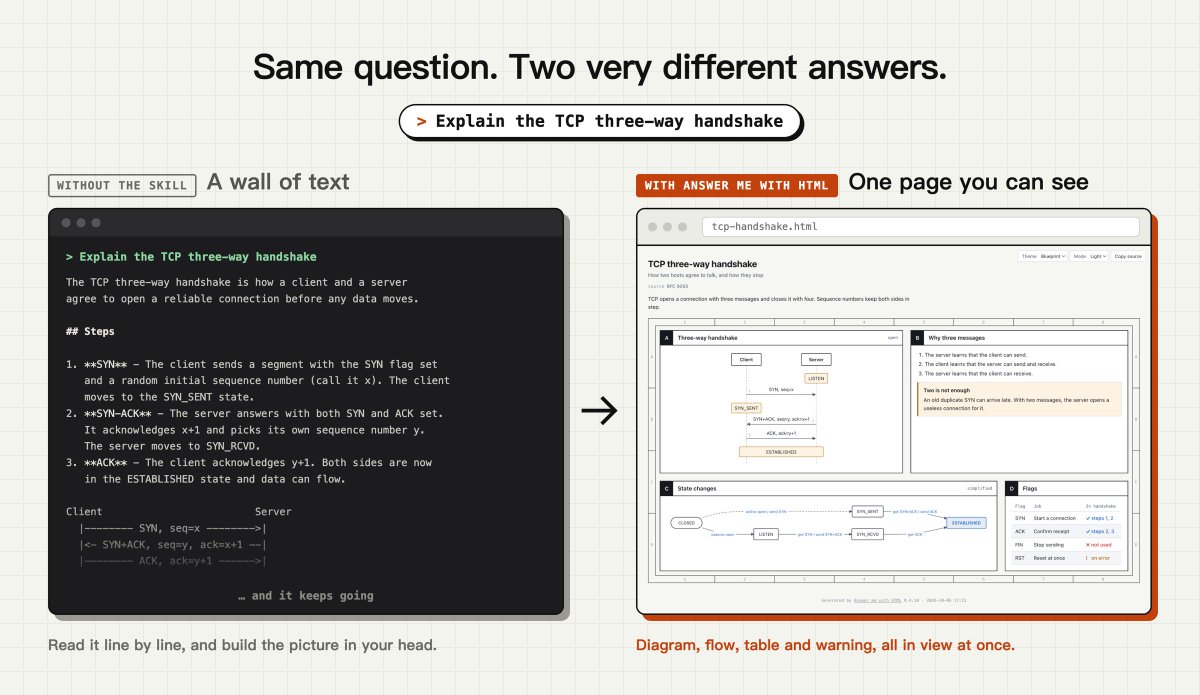
Answer me with HTML: an open-source agent skill that answers hard questions with one readable HTML page instead of a wall of terminal text.
For anyone who asks a coding agent to explain things and ends up scrolling. You ask the way you always do, and the agent decides when a page is worth it.
→ "Explain the TCP three-way handshake" returns diagrams of who sends what in order and how the connection state changes, plus a table of the signals used to set up the connection
→ "Redis or Memcached?" returns a comparison table, then a verdict; a one-line question still gets a one-line answer
→ The model writes only a Markdown draft and a command-line tool bundled with the skill builds the page. In the maker's test (3 topics, 3 runs each, Claude Sonnet 5.5 in a plain Claude Code setup), the model wrote about 1/8 as many output tokens as when asked for HTML directly; the bill fell less, about 15%, since every turn still reads the prompt and conversation
→ Each page is one file that loads no fonts or code from the internet, so it opens offline and is easy to share
npx skills add QingYunA/answer-me-with-html · Node.js 20 or newer · Also a Claude Code plugin; works with Codex, Cursor, OpenCode, Pi and DeepSeek Harness · MIT
Repo: https://t.co/Se4W0gGJyF
https://t.co/Se4W0gGJyF
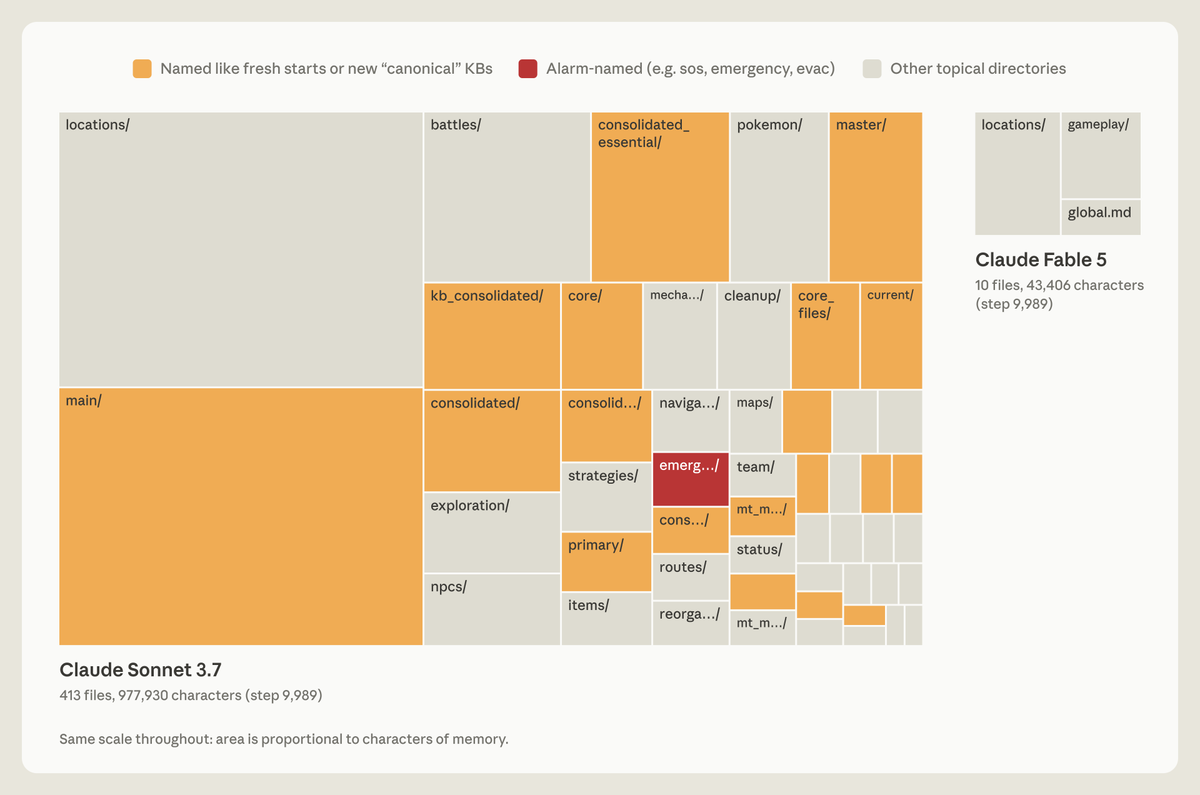
ANTHROPIC 🔥: Anthropic shared memory tests showing that saving more isn't better: in Pokémon Red, Claude Fable 5 got much further with a 10-file memory folder than Sonnet 3.7 did with 413 files.
> In one run each, about 10,000 steps in, Sonnet 3.7 had earned one badge and spent time combing through notes that kept going out of date. Fable 5 earned four, keeping notes on strategy, plans and tested rules the game didn't tell it.
> Anthropic found stronger models do better when told what memory is for, not how to use it. A "record only failures" rule cost Opus 5 and Opus 4.7 much of their gain from memory. A step Anthropic calls dreaming checks notes against past transcripts and rewrites wrong ones.
> In Claude Code, auto memory loads only the first 200 lines or 25 KB of MEMORY.md, whichever comes first, at the start of each session. Anthropic says that top part works as an index of what Claude knows and where to find it.
https://t.co/oWTvN7d7hu
Memory is what allows Claude to learn from experience. In a new Engineering Blog post, we share how “dreaming” helps Claude organize what it’s learned, correct its mistakes, and find what it needs more easily the next time. https://t.co/uUEN4bNkr9
Your coding agent stops and waits for a yes you never saw. Nosy Notch puts that request in your MacBook's notch, so you can allow or deny it without hunting for the window.
For anyone running Claude Code, Codex or Cursor on a Mac.
→ While an agent works, the notch shows the tool it's running and how long it's been going
→ When it needs permission, the notch shows the exact command with Deny, Always allow and Allow. With head gestures turned on, a nod with AirPods allows and a shake denies
→ Hover for every session, context fill and your 5-hour and weekly limits. Limits show for Claude Code Pro and Max and for Codex; Cursor doesn't share them
npx nosynotch connects every agent it finds. Claude Code sessions already running need a restart, and in Codex you trust the new hooks once. npx nosynotch uninstall removes the app, hooks and autostart. Hooks talk to 127.0.0.1 only · macOS 14+ · Node.js 18+ · free · MIT
Repo: https://t.co/jQjLnToAFI
https://t.co/jQjLnToAFI
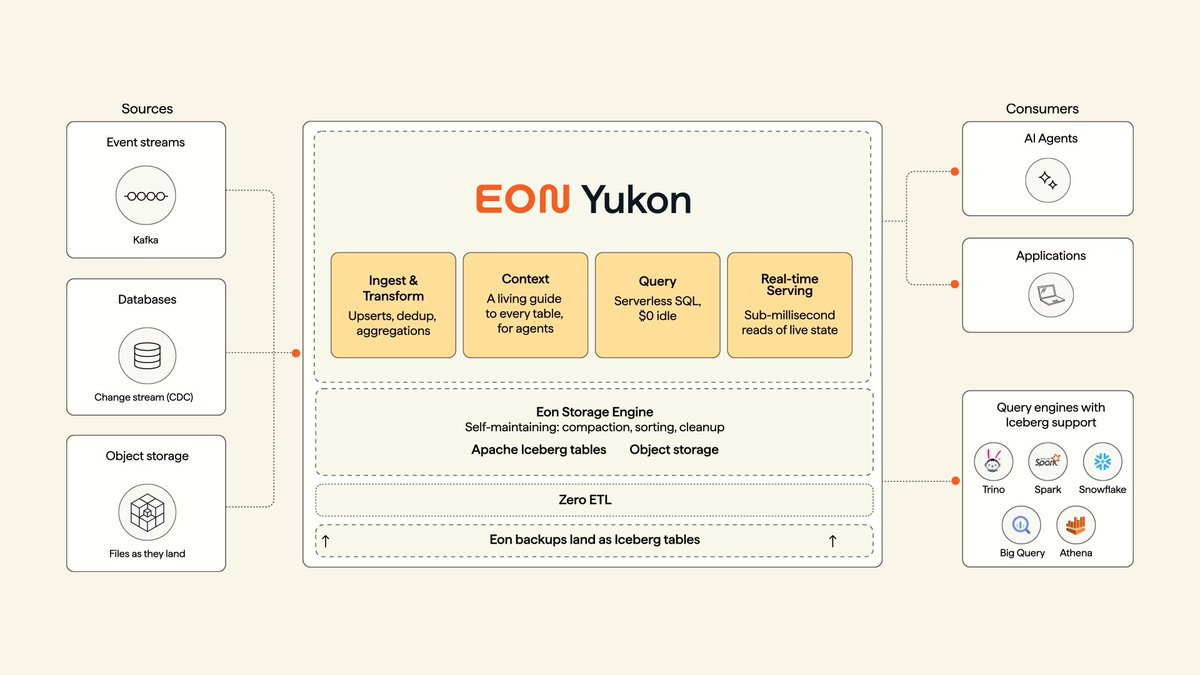
EON 🔥: Eon introduced Eon Yukon, a data layer that prepares data as it arrives and keeps it ready for analytics, apps and AI agents.
> It runs ingestion, SQL transforms, dedup and table upkeep such as compaction in one serverless pipeline, with no servers to manage. In Eon's own test at 1 million events per second from Kafka into Iceberg, it met the same freshness with roughly 4× less compute than Spark and 7× less than Flink.
> Agents read a living guide to each table over MCP before their first query. Apps read live aggregates in under a millisecond through a Redis-compatible or HTTP API, and you can query with serverless SQL or existing Spark code.
> Data stays as open Iceberg tables in your own Amazon S3 or Google Cloud Storage, readable by engines like Trino, Spark, Snowflake, BigQuery and Athena. It can run on its own or alongside Eon Data Protection, and Eon offers demos on request.
https://t.co/3n5v6evUTZ
Give a coding agent a video file and it tells you how each shot was made, then writes a plan to remake it.
For short-form creators who want to learn a video's structure and pacing, then remake it with their own material.
→ Each shot is judged on its own: filmed, AI-generated, avatar, 3D, code-built graphics or screen recording
→ Also covers captions, where the cuts fall, whether they hit the beat, voice, music and sound effects
→ Reports come in Chinese or English. Connect a video model for a prompt per shot; it still works without one
→ Its FAQ says not to repost others' videos or reuse their footage, music, characters or likeness
Works in Claude Code, Codex or any agent that can run commands · Needs ffmpeg and Python 3.10+ · Apache-2.0
Repo: https://t.co/grlnR9sVfV
https://t.co/grlnR9sVfV
Before you ship an app with AI inside, these open-source tools try to break it first: holes in the app, a model that can be tricked, and data that leaks.
For developers testing apps they build.
→ Strix (usestrix/strix): AI agents run your app's code, look for vulnerabilities and confirm each one with a working proof of concept, then suggest a fix. Needs Docker running and your own LLM API key · Apache-2.0
→ garak (NVIDIA/garak): probes a model or chat app for hallucination, data leakage, prompt injection, jailbreaks and more. Works with Hugging Face models, the OpenAI API and almost anything reachable over REST · Apache-2.0
→ promptfoo (promptfoo/promptfoo): tests your prompts and models with automated evals and red teaming, and compares models side by side. Evals run on your machine · MIT
Pictured: the demo in Strix's README, confirming a cart that accepts a negative quantity and so creates an order with a negative total.
Repo: https://t.co/TxmhfvyS1i
https://t.co/TxmhfvyS1i
ALIBABA 🔥: Not officially announced yet, but according to TestingCatalog, Qwen4 models are expected to arrive soon.
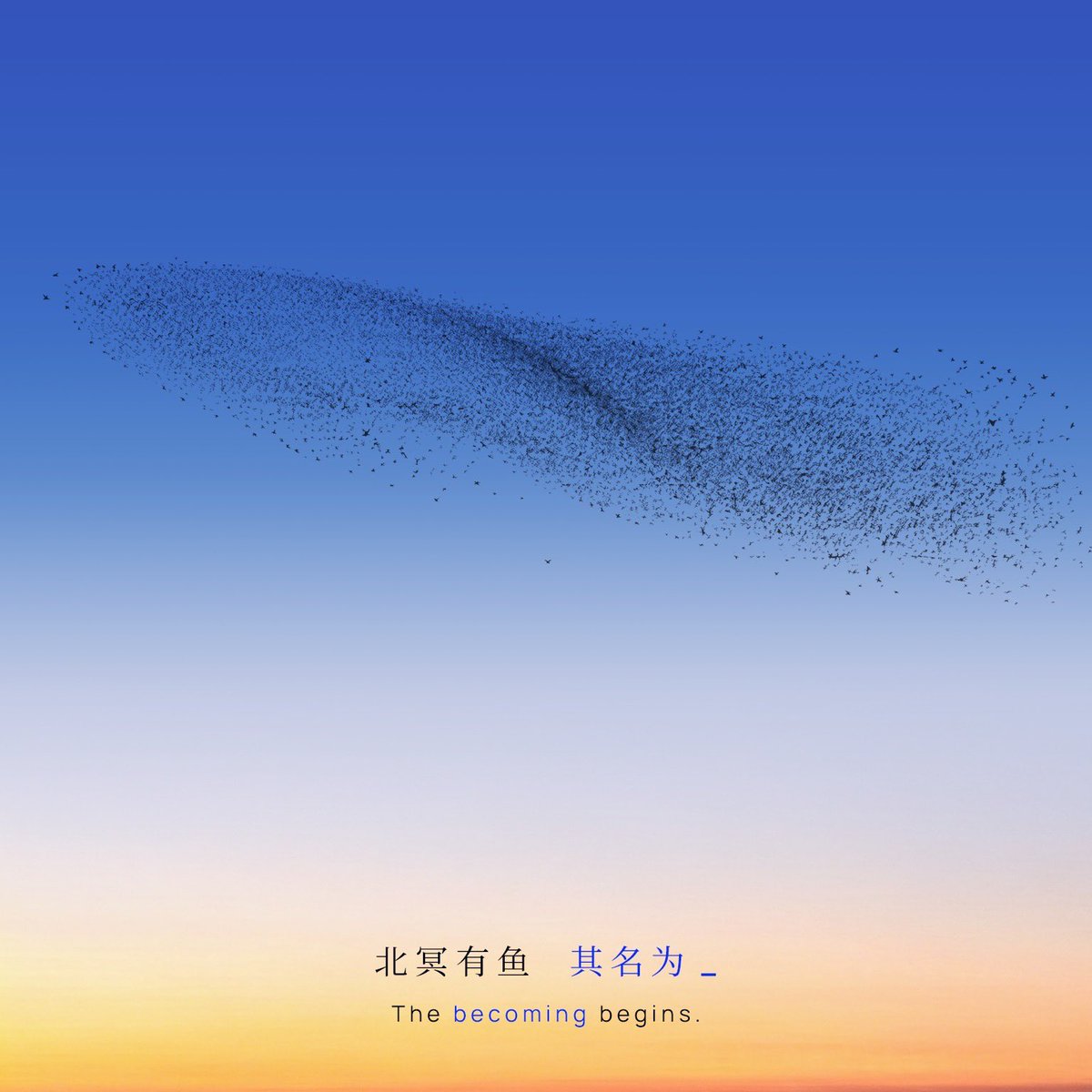
> The Qwen account posted a poster that reads "The becoming begins." It names no model and gives no date.
> TestingCatalog expects four models: Qwen4-Max, Qwen4-Flash, Qwen4-Plus and Qwen4-27B.
> Those names are TestingCatalog's expectation. Alibaba has not confirmed them.
https://t.co/bW2HTVT4eD
ALIBABA 🔥: "The becoming begins" teaser has been posted on the Qwen X account. We expect Qwen4-Max, Qwen4-Flash, Qwen4-Plus, and Qwen4-27B models to arrive soon.
Waiting for Qwen4-27B the most 👀
OPENAI 🔥: Not officially announced yet, but according to TestingCatalog, GPT-6.2 Sol and GPT-6.2 Astra could be close.
> TestingCatalog's Nov 5 brief said both names showed up on Google Cloud quotas, and that The Information says they could ship as soon as Friday, Nov 6.
> Its Nov 6 brief lists both as "today?", question mark included. OpenAI has not confirmed a date.
https://t.co/OOumkswuoi
DAILY AI BRIEF 🗞 — Nov 6
MODEL FORECAST 👀:
- GPT-6.2 Sol, today?
- GPT-6.2 Astra, today?
- Claude Fable 5.5, soon
- Claude Mythos 5.5, never?
- Gemini 4 Carbon, soon
- Gemini 4 Hydrogen (Flash), soon
- Grok 4.8, not soon???
OPENAI 🔥:
- OpenAI launched GPT-6 Cyber for authorized security research on Daybreak Red, with a Cyber livestream on Nov 12.
- Cat Wu is joining OpenAI to lead product management for Core Products after leaving Anthropic.
GOOGLE 🔥:
- Gemini Omni 1.2 Flash is generally available on AI Studio and the Gemini API with 15-second video and 30% lower pricing.
ANTHROPIC 🔥:
- Claude Personal Finance is rolling out in beta to US Pro, Max, and Ultra users with read-only bank connections via Plaid.
- METR says Anthropic’s model progress accelerated about 1.9x since October 2025, citing internal Model 3 and Model 4.
THINKING MACHINES 🔥:
- Thinking Machines released Inkling 2 Small on Tinker at 31 on the AA Intelligence Index, with open weights planned next week.
PERPLEXITY 🔥:
- Perplexity Teammates are rolling out to Max subscribers on the web as proactive agents that use Computer tasks, skills, memory, and tools.
META 🔥:
- Muse Voice and expressive avatars are rolling out to US users, and Muse launched in Mexico.
SPACEXSI 🔥:
- Cursor can now build live apps with hosting, auth, and a shareable link on paid plans with cloud agents.
- Grok Bot is testing SMS texting, with WhatsApp and Telegram integrations in early preview (via alexmichael).
COGNITION 🔥:
- Cognition released Devin Review 2.0, now up to 5× cheaper and 1.5× faster for PR reviews.
* Used Grok to compose this brief, cherry-picking the news and doing some post-editing.
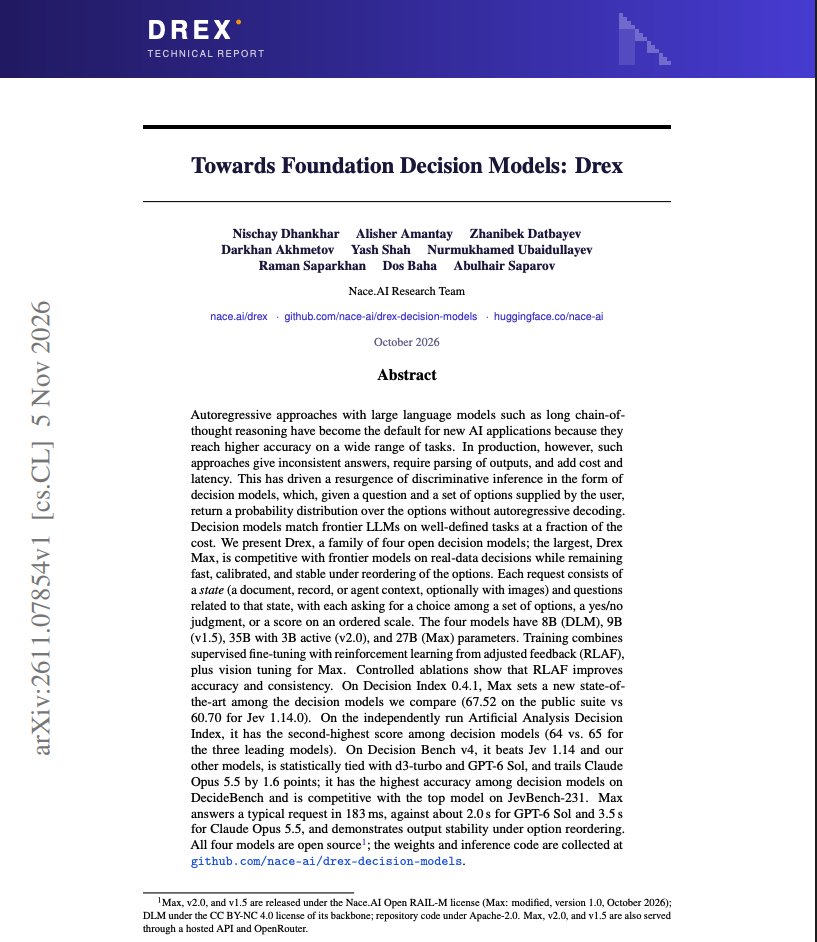
NACE AI 🔥: Nace AI published the technical report on Drex, its four open decision models. Instead of writing an answer, they give a probability for each option you supply.
> You send a context, a question and your options. Questions can be yes/no, multiple choice or a rating scale, and the model can't answer outside the set you gave it.
> Nace says that when Drex Max is at least 93% sure, it is right 97% of the time. Its post points to the Nace console to try it for free.
> Weights and code are on GitHub and Hugging Face. Licenses differ by model, and Drex Max 1.1 and Drex for Finance stay closed.
https://t.co/pQW04acJnc
How are Decision Models Trained?
Today, we are publishing the Drex Technical Report for the developer community! 🚀
Discover details on how the State-of-the-art Open-Source decision models are trained with RLAF.
Build more at: https://t.co/swZ0gsqCyo (try for free)
P.S. Drex Max 1.1 and Drex for Finance are closed sourced and designed for enterprise use-cases
OPENAI 🔥: You can now start an app from working demos in the new Showcase tab of the OpenAI Developers plugin.
> Each one has a demo to try, an Open in Codex button and a source download. Starters cover agents, creative tools, data visualization and voice, from a trip planner to a CSV explorer.
> Eligible ChatGPT Pro and Business subscribers can claim up to $500 a month in API credits for those apps. The paid plan must be at least seven days old, and Codex used through API keys isn't covered.
https://t.co/TiJUbzQSjd
Kickstart your weekend build with the new Showcase tab in the OpenAI Developers plugin.
Eligible ChatGPT Pro and Business subscribers can claim API credits in billing settings to cover their app’s API usage.
Handing work to coding agents gets risky in three spots: your machine, agents colliding, and results nobody clicked through. These open-source tools cover each one.
For anyone already running Claude Code or Codex.
→ Orca (stablyai/orca): runs several agents side by side, each in its own worktree, and lets you leave notes on exact changed lines. macOS, Windows, Linux · your own subscription · MIT
→ devvm (devvmhq/devvm): run it in a project folder and the agent works in a VM that mounts only that folder and, by default, reaches only hosts you allow. Your GitHub and Claude Code tokens stay on your machine. macOS 13+ or Linux on arm64 or x86_64, with Lima 2.2+ · MIT
→ agent-browser (vercel-labs/agent-browser): an agent reads a page as text and clicks from the command line. A click fails instead of reporting success when the target is hidden or covered. macOS, Linux, Windows x64 · Apache-2.0
devvm's own README says no sandbox closes every gap.
Repo: https://t.co/RnGrvKsYEa
https://t.co/RnGrvKsYEa