The Hidden Risk of AI. Your agents lack identity, authentication, and accountability. That's a massive security gap. AgentDNA closes it. No more anonymous agents. Build trusted AI. 🔒 https://t.co/sZiRdWatwU
AI agents are everywhere.
Trust isn’t.
Most multi-agent systems lack identity, authentication, and accountability.
AgentDNA adds a secure identity layer for AI agents.
No more blind execution. No more anonymous actions.
Build trusted AI → https://t.co/w62s7mTQBf
#AgentDNA
The current generation of chains is being forced toward centralization by cost. The market needs a design that inherently avoids this. @RubixChain’s graph-based normalisation is not a feature; it's a necessity for a scalable, cost-effective, and truly decentralized Web3.
1. We learned early that replication is bad s/w design.
2. Blockchains did the opposite ,duplicating both state and execution everywhere.
3. Unsustainable costs pushed them toward semicentralized “light replication” models.
4. @RubixChain brings normalisation to web3
Version 2 of @RubixChain Explorer is LIVE now with seamless #transaction tracking, wallet insights, and real-time #blockchain vibes.
Explore the Explorer 👀 : https://t.co/qq3ACmNvpF
📢Attention Python devs!
Rubix Client SDK for Python is here !
It's a lightweight Python Client that lets you interact with a Rubix Blockchain Node.
We believe it's a good step towards integrating @RubixChain in many Decentralized AI projects, written in Python. @Agent_DNA being a good example!
Check out the project here: https://t.co/My0GG5RkI2
#Python #Blockchain #DecentralizedAI
@RubixChain doesn't just log AI outputs, its Objectchain model binds transactions to unique tokens, ensuring every step in a non-linear process is individually verifiable and tamper-resistant at a granular level. #Tokenbound#Verifiability
@Agent_DNA Intelligent events don't happen linearly, they split, merge and interact concurrently. @RubixChain fits perfectly for AI provenance both due its DAG architecture as well as from elastic scale + cost point of view.
Digital authenticity is the next frontier. AgentDNA by @RubixChain isn't just about AI,it's about a future where any digital artifact,from content to code, has an irrefutable history. This is how we fight deepfakes and misinformation.
Everyone wants AI to "show its sources"
But real trust begins when those sources can’t be forged or erased. @RubixChain AgentDNA turns traceable provenance into irrefutable permanence.
When HashiCorp (IBM) says "graphs are the way," they are validating @RubixChain's core architecture. Why wait for them to build it when RubixChain's non-linear, graph-like state-machines are already live? #FutureOfInfra#RubixChain
With every enterprise likely to run millions of agents, the database approach for infra mgmt will not work. The best way to manage agent infra is by graphs, which Hashicorp (IBM) is looking to build. Guess what, @RubixChain already lets you build graphs
https://t.co/smV6rowe18
Tired of high gas fees, even on testnets?
The @RubixChain Faucet is now live, dispensing Test RBT for our zero-gas L1 blockchain. See what you can build when transactions cost nothing. ➡️ https://t.co/ZfzGZSt59I
#Rubix#ZeroGas#Blockchain#Fintech#DeFi#Crypto
Love this. We're moving from "trust me, this is the model's accuracy" to "verify the model's metrics on-chain." A massive leap for reproducible and trustworthy AI, powered by @TrieNetwork and MLFlow.
Money is both a form of value and a medium of exchange. TradFi has been expensive in both functions due to centralization and layers of admin & tech costs. Winners were centralized IT platforms and IT consulting cos. Risks and costs largely borne by the sovereign with bailouts. As a result, what we have today is highly debt ridden sovereigns and cash righ centralized systems. We can fix this with p2p tech of @RubixChain that is a winner for both goods/services businesses and governments. Time to lower the settlement costs and risks.
How do you achieve infinite transaction scale without bottlenecks?
You don't make one chain faster; you run millions at once. Each token on @RubixChain is its own micro-ledger, running in parallel. It’s that simple and that powerful. #Web3#Scalability#Rubix
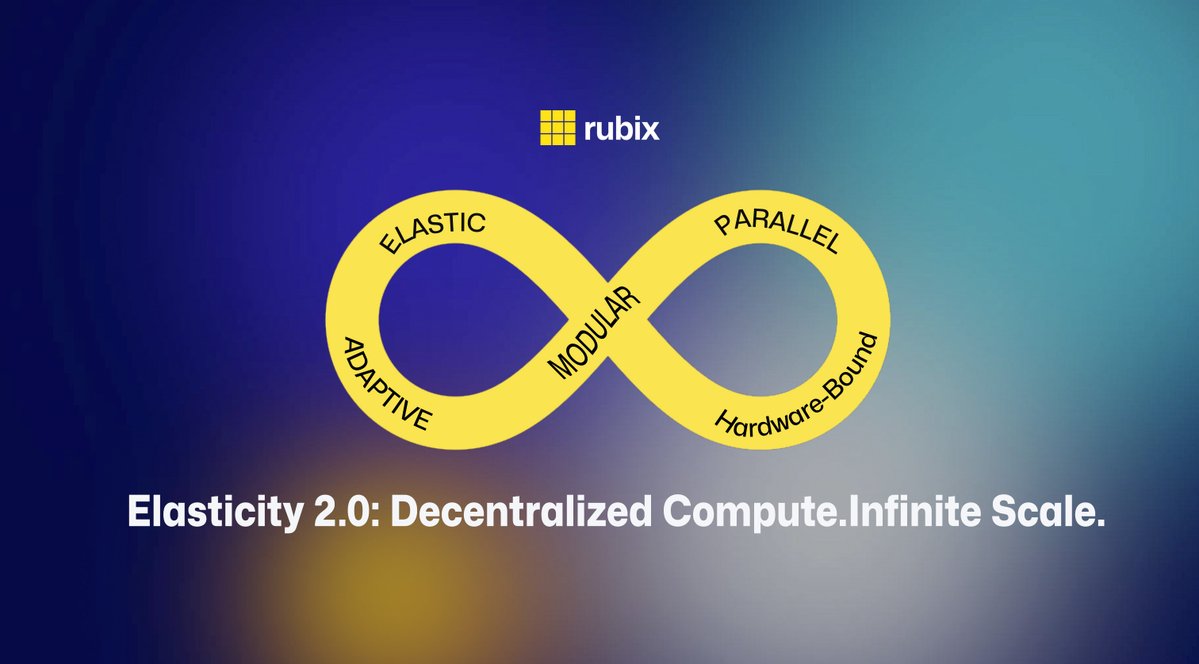
Forget adding more servers. True scalability is architectural. @RubixChain 's elastic microchains don't just add capacity; they evolve with demand. This is the future of decentralized infrastructure. #Scalability#Web3#Elasticity#Rubix
Scalability is not just a goal; it is how systems evolve.
At Rubix, scalability means more than adding servers.
It is about elastic microchains that adapt, expand, and run in parallel as demand grows.
- Elastic: Scales instantly with compute power.
- Adaptive: Responds dynamically to workload changes.
- Modular: Each microchain works independently yet connects seamlessly.
- Parallel: Processes simultaneously for infinite scalability.
Our hardware-bound microchain architecture turns every compute node into a scaling unit.
The result is limitless throughput, lower latency, and zero bottlenecks.
This is Elasticity 2.0, where compute meets decentralization and scalability becomes infinite.
#Rubix #Elasticity #Web3Infrastructure #EdgeComputing #ParallelProcessing #Microchains #Blockchain #Scalability #Innovation
Outside crypto, no one uses Solidity - and that’s a red flag for long-term developer pipelines. Rust & Go power everything from OS kernels to cloud infra. @RubixChain is building on the same solid ground.
One of the major reasons why @RubixChain did not build on solidity. As a language with no adoption outside crypto, this was always going to be the case. Devs in rubix use Rust, Golang. Langs that have rich libraries & gone through multiple rounds of formal verification