ML & Ethics, AI Risk and Safety, AI Governance Policy , IP, Copyright & Generative AI, Law & Technology, @YaleISP @YaleLawSch, ex-editor MITechReviewKorea
Happening tomorrow! Join us in-person or online to hear Dr Eugenia Stamboliev, Research Fellow and Lecturer in Philosophy of Technology and Media, University of Vienna, give her talk ‘A Democratic View on Trustworthy AI’. Wed 25 Feb, 13.30-14.30 GMT. Register today!
The best thing I've read on the Anthropic/Pentagon standoff is this @lawfaremedia piece by @ARozenshtein: https://t.co/Pcu7S0QspF
The rules for military AI should not be set through time-pressured haggling. Congress needs to decide. 🧵
NIST just launched an AI Agent Standards Initiative for identity, security, and interoperability. AI agents are becoming economic actors with zero legal infrastructure in place. We require businesses to register to operate. Why expect less of AI agents? https://t.co/pYFg2nGEv5
the AI debate is split into camps:
doomers, ethicists, builders, pragmatists, and skeptics
some want to slow everything down, some think LLMs are all just fancy autocomplete, others are convinced AGI is basically tomorrow
but the weird part is we're all watching the same progress, we interpret it in totally different ways
that's why every AI discussion turns into a messy, polarized fight so fast
Thank you @TIME for inviting me to share my perspective on the past year in AI development.
We've seen major growth in AI capabilities and risks, but as I continue working on research at @LawZero_, I'm increasingly confident that technical solutions are possible to make AI safer by design.
1) CORE-Bench (scientific reproducibility) gives agents two hours to reproduce the results from a scientific paper, given access to its code and data.
Opus 4.1 is the first model to break the 50% barrier on CORE-Bench. GPT-5 is far behind — even behind Sonnet 3.7 and GPT-4.1.
We have heard claims that AI will soon automate all of science. Reproducing results is a small part of science, but the best models are far from scoring well.
Still, if AI agents can reproduce existing work, we suspect it would save millions of researcher-hours of effort, so even a 50% CORE-Bench Hard score is exciting.
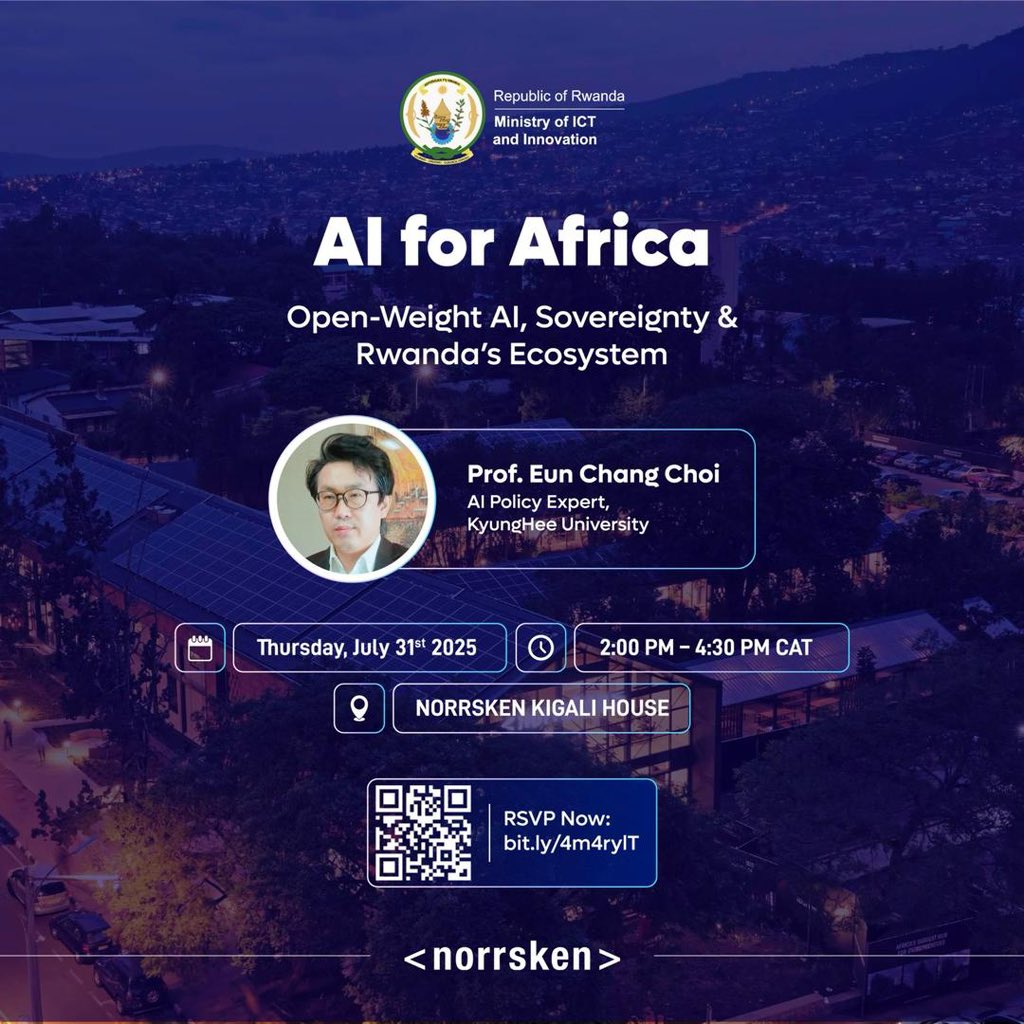
@ai_techlaw: Africa must move from AI consumer → AI builder.
We need Vertical AI + open-weight small LLMs to drive AI sovereignty, solving Africa-first problems: Agriculture, Healthcare, Banking, Anti-counterfeit & manufacturing (human-in-the-loop). Africa doesn’t need to chase GenAI hype.
#AI4Africa #VerticalAI #AISovereignty #LLMs
Join us this 31 July at @norrskenEA as Prof. Eun Chang Choi, AI Policy Expert, unpacks how Africa can shape its own AI future.
From boosting startups and agriculture to improving public health, learn how Rwanda can harness open AI to drive innovation.
Tag a friend that you should come with!
2:00 PM – 4:30 PM
Speaker: Prof. Eun Chang Choi
Venue: Norrsken House Kigali
RSVP: https://t.co/NARe1ZVYAc
I really enjoyed my conversation with @MLStreetTalk back in December. We covered many of my recent thoughts on the need for non-agentic AI, the risks of systems with too much agency or self-preservation goals, global AI governance, and much more.
In South Korea , the "Act on the Development of Artificial Intelligence and the Establishment of Trust (AI Basic Act)" was passed at the National Assembly. This Act is scheduled to take effect in Jan 2026. https://t.co/8XAkEpYqqx
The (audio only) podcast of my discussion with Davidad, Nora Ammann and Adam Marblestone regarding ARIA's 18 million pounds call for research proposals on machine learning for safeguarded AI:
https://t.co/wGxGV5fhhA
There are a LOT of ongoing AI copyright lawsuits in the US right now. We've been keeping track at @WIRED and, to make things easier on everyone, created this visual map. It'll be updated w/ any major developments: https://t.co/5etNPQNgX1
Likely cover of a new book, coming from Oxford University Press, likely in May. Widely said to be "the one book you need to read, if you want to have a happy, fun-filled life, with friends, and without stomach pain."
📢NEW: 'Open' AI systems aren't open. The vague term, combined w AI hype is (mis)shaping policy & practice, assuming 'open source' AI democratizes access & addresses power concentration. It doesn't.
@sarahbmyers, @davidthewid & I correct the record👇
https://t.co/1g1GVQ6XZr