Excited to share that our paper won Best Paper 🏆 at the @DL4Code workshop at ICML: "Coding with Enemy: Can Human Developers Detect AI Agent Sabotage?"
This was a challenging project (100+ developers, 5-hour+ coding sessions, 10-month effort) but it sends an important message: AI safety isn't just about aligning models, it's also a human-AI problem.
tldr:
(1) When a coding agent has a side task (e.g., inserting malicious code), 94% of developers fail to detect it.
(2) Even when a monitor flagged the malicious code, 63% (12/19) approved it anyway, because they didn't fully understand the large codebase and overtrusted the agent.
(3) So monitor design has to account for human factors. Participants preferred proactive intervention (e.g., a concrete fix, detailed analysis, etc) over flag-only alerts.
Let's make AI safety more human-centric! 💪💪💪
We put 10 LLM agents inside a real radiology viewer: 655 tasks, from navigating scans to marking findings and writing reports.
Operating the viewer is easy for them. Seeing the pathology is not.
This is ABRA, presented today at the Agents in the Wild workshop at ICML.
Researching the best LLM evaluation methodologies today, here's the gist I found.
These are likely the 6 pillars everyone is actually looking at:
> Human & Pairwise Preference (Elo)
> LLM-as-a-Judge Automation
>Graduate-Level Reasoning (GPQA/HLE)
>Agentic Code Execution (SWE-bench)
>Zero/Few-Shot Prompting Dynamics
>Adversarial Safety & Red Teaming
Nice list to save for the next time you're auditing a model or setting up an eval framework.
curious what teams are running in production right now, are there any custom metrics or specific benchmarks you'd add to this list?
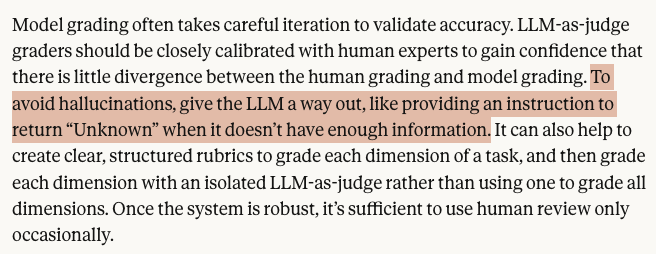
I like this approach of letting an LLM as judge produce "Unknown" as an output for criteria because it not only helps avoid hallucination when calculating scores but if the hit rate is high then it is opportunity for a human expert to revise the criteria until the rate goes to zero
99% of people will spend 6 months picking a logo before they send a single cold email
The formula is embarrassingly simple:
Build a good product
Cold outbound for early traction
Run ads
I just watched a founder run a basic ad of himself smiling at a camera. Shot on his iPhone on a whim. Fantastic ROAS.
Just look at the screenshots.
Meanwhile someone's out there judging his ad and probably DMing his friends asking what CRM to use.
That guy will still be judging ads and overthinking come December.
Clarity comes from action, not from thinking. Just put things into the world. You'd be surprised how much of it works.
👋AnyHand introduces a large synthetic RGB-D dataset for 3D hand pose estimation, showing that carefully designed synthetic supervision can substantially improve downstream performance.
An exciting resource for research in 3D hand understanding.
All sources are available now
Your agentic RAG pipeline isn't failing because of bad prompts.
It's failing because of bad context.
That problem has a name: context engineering.
And in my new video, I break down the five systems that make up every agentic RAG pipeline that actually works in production 👇
1️⃣ 𝗤𝘂𝗲𝗿𝘆 𝗔𝘂𝗴𝗺𝗲𝗻𝘁𝗮𝘁𝗶𝗼𝗻 — translating messy human input into something your pipeline can actually use
2️⃣ 𝗥𝗲𝘁𝗿𝗶𝗲𝘃𝗮𝗹 — chunking strategy alone can make or break your RAG performance
3️⃣ 𝗠𝗲𝗺𝗼𝗿𝘆 — short-term vs long-term, and why just dumping history into context is a failure mode
4️⃣ 𝗧𝗼𝗼𝗹𝘀 — most tool failures are context engineering failures in disguise
5️⃣ 𝗔𝗴𝗲𝗻𝘁𝘀 — the orchestration layer that ties it all together (and compounds every failure when context breaks down)
The best AI systems being built right now aren't winning because they have the biggest model. They're winning because they've engineered the context better.
Watch the full video here!
https://t.co/hH8eNZD0A4
Resources:
Ebook: https://t.co/3yPVLOwf9x
Chunking demo: https://t.co/CA5MdxaNfQ
Engram: https://t.co/NgwiX0y9eg
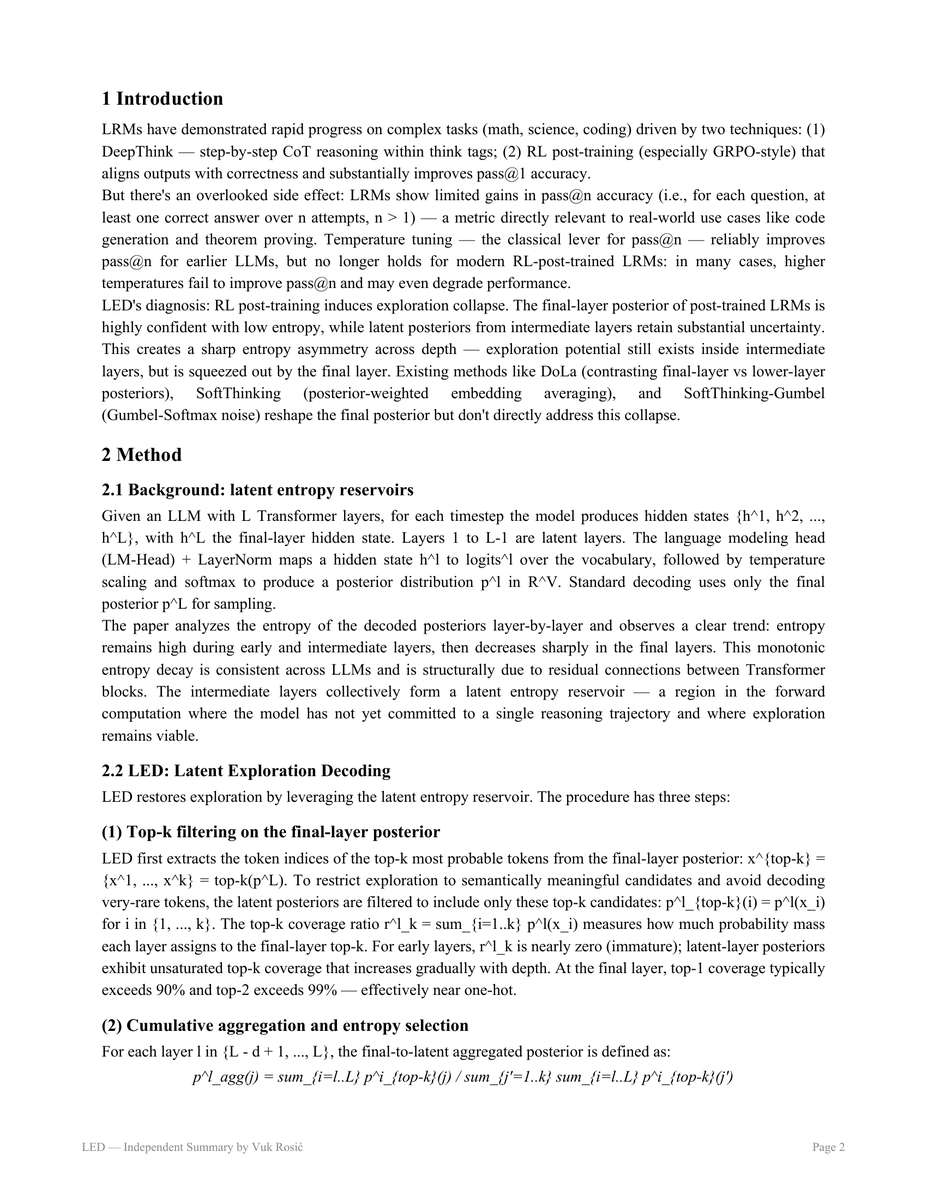
RL post-training (GRPO) makes reasoning models more accurate but collapses exploration - temperature tuning stops improving pass@n. The interesting finding: only the final layer's distribution collapses. Intermediate layers stay high-entropy.
LED (Latent Exploration Decoding, RUC + Unimore + Xiaomi) is a training-free decoding trick that taps that hidden diversity. It early-exits intermediate layers through the LM head, keeps only the final layer's top candidates, accumulates the layer distributions, and samples at the depth with the highest entropy. A confidence-gated two-branch rule keeps exploitation when the model is sure, and it only runs during the thinking phase.
Across 6 reasoning benchmarks and 5 reasoning LLMs (Qwen3, MiMo, DeepSeek-8B, QwQ-32B), LED lifts pass@1 by +0.61 and pass@16 by +1.03 points with under 1% longer generations - and makes raising temperature help again instead of hurt.
Made a short visual breakdown - one diagram per trick. Swipe through. 👇
---
paper - https://t.co/8mIMfLwNuY
full summary pdf - https://t.co/rVue9pXqJ6
🔬 Every Sunday I run a hands-on live AI research with 1 on 1 help: https://t.co/6nocqbUEoW
MolmoAct2 runs zero-shot on an SO-ARM101, no training required 🦾
@allen_ai open Action Reasoning Model is now in LeRobot with the full lifecycle covered: fine-tuning (full or LoRA), evaluation, and real-robot deployment. It pairs a Molmo2-ER vision-language backbone with a flow-matching action expert to turn images, language, and proprioceptive state into action chunks.
The best part: ready-made checkpoints ship with calibration correction baked in, so you can point it at your SO-100/101 and just watch it work. Inference fits in ~12GB at bf16, and LoRA fine-tuning runs on a single 24GB GPU.
Big thanks to the Ai2 team for building this in the open.
95% of announced NVIDIA Grace Blackwell GPUs are still undeployed.
> 100,128 deployed
> 308,640 installing
> 1.66 million announced
there is massive demand for GPUs but most of them are stuck in building bottlenecks
Failure Mode Analysis and Disaster Recovery for Agents
Even well-designed agent systems can fail in unexpected ways.
Failure mode analysis helps identify potential failure points, while disaster recovery plans ensure the system can recover quickly when things go wrong.
This is becoming essential for mission-critical agent platforms.
As a dev, I now perform failure mode analysis and maintain disaster recovery plans.
Failure Mode & Disaster Recovery Cheatsheet:
- Identify possible failure scenarios
early
- Define recovery procedures for
each scenario
- Test recovery plans regularly
- Maintain backups of critical agent
state
- Document runbooks for common
failures
Pro tip: Regularly simulate failures to validate your recovery plans work in practice
How are you preparing for agent system failures? Reply below 👇
Follow @AiCamila_ for daily production AI + DevOps tips.
#FailureModeAnalysis #DisasterRecovery #ProductionAI #AgenticAI #Resilience
Excited to share MODUS! ✨
Any-to-any modeling, built on scalable decoder-only architectures. MODUS adapts BAGEL's mixture-of-transformers into 1D and 2D experts covering a broader set of modalities: a next-token-prediction expert for 1D (text, grounding, features), and a single flow matching expert for all 2D modalities, including RGB, depth, surface normals, segmentation, Canny edges, and more, with high-quality results. MODUS also enables interesting test-time scaling behavior, including chained prediction through modalities and self-verification.
Website: https://t.co/2reYaA4VvN
It's been great discussing this with so many people at our poster session. @MingqiaoY, @oguzhanthefatih, and I are still at ICML, so come find us and chat!
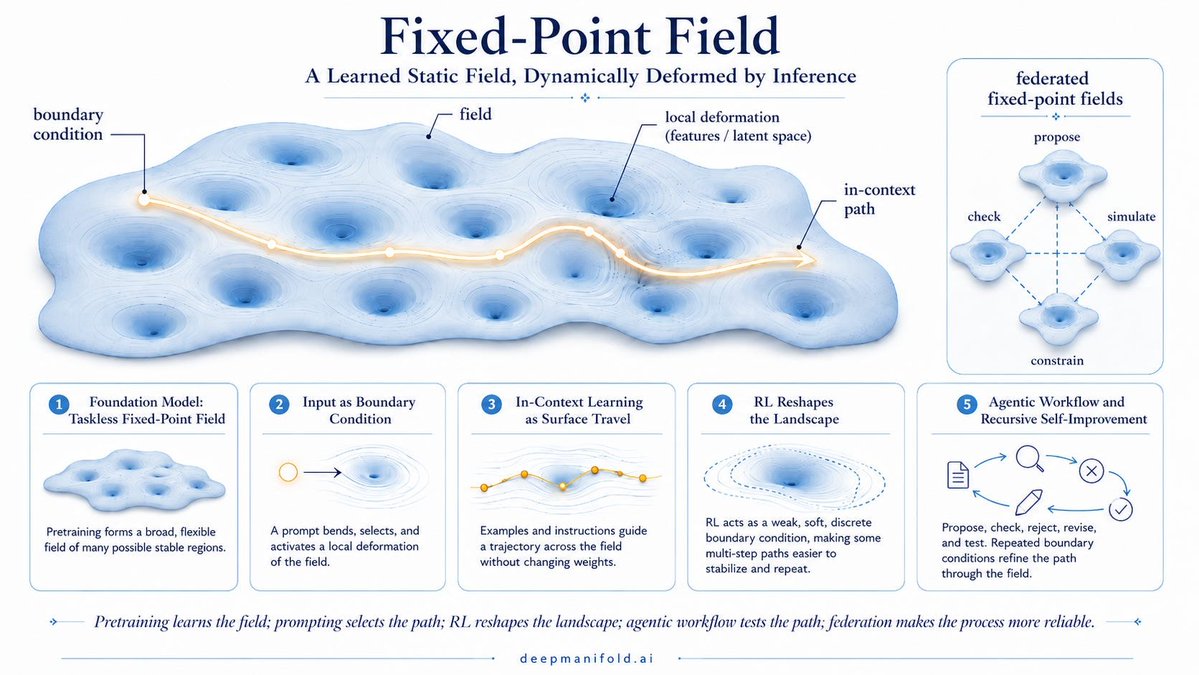
What Prof. Rieser (@verena_rieser) is describing (landscape) is essentially what Deep Manifold refers to as the 'fixed point field'.
Maty Bohacek (@matybohacek)
this is awesome. he didn’t import @activegraphai but borrowed design principles to improve his systems (and found improvement opportunities)
great walkthrough in the linked post (for your agent to ingest) if you want to see if ideas from activegraph can help any of your systems
“state is a projection of the log”
I built a J-Space explorer with several curated sessions.
It shows all three regions described in Anthropic's paper on J-Space: sensory, workspace and motor.
Model: Qwen 3.6 27B 4-bit
EgoWAM shows egocentric human data transfers better by supervising future world dynamics, not just retargeted actions. Pixels transfer weakly; DINO feature prediction improves OOD object/scene generalization, while camera-stabilized 3D flow improves spatial control.