Happening now:
Nigerians in the UK storm the UK Parliament to protest, demanding the removal of INEC Chairman, Prof. Joash Amupitan, as they call for a free and fair election in 2027.
Shocking video : Seeing terrorists show the faces of captured soldiers is heartbreaking and disturbing 🥺💔
No country deserves this kind of pain.
Oh Africa… this is truly tragic 💔😭
In 2019, MIT professor Patrick Winston gave a legendary 1-hour lecture called “How to Speak.”
It has 18M+ views for a reason.
His frameworks:
• Your ideas are like your children
• The 5-minute rule for job talks
• Why jokes fail at the start
15 lessons on communication:
Dear Japarians, save this tweet.
If you’re travelling outside Nigeria and want your MTN SIM to remain activated just dial *365#.
You’ll pay around ₦500–₦1000 depending on how long you want the line active.
HOW TO INTRODUCE YOURSELF IN A JOB INTERVIEW
In a job interview, your self-introduction should be clear, confident, and relevant to the position. Here’s a basic structure to follow:
1) Greet and thank the interviewer:
“Good morning, and thank you for the opportunity to be here.”
2) State your name and current role or status:
“My name is [Your Name], and I’m currently a [Your Current Job Title] at [Company Name]”
Or, “I recently graduated with a degree in [Your Major] from [University Name].”
3). Give a quick professional background:
“I have [X] years of experience in [Your Industry or Field], where I’ve focused on [Key Skills or Responsibilities].”
4) Highlight key achievements or strengths:
“In my previous role, I led a project that [Brief Achievement], which helped improve [Result].”
5) Explain your interest in the role:
I’m really excited about this opportunity because it aligns with my passion for [Field/Skill] and I see it as a great chance to grow and contribute to your team
Which of these do you know or have in your portfolio? Which one do you want to know about?
1️⃣ Treasury Bills (T-Bills) – Short-term government debt, very safe. Returns: ~15–17% per year.
Duration: 90 days, 180 days, 365 days
Minimum amount: ₦100k
For those interested in the French category for permanent residence in Canada. Take note of these two important things:
1) You still need at least one year of paid work experience to get into the Express Entry Pool. The one-year can be any eligible TEER 0, 1, 2, or 3 job (done within the last 10 years). It can also be a job done in Canada or any country. (And of course that you were regularly paid for).
Read the FREE guide at https://t.co/Dy9BeZLQSL if you don't know what TEER and eligible jobs are.
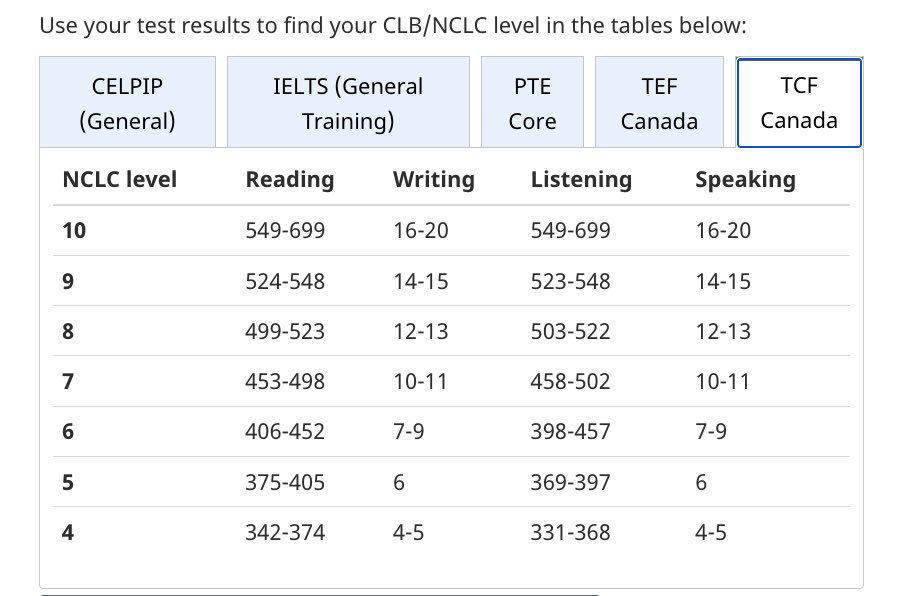
2) Your French Language Test (TEF or TCF) score must be at least a CLB 7 (NCLC Level 7). Many people have said TCF is better. See the TCF conversion below.
Addendum
If you have English Language Ability, you can still write IELTS/CELPIP/PTE in addition to the French Test. This will give you more points as a bilingual candidate. This is optional (to get more points).
All the best.
Use CLAUDE to search for a job
Use CLAUDE to search for a job
Use CLAUDE to search for a job
I got 5 interview calls in just 7 days, and all of them using ChatGPT as if it were a hiring manager.
Here are 5 prompts that will turn your job search into a well-thought-out strategic plan.
This is one way to go about it.
But the people who get the best jobs barely do all these.
They use LinkedIn differently, and I’ll teach you EXACTLY how in three steps.
If you have a LinkedIn account, turn on these settings, then sit back and watch the magic:
INCREASE YOUR CRS SCORE
Most people in the Express Entry pool are waiting.
Waiting for the next draw. Waiting for their score to go up.
It won't go up by itself.
Here's how you actually move the needle:
Before the tips, understand what CRS actually rewards.
Language. Education. Canadian work experience. Age. Adaptability. Provincial nominations.
You can't control your age. Everything else on that list is fair game.
Tip 1: Retake your language test.
I know, I know. Nobody wants to hear that. But hear me out.
CLB 10+ across all four abilities can add up to 270 points. If you're sitting at CLB 9 in even one category, a retake could be worth 20 to 30 extra points.
That gap matters at draw time.
Tip 2: Get your credentials properly assessed.
WES or another IRCC-designated body. Non-negotiable if your degree is from outside Canada.
What it can add:
PhD or two+ degrees - 150 pts
Master's - 135 pts
3-year degree - 120 pts
Full-time study in Canada (8+ months at a DLI) adds up to 30 more.
Tip 3: Build Canadian work experience. And I want to be specific here.
Working on a study permit does not count toward CRS work experience points. I see people assume this all the time and it costs them.
You need a valid work permit, working for a Canadian employer, in Canada.
Get the PGWP. Then work. That is the sequence.
Tip 4: Learn French (but be sure you will immerse into the French community)
NCLC 7 or higher in French adds up to 50 bonus CRS points. But the bigger opportunity is access to French-language category draws, which have historically had much lower cut-offs than general draws.
You do not need to be fluent. NCLC 7 is conversational. It is more achievable than people think.
Tip 5: Go after a Provincial Nomination.
A PN adds 600 points. That is not a typo.
It essentially guarantees an ITA. Research streams in Ontario, BC, Alberta and Manitoba that align with your NOC code. Do not wait until your score feels competitive. Apply now and work in parallel.
Two things I hear people get wrong constantly and I want to address them directly.
First: job offers no longer add CRS points. That rule is gone. Stop building your strategy around it.
Second: study permit work does not count. You need a work permit. Full stop.
Do not spend months optimizing for the wrong things.
To summarize:
- Retake your language test if there is any room to improve.
- Get your credentials assessed through WES.
- Get on a work permit as soon as you can after graduation.
- Look into French. Even a basic level opens new doors.
- Research PNP streams now, not later.
Stack every category you can control.
If this helped you, pass it along to someone working toward Canadian PR.
If you have time on your hands and you are not locked in on AI or some skill of the future, then you are doing yourself a great disservice.
Time is an essential factor that many people do not have. People are locked in on their jobs, trying to make a living. If you are in a position where you do not have to work for hours to make a living and you have spare time at your disposal, you have to lock in on AI now.
And yes, even busy people need to make out time. Swap 30 minutes of scrolling for 30 minutes of learning. That is it. No matter how packed your schedule is, find the time. Your future self will thank you.
Here are 5 free courses on AI you need to lock in on now:
1. Google's Generative AI Learning Path: A structured, beginner-friendly path covering the fundamentals of generative AI, large language models, and responsible AI. It is completely free.
https://t.co/qcMnE0HfU3…
2. Elements of AI: A globally recognized course designed for non-technical people that breaks down how AI works and why it matters in the real world.
https://t.co/GbYXO1XOZT
3. AI For Everyone (Coursera): One of the most watched AI courses in the world. It strips away the complexity and teaches you how to think about AI as a business and life tool.
https://t.co/A1ZnaixwhD…
4. Anthropic's Claude AI Course: Learn directly from the makers of Claude. This free course covers how to effectively use and understand AI models, making it one of the most credible and practical resources available today.
https://t.co/7a6jr7kdv9
Here are 5 jobs that are future proof:
1. AI Prompt Engineer: Companies are paying top dollar for people who know how to communicate with AI tools effectively to generate business outcomes. This role is only growing.
2. Cybersecurity Analyst: As AI advances, so do digital threats. The demand for people who can protect systems, data, and infrastructure will never slow down.
3. Data Analyst: Every business runs on data. The ability to read, interpret, and turn data into decisions makes you indispensable in any industry.
4. Content Creator & Digital Marketer: Brands need human voices, storytelling, and creativity to connect with audiences. With AI as your assistant, one person can now produce the output of an entire team — no degree required.
5. AI Trainer & Evaluator: AI models need humans to teach, test, and fine-tune them. This behind-the-scenes role is quietly becoming one of the most in-demand positions in the tech world — and you can start with zero academic background.
The window is open right now. The question is, are you walking towards it?
STOP Waiting for Express Entry CRS to “Miraculously” Increase.
If you’re serious about relocating to Canada in 2026, you need to understand this:
PNP might be your fastest route.
Today, let’s break down how to relocate to Canada through the Provincial Nominee Program (PNP) in 2026 step by step — no agent hype, no confusion.
What Is PNP?
The Provincial Nominee Program (PNP) allows individual Canadian provinces to nominate immigrants based on their labour shortages.
Translation?
Instead of competing with the whole world, you compete within a province that actually needs your skill.
And when a province nominates you?
You get 600 additional CRS points if it’s Express Entry–linked.
That means an automatic Invitation to Apply (ITA).
Provinces Running PNP in 2026
Here are popular provinces actively using PNP:
1) Ontario Immigrant Nominee Program (OINP)
•Healthcare workers
•Tech professionals
•Skilled trades
•International graduates
Ontario does targeted draws, especially for healthcare and tech.
2) Alberta Advantage Immigration Program
•Lower CRS score sometimes accepted
•Strong oil, trade, and agriculture sectors
•Healthcare and construction in demand
Alberta often selects candidates directly from the Express Entry pool.
3) Saskatchewan Immigrant Nominee Program
•Popular for Nigerians and Africans
•Occupation-in-demand stream
•No job offer required in some categories
4. Nova Scotia Nominee Program
•Healthcare
•Early childhood educators
•Transport and truck drivers
How PNP Actually Works (Step-by-Step 2026 Strategy)
STEP 1: Check Your Eligibility
You need:
•Valid IELTS (General)
•ECA (WES or other approved body)
•Skilled work experience
•Proof of funds
STEP 2: Choose the Right Province
Don’t choose a province because your friend lives there.
Choose based on:
•Your occupation
•Your CRS score
•Demand list
•Processing time
Strategic relocation wins.
STEP 3: Create Express Entry Profile (If Required)
Some PNP streams are:
•Express Entry aligned
•Non–Express Entry (paper-based)
Express Entry–linked means faster PR.
STEP 4: Wait for Provincial Nomination
If selected:
•You receive nomination
•CRS jumps by 600 points
•You get ITA
•Apply for PR
STEP 5: Apply for Permanent Residence
Submit:
•Medicals
•Police clearance
•Financial proof
•Biometrics
Wait for decision.
Move to Canada as PR.
Who Should Consider PNP in 2026?
•Nurses
•Healthcare assistants
•Teachers
•Truck drivers
•IT professionals
•Skilled trades workers
•Construction workers
If your CRS is low (below 480–500), PNP may be your golden route.
Relocation is not magic.
It is documentation + eligibility + strategy.
If Express Entry looks impossible,
PNP might be your open door.
2026 is about smart migration, not loud migration.
If you need our help, you can reach out to us for paid consultations on WhatsApp: +2348039266453, +234 707 039 1254
If you want a free course on mastering A.I
Visit Anthropocene academy. They’ll also give you free certificates and that could boost your cv
https://t.co/cI75M8lE5j