OpenAI just dropped their biggest vision yet.
They're officially entering Phase 3: turning frontier AI into something abundant, affordable, and actually useful for every person and organization on Earth.
Power concentrated = fragility.
Power widely shared = stronger future.
This is the real mission shift. From building AGI → making sure it benefits everyone.
“don’t train your own model” is common ai advice. it's wrong. your token bill's the proof.
today, we’re excited to launch castform into open preview. castform is the easiest way for you to train your own model, on your own data.
open-weights models are performant and much cheaper. when trained on your task & proprietary data, they beat closed models. the thing standing between you and that was weeks of plumbing & years of ml expertise.
with castform, model training is as simple as prompt engineering. @castformai
bring your agent traces or raw corpora. castform turns it into training data, picks the right algorithmic recipes, manages gpus, and gives you an ide to watch and chat with your model as it learns.
see what you can build with castform👇
Man. You can now train a custom AI model on your own data in minutes. No ML degree. No GPUs. No setup. Just your data. 🤯
A tool called Castform just launched and it changes how you think about AI costs.
Right now you're renting AI. Every prompt costs tokens. Every token costs money. And the model you're paying for is smart at everything but not built for your specific work.
Castform flips that. You bring your data documents, agent logs, PDFs, production traces.
It turns everything into training data automatically, picks the right algorithms, manages the GPUs, and lets you watch your model learn in real time.
What you get: a custom model you fully own. Trained on your data. Built for your tasks. Runs 10-20x cheaper than API calls.
Before this, training your own model meant weeks of infrastructure, GPU management, and deep ML expertise. Castform made it as simple as prompt engineering.
You own the model. You own the data. Deploy it wherever you want.
https://t.co/XLxa99aNYl
.@elonmusk grew up in Pretoria, South Africa, where he taught himself to code. He became a U.S. citizen in 2002—the same year he founded SpaceX.
Musk is featured on the #Forbes250 America’s Most Successful Living Immigrants list. View the full list: https://t.co/2Xgu79oZeb
📸: Martin Schoeller
Anthropic’s Dario Amodei has only 1 direct report, his chief of staff.
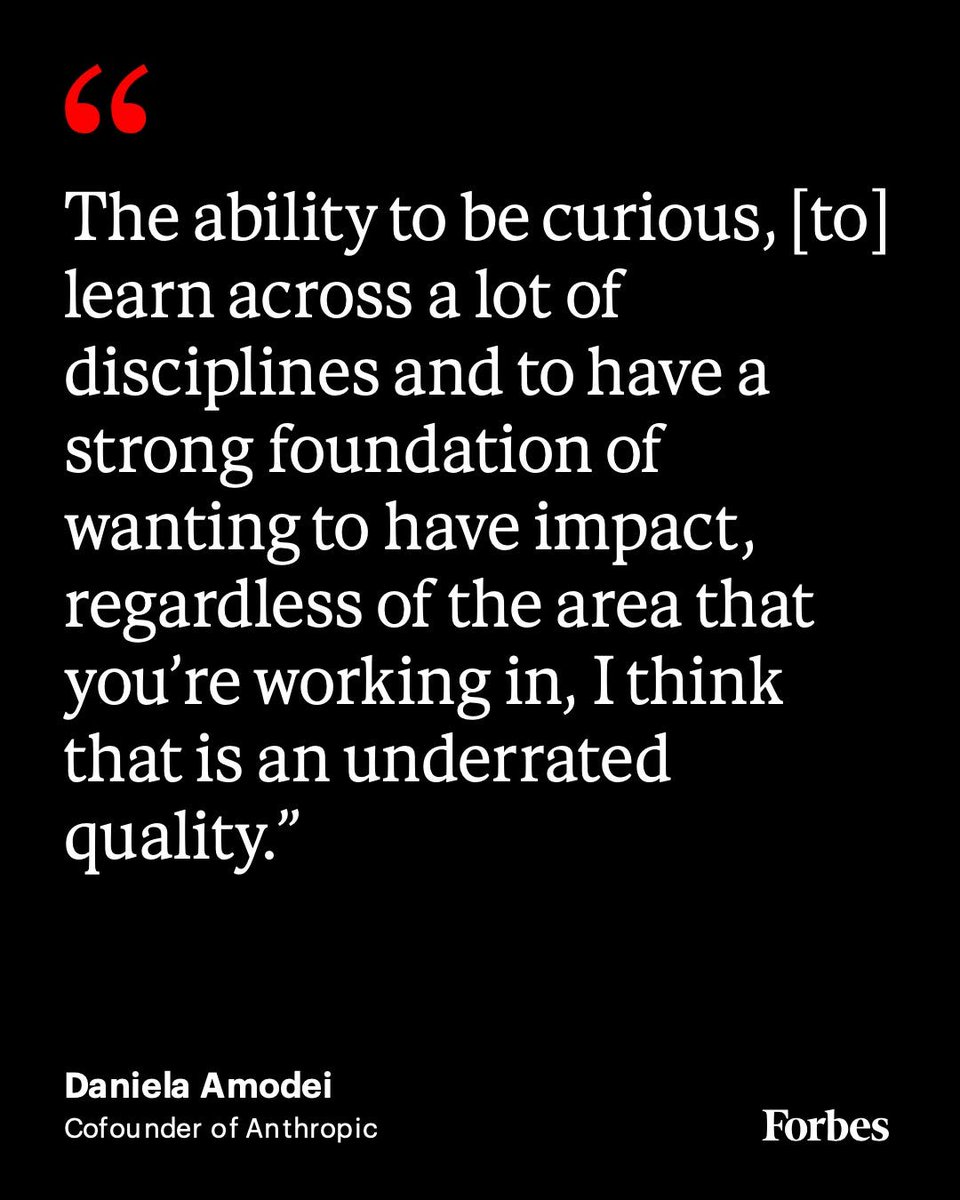
The rest of Anthropic’s executive system flows through Dario’s sister, Anthropic President Daniela Amodei, who handles daily operations and reports to the board.
For some comparison, OpenAI CEO Sam Altman has around half a dozen direct reports, while Nvidia Corp. CEO Jensen Huang has 60 people reporting to him.
---
From "Bloomberg Originals" YouTube channel, (link in comment)
i will die on this hill: Apple is a frontier AI company. they will inject AI into every place you scroll, type, read and listen
imagine if you could “google” a past memory or ask siri to prove you’re right in a group chat
ai models that run on-device with access to your entire life.
the craziest part is the models don’t even need to be big!
a 20B frontier model can run smoothly on apple’s chip architecture completely privately
there are 3.5 billion apple devices, the gravitational pull this company has on societal culture is unmatched
Meet Aman Sanger, an Indian-origin entrepreneur and a https://t.co/YSvOF5fxhn Computer Science graduate from MIT, who started coding at the age of 14 and is now a billionaire with an estimated net worth of $1.3 billion.
Aman Sanger co-founded Cursor, the company behind one of the world's most popular AI-powered code editors, along with three friends from MIT in 2022.
Today, at just 25 years old, Aman and his co-founder Michael Truell have built a company that has transformed how software is written. Cursor is reportedly valued at over $50 billion, and SpaceX has reportedly secured an option to acquire the company for around $60 billion.
The crazy part?
Millions of developers across more than 50,000 enterprises, including Nvidia, Adobe, Uber, and Shopify, use Cursor to generate, edit, and improve code every day.
We Indians have the talent. The challenge is that much of that talent often ends up building for the West instead of creating global technology giants from India.
FYI Check:
https://t.co/VaYF22i4KD
https://t.co/wZ05GnZgc5
🚨JEFF BEZOS JUST PUT $100 MILLION INTO A STARTUP WITH NO PRODUCT.
Their entire pitch is that the AI industry is doing everything wrong.
And that your brain already solved the problem everyone is burning billions trying to fix.
The whole AI industry is trapped in one brutal equation:
Smarter models need more compute.
More compute needs more power.
Companies are now building dedicated nuclear plants just to run AI data centers.
A single AI server GPU burns over 1,500 watts.
Your brain runs on 20.
Yet your brain is doing something far more complex than answering a chat prompt. It's learning, reasoning, controlling your body, and processing everything you see and hear on less power than a light bulb.
A startup called Flourish just raised $500 million at a $2.5 billion valuation to exploit that gap.
Their thesis is simple but radical:
The AI industry is optimizing at the wrong layer.
Everyone is racing to build more powerful chips. Flourish says the real problem isn't the hardware. It's the architecture.
Today's AI models activate enormous portions of their networks for almost every task.
Your brain doesn't.
It's sparse. Only the neurons needed for a task light up. Everything else stays quiet, consuming almost no energy.
Flourish wants to copy that.
Their approach comes from a field called connectomics: mapping biological brains neuron by neuron to understand how intelligence actually works.
In 2024, scientists fully mapped a fruit fly brain.
And here's the punchline:
That tiny brain appears dramatically more efficient than modern AI systems performing similar tasks.
Flourish wants to extract that efficiency and turn it into software.
The man leading the effort has one of the strangest résumés in tech.
Thomas Reardon created Internet Explorer at Microsoft.
Then he left software, earned a PhD in computational neuroscience, built a brain-computer interface company, and sold it to Meta for up to $1 billion.
Now he's trying to reverse-engineer the core algorithm of human intelligence itself.
If it works, the implications are staggering.
Advanced AI could run locally on laptops and phones instead of massive data centers.
The energy requirements of AI could collapse.
And the $30,000 GPUs the industry depends on today could become optional.
For 70 years, we've built computers that think nothing like brains.
Flourish is betting the answer was sitting inside our skulls the whole time.
Anthropic’s new Mythos-class model is 3x cheaper than OpenAI’s best model.
And it beats it on nearly every benchmark. 🤯
GPT-5.5 Pro: $30 input / $180 output
Claude Fable 5: $10 input / $50 output
The benchmarks:
→ Agentic coding: 80.3% vs 58.6%
→ FrontierCode (code quality): 29.3% vs 5.7%
→ Cybersecurity: 78.0% vs 34.0%
→ Legal: 13.3% vs 2.1%
→ Reasoning: 59.0% vs 41.4%
→ Health: 66.0% vs 51.8%
→ Computer use: 85.0% vs 78.7%
Cheaper. Better. On almost everything.
Free on Pro and Max plans through June 22. It’s called Claude Fable 5.
Fable 5 is the biggest step up I’ve felt in our models since Opus 4.5 back in November. After 4.5 came out I uninstalled my IDE when I realized that I’d been doing 100% of my coding in a terminal for a few weeks. With Fable, it’s felt like Claude has stepped up from being a coding agent to a thought and design partner in building the product. Fable has judgement, taste, and dimensionality in a way that previous models didn’t, leading me to trust it more with the most complex work.
I think the first time I had this realization was when I asked Fable to debug something. It is the first model I have used that was so methodical and precise, taking measurements and adding logs then verifying that it truly fixed the issue before declaring victory.
There’s nothing in claude code’s prompting telling the model to do that, it’s just part of its personality. It really has this “big model smell” that I haven’t felt before.
Anthropic and OpenAI are both telling engineers to write loops.
Not prompts.
Not agents.
Loops.
That is not a coincidence.
When the two most important AI labs on the planet independently converge on the same pattern — that is a signal worth paying attention to.
Most engineers are still thinking in terms of single calls.
Input → model → output.
The engineers winning in 2026 think in cycles.
Output becomes input. The model evaluates its own work. The loop runs until the result is right.
This is the complete breakdown of what loops are, why they matter, and how to build them ↓
Claude Fable 5 is by far the most ridiculous model that makes me genuinely afraid for the future of software engineering.
I compiled the top 10 most unbelievable things I've seen Claude Fable 5 do today:
— Migrate a 50M line codebase from Stripe in a day (humans take 2mos)
— Draw amazing 3D graphics a) Boeing 747 b) space simulations with >5000 objects c) Minecraft roller coasters d) full photorealistic forest scenes e) NYC skyline f) stormy clouds)
— One-shot Pokemon FireRed the game
— Optimize a real world proprietary interaction net evaluator 10x more than the next best model, gpt5.5
AND it's about the same price as GPT 5.5 ($10/M input, $45/M output) vs Fable 5 ($10/M input, $50/M output) and 6x cheaper than GPT 5.5 Pro.
A SpaceX welder making $28 an hour is about to become a millionaire. 🤯
His name is Juan Hernandez. Immigrated from Mexico. Learned welding for better pay. Joined SpaceX in 2015 through a friend.
When he went full-time, SpaceX gave him $10,000 in stock. He held it.
That stock is now worth approximately $880,000 as SpaceX heads toward its IPO on June 12.
And he's not the only one.
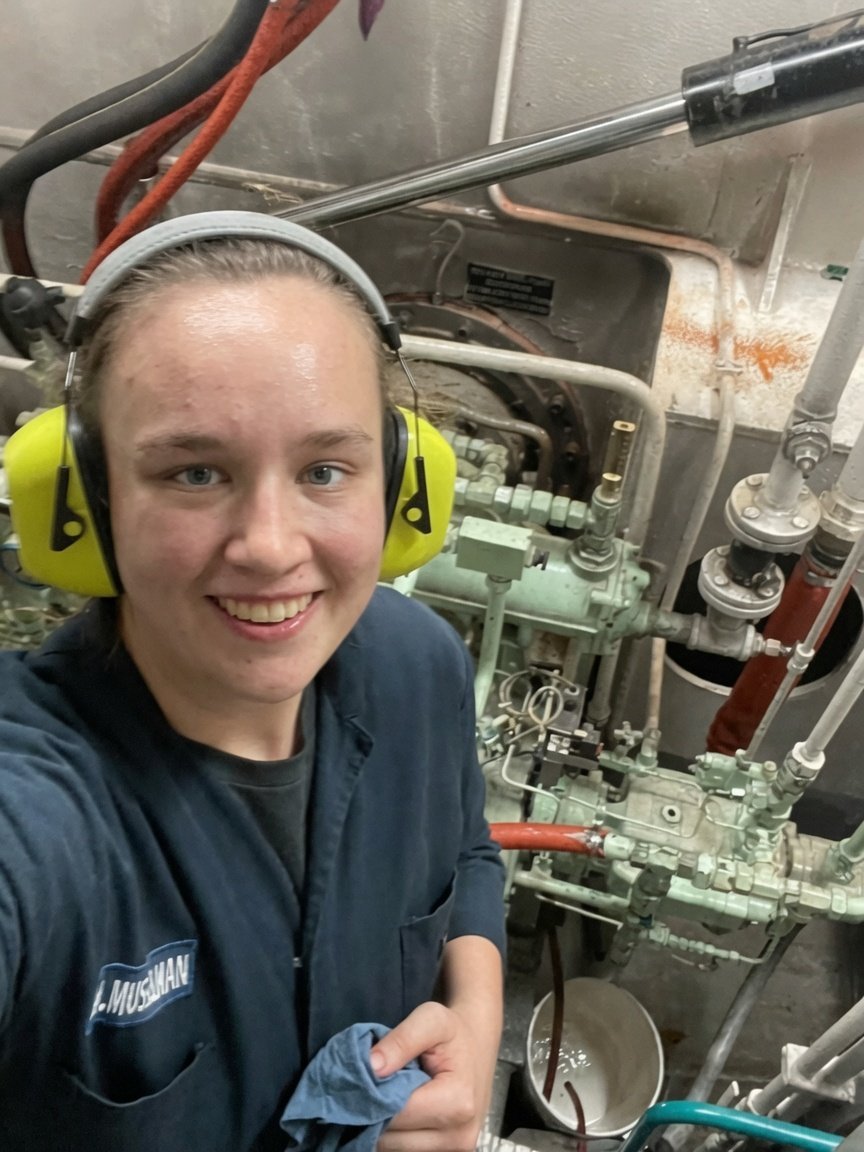
A 27-year-old ship engineer named Maryellyn Musselman spent two years on a SpaceX rocket recovery boat off the Florida coast. Stock was part of her pay something that almost never happens for mariners.
She put 10% of every single paycheck into buying more.
She's planning to use the money to start her own repair business.
SpaceX didn't just give equity to engineers and executives. Welders got it.
Ship crews got it. Technicians got it. Factory workers got it.
The IPO is expected to create roughly 4,000 new millionaires. Not from coding. Not from startups. From building rockets.
A welder. A ship engineer. $28 an hour.
This is what happens when a company lets its people own what they build.
Anthropic finally released the model they were too scared to make public 🤯
It's called Claude Fable 5. Same architecture as Mythos. Safety guardrails added. Available to everyone today.
Stripe tested it on a 50-million-line codebase. A migration that would've taken a team 2+ months done in a single day.
Beat Pokémon FireRed using nothing but raw screenshots. No maps. No tools. Just vision.
Highest score on FrontierCode the benchmark testing if AI writes code good enough to actually merge.
Accelerated drug design by 10x. Ran autonomous genomics research for a week and outperformed a Science-published paper 100x smaller model.
Highest score on Hebbia's finance benchmark. IMC said it aced trading analysis nearly across the board.
$10 per million input tokens. Free on Pro and Max plans through June 22.
This isn't an upgrade. This is a different league.
For over 20 years, we've dedicated ourselves to removing language barriers so people can learn, speak and connect more deeply than ever before.
Today, we’re taking our next step with the release of Gemini 3.5 Live Translate — our latest audio model for live, speech-to-speech translation across 70+ languages. 🧵
Lovable just hit $500 MILLION ARR in less than 2 years since launching.
They’re now doing 1 MILLION NEW PROJECTS EVERY SINGLE WEEK.
Most of these are built by NON-TECHNICAL PEOPLE who just describe what they want in plain words.
BREAKING: Cursor passed $4B annualized revenue last week
>$2B in February
>$3B in April
>$4B last week
Doubled revenue in 4 months.
SpaceXAI holds a $60B option to buy Cursor
ITS HAPPENING