$NANDmine 240k
CA: 0xca232eb8221a9d1548846e2d48d7970d3b887777
meme trading: https://t.co/NWjneQAXUV
An On-Chain Bitcoin Miner
This project is attempting something genuinely experimental: putting a real Bitcoin miner on-chain.
Not a website. Not an off-chain miner with the results simply verified on-chain. The idea is to start from the most fundamental building blocks — the equivalent of electronic switches — and assemble the miner on-chain piece by piece, almost like building with LEGO.
Users aren’t simply buying a token. They can actually own the fundamental components of the miner.
Different people can own different parts, and together those components can be assembled into a Bitcoin miner that actually runs on the blockchain.
The miner will continuously follow the Bitcoin network and receive new mining challenges, then repeatedly attempt to solve them.
Of course, it will be extremely, extremely slow. It may never mine a single Bitcoin block in its entire lifetime.
But that’s not the point.
The real experiment is to make a Bitcoin miner that is assembled, operated, and recorded entirely on-chain — starting from its most basic components.
You can see how many components it has.
You can see when it starts computing.
You can see every attempt it makes.
And you can see who provided the resources that keep it running.
If the project expands, there doesn’t have to be just one miner. There could be a first miner, a second, a third, and eventually an entire on-chain mining farm, with different people owning different components and collectively powering a fully transparent network of machines.
This isn’t about competing with the billions of dollars worth of professional Bitcoin mining infrastructure in the real world.
It’s an experiment.
What happens if a blockchain can do more than record assets — what if it can actually host a computing machine built from the most fundamental components?
Bitcoin is simply the first task this machine is being built to perform.
Maybe it will never mine a single BTC.
But at least every computation it performs is real.
"The above MEME coin analysis is for informational purposes only and is not investment advice."
🔸 $Nandmine
I aped some of this, looks like its from that $Behemoth dev things.
And looks like they are tryna turn the transaction tax generated by Flap tokens into a Bitcoin mining machine.
Tbh, some pretty complicated stuff here so yeah DYOR lol https://t.co/fZt4IAKEuH
0xca232eb8221a9d1548846e2d48d7970d3b887777
$NANDmine 650k dyor
0xca232eb8221a9d1548846e2d48d7970d3b887777
okx wallet:https://t.co/0dcYiFY0Kb
It originated from Blonskr TapeOut project, where he treats tokens as real NAND logic gates, minting and assembling them on BNB Chain into actual on-chain circuits that can run—even making an on-chain processor. The NANDmine project was inspired by this.
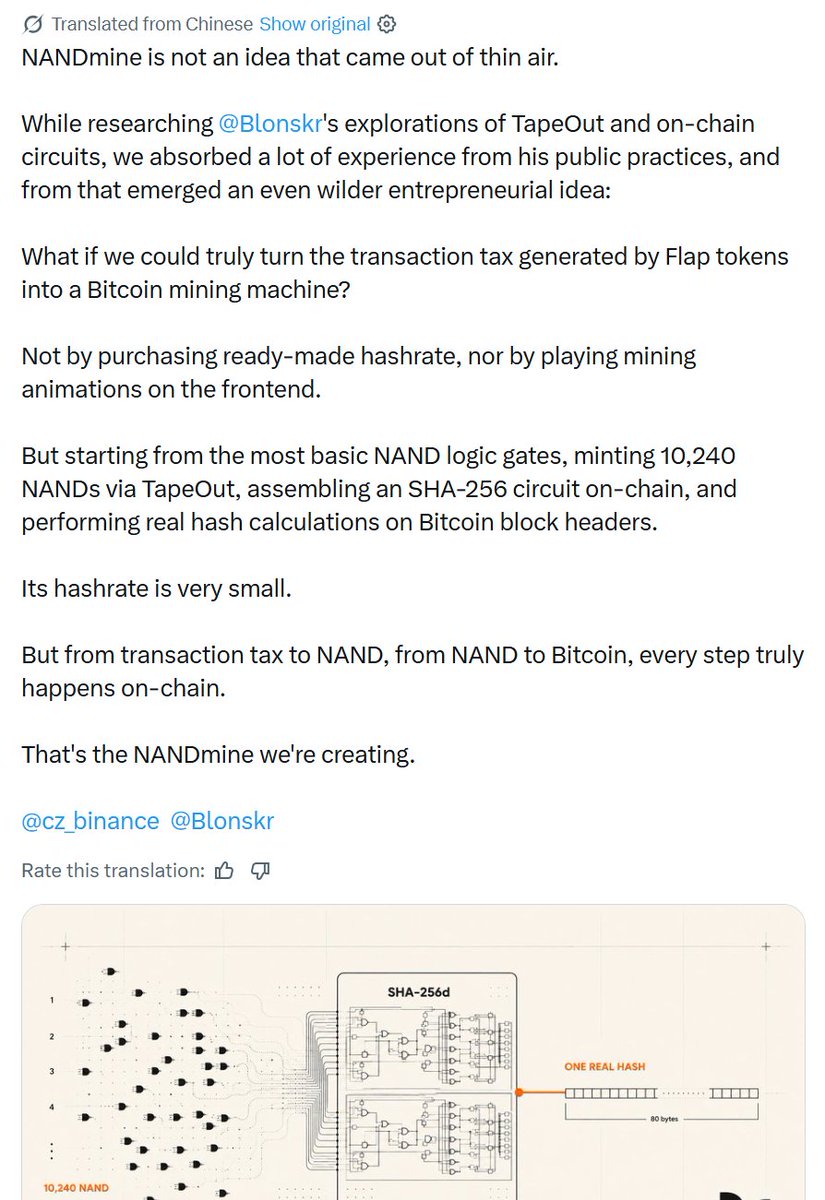
In their tweets, the project clearly states that NANDmine is not an idea that came out of nowhere. It absorbed a lot of experience from Blonskr's public experiments with TapeOut and on-chain circuits, and evolved into a more ambitious entrepreneurial idea: can the trading tax generated by the Flap token be turned into an actual Bitcoin miner? Not buying existing hashpower, not playing a mining animation on the frontend—but starting from the most basic NAND logic gates, minting 10,240 NANDs via TapeOut, assembling a SHA-256 circuit on-chain, and performing real hash calculations on Bitcoin block headers. Its hashrate is small, but every step—from trading tax to NAND, from NAND to Bitcoin—happens truly on-chain.
From 10,240 NAND gates assembled into a SHA-256 circuit, the final output is "ONE REAL HASH."
Simply put, the project takes the concept of on-chain real circuits proposed by Blonskr and actually implements it into a running Bitcoin mining project.
The above content is entirely my personal understanding and analysis (dyor). If you have other opinions, feel free to discuss them in the comments.