It was wonderful to hear stories of #developerstudentclubs leads about their experience with Google Pixel products, technologies, achievements in app development and entrepreneurship and unique
aspirations!
@google https://t.co/x39pgQhVg1
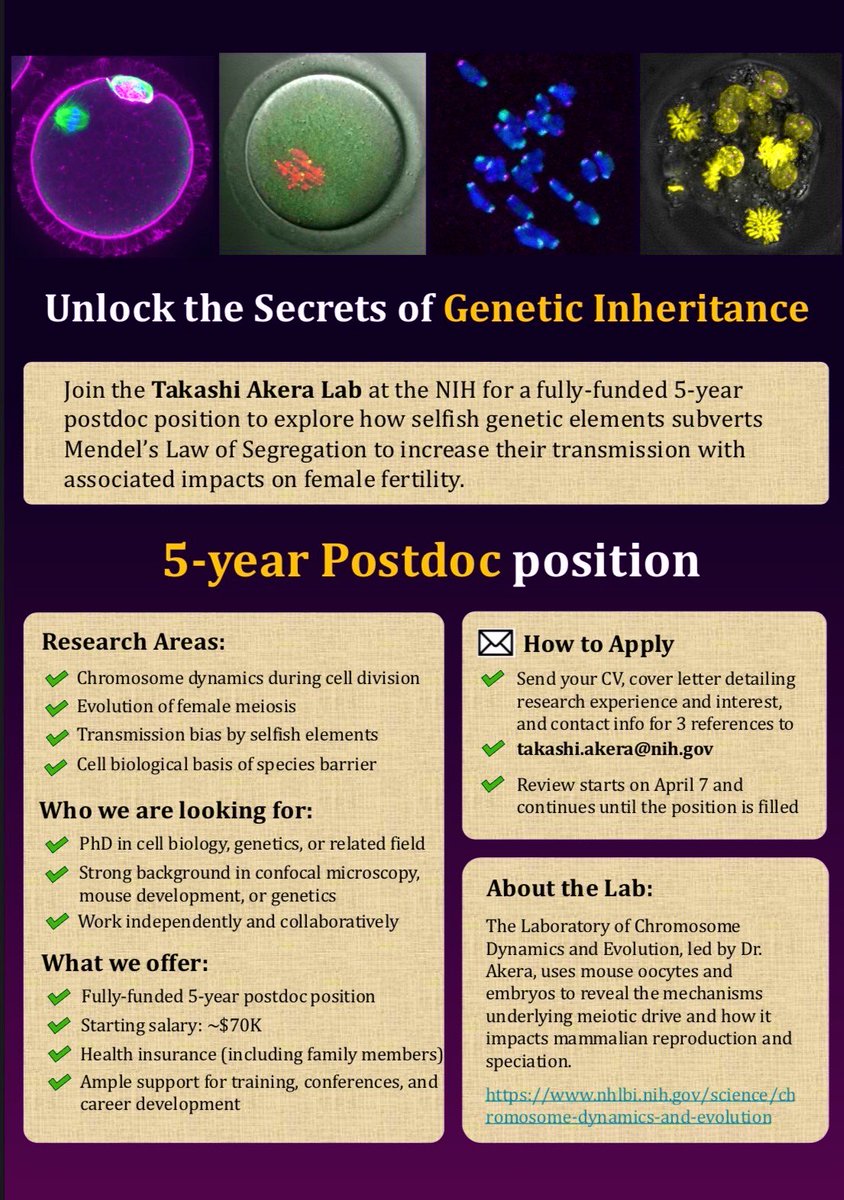
🚨Another open position in the lab! A long-term Staff Scientist position for people who love working on the bench!!👩🏻🔬👨🔬The Staff Scientist will function semi-independently in the lab to manage multiple projects 🧬🐭🔬#meiosis4eva
This is really cool (and wild):
Scientists simulated a complete living cell for the first time. Every molecule, every reaction, from DNA replication to cell division.
The paper (Luthey-Schulten et al., Cell 2026, https://t.co/PXxXWKC8yp), just out today, used JCVI-Syn3A — a synthetic minimal bacterium with fewer than 500 genes. A 3D+time simulation of the full 105-minute cell cycle: DNA replication, protein translation, metabolism, division. Every gene, protein, RNA, and chemical reaction tracked through physical space.
It took years to build. Multiple GPUs. Six days of compute time per run.
And this is the simplest possible cell.
A human cell has ~20,000 genes. It lives in tissue. It interacts with neighbors. It differentiates. It responds to drugs in ways that depend on context we haven't fully measured.
Mechanistic simulation of the minimal cell costs 6 GPU-days for 105 minutes of biology. You cannot scale that to human cells. The complexity isn't 40x harder. It's exponentially harder.
This is why the field pivoted to data-driven models. You can't hand-encode the regulatory wiring of a human hepatocyte. But you can learn it — if you have the right perturbation data collected across enough diverse biological contexts.
The two approaches aren't competing. Papers like this generate the ground truth that future ML models need for validation. But the path to a clinically useful virtual cell runs through foundation models, not through scaling up mechanistic simulation.
Amazing work!
If you are interested in the mechanisms of 3D genome folding, long-range regulatory interactions, and their roles in developmental gene regulation and how their misregulation can cause human disease—and want to learn how computational approaches can predict chromatin architecture directly from DNA sequence—this tour-de-force study is well worth reading. Congratulations to Feng Yu @yuefeng_1 and colleagues at Northwestern Biochemistry and Molecular Genetics on an outstanding contribution. @NU_BMG_SQE@NUFeinbergMed@Nature@MolecularCell@CellPressNews@theNASciences@ScienceMagazine https://t.co/rjcb8KQYB5
Senescent cells secrete chromatin components via senescence-associated extracellular particles --- New study from recently graduated PhD student in the lab, Lana Zaretski, co-supervised by Malene Hansen @thehansenlab and myself. Great job, Lana! https://t.co/Cd9rbkCOjR
Recently I had the chance to be a guest teacher at the Manaweb School Event in Fukuoka, and it became one of the most refreshing experiences I’ve had in a long time.
“Good smile! Good voice!
Aiya worked well using all English. She crouched down to the kids’ level and listened carefully, which left a very good impression.” — Kijima-san
I’m deeply grateful for this experience and for every moment.
(1/8) Excited to see our collab w. @ViraatGoel Ed Banigan @ngaboreden James Jusuf, Leonid Mirny and Gerd Blobel out in @NatureSMB https://t.co/2Ri3nom8jt
This was co-submitted with A Schooley and Job Dekker's preprint https://t.co/0Y6CmePM1Z which should also be online soon.