Director NCI-designated Cancer Genome and Epigenetics Program at SBP, Co-Editor-in-Chief Aging Biology Journal, Road/Gravel/Mtn Cycling, Wolf Pack Cycling.
@biogerontology@DMSabatini She is listed as a Career Development Fellow. Her productivity should be evaluated against pre-specified metrics and timeframe for promotion in that position, and at the appropriate time. Not random by snapshots.
@EricTopol@NatureBiotech Our ability to measure tissue specific disease risk through “remote” measures - plasma proteomics, facial appearance and now retinal vasculature - is accelerating👍
@MilsomMick@DKFZ@hi_stem_lab Congratulations, Mick! I wonder if these conserved signatures are more or less prone to change with age than non-conserved?
@ManelEsteller@CNIOStopCancer@idibell_cat@CarrerasIJC@IRSantPau Congratulations! I still teach Fraga et al 2005 to students. https://t.co/mbQOB1hZBA At that time, the evidence that altered epigenetics contributed to aging was minimal. The paper that coined “epigenetic drift”. Though drift is often now equated to “clock” which is different.
Great study from @ACovarrubiasPhD and team. In our recent paper on Cyclin D1 in senescence https://t.co/64isNbtvYB we noted that Cyclin D2 was up in senescence. Anthony and team have figured out the function. Surprising new roles for both D1 and D2. See also work of @marc_dema
The p53-p21-Cyclin D2 regulatory axis drives metabolic reprogramming and a distinct senescent macrophage senotype during aging and MASLD
https://t.co/eJxbYNgqTJ
@johncumbers@alantomusiak Amazing technology and biology. However, it’s a shame the first emphasis is on military applications. This will escalate the arms race and remove the disincentive to use nuclear weapons. We don’t want to go there. Better to promote for first responders, pilots, and astronauts.
Could we have got here earlier if not such a focus on amyloid and tau as targets? ApoE has been telling us for years that cholesterol/lipid metabolism is important in Alzheimer’s
1/
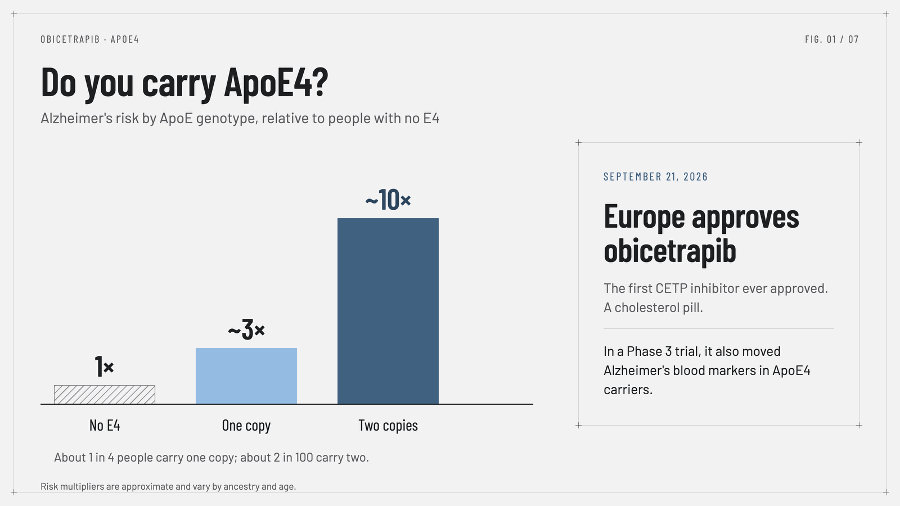
Do you carry ApoE4? About 1 in 4 ppl do. 1 copy: ~3X Alzheimer's risk. 2 copies: ~10X.
On Sept 21, Europe approved obicetrapib, a cholesterol drug that, in a large trial, lowered multiple AD markers in ApoE4 carriers.
Yes, a drug engineered to prevent heart attacks seems to lower AD biomarkers.
Read on for details.
Great thread. This is very exciting, if it holds up and extends to cognition/disease prevention. Obicetrapib is one of the most exciting emerging new drugs.
1/
Do you carry ApoE4? About 1 in 4 ppl do. 1 copy: ~3X Alzheimer's risk. 2 copies: ~10X.
On Sept 21, Europe approved obicetrapib, a cholesterol drug that, in a large trial, lowered multiple AD markers in ApoE4 carriers.
Yes, a drug engineered to prevent heart attacks seems to lower AD biomarkers.
Read on for details.
Agree this is a great synthesis - and I think can likely be applied to other aging disease mechanisms in other tissues; for example, pathology caused by senescent cells, inflammation…….can also apply to interactions between multiple “hallmarks of aging”
A brilliant new @Nature synthesis of what we know about Alzheimer's disease pathogenesis, which is non-linear, with discrete phases (Figure), and notable inflection and transition points. Also helps to explain why symptoms do not correlate with underlying pathology.
https://t.co/QTYGqhZkxT
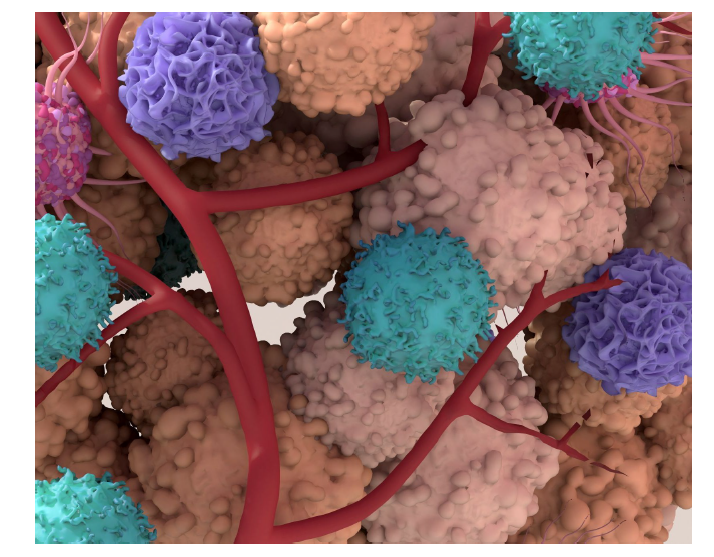
Tumors don’t evolve alone.
📣 New @GenomeBiology Collection on the Tumor Microenvironment: single-cell, spatial & multi-omic studies of how the TME shapes tumor evolution and therapy response.
Guest eds: @IamLinghua@kchenken & me
🗓️ until 19 May 2027
https://t.co/f7AytYygUp