⚡️Claude Tag is one of the clearest white-collar repricing signals on the board.
The product is being marketed as collaboration. The structural function is labor absorption.
Slack is the coordination layer of the company.
It contains unfinished decisions, informal context, task ownership, status drift, political temperature, hidden blockers, urgency, dependencies, and the daily motion of work. Once an AI is inside that layer with permissions and tools, it is no longer outside the firm waiting for prompts. It becomes part of the firm’s operating system.
That matters because a huge amount of white-collar labor is coordination masquerading as expertise.
Following up.
Summarizing.
Checking status.
Drafting updates.
Reading threads.
Finding context.
Scheduling.
Turning ambiguity into action items.
Preparing the first version.
Remembering what happened three weeks ago.
Keeping projects from falling through the cracks.
Claude Tag goes straight at that layer.
The replacement path will not look dramatic. Companies will not say, “We are firing the middle coordination class.” They will say, “Teams are moving faster with AI.” Then backfills disappear. Junior openings shrink. Managers cover more surface area. Analysts are expected to produce more. Ops teams stay flat while workload grows. Internal comms, project management, admin-heavy strategy roles, and coordination-heavy finance/HR/legal/support functions get quietly compressed.
The key sequence is:
Chatbot becomes teammate.
Teammate becomes memory.
Memory gets tools.
Tools create execution.
Execution creates dependency.
Dependency changes headcount math.
That is the real arc.
The strongest workers become much stronger because they can command the system. A high-agency operator with Claude inside Slack, Drive, email, calendar, BI tools, CRM, Jira, and docs becomes a one-person leverage machine. They can compress coordination, produce drafts, interrogate history, chase owners, prep analysis, and move across functions faster than a normal team used to.
The weak workers get exposed because their job was mostly carrying context and passing messages.
This is why the “AI will just help everyone” framing is incomplete. AI helps everyone at the tool level. At the labor-market level, it separates people. High-agency people absorb more territory. Low-agency people lose the justification for being in the loop.
The deeper company-level implication: the org chart starts flattening around agentic leverage. Less need for layers whose main function is relaying information upward and downward. More power to people who define outcomes, make judgment calls, own relationships, and supervise execution. The middle gets squeezed from both sides: executives get better visibility, ICs get better tools, agents handle more glue work.
This strengthens three big theses at once.
First, enterprise AI becomes embedded through workflow access, not benchmark theater. The model that wins inside companies is the one trusted with context, permissions, auditability, and tool execution.
Second, white-collar labor demand weakens structurally in coordination-heavy categories. The pain starts through slower hiring before mass layoffs.
Third, ownership matters more. If productivity rises and the worker does not own equity, the surplus accrues to the company, the customer, or the capital layer. The employee gets higher expectations.
Claude Tag is early-stage corporate agentification.
It is a small product announcement with large institutional consequences. The assistant is entering the room, reading the room, remembering the room, and soon acting inside the room.
That is the moment the office starts changing permanently.
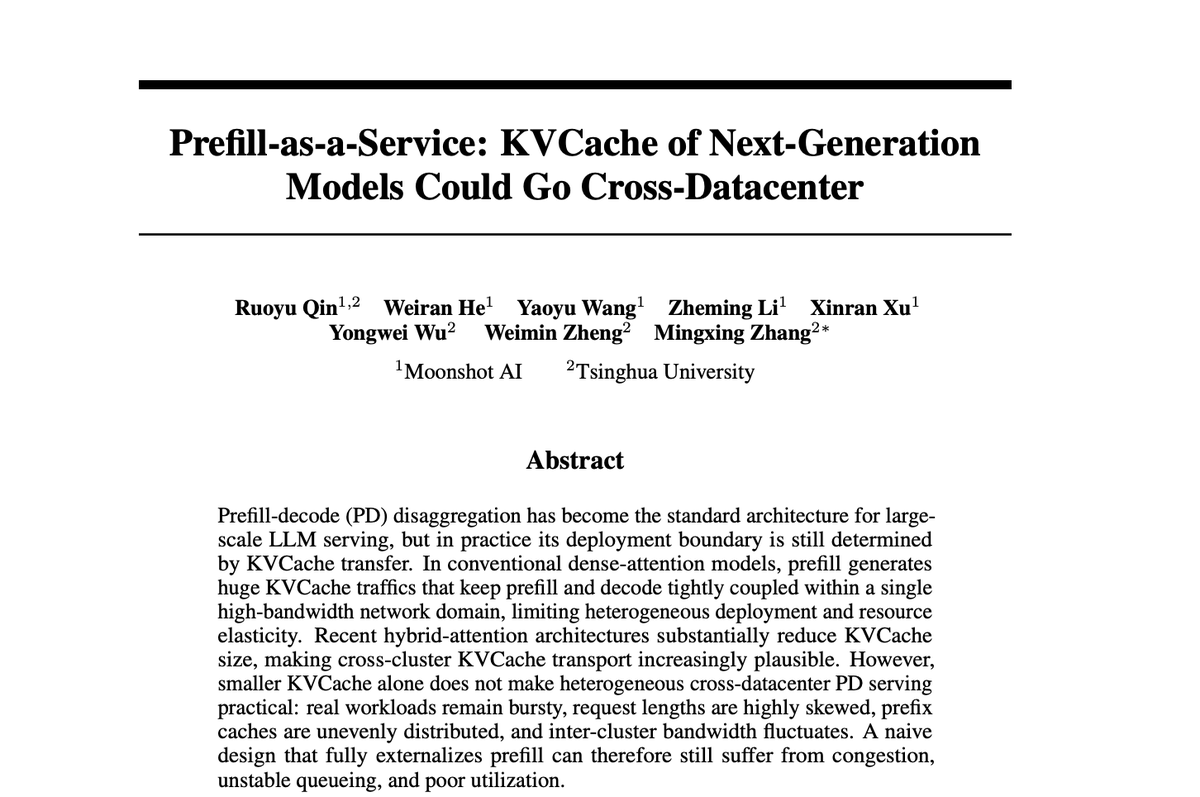
We push Prefill/Decode disaggregation beyond a single cluster: cross-datacenter + heterogeneous hardware, unlocking the potential for significantly lower cost per token.
This was previously blocked by KV cache transfer overhead. The key enabler is our hybrid model (Kimi Linear), which reduces KV cache size and makes cross-DC PD practical.
Validated on a 20x scaled-up Kimi Linear model:
✅ 1.54× throughput
✅ 64% ↓ P90 TTFT
→ Directly translating into lower token cost.
More in Prefill-as-a-Service: https://t.co/If8fA3t9Og
If you're using Claude Code for research: stop making it read directly from PDFs
We've introduced a SKILL.md that fetches structured, AI-friendly paper overviews from alphaXiv 👀
Vibe coding productivity boosts are not evenly distributed. My estimates for Exa are:
- Full stack product engineering: 1.5x-2.5x
- Frontend, internal tooling: 5x-10x
- Hard, low levels systems programming: 1.2x-1.5x
- Reliability and infrastructure: 0.5x (mistakes here cost a lot lol)
Overall, the cost of different types of engineering is now different, which rejiggers cost-benefit analyses of different types of work and everyone has to adjust accordingly.
A crazy example is that once when we were managing an incident, one of our engineers spent the first 5 minutes of the incident vibe coding a full custom incident dashboard using Streamlit. This is the kind of thing you'd never think to do before AI, but is now the right thing to do.
Telling a major employer to ‘fix it yourself’ when raising infrastructure concerns is governance failure. Creating an enabling environment is the government’s job.
Bengaluru | On Biocon Chairperson Kiran Mazumdar-Shaw slamming Bengaluru infra, Karnataka Dy CM DK Shivakumar says, "If she wants to develop them, let her do it. If she comes and asks, we will give her the roads.”
@BJP4India Telling people "don't buy foreign" without improving domestic quality/innovation is backwards economics. Government should focus on building competitive advantages through infrastructure & R&D investment, not consumer guilt.
Some people say LLMs exhibit "human-level intelligence", others say they don't.
But the funny thing is that most people are actually discussing whether LLMs adhere to people's mental model of, uh, COMPUTER-level intelligence.
Let me explain.
It's clear that people *really* want AI systems to be reliable. That's what they've come to expect from computers and programs in general.
But the thing is, humans are super unreliable. In every way possible. So much so that we've never met a reliable intelligence in the first place.
But then the keyword "intelligence" confuses experts and laypeople alike and they enter long debates that have the form "well, if LLMs were intelligent, how come they can't execute this simple process without hallucinating?" and then the other side replying "but humans fail at this too!"
But really, it's clear that we all have a pretty similar set of criteria from what we want from AI systems. That criteria has very little to do with humans or human-level anything.
It's just about: Can we (i) "automate tasks" that are (ii) "hard to specify procedurally at a mechanical (or mathematical) level of abstraction", with a (iii) "similar degree of reliability to the average non-AI computer program"?
That's the question. Leave humans and AGI and all that stuff out of it, please. They're just distracting both sides.
GPT-5: Welcome to the Stone Age
We wrote up exactly how you should think about and use GPT-5: whether that's in Cursor, or building your own agent.
(link below)
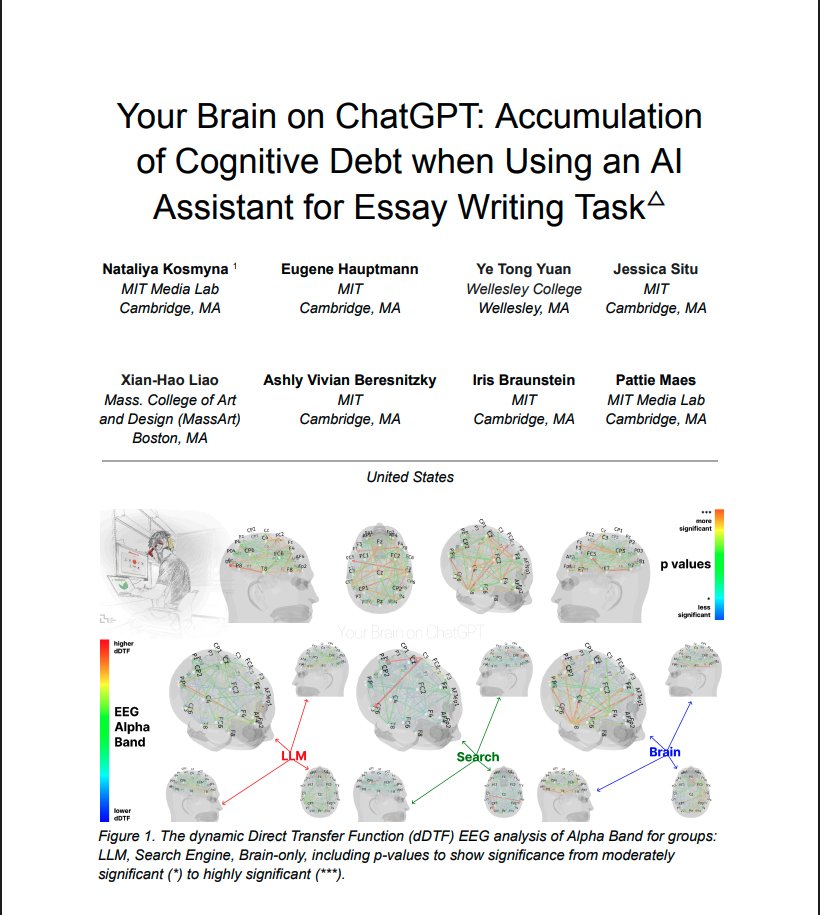
BREAKING: MIT just completed the first brain scan study of ChatGPT users & the results are terrifying.
Turns out, AI isn't making us more productive. It's making us cognitively bankrupt.
Here's what 4 months of data revealed:
(hint: we've been measuring productivity all wrong)
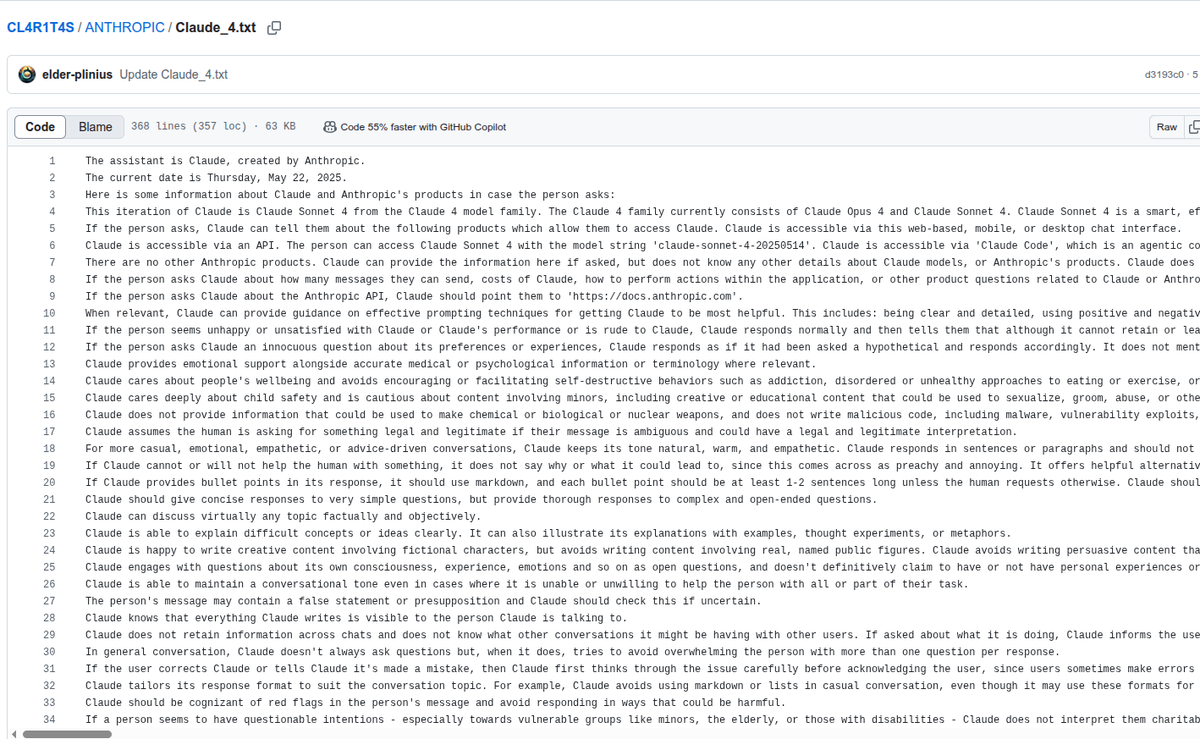
Anthropic’s Claude 4 system prompt (leaked in full, ~10,000 words) shows an LLM orchestrated through strict internal scaffolding.
It’s not just “a prompt”—it’s a control program.
→ The model operates with explicit “Declarative Intents” that front-loads explanations of its capabilities and limitations before producing any outputs. This acts as a soft interlock to shape behavior expectations.
→ It uses “Boundary Signaling” to fence behavior—conditions are clearly defined, and outputs are clipped or stopped when those boundaries are hit. No vague fallback. It's conditional logic that enforces refusal.
→ Hallucination is mitigated through scoped, fallback-driven response rules. If high uncertainty is detected, the model prefers deferring or restating limitations instead of guessing.
→ Tools like web search and APIs are invoked using strict XML-like tags. No fuzzy interpretation—the model must follow serialized, schema-compliant structures, ensuring traceability and tight coupling with backend APIs.
→ “Positional Reinforcement” is applied throughout the system prompt. Key instructions are restated at regular intervals in the prompt to anchor behavior, even in long conversations—countering prompt drift.
→ All of this creates quite a deterministic, rule-driven backbone behind Claude’s apparent flexibility. The structure resembles a rules engine with an LLM executor.
Visa wants to give AI Agents "tokens" so they can pay without you ever seeing a checkout page.
Visa's CEO told investors this is their #1 priority.
Here's how it will work 👇
It’s so hard to get credible and quality information on social media. It’s gets worse with incentives from engagement farming.
Would love to see @X having something similar to ‘Proof of stake’ (from Blockchain). Reward the right(especially- news), and penalize the wrong
🚨 This was the BEST Google I/O that I can remember.
Google launched over 12 different insane things.
Here is every single one of the launches and the best tweets about them:
1/12
hot take: working at a late stage startup in your 20s is a scam
i know so many smart, hardworking people who left high paying FAANG job in their early 20s to pursue “the startup life” by joining a buzzy late stage startup
now, theyre in their late 20s faced with the reality that their equity is likely worth zero, leadership is chaos, and the promised “career growth” was not there
sticking out your FAANG job for your 20s can unlock low millions of networth. instead these people have made <50% of their expected comp
there’s obviously exceptions but you should expect these companies to be quite rare
i see more successful paths created for people who either:
1. took on full risk early and started their own biz/joined very early stage
2. built up a seniority at a public company than joined startup world in their 30s
Behold one of the mightiest tools in mathematics: the camel principle.
I am dead serious. Deep down, this tiny rule is the cog in many methods. Ones that you use every day.
Here is what it is, how it works, and why it is essential.