TARIFFS > TAXES?
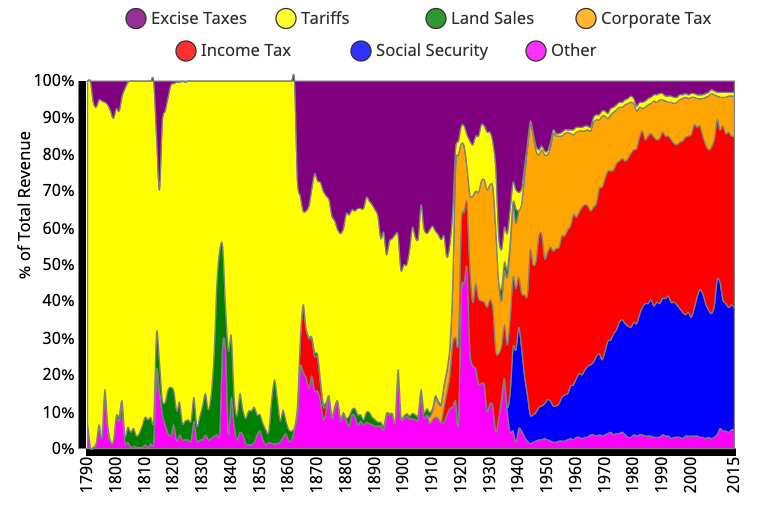
For most of American history, tariffs dominated taxes as a source of federal government revenue:
This was also the time when the US rose to become a manufacturing powerhouse. And as you can see from the graph, the income tax (and the Federal Reserve and much of the federal government as we know it) really only dates back to the 1910-1930s period. For most of US history the economy was set up in a completely different way.
MERCANTILISM VS FREE TRADE
The term for what the US used to be is "mercantilist". The founders thought of the US as like a giant merchant that needed to make more money than it spent.
As such, their rationale for tariffs was simple. A tariff is an incentive to build rather than buy. In theory, it encourages domestic manufacturing and is a tax on foreigners rather than citizens. We don't need to buy foreign goods; we have goods at home!
This is distinct from the last few decades of free trade. The idea was: you're good at making apples and I'm good at making oranges, so why not just specialize and trade? Comparative advantage proves it's a win/win!
This is a good argument until you make military robots and I make pieces of paper, which is the relationship between China and the US now. At that point it's no longer a win/win. With your military robots you can perhaps take my paper — and my oranges. And there is no need to trade.
That manufacturing (and hence military) asymmetry is one major reason why people now call for replacing taxes with tariffs to encourage making things in America again. And there is a good spirit to this! However, just instituting tariffs on their own is not a panacea. There are several problems you'd want to address at the same time.
THE PROBLEMS
1) The Fed. The first is that the most profitable export for the US is printed dollars, so there is no incentive to build physical things. Why export screws with a margin of 0.1% when you can print a dollar with a margin of 99.99%+? So the Fed is an obstacle.
2) The printing addiction. But to be honest, it's more than just the Fed. Everyone in the West is addicted to printed money and withdrawal would be like getting off heroin. Why would you voluntarily decide to work for a living after getting free printed money for decades?
The US would in a sense have to fire itself as CEO of the world and return to being an assembly line worker. I mean, founders actually do this all the time, they quit and start a new company where they code v1 from scratch...but it's quite hard to do that at country scale.
3) The regulators. The next issue is that building physical things is currently punishable by law in much of the US. The EPA, the Bureau of Land Management, the zoning codes, and countless agencies combine to present a thicket of laws in your way. So the regulators are an obstacle.
4) The physical risk. The fourth issue is that the US has become habituated to white collar and retail jobs that have minimal air pollution, noise pollution, chemical pollution, and physical risk. Yeah, EPA and OSHA might be overdoing it today, but plants really produce pollution and workers really do fall off buildings at times. So pain tolerance is an obstacle.
5) The vocational skills. The fifth issue is that 50+ years of outsourcing manufacturing, privileging college, and discouraging vocational training has meant the talent pool for US advanced manufacturing has to be rebuilt from scratch. All the plumbers, mechanics, electricians, carpenters, machinists, and assembly line workers are aging out. You'll need either new people who can do these jobs or robots. So lack of skill is an issue.
6) The domestic opposition. The sixth and perhaps obvious issue is that there will be howling resistance to any attempt to end taxes in lieu of tariffs. Huge agencies and powerful special interests benefit from the current system, and will fight hard to keep it that way — even if the population as a whole would prefer tariffs to taxes.
7) The external competition. The last issue is that there is now extremely challenging competition in the form of China. They are the world champ in low-tech and medium-tech. And they are now very competitive in high-tech too, with DJI drones, BYD cars, and Unitree robots.
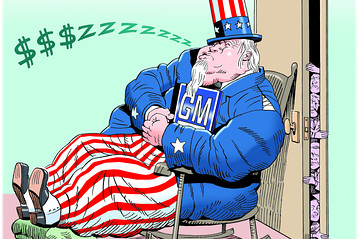
Think of Uncle Sam as a guy who was once in great shape, but got fat over the last 50 years. He still thinks he can walk over to the bench press and knock out 225 for reps — that he can just reindustrialize in a jiffy like he did in World War 2 — but neither the body nor the economy works like that. You have to build up physical capacity gradually over many years. And companies like GM and Boeing have been doing the opposite.
Meanwhile, building up physical capacity gradually is exactly what China's been doing. They've been paying their dues, grinding in sweatshops for decades while the US was watching Friends and cashing checks. To extend the analogy, they're in top physical condition while the US hasn't worked out in forever.
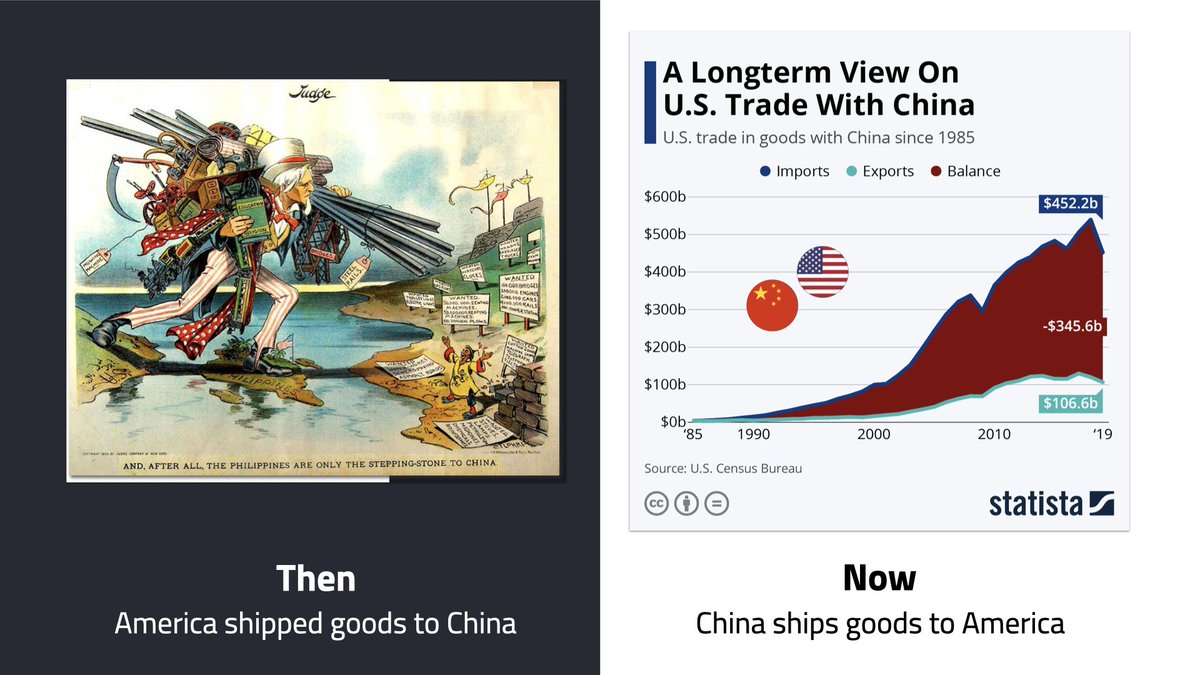
As a consequence, history has run in reverse. Back then, people made cartoons about how America was shipping goods to China. Now it's completely the opposite, where America is the market and China is the manufacturing powerhouse:
SUMMARY
So, what is to be done?
I just wanted to point out that the idea of substituting tariffs for taxes does have much historical support. The US became a manufacturing powerhouse in the 1800s with a mercantilist policy just like this, which incentivized the country to build rather than buy.
However, it's not trivial to just flip a switch and go back to the future. The state of the world is completely different from 100+ years ago. The printing addiction, the regulation, the lack of vocational skills, and the external competition...this is a multifaceted thing that requires flipping many policy levers at the same time in the face of enormous domestic opposition.
Imposing tariffs and rebuilding manufacturing means the US would also have to accept an enormous drop in its standard of living, perhaps lasting for decades, due to (a) giving up the money printer and (b) walling itself off from the number one provider of inexpensive goods while (c) working harder than it has in generations and (d) losing talented people who wouldn't want to spend decades paying dues.
The closest analogy would be Russia's rebuild into a natural resources economy after the Soviet collapse.
But you know what? It might still be worth doing. The US would be a poorer country for many years...but it could eventually be free of taxes and free of communists.
And freedom isn't free.
THE PURPOSE OF BITCOIN
The purpose of Bitcoin is to shatter the welfare/warfare state and return power to the people.
Yes, you can understand it as technological innovation — as a better way to hold and send large amounts of money — but at its core it is political revolution.
It stops both Putin's war machine and Powell's money printer. It defunds the secret police and the NGOs calling for defunding the police. It rewards places that attract skilled immigrants and punishes those that cannot protect property rights.
It does all this by breaking the 20th century centralized state's business model, by breaking both the wealth seizure of Communism and the money printer of Keynesianism. Because Bitcoin is money that can't be seized and monetary policy that can't be manipulated.
So, think of Bitcoin as the ultimate zero-based budgeting. It zeros out everything that centralized states spend money on. It ends the wars and starves the beast. And then, it allows free people to decide from scratch what collectives they want to form, what public goods they want to crowdfund, and what they want to voluntarily do together as a society.
In a word, it restores consensual government. You just don't do what you have not consented to do.
Because Bitcoin reverses several centuries of power centralization in a few decades of decentralization. It fuses the egalitarian global government of the internationalist left with the limited local government of the capitalist right. It does this by transferring sovereignty from each centralized local state to a decentralized global network, where the collective of Bitcoin holders act as the ultimate bond vigilantes, the ultimate international union, the ultimate government of governments.
And DC's declining "rules-based order" cannot match the legitimacy of this ascending Internet opt-in order. We already see tens of millions of Americans and Chinese alike voting against both Democrats and Communists by voting with their wallet for Bitcoin. Their states may be gearing for pointless war, but on the network these two great nations are at peace. Bitcoin Americans may not trust the Chinese state, and Bitcoin Chinese may not trust the American state, but neither of them trust their own states as much as they trust Bitcoin's network.
Trustworthy states, of course, have nothing to fear. If you have popular legitimacy you need not fear capital flight. And already we see early adopter states for Bitcoin, from Bukele to Bhutan. Early adoption serves as a political IQ test — small and smart governments can pull it off, while big and dumb states simply will not.
So big, dumb states will be hardest hit. And they will hit back. Just like they went from calling social media unimportant to assailing it as too important, so too will they go from questioning whether Bitcoin has any utility to calling it too powerful to leave in the hands of the citizenry. And then the attempts at seizure will begin.
The explicit use of state force will unify left- and right-libertarians against neocons and neolibs, shattering and remaking the political compass. That's likely to begin after this cycle. And it'll be a fight that will make 2016-2024 look like the good old days.
But at least we'll all know that Bitcoin has a purpose.
"If we held anything in the nascent field of Artificial General Intelligence to the lesser standards of engineering rigor that apply to a bridge meant to carry a couple of thousand cars, the entire field would be shut down tomorrow." https://t.co/BkD5vpnGob
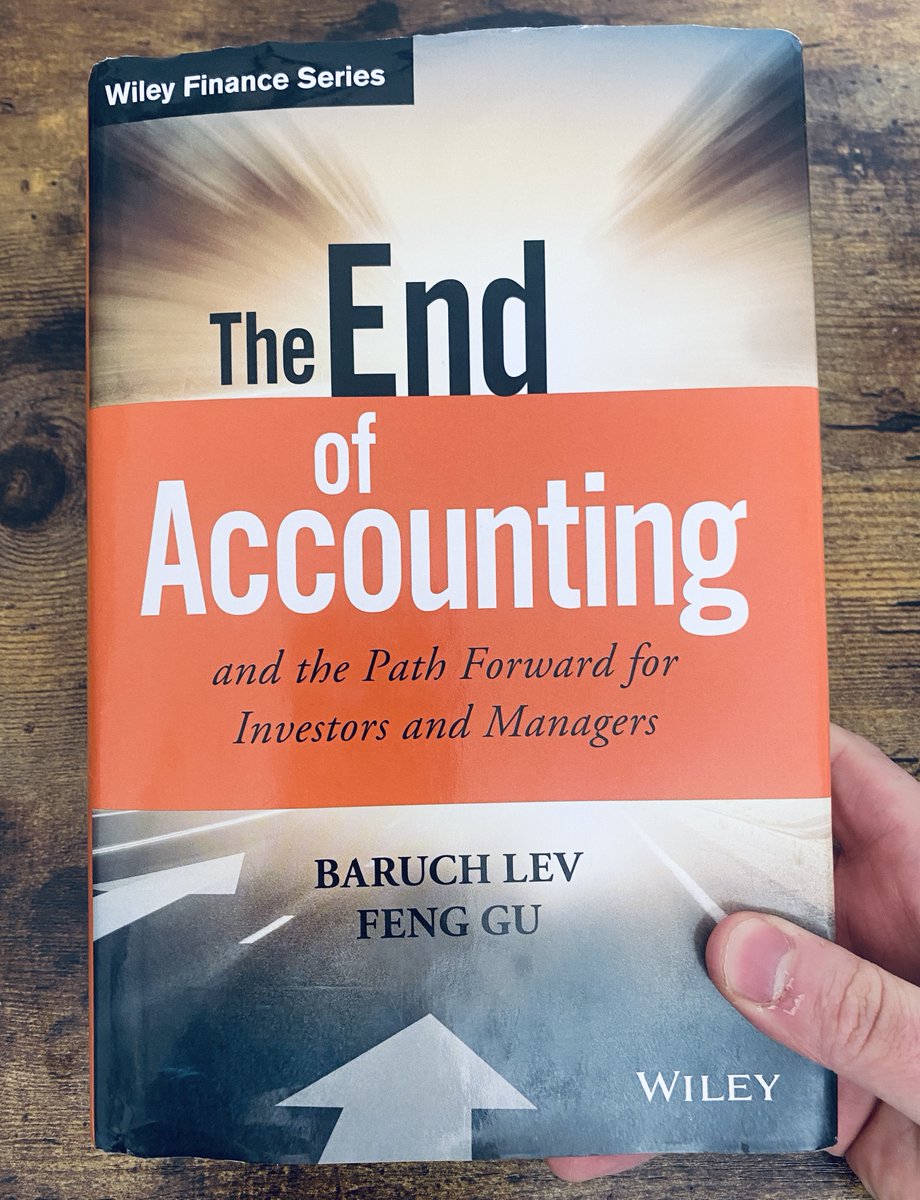
The End of Accounting belongs on the shelf of every serious investor.
Usefulness of financial information in investor's decisions is at an all-time low.
This book discusses:
1) Why that's the case
2) How it happened
3) How you can fix it
A thread on each section ... 🧵
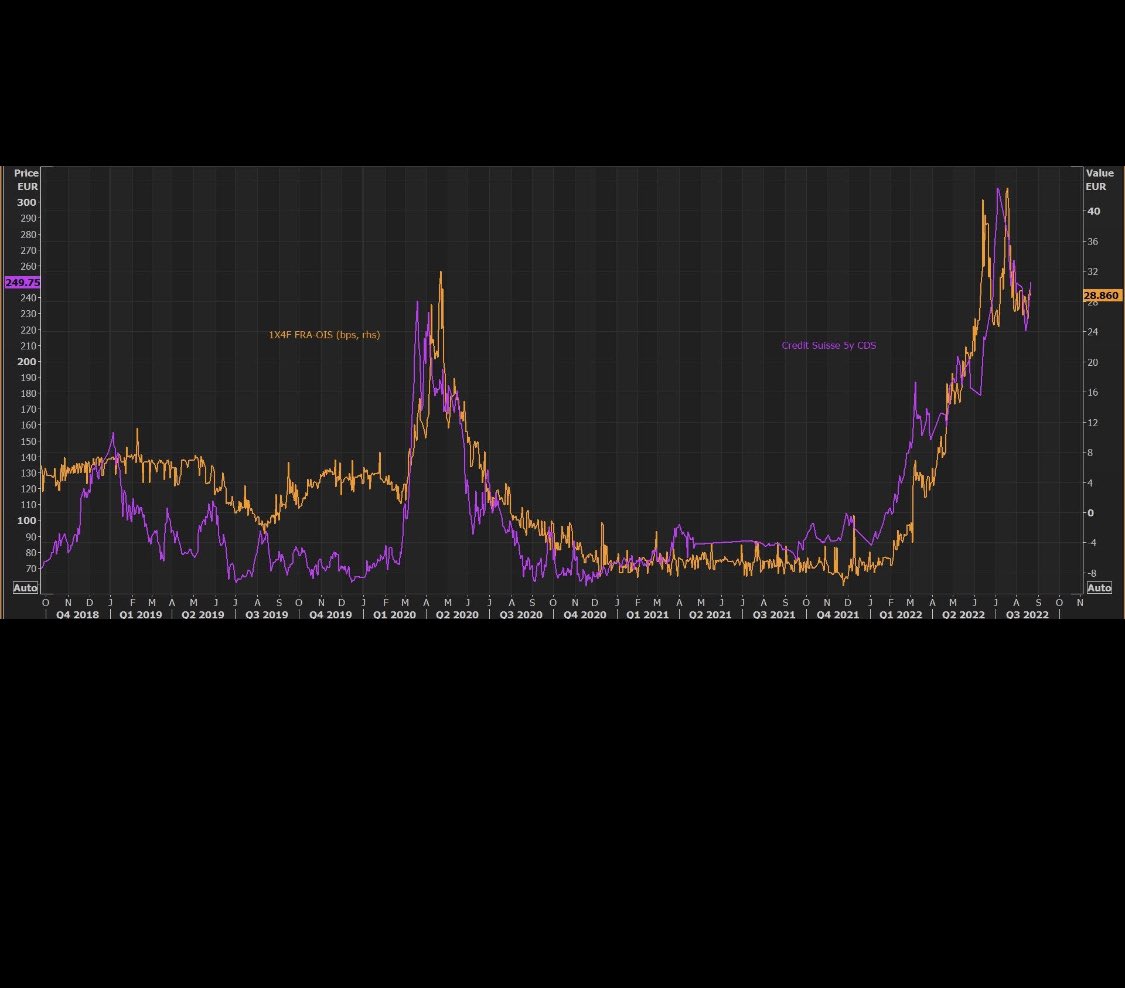
Credit Suisse is probably going bankrupt … $CS
The collapse in Credit Suisse's share price is of great concern. From $14.90 in Feb 2021, to $3.90 currently.
And with P/B=0.22, markets are saying it's insolvent and probably bust.
2008 moment soon ?
Systemic risk bank.
Quite hilarious that the hard core crypto enthusiasts argue crypto is needed to operate outside the influence of government. Then when they slip up, who do they call….?
Jeffrey Sachs raises questions.
“what we do have is definitive evidence that officialdom has tried to keep our eyes away from the lab creation hypothesis.”
“So come on: it’s time to open the books everywhere.”
https://t.co/huWmHFXrDj
After Celsius and 3AC tanked the market, another concerning event has started to emerge.
With nearly a billion dollars of liquidations on the line, the price of one of crypto's largest L1s is at stake.
🧵: What's happening to $SOL and @solendprotocol, and why you should care.👇
Costco is the worlds largest D2C warehouse brand. With annual sales exceeding $120b and almost 300k employees, it’s the king of “buy shit in bulk for your family.”
Unsurprisingly, Costco has tricks to get you to buy more than you expect every time you shop
Here are 5 of them 🧵