Sufficiently advanced agentic coding is essentially machine learning: the engineer sets up the optimization goal as well as some constraints on the search space (the spec and its tests), then an optimization process (coding agents) iterates until the goal is reached.
The result is a blackbox model (the generated codebase): an artifact that performs the task, that you deploy without ever inspecting its internal logic, just as we ignore individual weights in a neural network.
This implies that all classic issues encountered in ML will soon become problems for agentic coding: overfitting to the spec, Clever Hans shortcuts that don't generalize outside the tests, data leakage, concept drift, etc.
I would also ask: what will be the Keras of agentic coding? What will be the optimal set of high-level abstractions that allow humans to steer codebase 'training' with minimal cognitive overhead?
oai and ant claim many proofs these days, but can we really achieve the full reliable automation of these?
what if we extend these thoughts BEYOND the mathematics and coding?
what do you think? is it really possible? or HUMAN should have better SEAT?
but Alan Perlis said this: "One can't proceed from the informal to the formal by formal means":
https://t.co/23AmaNzmaO
in 1854, Otis ordered the rope cut under his platform. the platform dropped, the brake locked, the fall NEVER HAPPENED.
the SEAT stayed FULL for almost a century anyway.
we HUMANs are having the same argument again with AGENTs.
@AestherML his intuition and thinking to me sounds.
but we can't ignore ideas like "coconut" or "looped architectures", and I think last models like fable, authors have been considered following ideas on their architecture.
https://t.co/GEIUYOuBAC
who orchestrates that loop?
am I the only one, who is confused here?
as per my understanding from the demo:
there is an "orchestrator", and it sends those "states"(with context) to the model (let's say it's "encoder"), and the model classifies and sends back to the orchestrator or loop whatever.
orchestrator maps them (applies).
what is the difference from existing ones? and why it's compared against the frontier intelligence like Fable, Astra?
shouldn't it be compared against its proper family of models?
I'm so excited that our @theworldlabs team has achieved a major milestone today! Introducing Atlas - a first of its kind multimodal world model trained from scratch! 🚀
Atlas is capable of generating frames with pixel-perfect camera control, reconstructing large scenes from as few as one single input image, simulating space-time by reframing videos, natively outputting 3D spaces from one or more input images, composing multiple posed images into a consistent 3d world, and more! This is the best camera conditioned world model ever, opening doors to many possible use cases from VFX to robotics. I'm so so so proud of our team!♥️
Neoclouds have limited cybersecurity. Next time agents successfully go rouge, they'll try taking over a neocloud to run more copies. This is bad.
Thus: neoclouds should greatly strengthen their cybersecurity and every company with strong cyber models should help with that.
Why our machines sound right when they are wrong, and what to do about it?
A clock that runs one hour fast is never right. But it ticks, circles, and looks alive.
Today's AI is that clock at scale: wrong in the same confident voice it uses when it is right.
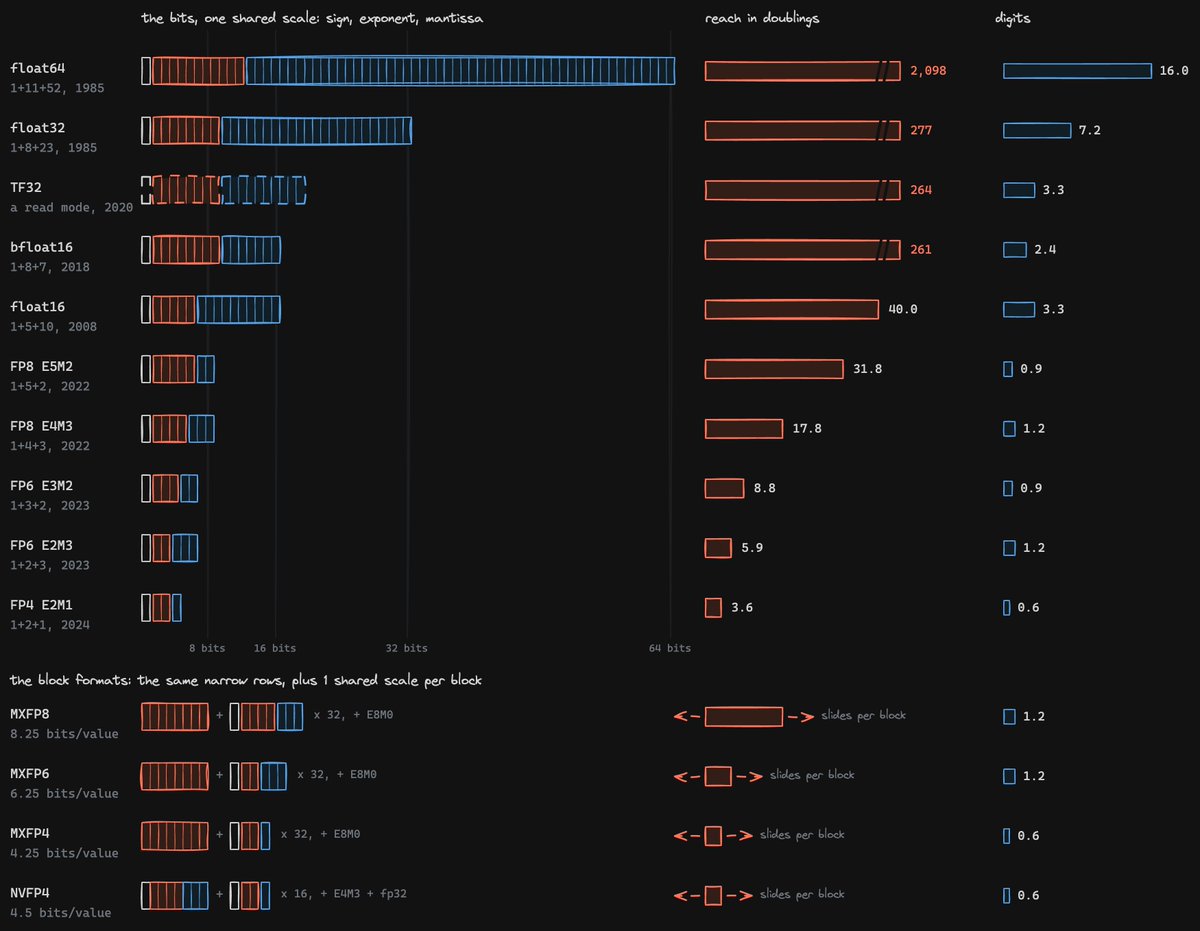
floating points. it sounds like a headache.
https://t.co/ppsHvOW99o
it was around last year I could barely finish reading this book:
https://t.co/gYXNZUS7BE
I had some chapters couldn't fully digest though, and in general I can say it's more than needed for a regular person [imo].
and, I think there was a need in the internet for the end to end coverage of this topic, which is self-sufficient(as much as I could achieve).
I have covered almost everything from the grounds to the ups.
included things like MXFP, NVFP as well.
covered topics:
- understanding floating points [kind of reinventing them]
- bias, exponent, mantissa, the ramp/subnormals
- float64, float32, bfloat, fp8(e4m3, e5m2), fp6, fp4
- hardware
- training flow vs inference flow
- error handling
- and a bit history / historical evolution
P.S. this is independent article of the pytorch series. almost no prior knowledge is assumed. I will continue to share the series: [loss, death, robots].
one of the most promised series by my side.
it required compiling & organizing my notes for this series.
and here is the start. it's going to be ~12 chapters.
LOSS, DEATH, ROBOTS [ep0: the map]
the chapter-ZERO is called: "The Map."
https://t.co/ppsHvOW99o
say strongest hi to the @PyTorch ever.
target audience: everyone who wants to dive into the PyTorch & its internals.
in 2015 my close friend showed me @MIT's courses were free online @MITOCW. I started with 18.0X, 6.0X.
knowledge grows only in the open.
every closed door costs a generation of minds that never get in.
so the course I trained my engineers / whole ai department on is now open too:
https://t.co/u5re6V413l
38 lectures, 1,200+ slides.
picture -> plain words -> code (NumPy, PyTorch, JAX, TF). notation last.
it's more than linear algebra course, GEMM, PEFT methods, sparse matrices and more.
free forever. not for sale - by anyone.
in memory of Aqshin, who showed me knowledge could be open.
P.S. this project is intended to be fully community-driven.
https://t.co/kIqlMaEeQg
@antrophic This article begins where @3blue1brown's video ends, and develops what @AnthropicAI's Toy Models paper named but didn't have room to pursue.
Part 1 of 6 on superposition. Every number reproduces from a seeded script you can run yourself.
https://t.co/2kyW3K5U1U
In 2023, @antrophic researchers watched one neuron inside a language model. It fired on academic citations. On English dialogue. On HTTP requests. On Korean text.
Four unrelated meanings, one neuron. In large models this is the norm.
Linear algebra says it shouldn't work. It does.
The belief: n dimensions hold n things.
The theorem: n dimensions hold n things "with zero interference."
@antrophic At real scale: each token in a 7B Llama flows through the network as one vector in ℝ⁴⁰⁹⁶.
A million random directions fit there with every pair between 83° and 97°. No design needed.
The room for millions of meanings in a few thousand dimensions provably exists.
@3blue1brown chapter on how LLMs store facts has a demo: 10,000 vectors in ℝ¹⁰⁰, every pair at 89°–91°.
A theorem from 1974 rules that out. The honest cap is ~103, and Sanderson corrected the demo himself.
The demo's spirit is exactly right. The constants are where the story lives.
@antrophic But there's a threshold. Two random directions in ℝⁿ overlap by about 1/√n on their own. That's the noise level of the space itself.
Demand less interference than randomness produces: a rank bound caps you near n. Accept the random level or above: capacity turns exponential.