Blockchain performance isn’t just about how fast a validator can execute.⚡
There’s another factor that often gets overlooked: how quickly information reaches the validator in the first place.
Blocks, attestations, and other network data have to travel across a global P2P network. When packets are lost or delayed, traditional systems may need retransmissions: adding more traffic, more bandwidth usage, and more waiting.
That’s where Optimum is taking a different approach.
Its mump2p networking layer uses RLNC (Random Linear Network Coding) to make data propagation more efficient.
Instead of depending on every specific packet arriving successfully, data can be encoded into useful shards. Nodes can then recover the original information once they receive enough independent pieces.
The idea is simple:
🔹 Less unnecessary retransmission
🔹 More efficient data propagation
🔹 Lower waiting time for validators
🔹 Better coordination across the network
Optimum isn’t trying to change what the blockchain does.
It’s focusing on how the blockchain communicates.
Execution needs speed.
Consensus needs coordination.
And both depend on information arriving when it matters.
As blockchain networks continue to scale, the networking layer could become just as important as the execution layer.
Better computation helps a blockchain process more.
Better communication helps the whole network keep up.🚀
@get_optimum #Optimum #RLNC #Web3
@cryptooflashh @ada_pegasus
https://t.co/IURYuUd5Tw
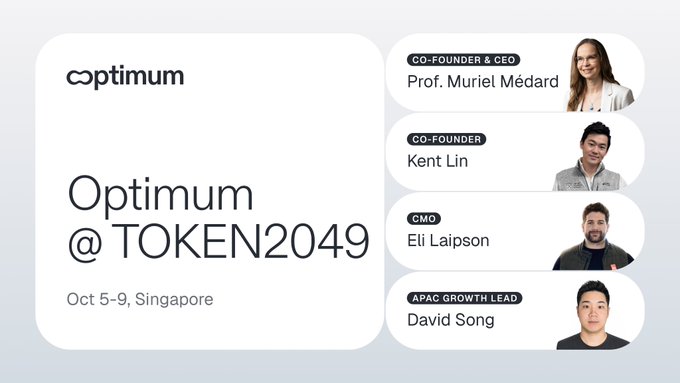
Optimum is taking its infrastructure story to Singapore. 🇸🇬
With TOKEN2049 happening this week, there’s a lot of attention around AI agents, agentic trading, institutional finance, and the future of onchain infrastructure.
@get_optimum is right in the middle of those conversations.
On October 6, Optimum × AMBR is bringing together Prof. Muriel Médard and Kent Lin to discuss AI agents, trading, and the future of financial infrastructure.
Then comes TOKEN2049 on October 7–8, followed by Brews by the Bay on October 8 alongside Spartan Group, Auros, and Canton Network.
Different events, but there’s a common theme underneath them:
The more advanced onchain applications become, the more important efficient data movement becomes.
AI agents need fast information.
Trading systems depend on timing.
Onchain applications are becoming more complex.
And none of that works at its full potential if the network underneath them struggles to move data efficiently.
That’s where Optimum’s RLNC-powered networking becomes interesting.
Rather than focusing only on execution speed, Optimum is working on the underlying propagation layer, improving how blockchain data moves between distributed nodes.
For me, this is an important part of the infrastructure conversation that doesn't get enough attention.
Faster applications need faster data movement.
Better execution needs better networking underneath it.
Singapore looks like another important step for Optimum as it brings this conversation directly to builders, institutions, traders, and infrastructure teams.
The bigger question is:
Could smarter networking become one of the next major infrastructure layers for onchain finance?
That’s the part I’ll be watching.
@get_optimum #Optimum #RLNC #Web3
@cryptooflashh @ada_pegasus
https://t.co/eOR7Yi2pPg
The "Stablecoins on Bitcoin" panel at @LuganoPlanB brought together some interesting perspectives.
Different approaches, one common goal: strengthening Bitcoin as the settlement layer for global finance.
Stablecoins left Bitcoin to stay competitive, and now they're coming back for the same reason.
See you tomorrow in Lugano for the Stablecoin Summit by @RGBAssociation!
Our team is attending @LuganoPlanB.
On the agenda:
→ “The Return of USDT on Bitcoin”
@VIhnatiuk's keynote at The Future of Capital Markets, hosted by @Blockstream Capital Partners & @BFXSecurities
→ Stablecoin Summit w/ @RGBAssociation
See you in Lugano!
Utexo has joined the @Mastercard Crypto Partner Program.
Stablecoins have become the connective tissue between onchain infrastructure and traditional financial networks.
Closer collaboration between the two is now more important than ever.
One Bitcoin output, shared by many users. Each can exit independently in a single transaction.
LayerTree explores a new approach to scaling Bitcoin.
We've supported Lightning since the beginning. Credit to the team for the open research.
https://t.co/nFiesC5McU