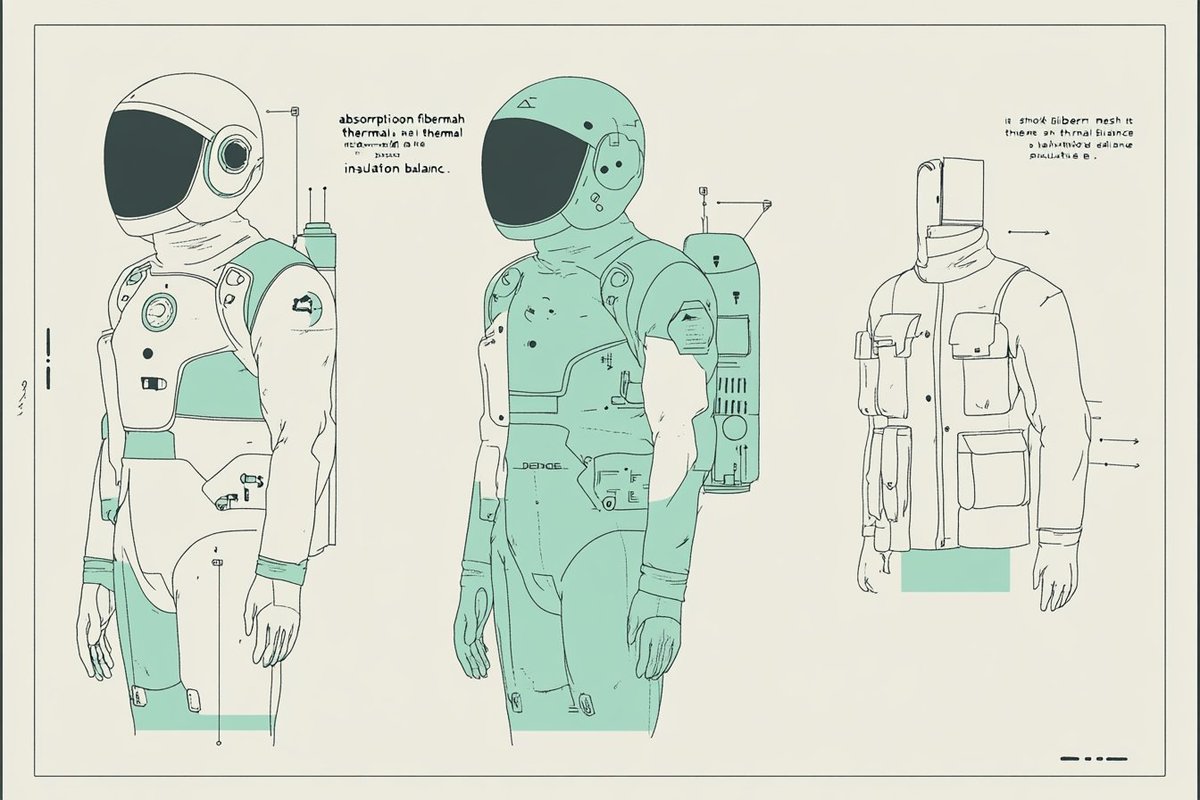
1/ General-purpose robotics is the rare technological frontier where the US / China started at roughly the same time and there's no clear winner yet.
To better understand the landscape, @zoeytang_1007, @intelchentwo, @vishnuman0 and I spent the last ~8 weeks creating a deep dive on humanoid robotics hardware and flew to China to see the supply chain firsthand.
Here's everything we've created + our takeaways about the components, humanoid comparisons, supply chains, and geopolitics👇
1/ The future of general-purpose robotics will be decided by one major question: which flavor of data scales reasoning? Every major lab represents a different bet.
Over the past 3 months, @adam_patni, @vriishin, and I read the core research papers, spoke with staff at the major labs, and mapped the talent pool. This has completely changed how we think about general-purpose robotics.
Our paper builds intuition, step-by step, across the 2025 frontier: from architectures → evals → data → industry dynamics. Each layer reveals a different bottleneck, but they all converge on one truth—data decides everything.
Our takeaways + process below👇
If you want access to our graph (sound on), comment or DM me
I started this year by teaching myself cuda / parallel programming and coded a kernel everyday.
now that there’s lot more people following :) I wanted to post about my blog here
optimized a layer norm kernel using coalescing, smem reductions, vector loads and more
code along!
We're releasing a state of the art, MIT-licensed autorouter soon
It uses a novel approach for an intermediate stage between global and local routing + an incredibly fast parallel high-density routing phase
(animation is slowed-down, normally instantly solved)
I was reading the "Intro to ProgCrypto" book by @0xPARC. To understand the examples and algos better, I translated them line-by-line to Jupyter notebooks.
I plan to add exercises and use it as a base to learn advanced topics for each chapter
https://t.co/Hjf1InQgdN
⬇️
For those nerdsniped by:
• Custom assembler & ISA design
• RTL -> tapeout process
• Simulation & emulation systems (ZEBU)
• TEEs without manufacturing risk
• Core & ALU architecture
• Low-level compilers & handrolling kernels
• CUDA acceleration & HALs
• Data center orchestration
• DSPs vs GPUs vs ASICs vs FPGAs
• Cryptography from a compute prospective
just found out that at minimum 16 million @ezklxyz proofs get generated per month out in the wild.
Kind of nuts to have gone from a side project i was building at night with @jasonmorton to this.
💯 Love this post on “info finance”. Prediction markets are an early special case of info finance - the use of markets to create distillations of more expensive mechanisms (eg predictions of voting outcomes). Multiple generalizations. At scale a possible revenue stream for AIs.
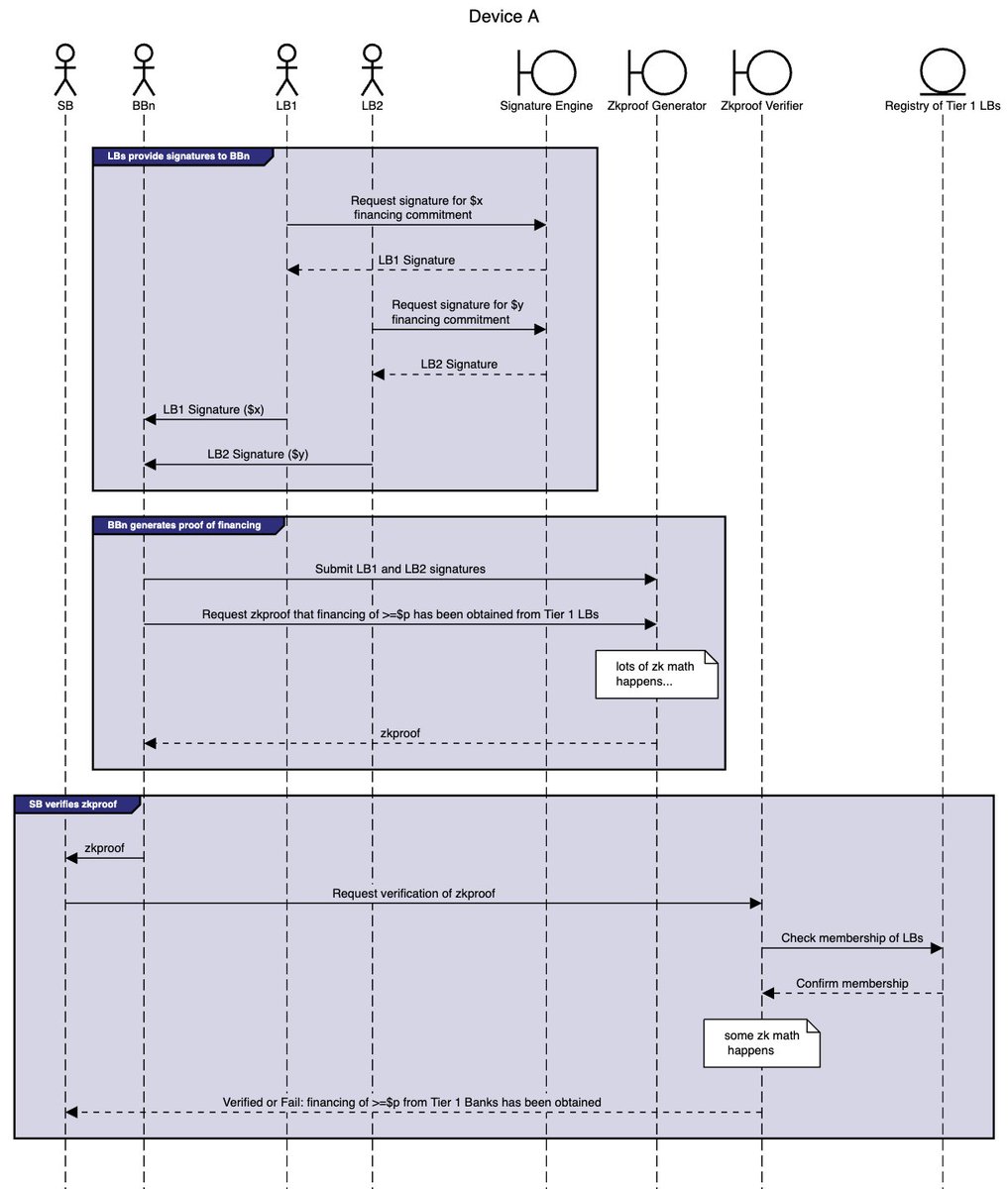
PROOF OF FINANCING IN M&A DEALS USING ZKPs
What I worked on with @ml_sudo at during the @JoinEdgeCity Lanna hackathon in Chiang Mai:
ML has expertise in M&A space, so it was exciting to solve a real, identified trust problems in the real world using ZKPs.
TLDR of the problem: As a buyer you want to prove financing to a seller, without revealing details of this financing. See quoted tweet and next tweet for more details.
Brief technical notes:
- Using RISC0 ZK-VM. This made it very easy to rapidly prototype since you can just write business logic in Rust and not fiddle with manual circuits. It was surprisingly easy to get started with this. Downsides are proving time (~2m on MBP M1 Max 64GB). This can likely be optimized a lot (naive serialization biggest overhead right now). Alternatives: Using prover network (some trust assumptions) or porting to manual circuits. In a high-stake scenario like M&A deals it is probably OK to assume a powerful computer (don't need to work from restricted devices).
- Basic server and frontend hooked up to local RISC0 back prover. In a real production scenario all the actors would have their own setup (lending banks doing their own signatures, seller bank verifying proof locally separately). This captures the essence of the interaction.
See video and repo (linked in next tweet).
We wanted to shine a spotlight on a particularly cracked community member (and now team member), @ElusAegis, who has written iOS bindings for EZKL.
You can now generate and verify EZKL proofs directly in native iOS apps 🥹.