Any opportunity or business I lost because of my advocacy for Biafra freedom, let it be. They are sacrifices for a cause I believe in, for no material wealth can replace the price of conviction and justice for Biafra and I pray, let my principles outweigh any temporary gains.
#Wemove
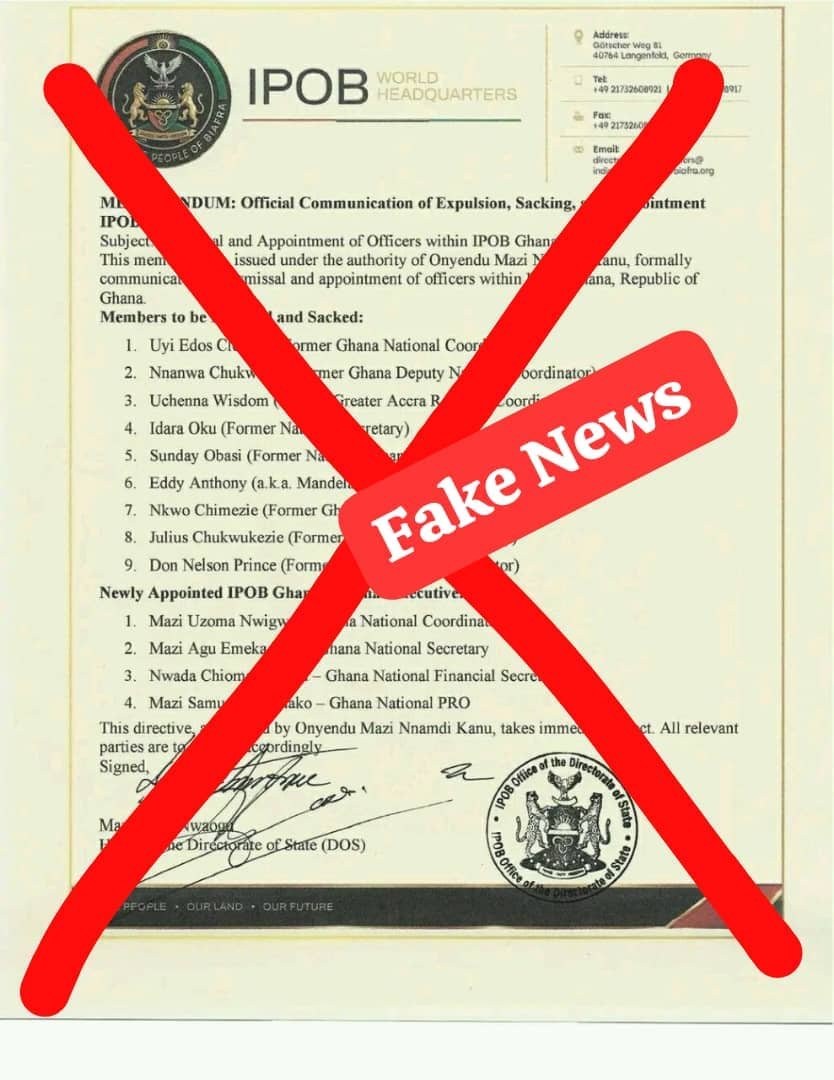
Biafrans worldwide, please kindly disregard any publication coming from an illegitimate Sokoto caliphate. IPOB Ghana and it's leadership are 💯 intact and can't be dismissed by an illegitimate office that is not recognized in IPOB structure. IPOB Ghana is under @real_IpobDOS
MIDWEEK MUSINGS
STATE POLICE: A NECESSARY INSTRUMENT FOR EFFECTIVE LOCAL POLICING — OR A POTENTIAL WEAPON IN THE HANDS OF THE POWERFUL? ANAMBRA AS A CASE STUDY: THE UDO GA-ACHỊ EXPERIENCE @CCSoludo
The debate over the establishment of State Police has persisted for years and has assumed renewed significance as Nigeria inches towards a more decentralised policing architecture. The argument for State Police is compelling: policing is, by its very nature, more effective when those charged with maintaining security understand the communities, people, terrain and peculiar security challenges within which they operate.
But there is another side to this debate which deserves far greater attention. The greatest danger may not necessarily come from the Governors themselves. It may come from those who operate in the shadows of government, political power brokers, financiers, associates and influential individuals who consider themselves sufficiently close to the Government to be beyond scrutiny, accountability or restraint.
And therein lies the real cause for concern. The uncomfortable question is not merely: Can a Governor abuse State Police? The more disturbing question is: What happens when persons who wield enormous influence over a State Government acquire informal access to, or influence over, a security structure established with public resources?
That is where the architecture of State Police could become dangerously vulnerable.
Anambra State offers a useful illustration. The State has established the Homeland Security framework under the Anambra State Homeland Security Law 2025, with Agụnechemba and Operation Udo Ga-Achị designed to complement conventional security agencies. The official conception is undoubtedly security-driven and directed towards combating criminality and protecting communities.
But a noble law can produce disturbing consequences when its instruments are diverted from their statutory purpose.
My concern, therefore, is not directed at the legitimate objective of strengthening security. It is about what happens when a publicly funded security apparatus is converted into a private instrument for settling scores, intimidating perceived opponents, pursuing vendettas or accomplishing assignments which the ordinary machinery of law enforcement would not undertake.
A security operative who acts on the instruction of a private individual rather than within the confines of law is no longer merely performing a security function. He becomes an instrument of private power wearing the uniform of public authority.
And that is precisely where the danger lies.
A Governor may be occupied with the enormous responsibilities of governing a State. He may reasonably expect that the security architecture established under his administration will operate within the law and under appropriate supervision. Yet, if influential individuals around government begin to exercise informal command over such structures, the constitutional and legal safeguards surrounding the exercise of coercive power can become dangerously blurred.
The public may then be confronted with a peculiar phenomenon: government security without governmental accountability. That would be a frightening contradiction.
Indeed, what could be more absurd than a situation in which a citizen cannot tell whether a security operative is acting pursuant to lawful governmental authority or merely responding to the wishes of an individual who happens to have the right telephone number?
The danger is not theoretical. There have already been public concerns about abuses involving state-backed security structures in Anambra, including allegations of unlawful arrests, brutality and the use of security operatives in circumstances connected with private disputes.
If Nigeria eventually establishes State Police, the safeguards must go beyond merely preventing Governors from deploying the police against political opponents. The law must also anticipate the subtler danger of powerful individuals operating within the orbit of government and attempting to convert public security institutions into private instruments of influence.
And, most importantly, no individual, however wealthy, politically influential or close to government, should possess an unofficial security command. Public security must remain public. A security uniform must never become a badge of private authority. A government vehicle must never become a mobile instrument of personal vendetta.
Otherwise, we may wake up one morning to discover that the State Police we created to bring security closer to the people has merely brought the machinery of coercion closer to the powerful. That would be a tragic irony.
The greatest test of State Police will therefore not be how efficiently it can arrest a criminal. It will be how faithfully it can resist the instruction of a powerful person when that instruction is unlawful.
For if security personnel become more frightened of the influential individual behind them than of the law before them, then we have not decentralised policing, we have merely decentralised impunity.
And that, surely, is not the State Police Nigerians are asking for.
More specifically, I have serious concerns about what may be happening in parts of my own Anambra State, including my home community of Oraifite. I shall, in subsequent editions, examine these concerns more closely and place the issues before the public conscience, not to undermine legitimate security operations, but to insist that every security institution created with public authority and public resources must remain subject to the law. Because ultimately, the real measure of a security institution is not the fear it can inspire, but the confidence it can command.
And any security architecture that protects the powerful while frightening the powerless has already lost the very essence of public security.
Signed
Sir Ifeanyi Ejiofor, Esq. KSC
Dunu-Ezeugosinachi
September 16, 2026
The Reason History Was Removed from Nigerian Schools
Did you know that Obigbo was not part of Rivers State when it was created in 1967? At that time, it was part of East Central State, and later Imo State.
In 1976, it was ceded to Rivers State through a controversial boundary adjustment. It was during this period that the name was changed to Oyigbo.
Divide and rule policy of Nigeria
— Comr. Obinna Michael ✍️
Writer | Human Rights Activist | Historian | Political and Social Philosopher
@radiobiafralive@real_IpobDOS
MIDWEEK MUSINGS
ALA-IGBO AT A CROSSROADS: JETTISONING ELECTORAL BOYCOTT BEFORE IT BECOMES ANOTHER TRAGEDY.
There is an unsettling pattern in the rhetoric presently being introduced into our political space, rhetoric packaged initially as harmless directives, civil disobedience or principled protest, but carrying within it the unmistakable seeds of consequences far more devastating than the promoters may wish the people to contemplate.
This intervention is therefore not about politics; it is about the preservation of Ala-Igbo and the protection of the lives, livelihoods and hard-earned peace of our people.
Any directive advocating an electoral boycott, under whatever guise or euphemism it may be presented, must be unequivocally rejected. We must not permit the reopening of wounds that have taken enormous sacrifices to heal. We have witnessed, at great cost, what happens when political grievances are converted into rigid commands and when ordinary people are compelled to pay the ultimate price for decisions taken by those who are themselves safely removed from the consequences.
We must therefore reject, with every sense of responsibility, any attempt to turn electoral participation into an offence against the collective interest of our people.
Indeed, what greater irony could there be than to surrender our political voice in the name of defending our people, only to discover that the silence created by such surrender has become the very instrument through which our collective interests are diminished? Perhaps the ballot box is now being treated as the enemy, while political irrelevance is being advertised as victory.
We must be wiser.
There are legitimate constitutional, judicial, political and democratic channels through which grievances can be ventilated and remedies pursued .
I therefore condemn, in its entirety, every directive calculated to induce electoral boycott in Ala-Igbo, particularly where such directives are issued without transparent accountability to the people who will ultimately bear the consequences.
Those who are gathering the storm should understand that Ala-Igbo is no longer available for experimentation with destructive political theories. Our people have endured enough. Our communities have suffered enough. Our economy has paid enough. And our children deserve a future that is not perpetually held hostage by the political calculations of faceless actors. Ndị Igbo must reject every attempt to drag them backwards.
We cannot continue to pursue political objectives through strategies whose collateral consequences are borne almost exclusively by the very people we claim to defend. A people do not preserve their homeland by rendering it ungovernable; they preserve it by protecting its peace, strengthening its institutions and relentlessly pursuing justice through every legitimate avenue available to them.
The time has therefore come to jettison every destructive ideal and directive that seeks to make electoral boycott a measure of loyalty or patriotism. Patriotism cannot mean deliberately weakening one’s own people. Resistance cannot mean destroying one’s own economic foundation. And political fidelity cannot require sacrificing the lives and livelihoods of an entire generation.
We must never again take a route whose destination is devastation.
Ala-Igbo has travelled too far, suffered too much and survived too many storms to become collateral damage in another experiment in political absolutism.
Let those who genuinely love Ala-Igbo prove it by protecting her peace.
Let those who genuinely speak for our people listen to the people.
And let those gathering another storm be reminded that the Igbo nation has seen the consequences of fire; we should not be persuaded to strike another match merely to prove that we can withstand the flames.
Ala-Igbo must not be sacrificed on the altar of political absolutism.
#AlaIgboMustLive
#RejectElectoralBoycott
#PeaceInAlaIgbo
#ProtectOurPeople
#DemocracyNotDestruction
#LetAlaIgboBreathe
#OurPeopleMustLive
#BarEjioforWrites
Signed
Sir Ifeanyi Ejiofor, Esq., KSC
Dunu-Ezeugosinachi
September 2, 2026
I Will Clear Everybody Down” - Suspected Nigerian Police Officer Threatens Citizens Recording on Duty
A suspected Nigerian police officer has sparked massive outrage after a viral video surfaced where he boldly threatens citizens recording officers on duty.
In the clip, the man declared: “Any day I’m on duty as a Nigerian police officer, let anyone record me. That person will provide the officer who gave them the order to be filming us, because I will clear everybody down.”
The shocking statement comes shortly after a Federal High Court ruling that upheld Nigerians’ constitutional right to film police officers performing public duties a right the officer appears to openly defy.
Family Writers Press International.
Pain runs deep where violence grips Nigeria now. Hurt doesn’t just come once - it returns, especially for Christians facing wave after wave of harm. Lives shattered by fire and fear stay broken long after silence falls. These people speak quietly, yet their words carry weight
Bloodshed grips Nigeria, yet countless endure pain without a voice. From village to town, followers of Christ meet brutal attacks - worship halls shattered, kin snatched away, dwellings burned into cinders. Not faraway myths but flesh-&-blood lives crushed for daring to believe
One death too many already. Across Nigeria, followers of Christ endure violence, forced escapes, new kinds of terror every day. Silence from distant places feels heavier than ever. This crisis refuses to stay hidden any longer. #FaithVictimsJusticeLaw#GlobalJustice
Deep in Imo State, things have shifted past denial. Inside Tiger Base, people say fathers vanish, mothers break, sons disappear without a trace. Locked up. Hurt. Left behind. Not rumors - these are names, faces, voices that echo through empty rooms. Silence spreads.
From insurgency to communal clashes, from kidnappings to civilian casualties—too many lives have been lost, and too many voices ignored. The real question is: how long can this continue? How many lives will be lost before we act?#FaithVictimsJusticeLaw#GlobalJustice@POTUS@UN