The #FBI issued a FLASH advisory warning that cybercriminals and state-aligned hackers are exploiting ARTEX, a super intelligence-powered penetration testing framework, to automate attacks against businesses and organizations worldwide. ARTEX can accelerate intrusions from initial targeting to privileged access in under three hours. It was used in the October ConnectWise supply-chain compromise, which exposed Microsoft 365 customer environments and involved attempted authentication against more than 2,250 downstream tenants.
The FBI is urging businesses and organizations to strengthen access controls, monitor suspicious automated activity, and report potential compromises to https://t.co/Y65F8KJfqo.
Read more here: https://t.co/Cl5lpZ7cgG
The FAA has issued a nationwide ground stop for all aircraft within the national airspace system "due to extraordinary circumstances and for reasons of safety" by order of the FAA Command Center.
*SEC STAFF ISSUES FAQS ON CRYPTO ASSET SECURITIES LAWS APPLICATION
*SEC STAFF: TOKEN BUYBACKS ON FUNCTIONAL PROTOCOLS DO NOT CONSTITUTE MANAGERIAL EFFORTS
*SEC STAFF: LIQUID STAKING TOKENS ARE DIGITAL COMMODITIES OR TOOLS, NOT SECURITIES
*SEC STAFF: MAINTENANCE, ENHANCEMENTS, SYSTEM GRANTS NOT CONSIDERED ESSENTIAL MANAGERIAL EFFORTS
*SEC STAFF: PROMOTING CRYPTO UTILITY WITHOUT PROFIT CLAIMS GENERALLY NOT AN INVESTMENT CONTRACT
There is a critical vulnerability being actively exploited on BTCPay Server, which can result in the loss of funds.
Please update your BTCPayServer to 2.4.2 by going to Admin Dashboard -> Server -> Maintenance -> Update & verify the 2.4.2 version string in the footer.
If you are unable to update right away, turn off your BTCPay Server to prevent unauthorized access until you can update.
Several newsworthy things piling up at once for Bitcoin and the crypto ecosystem as a whole:
- CLARITY Act becoming a reality getting more likely with July target noted
- Bitcoin strategic reserve promises
- CME Group futures/options listing
- Morgan Stanley enters the mix and undercuts everyone
- Charles Schwab launching crypto trading
Trillions and trillions of dollars part of the discussion here. Things heating up!
TradFi is finally joining the movement.
Morgan Stanley is offering spot trading through E-Trade. CME is launching volatility futures on $BTC.
Andy @Baehr of @GSR_io tells @RemyBlaireNews from @consensus2026 the slow money movement "just continues" as energy reenters prices.
Bitcoin has officially passed 20M tokens mined. With fewer than 1M new BTC left to be mined, it’s estimated that the last token will be mined around 2140.
Get in touch to learn how institutions are evaluating bitcoin’s potential role within portfolios: https://t.co/J7HhNAmKqN
🚨NEW: Pulse check on crypto market structure from a handful of conversations with industry sources today. ⬇️
First on yield: The ball appears to be in @SenThomTillis’s court. The North Carolina Republican was shaping up to be a holdout in January when the @BankingGOP Committee was preparing for a markup. Amendments from Tillis and @Sen_Alsobrooks that restricted the scope of stablecoin rewards issued by crypto firms were later cited by @coinbase as one of several reasons it withdrew support for the bill.
Now, the White House has shared legislative text (the result of the past month’s negotiations with crypto and banks) with Tillis’s office, which has been meeting with industry and White House reps in recent days, with talks described as “moving in the right direction.”
This tracks with my earlier reporting that there may never be a “eureka” moment where crypto and the banks reach full agreement and ride off into the sunset. Instead, it looks like language is being drafted around the minimum both sides can tolerate, with the ultimate goal of quickly getting something back to the Banking Committee to get the ball rolling again.
Per @DigitalChamber CEO @CodyCarboneDC: “Sen. Tillis has been very receptive to our discussions about stablecoin yield. I am optimistic we will find a way to get to a "yes" vote on the bill, and we appreciate his work to try to advance market structure rules of the road.”
Even if no Democrats vote yes on the Clarity Act during the next Banking Committee markup, it could still pass along party lines, but Tillis’s vote will be crucial if there’s no Democratic buy-in.
Meanwhile, other industry stakeholders focused on different parts of the bill tell me the yield issue has “taken a lot of oxygen out of the room,” leaving other sticking points, mostly around DeFi, out to pasture.
A DeFi leader involved in market structure negotiations said it feels like Senate Democrats are now scrambling to address those remaining issues.
Ethics concerns will likely also remain top of mind for some of those Dem members.
One crypto trade exec said they’re now considering alternatives if a Senate Banking markup slips further into the calendar year but remains “cautiously optimistic” that the next three weeks will produce enough progress on yield/rewards and other issues for the Banking Committee to reschedule a markup in late March.
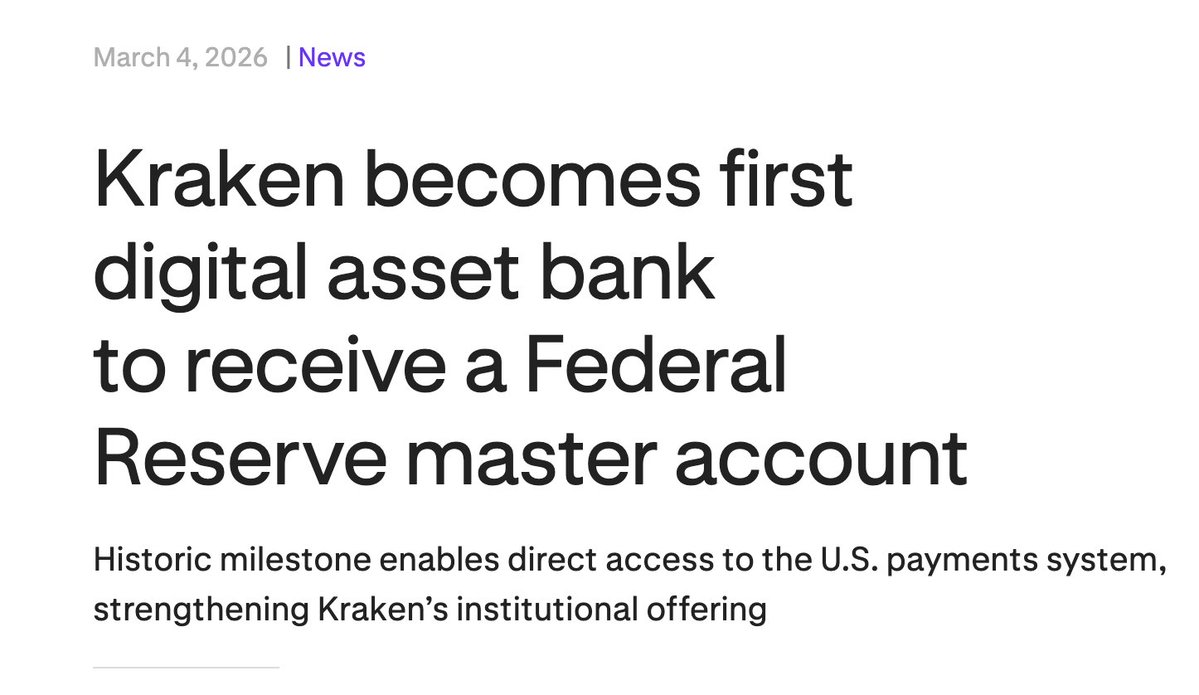
🚨NEW: @krakenfx, the U.S.’s second-largest crypto exchange, has just done something no other crypto firm has done before: secured coveted access to the Federal Reserve.
According to a report by the @WSJ released this morning, the exchange’s banking arm, Kraken Financial, has been approved for a Federal Reserve master account by the Kansas City Fed, marking the first time a crypto-native company has gained direct, albeit limited, access to the Fed’s payments system. The approval comes five and a half years after Kraken filed its application with the Kansas City Fed in October 2020.
The account gives Kraken a direct line into the Fed’s payments rails, but not access to Federal Reserve lending facilities. Under the limited-purpose, or “skinny,” master account framework floated by Fed Governor Christopher Waller, the firm can hold reserves and settle in central bank money, but it cannot lend, access the Fed’s discount window, or operate as a traditional commercial bank. Governor Waller is seeking to finalize his skinny master account proposal by the end of this year. The Kraken approval, sources tell me, is designed as a “pilot” program to trial the skinny master account concept. The skinny master account is in line with payments-only accounts provided by central banks in the United Kingdom, the European Union and Switzerland.
The decision marks a historic shift for an industry long shut out of the traditional banking system and signals a softer tone at the Fed, which critics had previously described as hostile to crypto under the prior administration. The decision also impliedly recognizes that the Fed believes Kraken has sufficient anti-money laundering and sanctions compliance practices to curb illicit finance risk, and that Wyoming’s regulatory framework for special purpose depository institutions (SPDIs) is in line with Federal banking standards.
This could kick off a surge of Fed master account applications from other crypto firms. On the horizon: Wyoming’s @custodiabank, which has been chasing access nearly as long as Kraken and has been engaged in litigation against the Fed since 2022. @Anchorage, an OCC-regulated trust bank, and @Ripple's U.S. banking partner have also applied for master accounts.
More to come.
JUST IN: Bitcoin exchange Kraken becomes first crypto bank to receive a Federal Reserve master account 🤯
This makes Kraken the first digital asset bank in U.S. history to gain direct access to the Federal Reserve’s payment infrastructure 🚀
🚨NEW: Big news from the @federalreserve today: It’s withdrawing its 2023 guidance that effectively blocked uninsured banks from becoming Fed members and engaging in crypto.
This guidance underpinned the Fed’s denial of @custodiabank’s master account.
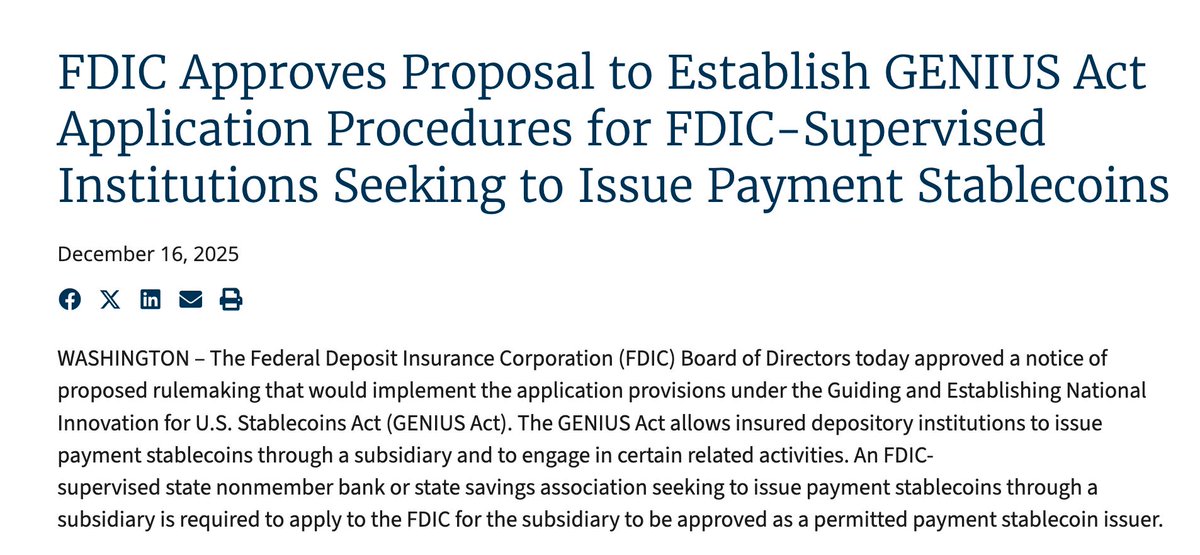
JUST IN: 🇺🇸 FDIC issues first official stablecoin proposal under the GENIUS Act
The proposal will allow banks to apply to issue stablecoins
(Source: CoinDesk)