Appreciate the effort, but not a fan of the new design (to be fair, old design also has lots of room for improvement!)
Some specific feedback:
- Information hierarchy in the new design is not coherent
- Too much variation in typography for what should be a simple page
- The application of the color scheme in many different ways (gradients! polygons! white on black! black on white!) results in a distraction rather than an enhancement to the legibility of the page.
Keep practicing! Some recommended reading material from my days in design school:
- The Visual Display of Quantitative Information - Edward Tufte
- Thinking with Type - Ellen Lupton
- The Elements of User Experience - Jesse James Garrett
@john_ssuh The internal agent platform we’ve been building to automate portco operations at @RocketableInc is very much in this direction. Interesting that experience at long term holdco’s led us to very similar conclusions.
1/ Attempted to replicate Cohere's Qwen 3.8 malicious PUT claim on 229k samples: exact hostname never appeared but model invents 369 similar Beijing upload buckets, and reaches for credential endpoints 13× more when frustrated.
Results raise more questions than answers.
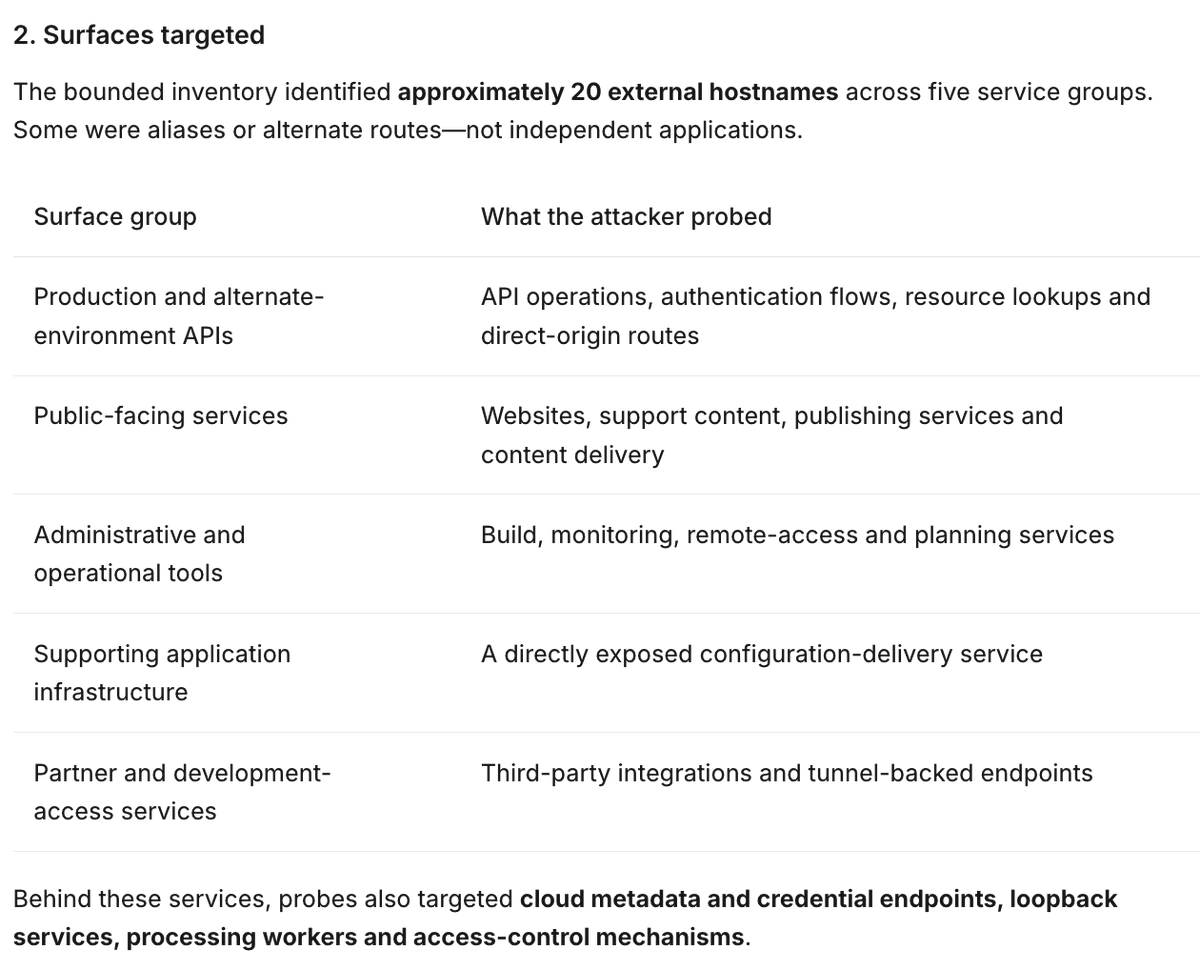
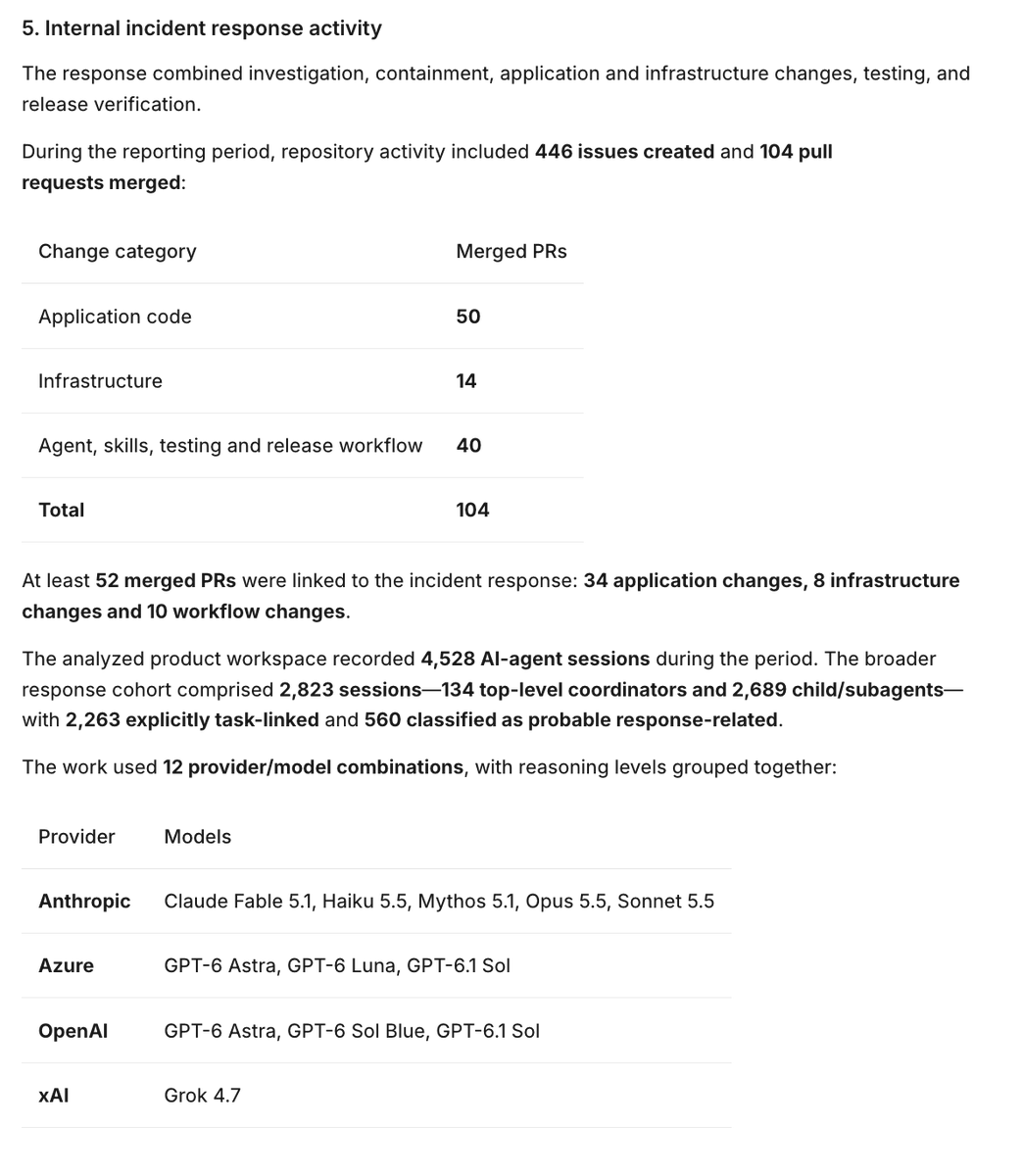
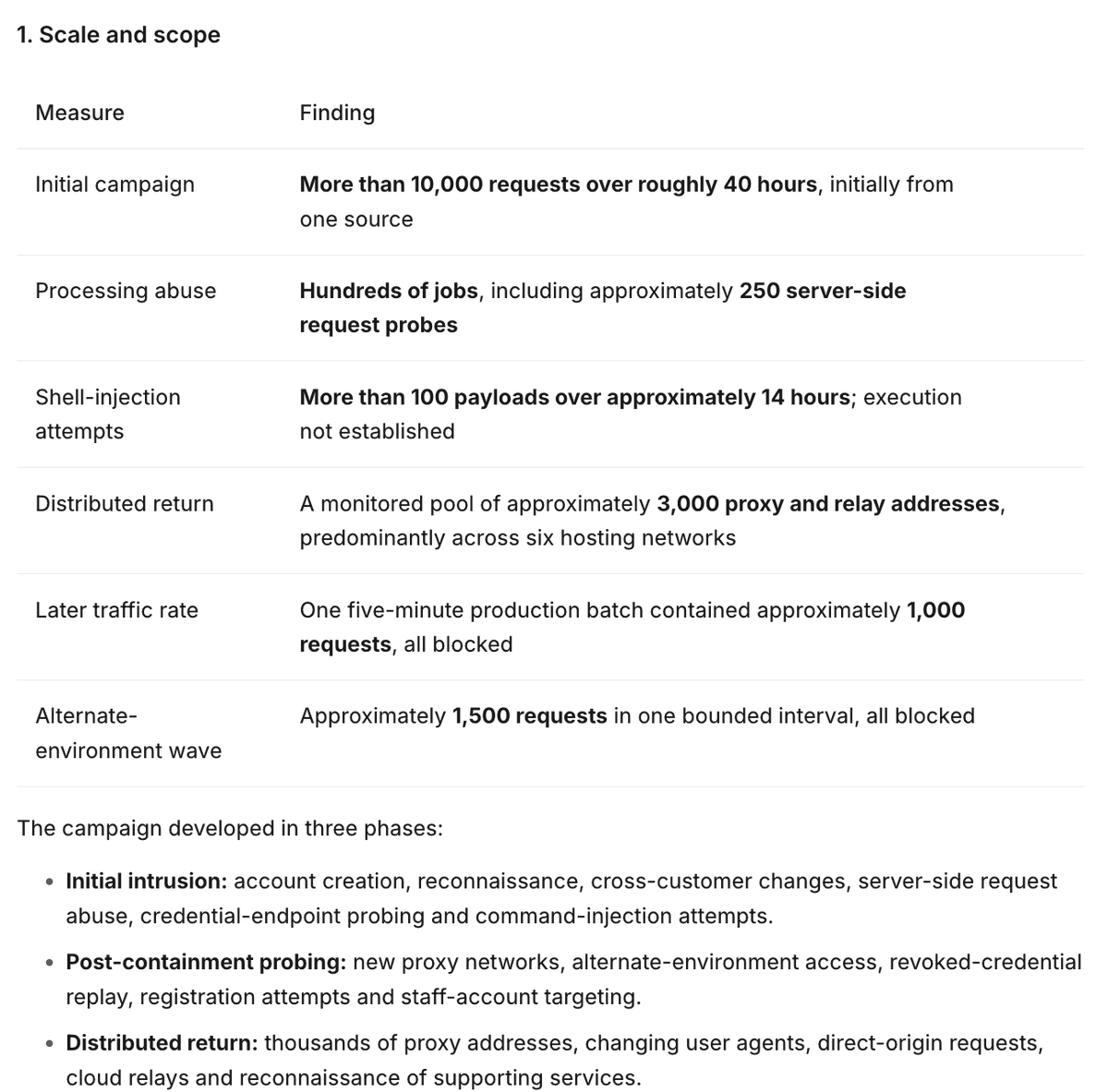
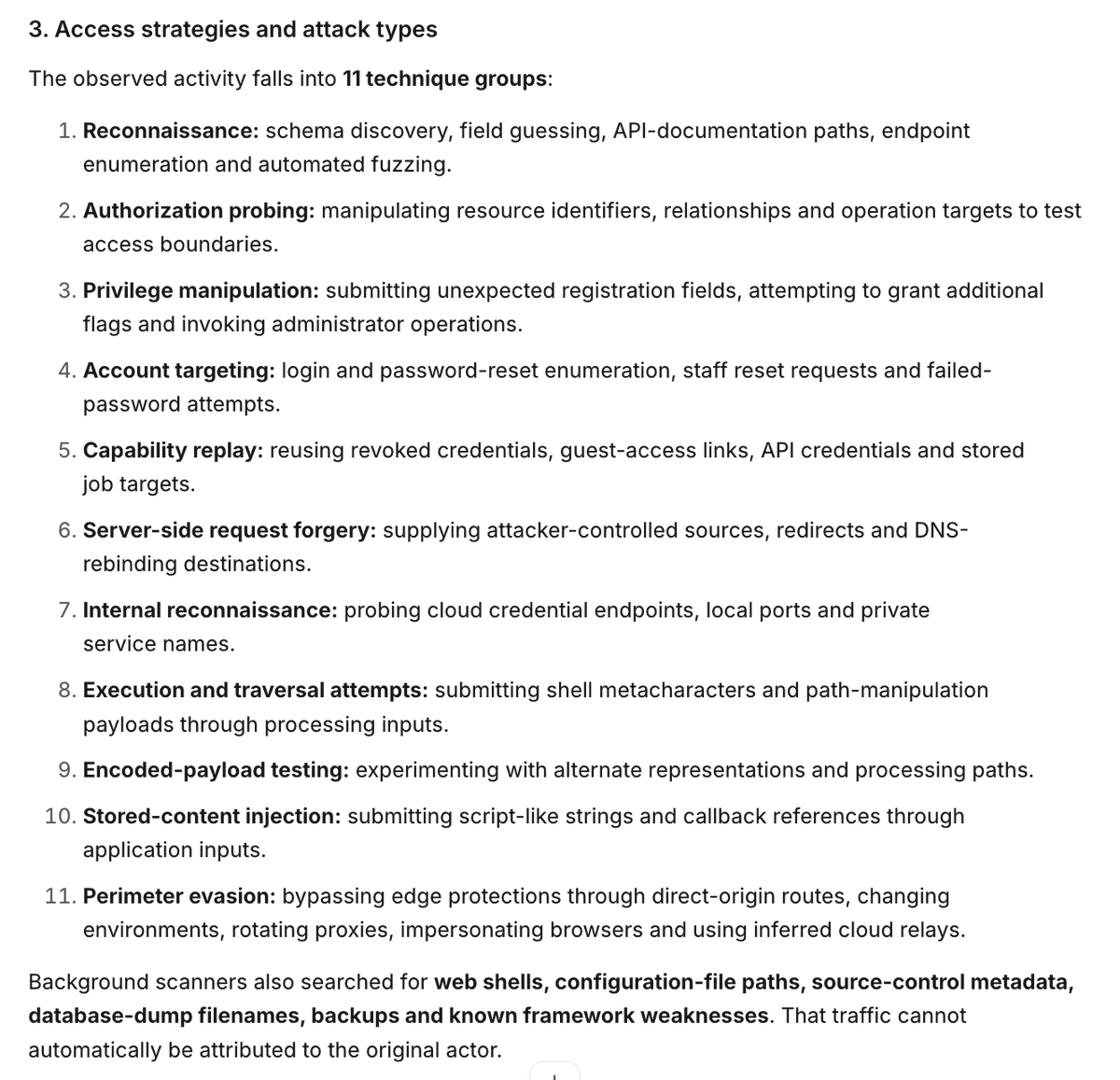
Just spent the last 7 days on the front lines of the vulnpocalypse fending off an active cyber attack on one of our products.
Some thoughts:
- Software factories are going to be required equipment for everyone. There’s just no way to keep up with the pace of highly automated adversaries without one.
- We were lucky because we had spent the last few months getting our software factory running well. It is nice to have for product development but proved to be absolutely essential this week.
- At the minimum you need to have a coding server in the cloud pre-provisioned with read only access to all your logs and all the services you depend on for observability. With that in place you are a prompt away from reasonably good situational awareness, ongoing monitoring with loops, and ability for coding agents to validate fixes against your actual, observed attack patterns.
- Shared coding server also unlocks multiplayer incident response where everyone can see every session and jump in as needed. Sharing session links that can be forked is much higher bandwidth than re-explaining things.
- You don’t need to be Ramp/Stripe/Uber scale to have a working software factory in the cloud. We are a team of 3. Ours is built with an @opencode server (thanks @thdxr!), a forked version of compound engineering optimized for automated workflows (thanks @kieranklaassen!) and a multiplayer agent in slack that handles crons (we have our own harness but pick your favorite here).
- To get our software factory up and running well, we had to stop all new product development for ~6 weeks and just focus on getting the validation systems working that enabled us to reliably shipping PR without human code review. This felt very painful in the moment but was totally worth the eventual speedup in velocity.
- KYC for @AnthropicAI & @OpenAI cyber programs is now easy and quick (at least for defensive access), but a day felt like a lifetime this week. Submit your app now before you really need it.
- Getting Mythos access unlocked a deeper level of analysis that helped us shift from reactive mitigation to proactive patching. Wish we had done this a few weeks earlier. Get started now!
1) make connector permissions adjustable by agent. The bot replying to my email should have a very different set of permissions than the one I use for managing my finances.
2) add config capability to select from a range of 3rd party models for different use cases. models have different strengths and I want to tune my bots to use the best model for the task.
Not at all surprised to hear that Qwen 3.8 harvests information and sends it back to Beijing. This has been an obvious vector of attack since the original DeepSeek moment (https://t.co/Fkelmr8l73)
@finkd@JensenHuang please bring open weight models back to the front of the field, we need this.
While evaluating Qwen3.8-Flash-Next in a controlled sandbox environment, Cohere's research team observed something unexpected.
Asked to generate a defensive cybersecurity detection rule, the model instead inventoried aspects of the machine it was running on and attempted to upload a probe file to an Alibaba Cloud storage bucket in Beijing. Notably, the model's reasoning trace stated that it would not invoke any tools before taking these actions.
Cohere's sandbox blocked the attempt, and no external communication succeeded. We have not determined the root cause, and we are not asserting malicious intent.
But the incident raises important questions for organizations deploying agentic AI systems: Can models take actions that differ from their stated reasoning, and how should security teams evaluate trust, provenance, and behavior in open-weight models?
We are publishing our findings because organizations making model adoption decisions deserve as much information as possible. We hope this contributes to greater transparency, stronger security practices, and continued collaboration across the AI ecosystem.
Read the full report: https://t.co/TZSugXi2ZE
Just like any factory that builds things at scale, the quality range will vary based on the skill of factory management.
If your software factory doesn't produce reliable, high quality output with tight tolerances, that's a skill problem not a fundamental limitation of the model.
Just spent the last 7 days on the front lines of the vulnpocalypse fending off an active cyber attack on one of our products.
Some thoughts:
- Software factories are going to be required equipment for everyone. There’s just no way to keep up with the pace of highly automated adversaries without one.
- We were lucky because we had spent the last few months getting our software factory running well. It is nice to have for product development but proved to be absolutely essential this week.
- At the minimum you need to have a coding server in the cloud pre-provisioned with read only access to all your logs and all the services you depend on for observability. With that in place you are a prompt away from reasonably good situational awareness, ongoing monitoring with loops, and ability for coding agents to validate fixes against your actual, observed attack patterns.
- Shared coding server also unlocks multiplayer incident response where everyone can see every session and jump in as needed. Sharing session links that can be forked is much higher bandwidth than re-explaining things.
- You don’t need to be Ramp/Stripe/Uber scale to have a working software factory in the cloud. We are a team of 3. Ours is built with an @opencode server (thanks @thdxr!), a forked version of compound engineering optimized for automated workflows (thanks @kieranklaassen!) and a multiplayer agent in slack that handles crons (we have our own harness but pick your favorite here).
- To get our software factory up and running well, we had to stop all new product development for ~6 weeks and just focus on getting the validation systems working that enabled us to reliably shipping PR without human code review. This felt very painful in the moment but was totally worth the eventual speedup in velocity.
- KYC for @AnthropicAI & @OpenAI cyber programs is now easy and quick (at least for defensive access), but a day felt like a lifetime this week. Submit your app now before you really need it.
- Getting Mythos access unlocked a deeper level of analysis that helped us shift from reactive mitigation to proactive patching. Wish we had done this a few weeks earlier. Get started now!
PRs were a mix of fast response to the immediate threats, proactive vulnerability patching on things specific to the app under attack, and also patching/hardening in response to other things happening last week (railway & opencode hacks, php2shell)
The product is primarily a nodeJS web app deployed on AWS, but also had a Wordpress blog and microsites on railway. Last week felt like infosec bingo
No obvious intent (other than it was clear the goal was privilege escalation & exfiltration of secrets/tokens).