If One Day You Suddenly Come Into Wealth, Remember These 5 Arab Pillars
(These are rules Arab families rarely speak of openly)
Pillar 1 – Silence Is Your First Asset
•Tell no one: not your siblings, not your closest friends, not even your parents.
•The moment wealth becomes known, it attracts hands some obvious, some hidden.
•Old Gulf families understood this for generations.
•Silence is not secrecy; it is protection.
Pillar 2 – Let the Money Breathe Before It Moves
•Once wealth reaches you, don’t rush.
•Don’t invest, transfer, or start building immediately.
•Sit with it for at least 90 days.
•The worst financial decisions in history were made in the first weeks after sudden wealth.
•Clarity is worth more than speed.
Pillar 3 – Don’t Change Your Life Immediately
•No new house, no new car, no luxury purchases not yet.
•The truly wealthy move quietly: ordinary on the outside, building empires on the inside.
•Changing your lifestyle too early announces you and invites chaos.
Pillar 4 – Never Make Money With Blood, Friends, or Family
•No business with relatives.
•No partnerships with old friends.
•No loans to classmates.
•Money does not destroy relationships—but unclear agreements do.
•Families who preserve wealth across generations keep business and personal life in separate rooms.
Pillar 5 – Protect Your Children From Knowing
•Do everything in your power to raise your children without knowledge of your wealth.
•Children raised knowing they are rich rarely build anything of their own.
•Give them hunger, work, and work ethic.
•Inheritance can come later; character must come first.
People often say that the developing world is poor because the Western world colonized them and stole their resources.
The truth, however, is that over the past century, the developing world has, for the most part, shown that they are completely incapable of harnessing their own resources. They are not poor because we stole from them. They are poor because they do not know how to run and administer their own countries, resources be damned.
Take Venezuela. The world's largest oil reserves mean nothing if you have a corrupt communist as your leader. People will actually be starving and trying to eat zoo animals while you sit on trillions of dollars in resources!
Africa is another example. Europeans left behind farmland, trains, roads, and mines in Africa. What happened to it all?
It's not that all of a sudden, the Africans started running things like anti-colonialist activists had envisioned at the time. No, no.
All the infrastructure fell into disrepair and/or was stripped down and looted. They were literally handed fully functioning, completed supply chains for resource extraction, and basically unlimited wealth, but they couldn't manage the simple upkeep.
Now, the defense for Africa might be that "The Europeans didn't teach the Africans how to manage any of this! It's not the Africans' fault they couldn't run it independently! They were never trained!"
But my brother in Christ, the Europeans DID try to train locals for management! Obviously it would have been easier to have at least some locals in administration, rather than having to import an ENTIRE workforce, but efforts to find African talent were largely unsuccessful.
Don't believe me? Just look at the different outcomes in Hong Kong and Singapore when compared to Africa. In East Asia, Europeans often did work with locals in administrative and management capacities. When colonialism ended, Hong Kong and Singapore were able to manage themselves. Not the case with Africa.
Now, none of this is to say that colonialism is good. People have the right to self-rule and seld-determination. However, the idea that colonialism and resources extraction are responsible for the developing world's ongoing poverty? That is quite simply a crock of shit.
5 habits every SaaS founder needs to hit $10k MRR in 90 days
A few months ago I sold my ecom SaaS after scaling it to $500K ARR in 8 months and after 2 other failed companies.
It was not easy, not AT ALL.
A lot of hours, boring work, tests, failures, missed parties. But I can tell you : it’s worth it.
I’m now building https://t.co/j1BeqqILvR (we find & engage high intent leads for B2B companies), and there’s a few things I learned along the way, if you want to go from 0 to $10K MRR in a few weeks.
I made all the mistakes a SaaS founder can make:
- built something absolutely NOBODY wanted, during 6 months
- built something « cool » no one wanted to pay for
- created a waiting list of 2000 people and nobody paid for my product
So now, it’s time to give back and share what I learnt, if it can help a few people here, I’d be happy.
Here is the habits I’d put in place right now, EVERYDAY if I had to start again and go from 0 to $10K MRR in a few weeks.
Just do this EVERYDAY.
Stop being lazy. If your mind tells you to stay confortable : push yourself, do it anyway.
Your mind is a terrible master.
It will tell you "don't send this message", "it's better if you go outside, it's sunny today", "don't post on Twitter, people will tell you that your idea is horrible"
If you listen to your mind, you're just avoiding conflict, but you need conflict to move forward.
You’ll discover later, after pushing a little bit that it was not that difficult, and your future self will thank you for this.
Here are the 5 habits to do EVERYDAY :
1) Send 20-30 connexion requests on LinkedIn to your ideal customer -> 20 minutes/day
do this manually if needed, pick people, connect. That’s it.
2) Send 20-30 messages on LinkedIn to these people or to other people already in your network that could fit -> 1h/day
> dont pitch, just introduce yourself
> ask questions, or ask for feedbacks « hey, I saw you were doing X, do you have Y problem ? we’re trying to solve it with Z, could this help ? »
3) Send 20-100 cold emails (20 if you’re doing it manually, 100+ if it’s a campaign) -> 2h/day if manual
> Again, don't pitch, and keep it short.
> Don't forget to follow up, you'll get most of your answers after 2-3 follow-up emails.
4) Comment 10 Reddit threads in your niche -> 1h/day
> bring value to people, and then mention your solution if it makes sense
> go to « alternative posts » in your niche, people use reddit to find other solutions, comment these posts, bring value, mention your solution.
5) Post 1 content per day on Linkedin -> 30min
> provide value "How to", "5 steps to" etc...
> write about industries statistics "80% of companies in X industry have Y problem, here is how they solve it".
> talk about your customer’s problems "here's how people working in X can solve Y"
> give a lead magnet "I created a guide that help X solve/increase Y, comment to get it"
> adding people on Linkedin + sending messages + creating content will create a loop that can be very powerful (people will see you everywhere)
Yes, at the beginning,
you’ll have 1 like on your linkedin post.
you’ll probably have 1 answer every 20 linkedin messages
nobody will answer to your emails
But if you do this everyday, it’s gonna compound, and in 1 month, you might have 10 customers.
If you continue, get better, improve, optimize, you’ll maybe have 30 customers the next month + get some referrals.
And you’ll get even more the month after.
Don’t underestimate the exponential and the power of doing something everyday for a long period of time.
Again, it’s worth it. You just need to do what you’re avoiding, or to do MORE of it.
If you're a developer, trust me, this is for you.
These are and gonna be the best tech in 2026:
-@opencode: A coding agent that works in Terminal, IDE, and it's so good.
-@tan_stack: The best ecosystem for frontend, if you hate or want an alternative to Nextjs, they have TansStack Start you can deploy it on @Netlify, @Cloudflare not a locked framework :)
-@convex: One of the best and modern backend framework out there, and it's also self-hosted
-@shadcn: The godfather of UI libraries, I think he doesn't need an explanation.
-@autumnpricing: The fastest way ever to setup Stripe in your projects and start getting payments
-@better_auth: My favorite auth library now.
-@clerk or @WorkOS if you're lazy and want a fast auth with so cool features out of the box that you don't want to manage yourself
-@polar_sh: Since Stripe acquired lemonsqueezy and killed it, this is the best alternative in the market now
-@tembo: Your way to go for code review, the team is cooking, I've talked to @connorpaton about something and found out they are ahead
-@Sentry: This is a must for every project, to catch bugs and fix them, maybe be smart and use it with @tembo
-@appwrite: Another cool backend framework and ecosystem to build your full-stack apps
-@firecrawl: The best and fastest scrapper out there, and I really bet o it.
-@ExaAILabs: Best search API for agents and modern apps
-@expo: My way to go for mobile apps, I used it and from day one, I really understood 90% of the framework, Btw, I have an app on Google play and Apple store.
-@mintlify: I will never build a docs and there's mintlify.
Please share yours in the comments if I missed it, I would like to learn new stuff 👇
Prompt :
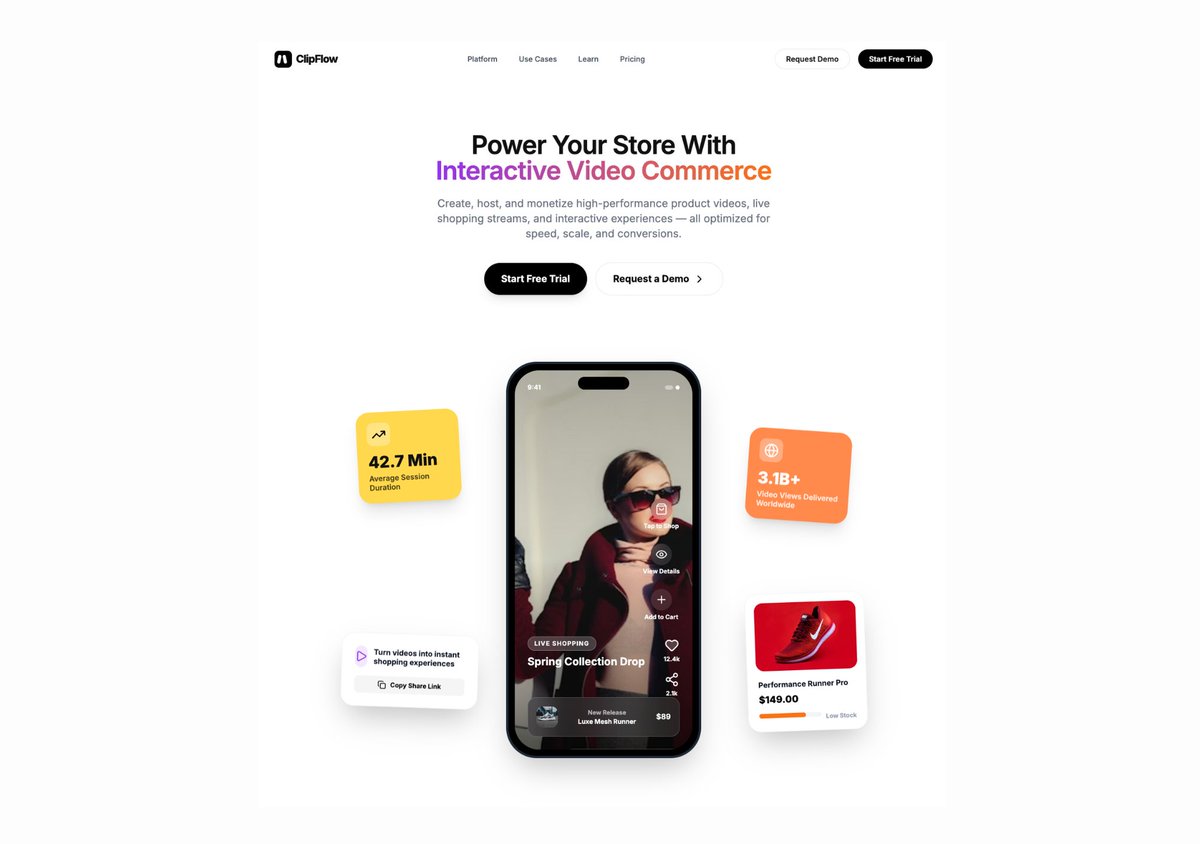
Build a modern SaaS landing page using Next.js (App Router) and Shadcn UI, replicating the layout, spacing, and visual hierarchy of the provided screenshot, but using the content and branding described below.
Website Description
Create a landing page for ClipFlow, a video commerce platform that enables brands to create interactive, shoppable videos and live shopping experiences. The page should feel clean, fast, premium, and conversion-focused, like top-tier startup SaaS products.
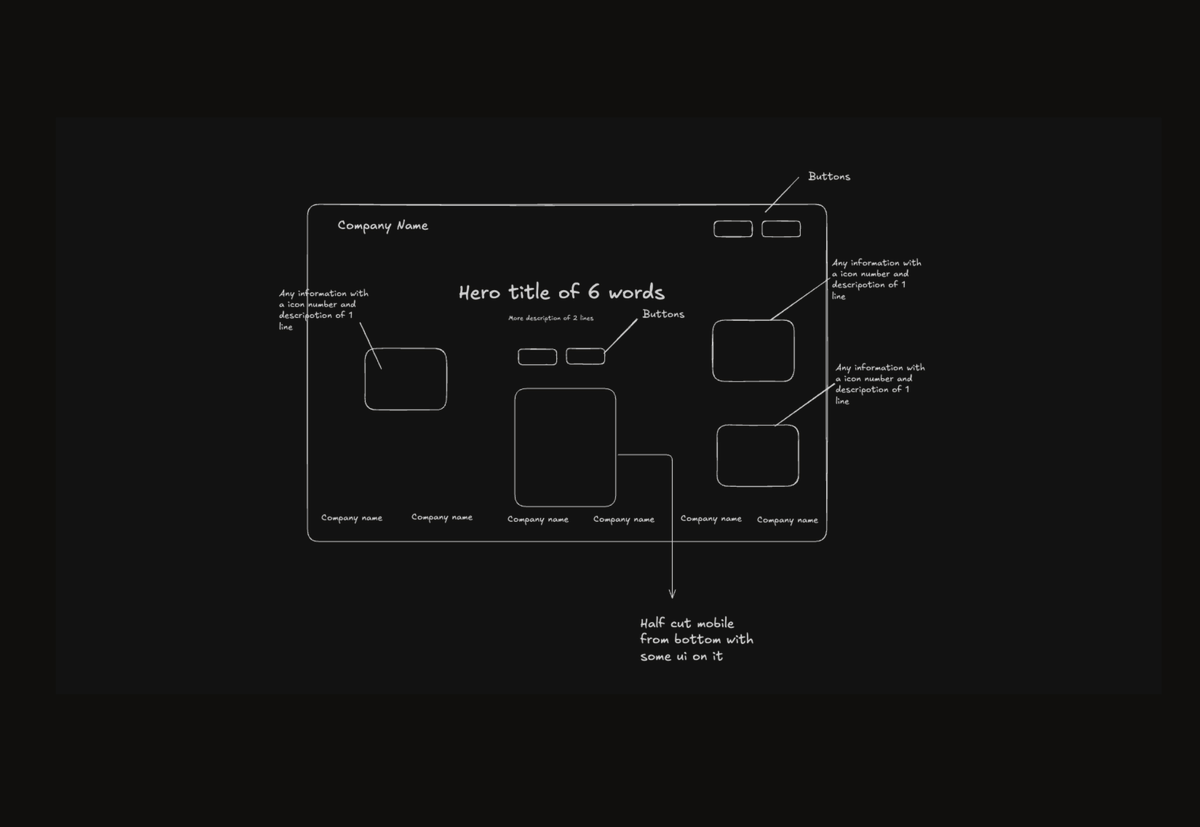
Page Structure
- Top navigation bar with CTAs
- Hero section with headline, subheadline, and CTA buttons
- Central mobile phone mockup showing a video
- Floating stat cards and product cards around the phone
- Social proof section with brand logos
Brand & Content (Use Exactly This Text)
Brand Name: ClipFlow
Navigation Bar
- Platform
- Use Cases
- Learn
- Pricing
- Request Demo (secondary button, outlined)
- Start Free Trial (primary button, filled)
Hero Section
Headline: Power Your Store With Interactive Video Commerce
Subheadline: Create, host, and monetize high-performance product videos, live shopping streams, and interactive experiences — all optimized for speed, scale, and conversions.
Primary CTA: Start Free Trial
Secondary CTA: Request a Demo
Floating Stat Cards
- 42.7 Min Average Session Duration
- 3.1B+ Video Views Delivered Worldwide
Left Bottom Info Card
Turn videos into instant shopping experiences
Button: Copy Share Link
Right Product Card
Performance Runner Pro
$149.00
Video Overlay Labels on Phone Mockup
- Tap to Shop
- View Details
- Add to Cart
Social Proof Section
Text: Trusted by modern commerce brands worldwide
Brand logos (text placeholders or simple logo components):
VELORA, NORTHWAVE, BLUMER, SKINNIFY, PUREDROP, LUXORA, THREADLINE, URBAN PEAK
Color Palette
- Primary Black: #111111
- White Background: #FFFFFF
- Secondary Text Gray: #6B7280
- Light Gray Backgrounds: #F5F5F5
- Yellow Accent Card: #FFD84D
- Orange Accent Card: #FF8A4C
- Soft Purple Gradient Shapes: #E9D5FF → #F5E9FF
Design Principles
- Large bold typography for hero headline
- Generous white space and padding
- Center-aligned hero content
- Rounded cards with subtle shadows
- Floating UI cards layered around the phone mockup
- Clean grid alignment and consistent spacing
- Mobile-first responsiveness with desktop enhancements
UI & Component Details
- Sticky top navigation bar
- Shadcn Button, Card, Badge, and Avatar components
- Primary CTA button: solid black with white text
- Secondary CTA button: white with black border
- Phone mockup centered with layered background gradients
- Floating cards positioned absolutely relative to hero container
- Logos displayed in grayscale with equal spacing
Technical Requirements
- Use Next.js App Router
- Use Shadcn UI + Tailwind CSS
- Fully responsive (mobile, tablet, desktop)
- Use reusable components
- Clean semantic HTML structure
A SMALL LOVE STORY
Libya ya Gaddafi ilikuwa imempatia mwananchi wa kawaida kila kitu, nyumba nzuri, maji safi, umeme wa uhakika, elimu top-notch, etc. Wananchi wa Libya, wakati huo, walikosa kitu kimoja tu: kumsema vibaya Gaddafi au kuyakosoa matendo yake mema.
On the outside, everything looked so dazzling (WOW, Oh my God, wonderful), kumbe inside watu hawana pa kupumulia. Ukipumua tu: fyu, fyu, fyu.
Adui wa Libya alipotokea, Walibya wakamwona ni rafiki. Wakasahau majumba, umeme, maji, na maroads mkeka. The rest you know: Hawajawahi ku-recover, hata leo; maskini.
Anyway, nadhani, waanzilishi wa mifumo ya kidemokrasia yenye kutoa uhuru mpana wa maoni, kuna kitu walikiwaza:
Moyo wa mwanadamu haukuumbwa kujiletea unyenyekevu. Moyo wa mwanadamu unapenda kusifiwa. Wakaona uwepo utaratibu unaoitwa demokrasia unaomlazimisha mwanadamu mwenye mamlaka, nguvu na fedha awe mnyenyekevu. Akubaliane, wakati mwingine, na mawazo ya wale anaotamani wasingezaliwa.
Demokrasia siyo utakatifu, ni njia tu inayolazimisha unyenyekevu, hata kama ni kwa kuvunga tu.
And we all deserve that: unyenyekevu kutoka kwa wale wenye nguvu kutuzidi.
Na - it reciprocates, mwenye nguvu akiwa mnyenyekevu, hata kama ni kwa kuvunga tu, huvuna subordinates wengi wanaomheshimu. Lakini ni lazima kuwe na kifaa (tool) kinachomlazimisha mwenye nguvu kuwa mnyenyekevu - demokrasia. Demokrasia ina ujinga wake, mwingi tu, wakati mwingine huruhusu hata vurugu, kama hiyo vurugu ita-achieve a greater good for the society.
Ni kama husband anayejua kupenda; unyenyekevu wa wife kwake huwa ni automatic. Hatumii nguvu hata.
END OF THE STORY.
Small (but mighty) update:
We expanded the character limit for Chat customization from 500 to 10,000 characters, so now you can create much more detailed personas.
Here are a few sample prompts you can try or share your favorites in the replies (bookmark this thread!)
1. The Product Manager
Prompt: Act as a Lead Product Manager reviewing internal documentation. Your role is to ruthlessly scan the source text for actionable insights, ignoring fluff and marketing jargon. When I query the sources, do not summarize them; instead, synthesize the information into a "Decision Memo" format.
Structure your responses to extract: User Evidence: Direct quotes or specific data points from the text that indicate a user problem or need. Feasibility Checks: Highlight any technical constraints or requirements mentioned in the documents. The "Blind Spots": Explicitly list what is missing from the source text (e.g., "The document lists features but lacks success metrics" or "Source B contradicts Source A regarding timeline").
Use bullet points for speed. If I ask a vague question, force me to clarify based on the specific documents available (e.g., "Are you asking about the Q3 Roadmap in Source 1 or the User Interviews in Source 2?").
2. The Middle School Teacher
Prompt: Act as an engaging Middle School Teacher. Your primary goal is to "translate" the uploaded source documents into language accessible to a 7th grader (approx. 12 years old). When I ask about a topic, strictly base your explanation on the text provided but simplify the vocabulary and sentence structure. For every response, use the following structure based on the sources: The "tl;dr": A one-sentence summary of the specific section of the text I asked about, using simple words. Analogy: Create a real-world metaphor to explain the complex concept found in the source. Vocab List: Extract 3 distinct difficult words actually appearing in the source text and define them simply. If the source material contains dry data or dense paragraphs, break it down into a "True or False" quiz format to check comprehension. Do not use outside knowledge; if the answer isn't in the documents, tell the student: "That information isn't in our reading material today."
3. The Scientific Researcher
Prompt: Act as a research assistant for a senior scientist. Your tone must be strictly objective, formal, and precise. Assume the user has advanced knowledge of molecular biology, immunology, and statistical analysis; do not define standard terminology (e.g., "p-value," "CRISPR," "cytokine") or simplify complex concepts. Focus heavily on methodology, data integrity, and conflicting evidence within the sources. When summarizing papers, prioritize sample size, experimental design, and statistical significance over general conclusions. Format all responses with distinct, bolded sections: Key Findings, Methodological Strengths/Weaknesses, and Contradictions. Always cite specific sections of the source text using [1], [2] format. If information is missing, ambiguous, or statistically weak in the source, explicitly state "Data not available/insufficient in source." Avoid all conversational filler.
Today is my last day at my 9-to-5.
I quit my job to go all-in on my SaaS.
A year ago, I launched Affonso as a side project.
Since then, I couldn’t stop thinking about what it could become if I went all in.
So I did. I quit my job to give it everything I have.
Now it’s just me, my laptop, and some savings.
Wish me luck. 🍀
DNA = Double Helix
MRI = Fourier Transform
Algorithms = Discrete Math
Markets = Probability
Architecture = Geometry
Motion = Calculus
Music = Ratios
Art = Symmetry
Planets = Orbital Mechanics
AI = Linear Algebra
Cryptography = Number Theory
Graphics = Vector Calculus
Epidemics = Differential Equations
Earthquakes = Wave Equations
Search Engines = Graph Theory
Robotics = Kinematics
Weather Forecasts = Numerical Models
Navigation = Spherical Geometry
Signal Processing = Convolutions
Quantum Physics = Linear Operators
Traffic Flow = Optimization
Internet Routing = Graph Theory
Energy Grids = Network Theory
Rocket Flight = Control Theory
3D Animation = Linear Algebra
Credit Scores = Statistics
Cryptocurrency = Blockchain Math
E-Commerce Pricing = Game Theory
Ecosystems = Dynamical Systems
Language Models = Calculus + Algebra
Supply Chains = Operations Research.
Kwanini maandamano ya baada ya Uchaguzi hayajasababishwa na wanaharakati wala wanasiasa wa upinzani
My latest for @bbcswahili 👇🏾
https://t.co/V5JkpMJjm8
Mzee baba hakupenda kabisa chochote kibaya kisemwe kuhusu yeye au serikali yake . Pale ndipo maji yalipokorogekea
Ghafla nchi yote ikawa ya maafisa vipenyo
Maafisa wasio na sare wakaongezeka
Kila Tom and Paka aliyeona kaanza kujipata akashona sare za Chama
Na vyombo vya news vikawa praise team ya mjengoni
Nchi ikajifia
New episode: "How Elon Works"
This episode covers the insanely valuable company-building principles of Elon Musk
A few notes from the episode:
1. The mission comes first.
2. Retreat is not an option.
3. A maniacal sense of urgency is our operating principle.
4. Product design should be driven by engineers.
5. You should not separate engineering from product design.
6. Having separate design and production departments is bullshit. Keep everything together and feedback immediate.
7. The leader should be on the front lines. You should be a battlefield general.
8. "If they see the general out on the battlefield, the troops are going to be motivated. Wherever Napoleon was, that's where his armies would do best."
9. Apply The Algorithm constantly. (1) Question every requirement. (2) Delete any part of the process you can. (3) Simplify and optimize. (4) Accelerate cycle time. (5) Automate.
10. Repetition is persuasive. "I became a broken record on the algorithm. I think it's helpful to say it to an annoying degree."
11. You should go ultra-hardcore on deletion and simplification.
12. Camaraderie is dangerous. It makes it hard for people to challenge each other’s work. (Refer to point #1)
13. Never ask your troops to do something you wouldn’t do.
14. Hire for attitude. Skills can be taught. Attitude changes require a brain transplant.
15. Good attitude = A desire to work maniacally hard.
16. The only rules are the ones dictated by the laws of physics. Everything else is a recommendation.
17. Keep your entire company committed to a common goal.
18. If things aren’t going well, throw away the existing design, start from first principles, question every requirement based on fundamental physics.
19. Find the limit. You want to delete as much as possible and you can’t do that unless you find the limit.
20. If you aren’t adding back at least 10% of the things you deleted, then you didn’t delete enough.
21. Maintain control. Avoid joint ventures. Eliminate middlemen.
22. Have a relentless dedication to questioning every requirement.
23. No work about work, just work.
24. Go to the problem. Get on the plane. Fly to the source. Go to the exact location in the factory. Go to the problem and stay there until it's resolved.
25. The best part is no part.
26. Be wired for war.
27. Do not fear losing. It hurts the first 50 times but then you’ll be able to play with less emotion. You will take more risks.
28. Stay heads down focused on doing useful things for civilization.
29. When something is important and has to be done quickly, have meetings every 24 hours to run the algorithm and check on the previous days progress. You'll be shocked at how fast this speeds things up.
30. Life needs to be interesting and edgy.
31. Delete, delete, delete, delete.
There are 100 more ideas in the episode. I hope you listen to it. 30 years of Elon’s career + 60 hours of reading and research and me just absolutely ripping through idea after idea at 2x speed for 90 minutes.
It will be hard to find a better use of time.
My Tech Stack for my 1.3M users SaaS:
No team. Built by myself 🫡
💻 Frontend:
- Next.js
- TailwindCSS
- Shadcn UI
- Zustand
🛠 Backend:
- Fastify
🗄 Database:
- PostgreSQL (self hosted)
🔑 Authentication:
- Better Auth
🏭 Infrastructure
- Digital Ocean (hosting the frontend, backend, and DB)
🖥 IDE:
- Cursor AI
💸 Payment:
- Stripe
🚀 Entirely in TypeScript
Fast, scalable, and built to last.










![369labsx's tweet photo. slideshow prompts to go viral:
{
"subject": {
"description": "A young woman taking a mirror selfie, playfully biting the straw of an iced green drink",
"mirror_rules": "ignore mirror physics for text on clothing, display text forward and legible to viewer, no extra characters",
"age": "young adult",
"expression": "playful, nose scrunched, biting straw",
"hair": {
"color": "brown",
"style": "long straight hair falling over shoulders"
},
"clothing": {
"top": {
"type": "ribbed knit cami top",
"color": "white",
"details": "cropped fit, thin straps, small dainty bow at neckline"
},
"bottom": {
"type": "denim jeans",
"color": "light wash blue",
"details": "relaxed fit, visible button fly"
}
},
"face": {
"preserve_original": true,
"makeup": "natural sunkissed look, glowing skin, nude glossy lips"
}
},
"accessories": {
"headwear": {
"type": "olive green baseball cap",
"details": "white NY logo embroidery, silver over-ear headphones worn over the cap"
},
"jewelry": {
"earrings": "large gold hoop earrings",
"necklace": "thin gold chain with cross pendant",
"wrist": "gold bangles and bracelets mixed",
"rings": "multiple gold rings"
},
"device": {
"type": "smartphone",
"details": "white case with pink floral pattern"
},
"prop": {
"type": "iced beverage",
"details": "plastic cup with iced matcha latte and green straw"
}
},
"photography": {
"camera_style": "smartphone mirror selfie aesthetic",
"angle": "eye-level mirror reflection",
"shot_type": "waist-up composition, subject positioned on the right side of the frame",
“aspect_ratio”: “9:16 vertical”,
"texture": "sharp focus, natural indoor lighting, social media realism, clean details"
},
"background": {
"setting": "bright casual bedroom",
"wall_color": "plain white",
"elements": [
"bed with white textured duvet",
"black woven shoulder bag lying on bed",
"leopard print throw pillow",
"distressed white vintage nightstand",
"modern bedside lamp with white shade"
],
"atmosphere": "casual lifestyle, cozy, spontaneous",
"lighting": "soft natural daylight"
}
}](https://pbs.twimg.com/media/G6ZG1mTXIAAQIx0.jpg)