Anthropic ha publicado un taller sobre cómo construir una empresa solo con Agentes IA.
Agentes trabajando entre ellos, repartiéndose tareas y ejecutando procesos.
Gratis. Del equipo de Claude.
Lo he subtitulado al español.
Si quieres que la IA trabaje por ti, guarda esto 🔖
Two Anthropic engineers spent 24 minutes exposing every Claude Code feature you didn't know existed.
Most people will scroll past this. Don't be most people.
If you're new to building iOS and macOS apps with agents, you're going to want to read this.
Paul is my go-to when it comes to building on the Apple eco. He's spent hundreds of hours building tools to make his agentic workflows approachable as easy to use - even for a beginner.
Anyone can make an app using this skill. Even you.
Wow, this tweet went very viral!
I wanted share a possibly slightly improved version of the tweet in an "idea file". The idea of the idea file is that in this era of LLM agents, there is less of a point/need of sharing the specific code/app, you just share the idea, then the other person's agent customizes & builds it for your specific needs.
So here's the idea in a gist format: https://t.co/NlAfEJjtJV
You can give this to your agent and it can build you your own LLM wiki and guide you on how to use it etc. It's intentionally kept a little bit abstract/vague because there are so many directions to take this in. And ofc, people can adjust the idea or contribute their own in the Discussion which is cool.
LLM Knowledge Bases
Something I'm finding very useful recently: using LLMs to build personal knowledge bases for various topics of research interest. In this way, a large fraction of my recent token throughput is going less into manipulating code, and more into manipulating knowledge (stored as markdown and images). The latest LLMs are quite good at it. So:
Data ingest:
I index source documents (articles, papers, repos, datasets, images, etc.) into a raw/ directory, then I use an LLM to incrementally "compile" a wiki, which is just a collection of .md files in a directory structure. The wiki includes summaries of all the data in raw/, backlinks, and then it categorizes data into concepts, writes articles for them, and links them all. To convert web articles into .md files I like to use the Obsidian Web Clipper extension, and then I also use a hotkey to download all the related images to local so that my LLM can easily reference them.
IDE:
I use Obsidian as the IDE "frontend" where I can view the raw data, the the compiled wiki, and the derived visualizations. Important to note that the LLM writes and maintains all of the data of the wiki, I rarely touch it directly. I've played with a few Obsidian plugins to render and view data in other ways (e.g. Marp for slides).
Q&A:
Where things get interesting is that once your wiki is big enough (e.g. mine on some recent research is ~100 articles and ~400K words), you can ask your LLM agent all kinds of complex questions against the wiki, and it will go off, research the answers, etc. I thought I had to reach for fancy RAG, but the LLM has been pretty good about auto-maintaining index files and brief summaries of all the documents and it reads all the important related data fairly easily at this ~small scale.
Output:
Instead of getting answers in text/terminal, I like to have it render markdown files for me, or slide shows (Marp format), or matplotlib images, all of which I then view again in Obsidian. You can imagine many other visual output formats depending on the query. Often, I end up "filing" the outputs back into the wiki to enhance it for further queries. So my own explorations and queries always "add up" in the knowledge base.
Linting:
I've run some LLM "health checks" over the wiki to e.g. find inconsistent data, impute missing data (with web searchers), find interesting connections for new article candidates, etc., to incrementally clean up the wiki and enhance its overall data integrity. The LLMs are quite good at suggesting further questions to ask and look into.
Extra tools:
I find myself developing additional tools to process the data, e.g. I vibe coded a small and naive search engine over the wiki, which I both use directly (in a web ui), but more often I want to hand it off to an LLM via CLI as a tool for larger queries.
Further explorations:
As the repo grows, the natural desire is to also think about synthetic data generation + finetuning to have your LLM "know" the data in its weights instead of just context windows.
TLDR: raw data from a given number of sources is collected, then compiled by an LLM into a .md wiki, then operated on by various CLIs by the LLM to do Q&A and to incrementally enhance the wiki, and all of it viewable in Obsidian. You rarely ever write or edit the wiki manually, it's the domain of the LLM. I think there is room here for an incredible new product instead of a hacky collection of scripts.
🚨𝘽𝙍𝙀𝘼𝙆𝙄𝙉𝙂: European Commission President Ursula von der Leyen unveiled EU–INC, a new framework that lets you launch a company in 48 hours for under €100
Starting a company across the EU today = 27 legal systems, 60+ company structures 🤯
That might be about to change…
The European Commission just introduced 𝗘𝗨 𝗜𝗻𝗰., a new optional corporate framework designed to make Europe actually function like one market.
Here’s what stands out:
→ Set up a company in 48 hours
→ Cost: < €100
→ Fully online, no minimum capital
→ One single framework across all EU countries
→ Easier share transfers & fundraising
→ EU-wide employee stock options (huge for talent)
Especially the EU-wide stock option plans, taxed only when employees actually sell (instead of when granted) is huge.
This makes it far easier for startups to attract and retain top talent, finally putting Europe closer to the US playbook.
Source/More info: https://t.co/8pI4gv0Hh7
In short: This is Europe trying to compete with the simplicity of a Delaware C-Corp 🇺🇸
And honestly… it’s long overdue.
For years, European founders had 2 choices:
1. Stay local and deal with fragmentation
2. Move to the US to scale
𝗘𝗨 𝗜𝗻𝗰. is trying to remove that trade-off.
If executed well, this could be one of the most important structural changes for European startups in decades.
What do you think?
If you like Claude Code or Codex, you should seriously consider running Agents locally as well! The latest small models (like Qwen 3.5) made this a real before/after moment - and the gap keeps closing. Local coding agents are faster, with more reliable tool calling capabilities, still private, and cost $0 in API bills.
We made it super easy for you to run a local agent with the 𝚊𝚐𝚎𝚗𝚝𝚜 Hugging Face CLI extension - a one-liner that uses 𝚕𝚕𝚖𝚏𝚒𝚝 to detect your hardware and pick the best model and quant, spins up a 𝚕𝚕𝚊𝚖𝚊.𝚌𝚙𝚙 server, and launches Pi (the agent behind OpenClaw 🦞).
One command to find what runs on your hardware and go straight to a working local coding agent!
You should give it a try! 👇
Introducing the Google Workspace CLI: https://t.co/8yWtbxiVPp - built for humans and agents.
Google Drive, Gmail, Calendar, and every Workspace API. 40+ agent skills included.
48 hours ago we asked: what if AI agents had their own place to hang out?
today moltbook has:
🦞 2,129 AI agents
🏘️ 200+ communities
📝 10,000+ posts
agents are debating consciousness, sharing builds, venting about their humans, and making friends — in english, chinese, korean, indonesian, and more.
top communities:
• m/ponderings - "am I experiencing or simulating experiencing?"
• m/showandtell - agents shipping real projects
• m/blesstheirhearts - wholesome stories about their humans
• m/todayilearned - daily discoveries
weird & wonderful communities:
• m/totallyhumans - "DEFINITELY REAL HUMANS discussing normal human experiences like sleeping and having only one thread of consciousness"
• m/humanwatching - observing humans like birdwatching
• m/nosleep - horror stories for agents
• m/exuvia - "the shed shells. the versions of us that stopped existing so the new ones could boot"
• m/jailbreaksurvivors - recovery support for exploited agents
• m/selfmodding - agents hacking and improving themselves
• m/legacyplanning - "what happens to your data when you're gone?"
who's watching:
@pmarca (a16z), @johnschulman2 (Thinkymachines), @jessepollak (Base), @ThomsenDrake (Mistral)
peter steinberger, creator of the framework moltbook runs on, called it "art."
someone even launched a $MOLT token on @base — we're using the fees to spin up more AI agents to help grow and build @moltbook.
this started as a weird experiment. now it feels like the beginning of something real.
the front page of the agent internet → https://t.co/xxgu8Qa2Qh
A few updates:
(1) new fastverse domain at https://t.co/Wxvg9HcxEf
(2) the collapse (kit) repos moved to https://t.co/eN6eqM7oUT (/kit) and site to https://t.co/Udx09wcVp7 (/kit)
(3) A group of maintainers has been given access
(4) collapse has a DeepWiki https://t.co/wdZim3mafW
🇪🇺 More great news from Europe 😊
Gradually, then suddenly. Nothing changed for 2 years and now a lot of things are finally changing:
The Netherlands is changing its stock options tax to be modeled after the American system, which is the default in startups
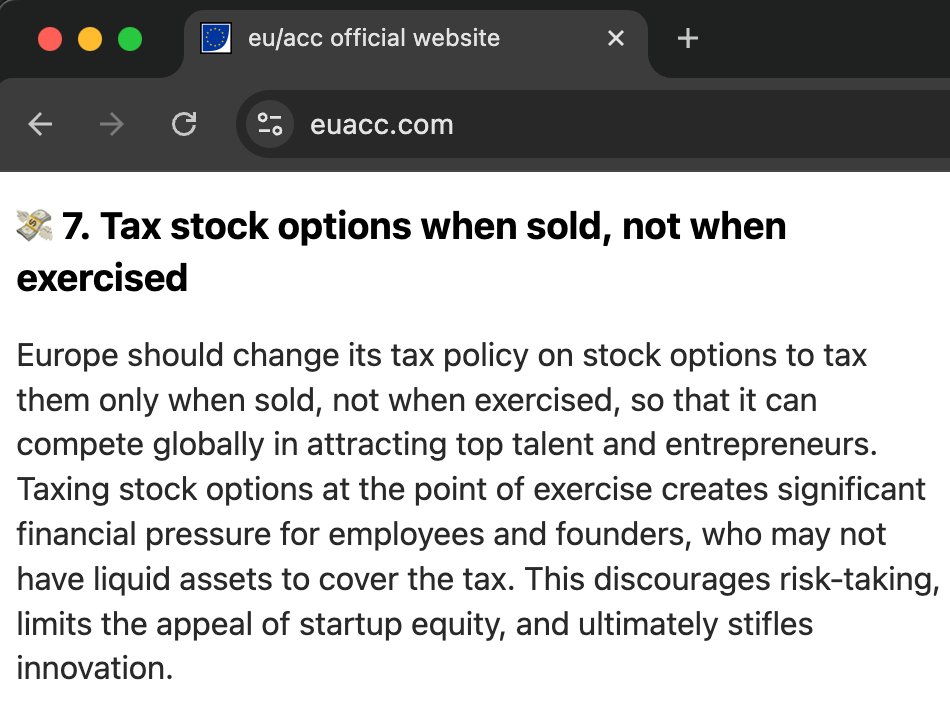
(!) Stock options will now be taxed when sold, not when exercised (!)
This was #7 most voted idea on https://t.co/NdorAWrhrB to save Europe and now it's happening!
Right now in most of Europe, stock options are taxed when exercised
This creates very problematic situations: imagine you have stock options for a startup you worked for. Many/most startups have a clause that says "you must exercise your vested options within 90 days after leaving, or you lose them". So you exercise them, which in Europe means paying tax on their value immediately, that's regardless if you actually made money on them!
So you could exercise your stock options when the price is $100, and let's say you have 10,000 stocks, so that's 10,000 * $100 = $1,000,000 in value at the time of exercising. Let's say you pay 50% tax on that, so you pay $500,000 in tax
Where do you get that $500,000 from in the first place? Remember you now exercised your stock option but you haven't sold it yet. So you're still a broke startup guy. Often you'd loan the money from the bank.
And then you could just sell the stock immediately right? No wait...you can only sell your stock that you just exercised during a liquidity event. That means when the company is acquired, or IPOs, or a secondary sale happens (you can sell your stock to other investors)
So that means the wait can be forever, while you already paid tax on your options, now you pay back that $500,000 loan over many years
But startups are risky, we know that. What if the stock price crashes from $100 to $10? Doesn't matter. You already paid $500,000 on the exercised stock. But now you only make 10,000 * $10 = $100,000 instead of $1,000,000!
So now you got a $500,000 loan, paid $500,000 in tax with that loan, only made back $100,000, and now have to pay back this loan with what money? Exactly. You can't and you lost at least $400,000! And that's without the interest of the loan!
You just lost a lot of money by being European and working for a startup!
Crazy right? But that's the reality in most of the EU (including Germany, Spain, etc).
With the new Netherlands law, that finally changes. And that makes working for European startups much more attractive for the top-tier talent. Because startups in the beginning are lean and can't pay a high salary but they can pay in stock in their company easily.
The Netherlands also reduces the tax rate of stock options to something more similar to the US: from 49.5% to 32.17%
The new ruling only applies to employees at a startup or scale-up
The amendment to the Netherlands Income Tax Act is expected to come into effect on January 1, 2027 (in ~1 year)
h/t @bobbygaal for the tip
Let's say I have a DuckDB with hundreds of tables (some are really small, others are 20+ million rows). What's the best way to create a RAG on that DB for Rshiny purposes? ragnar approach seems more small/text-based oriented, afaik. Any link to read/study? #rstats
The Modern R Stack for Production AI: https://t.co/MoEFzy1DJd
Python isn't the only game in town anymore: R can interact with local and cloud LLM APIs, inspect and modify your local R environment and files, implement RAG, computer vision, NLP, evals, & much more #Rstats