Helping brands grow email revenue without building an email team. Founder of Mailberry. Founder of Mailberry. Sharing email strategy, deliverability, AI, etc.
Most Shopify brands do not need another email platform.
They need the work done:
• Strategy
• Campaigns
• Flows
• Segmentation
• Deliverability
• Reporting
Traditional software gives you more tools and more work.
We’re building Mailberry to give lean teams an AI-native email team instead.
I’ve spent years helping companies diagnose email performance, strategy and infrastructure problems.
Here, I’ll share:
• Real email teardowns
• Deliverability lessons
• Revenue opportunities brands miss
• What we’re learning while building Mailberry
Follow along if email has become a second job.
8/
That's what we're building at Mailberry: an Email Brain that learns what your brand sends, who responds, and what drives revenue.
Not more emails. An email system that gets smarter with every send.
1/
Every email platform now says it "uses AI."
Most mean one thing: it can write a subject line.
But writing the email is the smallest part of email marketing. Here's the part AI usually can't do 🧵
7/
The difference in one line:
Prompt: "Write an abandoned-checkout email."
System: "This returning customer viewed the product 3x, bought twice, converted last time without a discount — write the follow-up and add it to their journey."
Both use AI. Not the same job.
Most email problems aren’t creative problems.
They’re funnel diagnosis problems.
Marketers obsess over the CTA.
But performance usually breaks long before the click.
If you don’t measure the entire email funnel, you’ll fix the wrong thing.
Here’s the real email funnel:
1. Sent → Delivered
If it’s not delivered, nothing else matters.
Measure: bounce rate, block rate, domain/IP reputation.
If you have inbox placement issues, stop rewriting copy.
2. Delivered → Opened
Low opens?
It’s either inbox placement or subject line resonance.
Measure: spam placement rate, inbox placement, open trends by segment.
Don’t debate emojis if you’re in spam.
3. Opened → Clicked
Now it’s messaging.
Measure: CTR, unique clicks, engagement by segment.
This is copy, design, clarity.
4. Clicked → Page Visited
Measure: link health, load speed, tracking integrity.
Broken links quietly destroy revenue.
5. Visited → Conversion
Now it’s offer, UX, pricing, trust.
Every stage compounds.
If you have deliverability problems and you’re debating button color, you’re solving stage 3 while stage 1 is broken.
Great email marketers diagnose before they optimize.
Where’s your leak?
Unsubscribe rates climbing?
It's time to take a hard look at your email strategy.
High unsubscribe rates are often a sign that your emails aren’t meeting your audience’s expectations.
The good news? It's never too late to turn things around.
Let's make a plan together...
WHY SUBSCRIBERS LEAVE
1. Too Many Promotions
If you're constantly pushing for more commitments, your brand starts to feel like an overly aggresive salesperson.
2. Irrelevant Content
If your emails don’t resonate with your audience’s needs or interests, they’re going to disengage.
3. Lack of Value
People want to feel like they’re gaining something—whether it’s education, inspiration, or a good deal. Without value, they’ll disengage.
4. Inconsistent Sending
When it comes to email, absence does not make the heart grow fonder.
Subscribers can't feel connected to your brand if your sending cadence is sparse or erratic.
HOW TO IMPROVE RETENTION
1. Set (& Deliver On!) Clear Expectations
Use your welcome email to let subscribers know what kind of content they’ll receive and how often. Then, stick to it.
2. Offer a Preference Center
Allow subscribers to choose how often they hear from you and what topics they’re interested in. This reduces unnecessary unsubscribes.
3. Make Every Email Valuable
Before you hit send, ask: Does this email educate, entertain, or solve a problem for my audience?
If the answer is no, revise your email to be a little more customer-centric and a little less self-serving.
4. Segment Your Audience
Group subscribers by behavior, interests, or demographics. Personalized emails are more relevant –– and relevancy keeps people engaged.
5. Re-Engage Inactive Subscribers
Send targeted campaigns to win back disengaged subscribers. If they still don’t engage, remove them to keep your list clean and your reporting accurate.
Unsubscribes aren’t always a bad thing—they can improve your deliverability and leave you with a more engaged audience.
What we want to avoid, though, is losing qualified prospects because our messaging was misaligned or our customer experience was sub-par.
Focus on the three pillars of effective email marketing:
→ Relevance
→ Value
→ Consistency
If you can send valuable emails with content that's relevant to the recipient on a consistent basis, you're going to build a list of loyal subscribers who actually look forward to your emails.
Need help installing this in your business?
Drop me a comment or a DM.
I'll be happy to take a look at your current set-up and recommend a few high impact adjustments you can make.
The Flywheel Effect is one of the most powerful concepts in marketing, but many brands still get it wrong.
Let's make sure you're not one of them...
I first heard about The Flywheel Effect through Jim Collins' book "Good To Great."
The idea is simple:
Most marketing channels are like massive, heavy flywheels.
They require a TON of effort to get moving, but if you can brute force them to a certain tipping point, they'll start to grow faster and more efficiently, powered by their own momentum.
At first, the ratio of effort-to-output is something like 10:1.
Once The Flywheel Effect kicks in, that ratio flips, and you start getting 10, 50, or even 100 times the output for the same amount of up-front effort.
THAT'S the kind of performance and efficiency we're trying to capture through email marketing.
Here's how to take advantage of The Flywheel Effect in your email marketing program:
1. ATTRACT – Create irresistible incentives to grow your subscriber base
2. ONBOARD – Introduce your brand, set expectations, and establish your authority
3. ENGAGE – Deliver consistent value and strengthen relationships through trust
4. DELIGHT – Align with customer preferences, prioritize long-term relationships over quick returns
5. RETAIN – Keep subscribers active and engaged without being pushy or self-interested
6. CONVERT – Cash in on the trust and engagement you've built to convert attention into revenue
It can take a while to get each component dialed in, but when all of these elements start to work together, magic happens.
Each turn of the flywheel builds on previous efforts, compounding your results over time.
You'll notice that instead of constantly having to arrange partnerships, pay for ads, or create new lead magnets, your email list has started to grow organically.
You'll notice that instead of constantly having to run promotions or discounts, your baseline sales figures have risen month-over-month.
You'll notice that instead of having to incentivize customers to buy again, your customer lifetime value has started to trend upward all on its own.
It's not about pushing harder.
It's about pushing in the right places, consistently, over a long period of time.
It doesn't happen overnight, but if you stick to it long enough, you'll wake up one day and realize you've built a thriving list of engaged subscribers who consistently drive revenue for your business.
And that's a pretty amazing feeling.
Worrying about the future is like trying to solve a puzzle with missing pieces.
It's frustrating, unproductive, and often leads nowhere.
Mark Twain once said, "I've had a lot of worries in my life, most of which never happened."
Does this resonate with you? Because it hit me HARD when I first read it.
We spend countless hours fretting over potential problems, imagining worst-case scenarios, and trying to prepare for every possible outcome.
But here's the truth...
The vast majority of our worries never materialize.
And even when they do, all that worrying didn't make us any more prepared to handle them.
Thinking is one of the most energetically expensive bodily functions, which means all of this OVERthinking is a literal waste of time AND energy.
How often does something unexpected happen and totally throw a wrench in your plans?
How often does something you thought was guaranteed to happen never actually take place?
Worrying about things we can't control robs us of the present moment and has ZERO impact on what the future holds.
Adversity is part of life –– and it's not going to politely wait for us to finish worrying before it shakes things up.
So, what's the alternative?
1. Focus on the present. Take ownership over the things you can control right now.
2. Prepare for the future, but don't obsess over it or try to predict what comes next.
3. Build your personal and professional resilience, so you are prepared to handle whatever comes your way.
4. Regularly practice gratitude for what you have now instead of stressing about what you might lose later.
Remember, your mind is a powerful tool.
Everything around you started as an idea in someone's head before it was turned into something tangible.
If your mind is full of negativity, you're going to manifest negative outcomes in your life.
Use it to create, not to worry.
Use it to solve real-world problems, not to roleplay imaginary scenarios that may not even occur.
When you find yourself getting stuck in a negative spiral, ask yourself:
"Is this a real problem I can solve right now, or am I just borrowing trouble from the future?"
If you can maximize the time you spend working on present-day problems, you'll find that more and more of those "future problems" you were worried about never actually happen.
Funny how that works, huh?
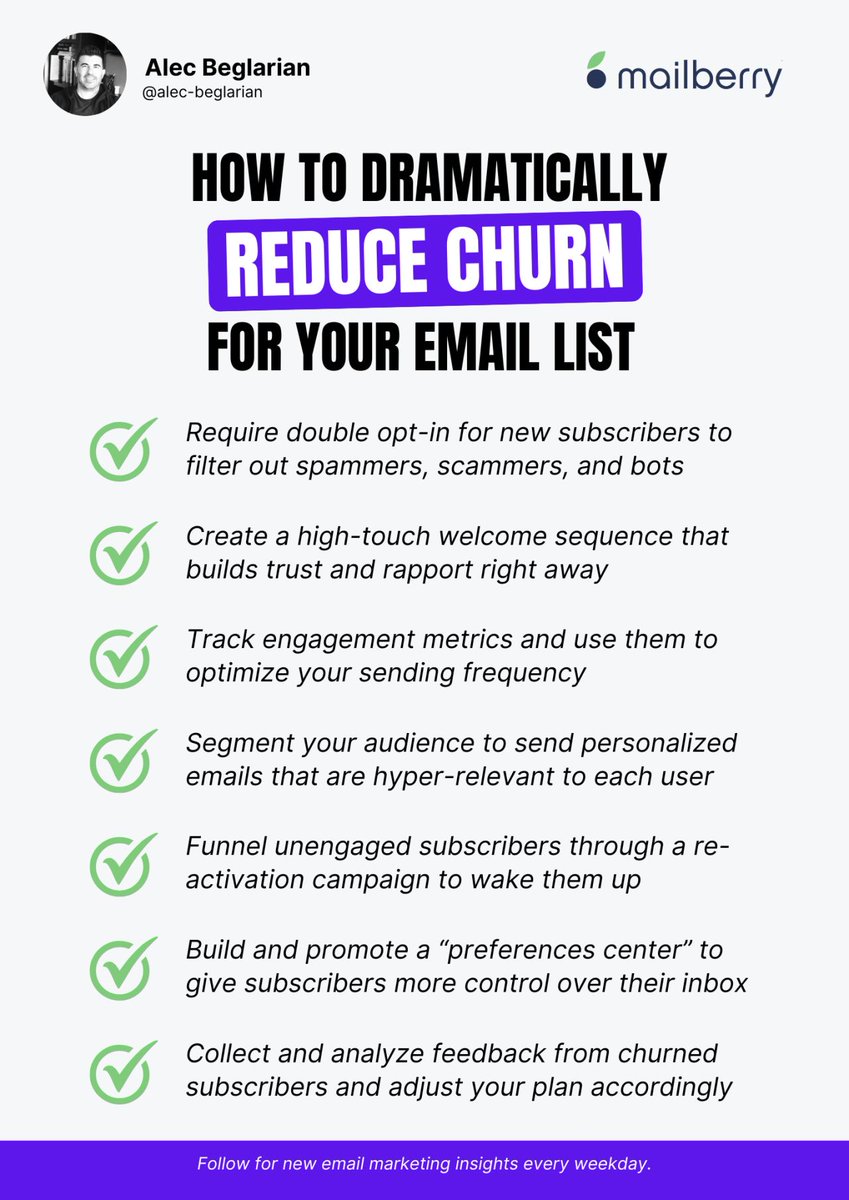
Everybody loves to talk about how fast their list is growing, but nobody talks about churn.
Churn is inevitable, like aging.
But, like aging, you’re much better off if you can slow it down.
Here are 7 things you can do today to reduce subscriber churn:
↳ Use a double opt-in to keep out the spammers, scammers, and bots
↳ Send new subscribers into a dedicated welcome sequence, not the main feed
↳ Closely monitor engagement and unsubscribe rates to dial in your sending frequency
↳ Use segmentation and personalization to send more hyper-relevant emails
↳ Segment unengaged subscribers and send them a re-engagement campaign
↳ Create a preference center, so subscribers can adjust their settings instead of unsubscribing
↳ When people unsubscribe, collect feedback and use it to improve your experience
Here’s the good news...
You can have all of these items checked off in a week or less, which makes it a low cost, high impact effort.
(Those are the best kind!)
Increasing the size of your email list is great, but if you’re losing subscribers all along the way, it’s kind of like filling up a leaky bucket.
Invest some time into plugging up those holes, and you’ll get the job done much faster.
P.S. – Mailberry can make this process even more efficient. If you want to learn how, drop me a message and I’ll be happy to give you a demo.
A lot of founders come to me asking for the Pareto Principle of email marketing.
“What are the 20% of emails I can optimize to get 80% of the sales outcomes?”
Here are five types of emails I always recommend starting with to grow your audience AND your revenue.
DISCOUNTS & PROMOTIONS
Everybody loves a good deal!
If you have a killer offer or a seasonal discount, sending a dedicated promo email is a great way to boost sales quickly.
Don’t overdo it, though. Getting off the discount hamster wheel is really, really hard.
FEEDBACK REQUESTS
This email should be an integral part of every onboarding and post-purchase experience.
The brand that knows their customer the best will always win. Give your customers plenty of opportunities to share their wins, feedback, and ideas with you.
More importantly, USE those insights to inform things like product development and marketing strategy, which will help you gain and retain more right-fit customers.
PRODUCT SPOTLIGHTS
Customers have a lot of noise in their inbox. Sometimes you need to make a simple, direct offer, and give a particular product its moment in the sun.
Product launches, restocks of sold out items, or increased seasonal demand are all great reasons to send a dedicated product spotlight email, especially to targeted customer segments.
VALUE-BASED EMAILS
If all you ever do is promote yourself and your products, you’re going to burn out your audience.
Make sure to balance your sales efforts with value-based emails. These are designed to educate, entertain, or inspire your subscribers.
You can share tips & tricks, highlight customer success stories, or slip them some exclusive content to keep your brand top-of-mind.
WELCOME EMAILS
Everyone knows the value of a strong first impression, which is why I’m always confused when brands decide to use a templated welcome email to kick off a relationship with a new subscriber.
This is THE best opportunity to encourage a prospect to learn more about (and engage with) you and your brand.
Don’t phone it in!
Tell your brand story, set expectations for what comes next, and consider offering a no-brainer special incentive that gets their journey with you started on the right foot.
Getting these five types of emails dialed in can do wonders for your business.
And here’s the best part...
With Mailberry, you can have all five up and operational in ONE DAY.
We've built a custom platform that takes over your email marketing, putting it on autopilot to help you launch high-impact campaigns fast—without sacrificing quality.
Interested in taking it for a spin? Drop a comment below.
I’ll be happy to set up a strategy session to show you how it could amplify your marketing efforts.
The ability to stay focused is a superpower.
Eric Schmidt, former Google CEO, once noted that we create as much information every two days as we did from the dawn of civilization until 2003.
He said that back in 2010 – can you imagine what the statistic is now?
The point is, distractions are at an all-time high, so if you’re having trouble consistently knocking out that daily to-do list, you’re not alone.
Here’s how I block out the noise and focus as much of my energy as possible on what truly matters most...
TIME BLOCKING
At the beginning of each week, I reserve specific blocks of time for my most important activities.
Getting these items on my calendar first forces me to say “no” to other requests, or at least weigh them against the importance of what’s already there.
When you can literally SEE how much time is available in your day or week, you get a much better understanding of how ruthless you need to be with your commitments.
TASK BATCHING
The cost of context switching is almost as high as inflation.
I like to group similar tasks together and tackle them in a single sitting. For example, I’ll spend half an hour responding to emails or dedicate an hour to reviewing/approving work products.
This eliminates the need to jump between different apps and types of work, which can break my concentration and disrupt my flow for an entire day.
PROTECTING “QUIET TIME”
When I need to get some serious work done, I turn off all notifications and throw on some background noise using a tool called Endel.
It’s impossible to stay focused when you’re constantly being interrupted by pings and alerts, each of which is probably someone else trying to add THEIR responsibilities to YOUR to-do list.
There are very few things that can’t wait an hour or two for a response.
PAYING MYSELF FIRST
I have a personal rule that I always do the 1-2 tasks that will have the biggest impact on MY goals before I even think about doing things for someone else.
It sounds conceited, but if I don’t stay committed to my own success, I’ll never be in a position where I can selflessly serve others.
By tackling the most important work first, when my energy and creativity are at their peak, I guarantee I’ll make progress on what truly matters before getting caught up in busywork.
Distractions are inevitable, but with the right strategies, you can mitigate the effect they have on your productivity.
It takes a lot of discipline, but these tactics have been extremely effective at helping me stay focused and get the most impactful work done every single day.
What about you?
What are you struggling with and what has helped you address those productivity challenges?
I've run hundreds of email account audits, and I always see the same mistakes.
Here are the "5 Deadly Sins" that are killing your email performance – and how to fix them.
MISTAKE #1: TOO MUCH EMAIL VOLUME
When it comes to email marketing, engagement is far more important than list size.
Sending too many emails can overwhelm your subscribers, leading to lower engagement rates, increased unsubscribes, and damage to your sender reputation.
This turns into a “boy who cried wolf” scenario, where too much volume results in your messages getting ignored or sent to SPAM.
THE FIX: Focus on quality over quantity.
Prioritize sending valuable content at a steady cadence rather than hitting an arbitrary volume target.
MISTAKE #2: NOT SEGMENTING YOUR AUDIENCE
If you’re still sending “email blasts” in 2024, you’re gonna have a bad time.
Sending the same email to your entire list without considering a subscriber’s unique needs or interests is a recipe for terrible engagements, sales, and unsubscribe rates.
THE FIX: Segment your list based on demographics,interests, or behaviors. Send hyper-personalized content to maximize relevance and improve conversion rates.
MISTAKE #3: WEAK OR MISLEADING SUBJECT LINES
Using vague, spammy, or clickbaity subject lines is an absolute no-no.
If your subject line is unclear, it’s not getting opened. If it makes a promise that your content doesn’t deliver on, your subscribers will lose trust, killing your future engagement metrics.
THE FIX: Craft subject lines that are both clear and compelling. Set expectations for what’s inside and make sure the email content follows through on that claim.
MISTAKE #4: IGNORING MOBILE OPTIMIZATION
Current estimates suggest that around 60% of website visits take place on mobile devices. Similarly, studies have shown that around 40-60% of email opens happen on mobile.
So, why do so many brands invest thousands in mobile optimization for their SITE, and almost nothing in optimizing their EMAILS?
THE FIX: Use responsive email templates that adjust to any screen size, and always test how your emails look on mobile before sending.
MISTAKE #5: FAILING TO ANALYZE PERFORMANCE
For many brands, email marketing is an item on a to-do list that just needs checked off.
If you’re not running a post-send analysis to determine what’s working and what’s not, you are absolutely leaving money on the table.
THE FIX: Analyze your email marketing metrics on a monthly basis to understand what’s working and use that to drive further experimentation and optimization.
I see these mistakes in every single account I audit – and it KILLS me.
Get these low cost, high impact opportunities dialed in and you’ll dramatically improve your results.