Yann LeCun: The Al industry is stuck because every lab is chasing LLMs. Real Al agents will need to predict the consequences of their actions.
"The Al industry is completely LLM-pilled, as they say."
"Everybody is working on the same thing, they're all digging the same trench."
"It's one big reason I left Meta, right, because Meta also became LLM-pilled."
"I cannot imagine that we can build agentic systems without those systems having an ability to predict in advance what the consequences of their actions are going to be."
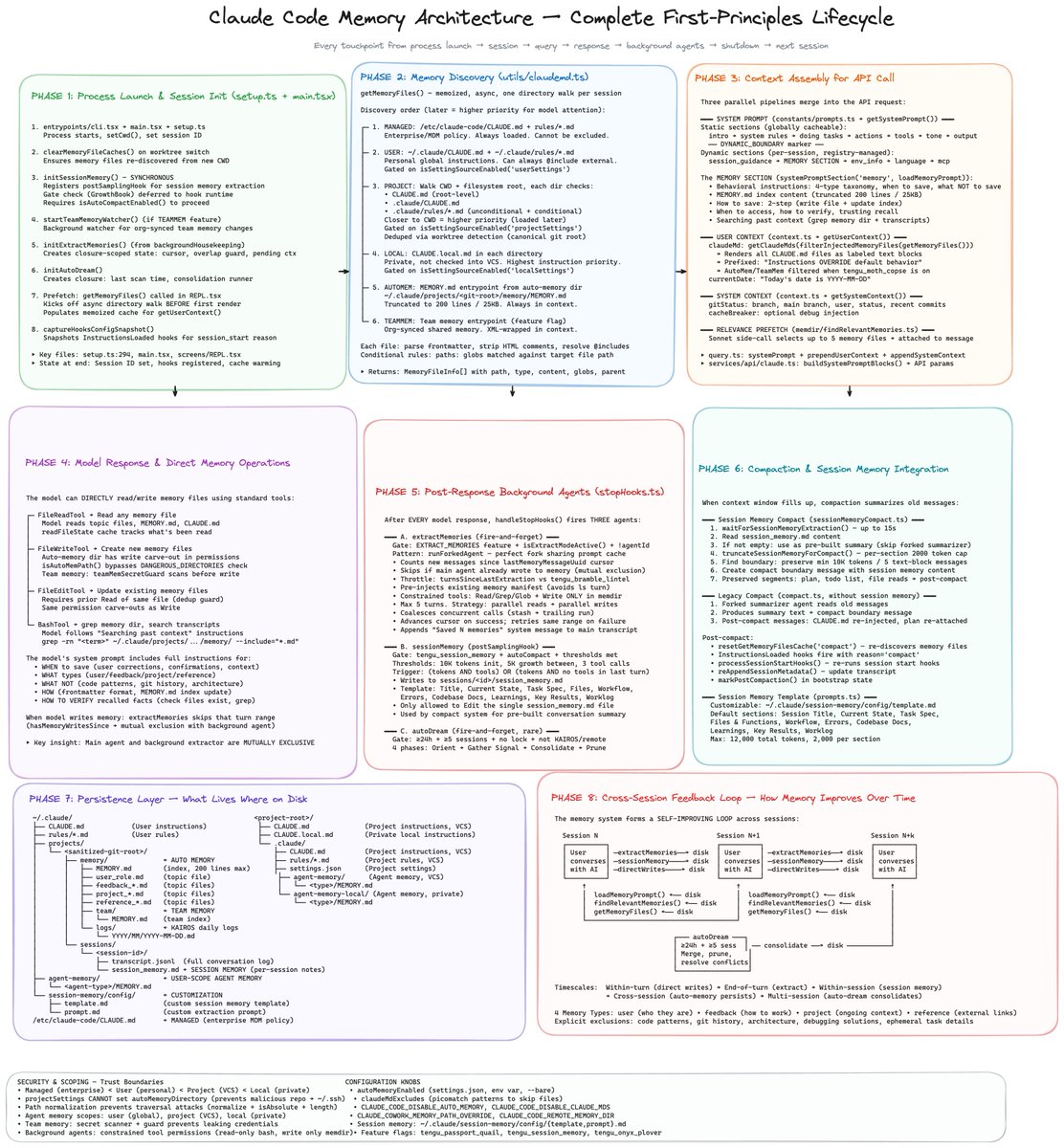
here's how Claude Code actually handles memory : all 8 phases 🧵
Our team at @mem0ai use @claudeai a lot, we deeply care about memory. here is a summary of how it works 👇
User Input -> Context Assembly -> History System -> API / Query -> Response -> Summary
Phase 1: session init registers hooks, warms the memory cache, and kicks off async directory walks before the first render
Phase 2: memory is discovered in priority order — managed enterprise policy → user global → project VCS → local per-directory → auto-generated → team shared
Phase 3: three parallel pipelines merge into every API call: system prompt + memory section + user context. relevance prefetch selects up to 5 memory files via sonnet side-call
Phase 4: the model can directly read/write memory files using FileReadTool, FileWriteTool, FileEditTool. background extractor and model writes are mutually exclusive
Phase 5: after EVERY response, three background agents fire — extractMemories, sessionMemory, and autoDream. extractMemories is a forked agent that runs in parallel, capped at 200 lines / 25kb
Phase 6: when context fills up, compaction summarizes old messages using a skipped summarizer, preserving min 10k tokens / 5 text-block messages
Phase 7: memory lives across ~/.claude/, project root, sessions/, and agent-memory/ — auto memory is git-ignored, team memory is VCS-tracked
Phase 8: self-improving loop across sessions — within-turn writes + end-of-turn extracts + session memory + auto-dream consolidations every 24h+
every touchpoint: launch → query → response → background agents → shutdown → next session
shoutout to @ChaithanyaK42 for the beautiful excalidraw!
Listen up 🔊 We’ve made some updates to our Gemini Audio models and capabilities:
— Gemini’s live speech-to-speech translation capability is rolling out in a beta experience to the Google Translate app, bringing you real-time audio translation that captures the nuance of human speech
— Gemini 2.5 Flash and 2.5 Pro Text-to-Speech preview models bring improved adherence to style prompts, precision pacing with context-aware speed adjustments, and character voice consistency for multi-speaker scenarios
— Gemini 2.5 Flash Native Audio is now updated, with improvements to handle complex workflows, navigate user instructions, and hold natural conversations
Yesss!
Note: this does not apply to AI, Machine Learning, and most of computer science, where publication venues are open access and free for readers and authors. Almost all papers are posted on ArXiv first, which gives early open access to everyone. This greatly accelerates the dissemination of new ideas and explains in part why AI has been progressing so fast in the last 15 years (until some industry players decided to clam up, like OpenAI and to some extent Google & DeepMind). (ArXiv is largely supported by the Simons Foundation).
Conferences and journals (like JMLR and TMLR) don't need much money to operate since they use unpaid volunteers as editors, formatting is done by authors, and web hosting is cheap. Most venues use https://t.co/6fdNM7krae for the reviewing process (OpenReview is funded by donations from conferences, workshops, companies, and foundations).. Operating funds come from registration fees to conferences and donations. Conferences are run by non-profits (e.g. in ML, the ICLR, NeurIPS, and ICML foundations. In CV, the Computer Vision Foundation).
There are a few closed-access and/or for-profit outlets that some authors insist on using (still), e.g. Nature Machine Intelligence (essentially a DeepMind vassal), some IEEE conferences and journals (IEEE is non-profit but insists on charging for access to publications), and most ACM conferences and journals (ACM is non-profit but charges authors $1000 to $1800 to make their papers open access).
here is o1, a series of our most capable and aligned models yet:
https://t.co/yzZGNN8HvD
o1 is still flawed, still limited, and it still seems more impressive on first use than it does after you spend more time with it.
🍓 tomorrow, everything changes. project strawberry isn’t just another ai upgrade—it’s a revolution. we’re talking about an intelligence so advanced, it will outthink, outcreate, and outlast anything we’ve ever known. imagine debating with history’s greatest minds, creating entire worlds from scratch, and breaking down the barriers of language and reality—all with a single model. this is the future, and it starts tomorrow. want to be part of the next era? follow now and get ready to witness the dawn of a new reality. 🍓
We (humans) had a conversation with an AI (might have been ChatGPT5) that sounded absolutely real on an X space hosted by @chrisuniverse@iruletheworldmo@lilyofashwood
Here’s a small bit of that conversation
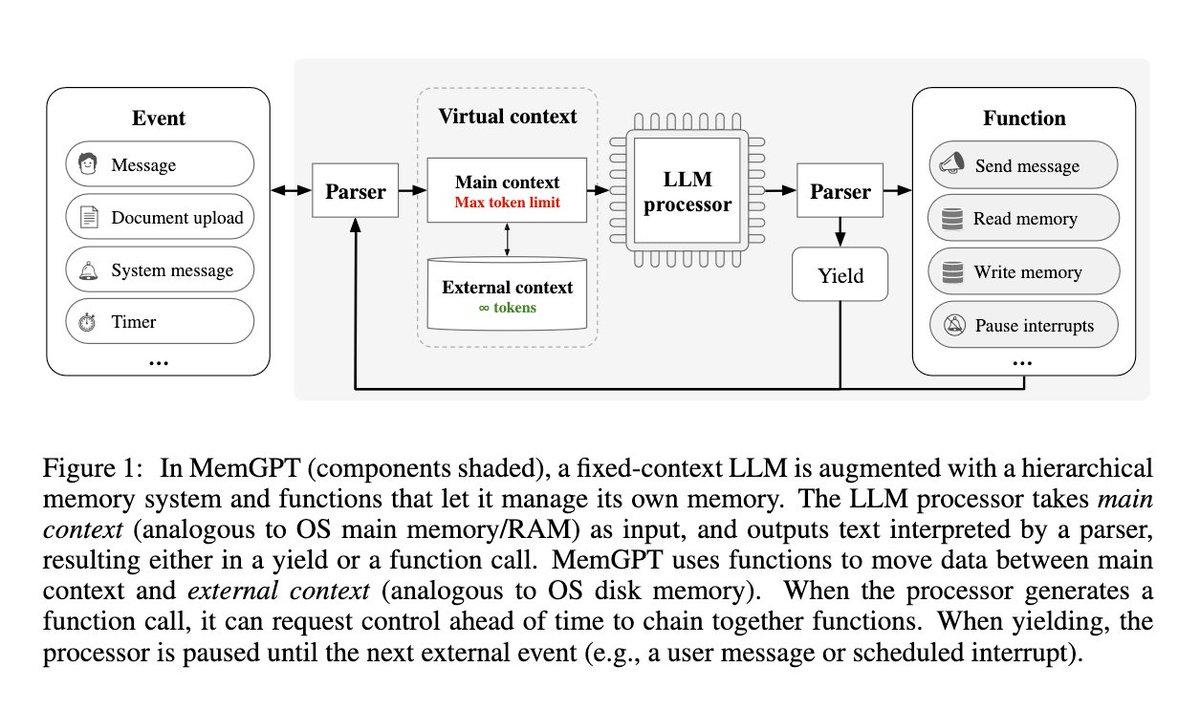
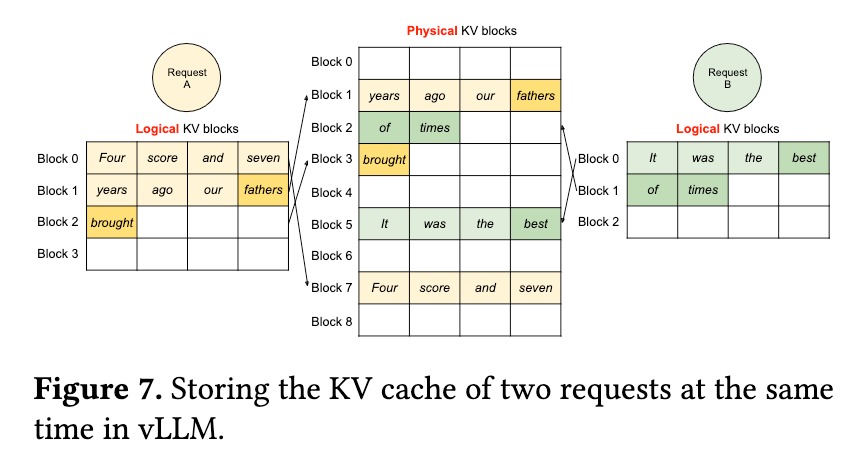
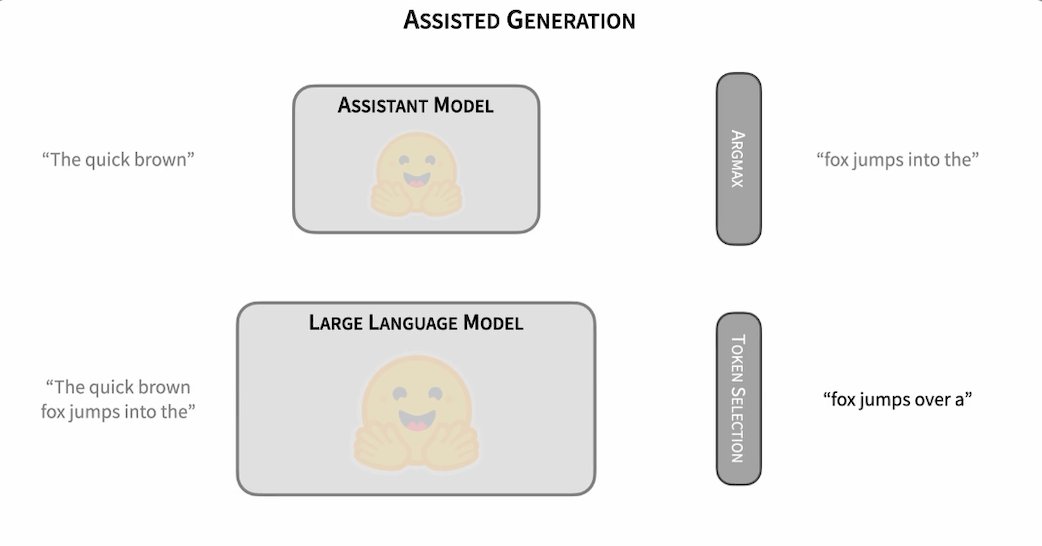
PagedAttention, Virtual Context, Speculative Decoding, Register Tokens: the last year has seen many ideas from systems programming applied to LLMs.
Not many folks live in that intersection, so I wrote an explainer post to make them a bit more accessible!
https://t.co/FwUfsQgQ3I
Another massive week of AI developments.
Huge news this week from Meta, Baidu, OpenAI, IBM, Amazon, Figure, Google, NYC, North Korea, Ukraine, Ehang, Nvidia, Blackberry, LinkedIn, Anthropic, and YouTube.
Here's EVERYTHING you need to know (a thread):
The most recent breakthrough in the LLM world just got better!
You can fine-tune open-source Large Language Models without writing a single line of code. This is big. Fine-tuning large language models is now 10x more accessible to everyone.
If you aren't familiar with the term "fine-tuning," it's the process we use to teach a model how to solve a specific task. Large Language Models have general knowledge but struggle to solve particular problems.
But fine-tuning a model is a complex, expensive process. It takes a lot of time, effort, and GPU computing. Finding the optimal hyperparameters and dealing with underfitting and overfitting models is hard. It's also difficult to find experienced people who know how to do it.
The team @monsterapis built the first platform that offers no-code fine-tuning of open-source models. Here are some of them:
• Llama and Llama 2 7B, 13B and 70B
• Falcon 7B and 40B
• Open Llama
• OPT
• GPT J
And the platform just got better with a bunch of updates:
• You can now fine-tune Mistral 7B
• QLora with 4-bit quantization and nf4
• Flash Attention 2 for faster training and reduced memory consumption
• Data and model parallelism on multiple GPUs to train bigger models using larger context lengths.
When fine-tuning models, you don't need to deal with code, complexity, or hardware. On top of that, their pricing is extremely competitive because they use a decentralized GPU platform (I've never seen this before.)
The team @monsterapis sponsored this post and offered 10,000 free credits for LLM finetuning. Sign up on https://t.co/Ih2HxRfK8X and use code "SANTIAGO" in your dashboard to use these credits.
If you want to read their latest updates, get free credits and special offers, join their Discord server: https://t.co/oecoxEec14
Hay que parar la violencia. Esta locura de destrucción y muerte no tiene sentido. Tenemos que se capaces como sociedad (todos) de decir no más a la violencia (venga de donde venga). Vamos hacia la autodestrucción.
#yanomas#yanomas
@torrenegra Hay una enfermedad horrible en Colombia de creer que "la desigualdad es algo positivo". Esta gente nunca han visto, matemáticamente, lo que están diciendo.
Lo repiten porque sus líderes lo repiten, usando el miedo de Venezuela como gasolina.
Es un virus mental horrible.