LIONEL SCALONI: “Mi papá venía de manejar 10 horas un camión lleno de piedras, y aún así se bajaba y me decía: ‘Vamos a entrenar, no hay tiempo que perder’.”
Tenía 13 años y vivía en Pujato, un pueblo donde nadie hablaba de Mundiales, pero yo soñaba con uno. Mi cancha era un garaje. Mi camiseta, la de Argentina, aunque jugara en Newell’s. Mi viejo no descansaba. Me llevaba a entrenar, me esperaba, y volvía a trabajar. Él tenía más hambre de fútbol que yo.
A los 17 debuté como profesional. A los 29, fui al Mundial. A los 44, gané uno como entrenador. Y ese día, cuando Montiel metió el penal, no pensé en la copa. Pensé en mi viejo, en el garaje, en ese niño que viajaba a dedo para perseguir un sueño.
Desde que ganamos, no recuerdo haber pagado una comida en Argentina. La gente me abraza, llora y me dice: “Nos hiciste felices.” Y cada vez que lo escucho, me repito algo: valió la pena, cada kilómetro, cada piedra, cada entrenamiento a oscuras."
🚨 Carlo Ancelotti on why he did not celebrate wildly after Gabriel Martinelli’s late winner for Brazil against Japan:
🗣️ “People asked me why I didn’t celebrate, but football is also about respect. Yes, we were happy to win, but I looked across and saw a Japanese team that had given absolutely everything. They fought with incredible courage, and I know exactly how painful a defeat like that can be.”
“Of course I celebrated inside because my responsibility is to Brazil and qualifying was our objective. But I’ve been in football for many years, and I’ve experienced both victory and heartbreak. Sometimes the best way to respect your opponent is to remain humble in your biggest moments.”
“Japan made us suffer for ninety-five minutes. They deserved our respect, not exaggerated celebrations. Brazil are through, but we know we must improve. Tonight we celebrate the qualification, but tomorrow we go back to work because the World Cup only gets more difficult from here.”
{@FoxNews }
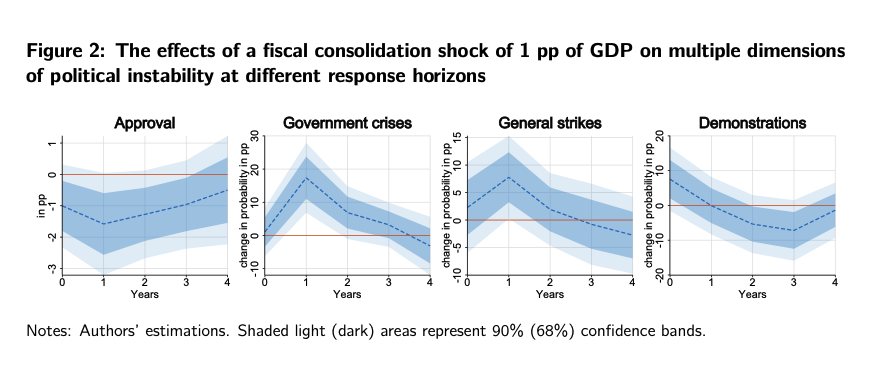
Our paper on fiscal consolidation and political instability in advanced economies: fiscal consolidation carries political costs. It lowers gov. approval and increases the likelihood of protests and government crises. However, costs vary with econ. conditions and policy design. 🧵
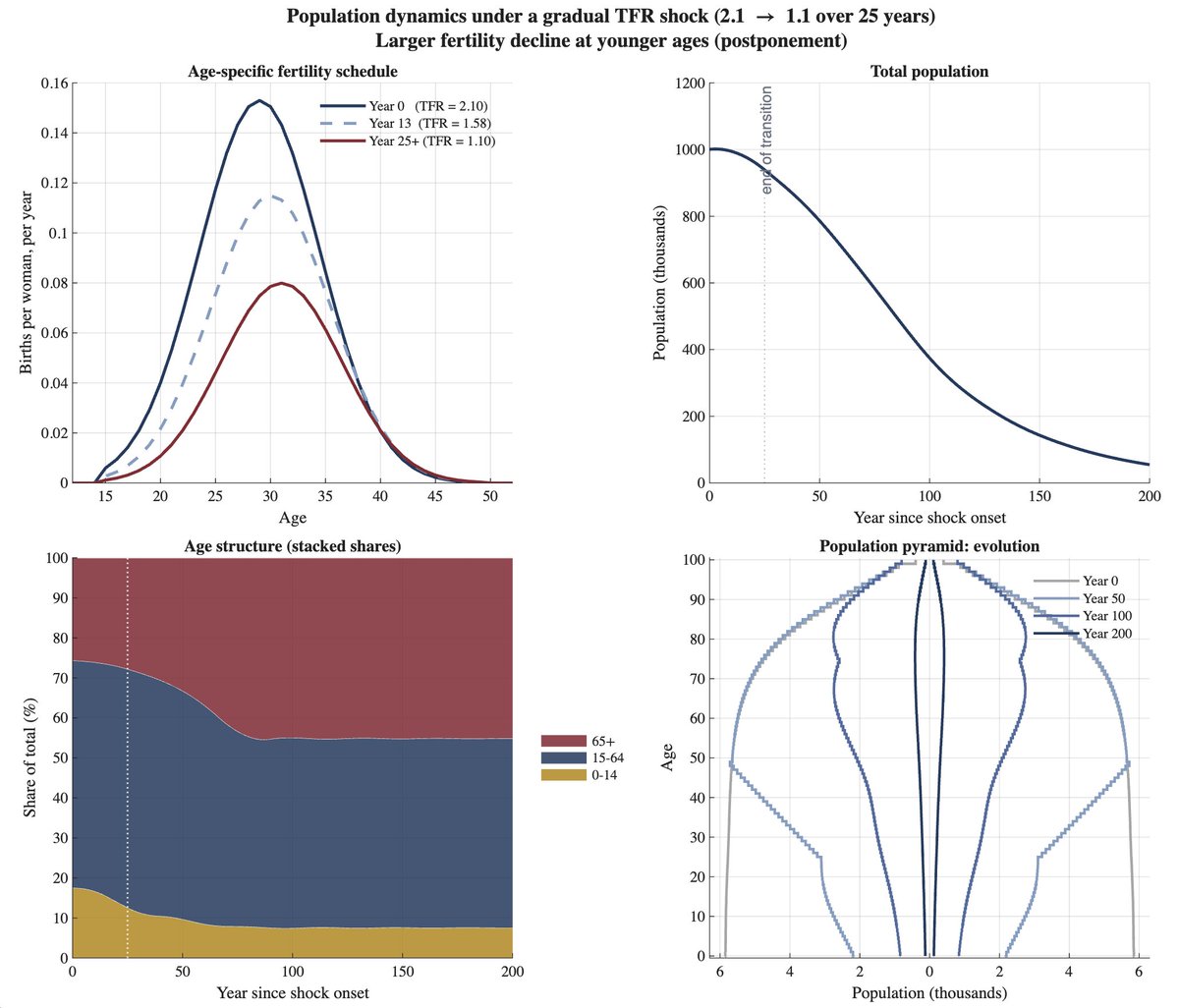
When I write about the long-run consequences of population decline, I’ve noticed that most people cannot grasp what a total fertility rate (TFR) of 1.1 means. Many of my readers look at 1.1 and treat it as not that different from 2.1. This is the wrong way to think about it: TFRs are like interest rates; they compound over time.
To make the point, I ran the following simulation. I built the population structure of a country with 1 million inhabitants, a TFR of 2.1 (just at replacement level), and a life expectancy of 85 (with realistic survival rates). Thus, this country has a stationary population over time.
I then hit this country with a reduction in the TFR from 2.1 to 1.1. The reduction, which takes 25 years to complete, is similar in size and duration to what we’ve seen in many advanced and middle-income economies. It is also concentrated among younger women, with fertility postponed to later years. I plot the initial, middle, and final TFR in the top-left panel of the figure.
I then simulate the next 200 years of this population. By the year 200, the original 1 million has fallen to 54,900, a 95.5% reduction. The top-right panel illustrates this evolution. This is not a minor adjustment: it means closing 95 of every 100 universities, hospitals, and shops. Since the population is likely to concentrate in a few remaining cities, nearly the whole country becomes a population desert.
The bottom two panels show the population structure and pyramids. The population stabilizes at a median age of 61 and an old-age dependency ratio of 95.21%.
You might argue that TFR is unlikely to remain at 1.1 for so long because higher-fertility subgroups (e.g., the highly religious) would grow as a share of the population. Fair enough. But I am not offering this simulation as a forecast. I am illustrating how, at current rates, countries of 50 million people (roughly South Korea or Spain) would become countries of 2.75 million, ignoring immigration.
These are the issues for the next century.
Since today is Marx's birthday, a few reflections from my slides posted yesterday.
First, thanks to everyone who left comments. I had a few typos (fixed) and a few inaccuracies (also fixed). There are also questions of interpretation. Some counterarguments I find compelling, others I do not.
Marx wrote an enormous amount. MEGA2 is planned for 114 volumes. Much of it exists as unfinished manuscripts and notebooks, making it easy to find different interpretations of the same ideas in the corpus, each with textual backing. Much of the scholarship has focused on working out what he meant by x or y. Natural language is inherently ambiguous, and translations only make things worse. (Btw, this is another reason math is so great: there is no industry of “what Bob Lucas meant” because he used math.)
I have often seen people misinterpret what I meant, even when the reader was very sympathetic, either because what I wrote was not 100% unambiguous or because I had background context the reader did not. I have also changed my mind on several issues. A text by the Jesús of 2006 might be inconsistent with a text by the Jesús of 2026. Who is the real Jesús? My older self? My current self? Derek Parfit wrote a lot on this if you are intrigued.
Two key ideas to keep in mind.
First, my agreement or disagreement with a thinker is largely irrelevant to my assessment of his importance in intellectual life. Few philosophers are farther from me than Edmund Husserl, yet I would never dare deny the fundamental importance of the phenomenological research agenda in 20th-century philosophy. I have spent a fair amount of time trying to understand phenomenology precisely because I disagree with it as a research agenda. A basic measure of intellectual maturity is the ability to distinguish between agreement and importance. Whether Husserl is cited is also largely irrelevant, except as an empirical question in the sociology of knowledge. A Penn colleague told me, before I wrote my first tenure reading report: “At Penn Economics, we read; we do not count.”
Second, thinkers are not like a religious creed. You cannot pick the doctrines you like, drop the rest, and still claim the label. You take it whole, or feel free to start your own denomination. But I do not need to agree with or find insights in 100% of Marx. Even if I find insights in just 10%, it is still a valuable exercise.
I remember in college, talking with some Austrians, how their “Von Mises is the Holy Father and every word he spoke is the truth” approach turned me off that research agenda immediately. It was just infantile.
So, back to the birthday boy. You can disagree with most of his answers and still take the questions seriously. That is what my slides try to do. Worshipping a thinker or dismissing him out of hand are both ways of avoiding work.
Many readers yesterday asked for more concrete examples of what I have in mind regarding the distinctions between features inherent to modernity and those inherent to “capitalism.”
Imagine we have a functioning socialist commonwealth. For simplicity, I will call it the SC.
Imagine also that this SC aims to provide state-of-the-art medical care to its citizens. This is not about superfluous consumption. It is about the desire to provide good preventive care, adequate treatment, palliative care, and so on.
Soon, you realize that you need the scientific-technological complex that develops advanced mRNA vaccines and, even more importantly, the industrial capacity to produce tens of millions of doses at short notice when a new virus arrives or an old one mutates. These are sophisticated processes that involve coordinating millions of individuals with diverse knowledge, skills, and personalities.
But it does not stop there. You will need to produce thousands of MRIs, scanners, FLASH radiotherapy machines, and all the bewildering array of equipment you find in a top hospital.
And I insist: wanting to be treated with the latest oncological equipment if you get cancer is not frivolity. It is a deep human desire that a good society (any society, really) should attempt to provide.
How are you going to accomplish all this? An SC does not want to use private property, so it relies on some form of public property. But public ownership is not the main issue. The real issue is that the SC would need to organize large bureaucratic organizations. Without them, it cannot develop and deploy vaccines, MRIs, scanners, and the rest. The need to scale is the key mechanism at play, not who owns the property.
And, because of their scale, these large bureaucratic organizations will suffer the type of problems that critics of “capitalism” attribute to “capitalism.” The organization will be impersonal and alienating, and inefficient due to career concerns, asymmetric information, conformity effects, and internal politics.
Moreover, because resource constraints hold in every human endeavor, some claims for medical treatment will be denied. The SC will not have enough resources to satisfy every medical demand (and medical demands are, for all practical purposes, unlimited), every demand for education, every demand for the environment, and every demand for this or that worthwhile cause. Sorry, yes, scarcity will always be with us, with or without AI.
Patients whose requests for medical treatment are denied will be particularly annoyed because the SC is built on the idea that such events cannot happen. At least in a “capitalist” society there is someone to blame (the “capitalist”).
Those who deny the need for large bureaucratic organizations are living in a fantasy world. I am pretty sure the day they are told they have prostate cancer, they will run to their closest large bureaucratic organization for treatment.
Those who deny the problems of large bureaucratic organizations, and how deeply irresoluble those problems are, have not seen how not-for-profits work. I have never seen more acrimonious fights than within not-for-profit organizations, where some shared sense of the common good unites members. The fights are fierce precisely because profits play no role.
I have been reading about these issues for nearly 40 years, and I have seen plenty of proposals to address the problems of large bureaucratic organizations. A favorite among many is “participation” or “more democracy” within the organization. No, sorry, more “participation” or “more democracy” only makes things worse. Yugoslavia taught us that you cannot run a large bureaucratic organization based on democratic participation (well, you only need to know some basic economics; Arrow’s impossibility theorem, anyone?).
Large bureaucratic organizations are essential to modern life, and they are full of problems, with or without “capitalism.”
This is what Weber understood and what Marx, who had an incredibly naïve view of the future, never grasped. Weber saw that bureaucracy is not a feature of “capitalism” but the institutional form modern society uses to coordinate large-scale tasks under rational, impersonal rules. Hospitals, ministries, armies, universities, and, yes, corporations all converge on the same form because it works at scale. The iron cage is not capitalist. It is modernity.
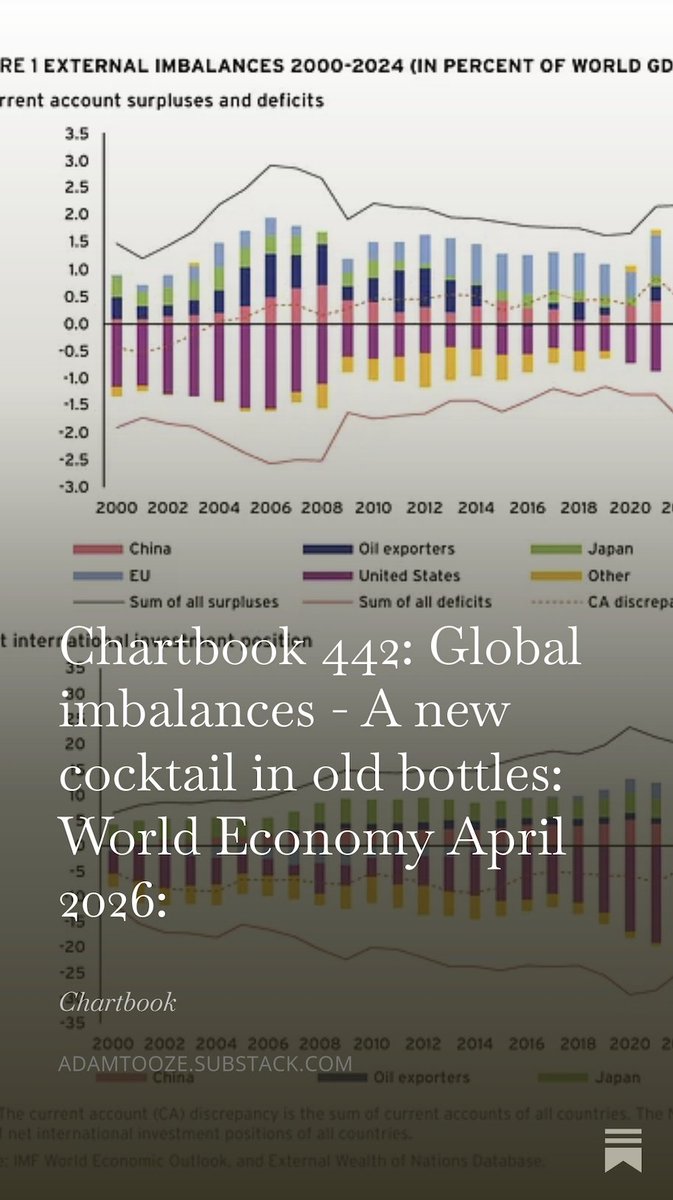
Global imbalances - April 2026. A new cocktail in old bottles.
The latest Chartbook newsletter just dropped.
Check it out here:
https://t.co/mMfEDcYvoJ
Many of us, liberal Europeans, spent decades pushing back against the European extreme left's cartoon version of America ( it's all oil/ imperialism/getting rich at the expense of others) and then one dumb administration walks in and performs the caricature to perfection.
Indeed no Treasury has ever said "stop monetizing debt, that's inflationary." It is the independent central bank's job to push back on debt monetization.