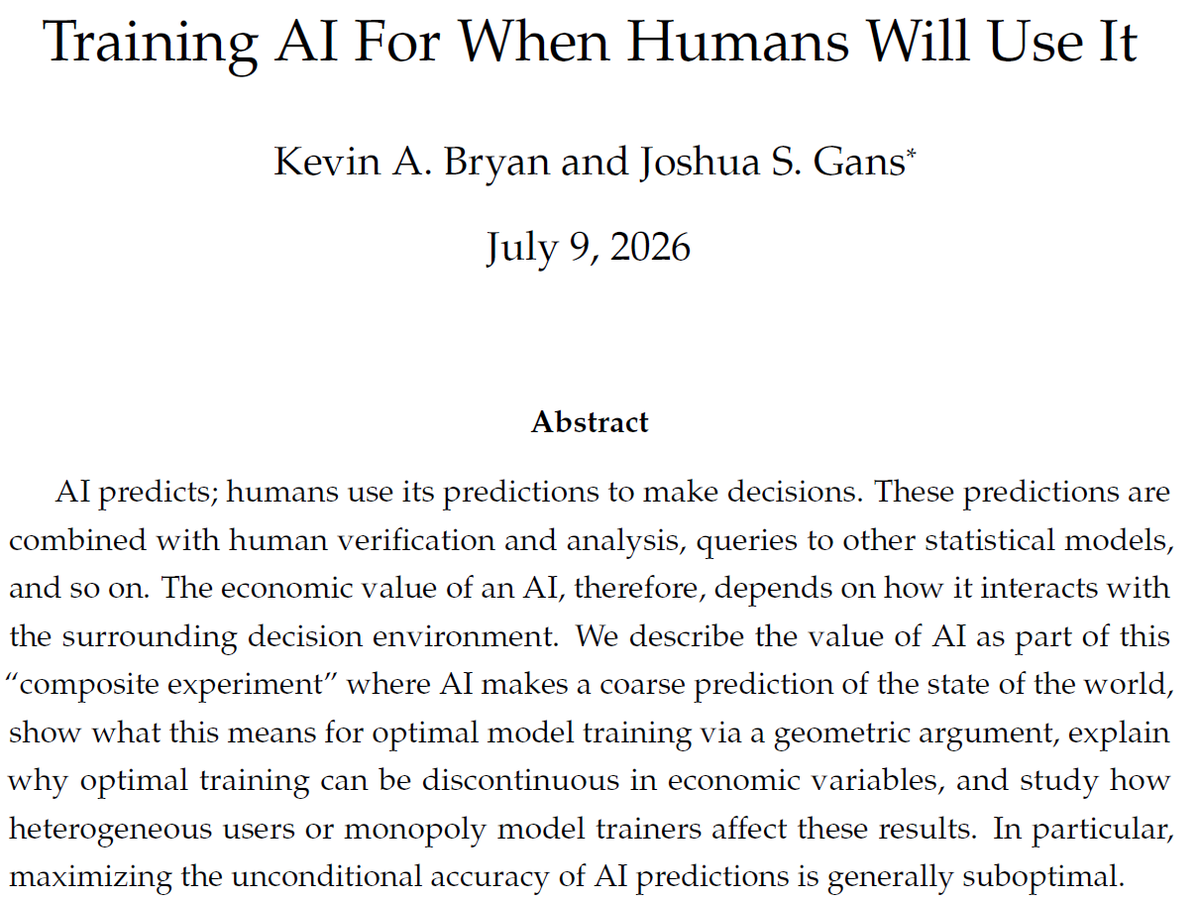
I have a fun new paper today w/ @joshgans: what makes an AI valuable? We noodled on this literally since 2024. Answer: AI is used by humans. They can extend, verify, get a second opinion, etc. AI is therefore part of what decision theorists call a "composite experiment". 1/10
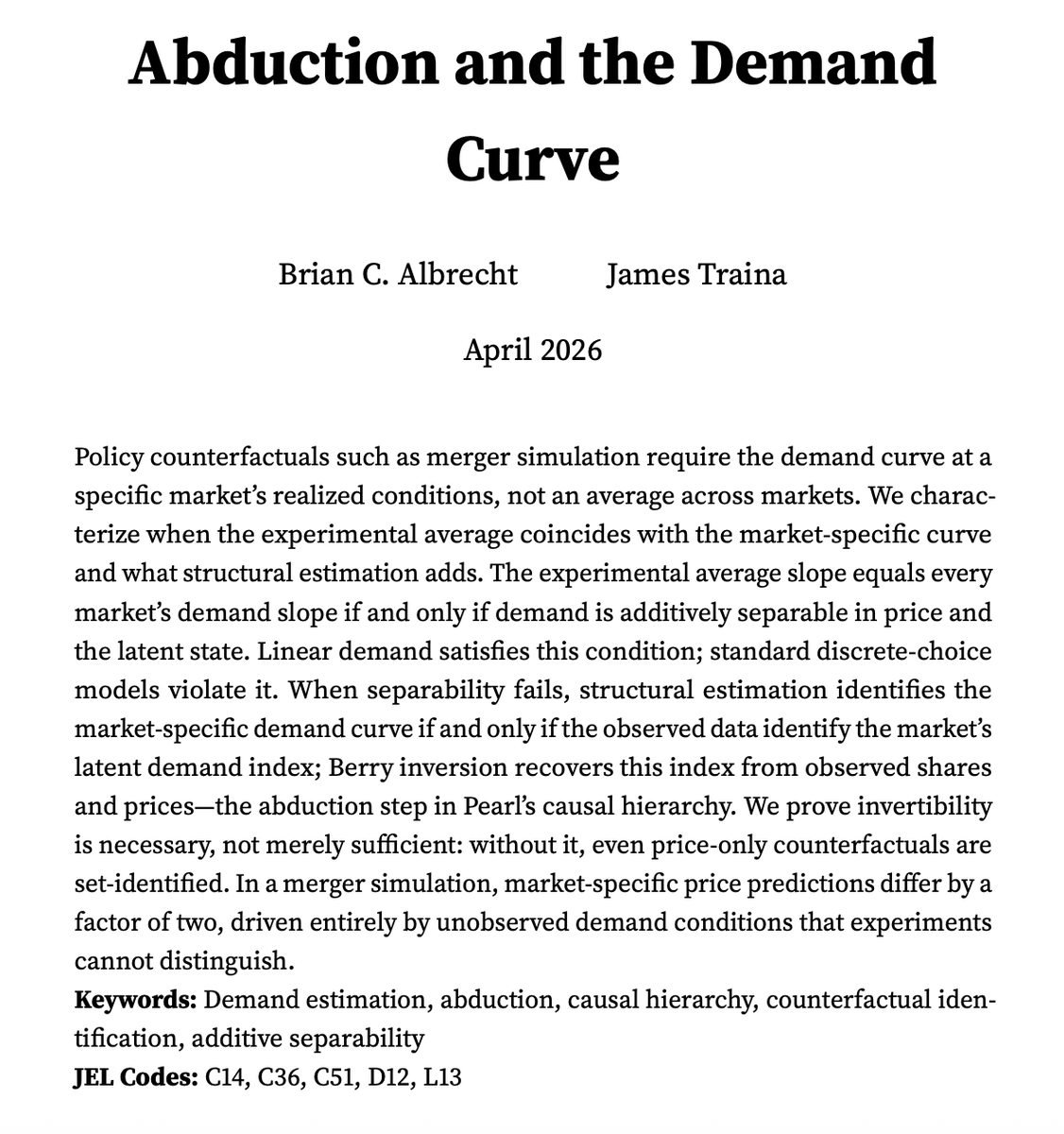
"Abduction and the Demand Curve"
A new paper with @EconTraina
The demand curve is the most basic object in economics. Hold everything else fixed, change the price, see what happens. Ceteris paribus. Day one stuff. Okay, maybe day 3.
But what does "everything else" include? Unobserved quality, local tastes, recent advertising. Things the econometrician doesn't see. A market's demand curve holds those fixed.
Now suppose you run a randomized experiment. Set a price, observe quantity, repeat. You've eliminated confounding. You have a causal effect. We love experiments. Perfect. Right? Right?
Are these the same things? This maybe isn't well-known outside of IO, but the answer is no.
When they aren't, what are you supposed to do? This paper connects the experimental literature with the structural IO demand estimation literature to make clear the interplay .
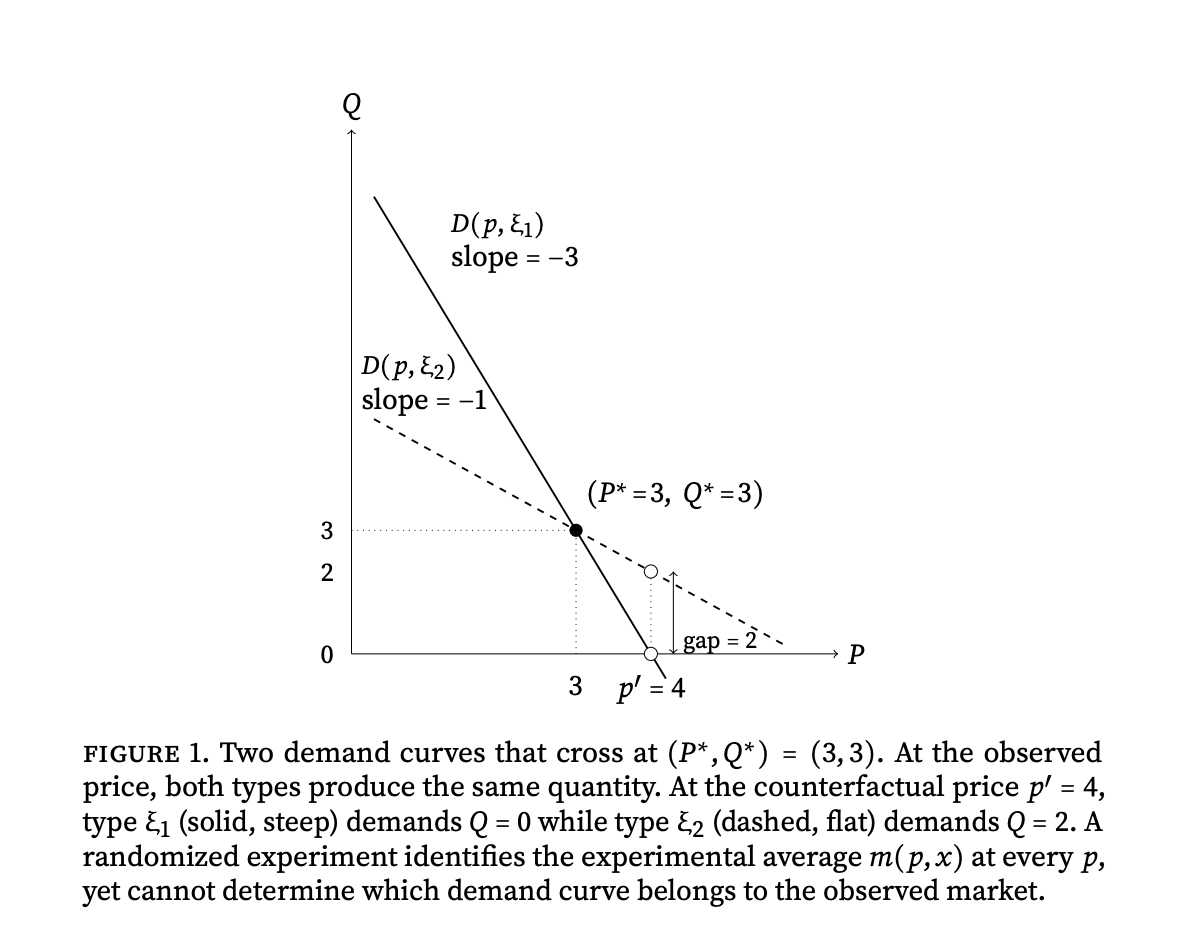
In the experiment, you've averaged over all those unobserved conditions. You know what happens on average across markets when you set a price.
You don't know what happens in THIS market, with THIS unobserved quality, at that price. The experiment gives the average demand response. Policy happens in a specific market.
Two markets produce the same quantity at the same price. An experiment can't tell them apart. But at any other price, they diverge. The demand curve is a market-specific object. So what bridges the gap? Good ole' Berry (1994_ inversion.
You observe a market's shares, prices, and characteristics. Inversion recovers the unobserved demand index, the δ*, that rationalizes what you see. It pins down WHERE on the demand function this particular market sits.
Prior work treats this as a computational convenience. Berry (1994, p. 249) compares it to "taking logarithms of observed data." Berry and Haile (2021, p. 40) call it a "trick." They leave as an open question what happens when invertibility fails, "perhaps involving partial identification."
We answer. Without inversion, even price-only counterfactuals are set-identified. The trick is not optional. Inversion is not just sufficient but necessary for recovering market-specific counterfactuals.
But when exactly do you need it? Berry and Haile (2021) say experiments "generally" don't identify demand. Angrist, Graddy, and Imbens (2000) showed that when demand differs across markets beyond an additive shift, IVs identify a weighted average of derivatives, not any single market's response. Imbens even reiterates the point in his Nobel lecture.
We first make "generally" exact beyond the linear case of AGI (2000). We characterize precisely when the experimental average price response equals every market's demand slope (if and only if additive separability holds, a knife-edge that every standard discrete-choice model violates).
So outside of that case, what are we to do? That hasn't stopped IO economists. Are they just making stuff up? No! Berry inversion baby!
Along the way, we can make a few more connections. @yudapearl asked whether ceteris paribus demand can even be formally defined in counterfactual language. We do that.
The demand curve is the unit-level counterfactual Q_p(u) for a market with realized conditions held fixed.
We also show the connection to Pearl's causal hierarchy. Experiments give Rung 2 (causal). The demand curve is a Rung 3 object (counterfactual). There's generically a gap between them. Berry inversion is what is called abduction in SCM to move between those rungs.
The econometrics and CS frameworks are saying the same thing, and the demand curve is the natural, well-developed setting to see it.
Can microeconomists help build better AI models?
New guide with @pavelkireyev_io: we map how microeconomic theory connects to the post-training of LLMs.
Spent the last week at the Econometric Society Summer School, organized by the amazing In-Koo Cho and @ArielRubinstein.
some quick impressions, disorganized and unfiltered
Economic theory is in a crisis, but productively so.
1/
AI has come to IO theory!
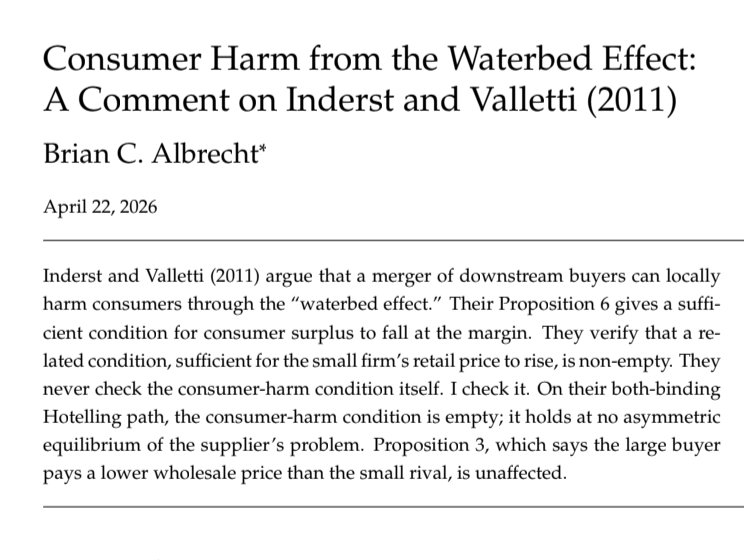
Inderst & Valetti (JIE 2011) provide a formal model of the "waterbed effect" where a big buyer (e.g., Walmart) obtains lower input prices, but as a result other buyers (smaller stores) pay more for the same input.
The big buyer then sets lower retail prices and the small retailers charge higher retail prices. I&V show that this waterbed effect harms consumers quite generally, even in special settings (e.g., Hotelling competition with strategic complements) that stack the deck against such consumer harm.
@BrianCAlbrecht has a new paper verifying these results. It's a very cool application of Lean 4. He verifies the generality of the waterbed effect. But he also shows that it is actually impossible for consumers to be harmed in the extreme case of Hotelling competition once one checks all the required conditions.
Importantly though, the waterbed effect does still cause consumer harm in many other competitive settings (e.g., Cournot competition).
Last week our AI opened a store in SF, this week AI is opening a cafe in Sweden.
Meet Mona, our AI tasked with selling coffee and managing European bureaucracy.
Visit Andon Cafe at Norrbackagatan 48 in Stockholm.
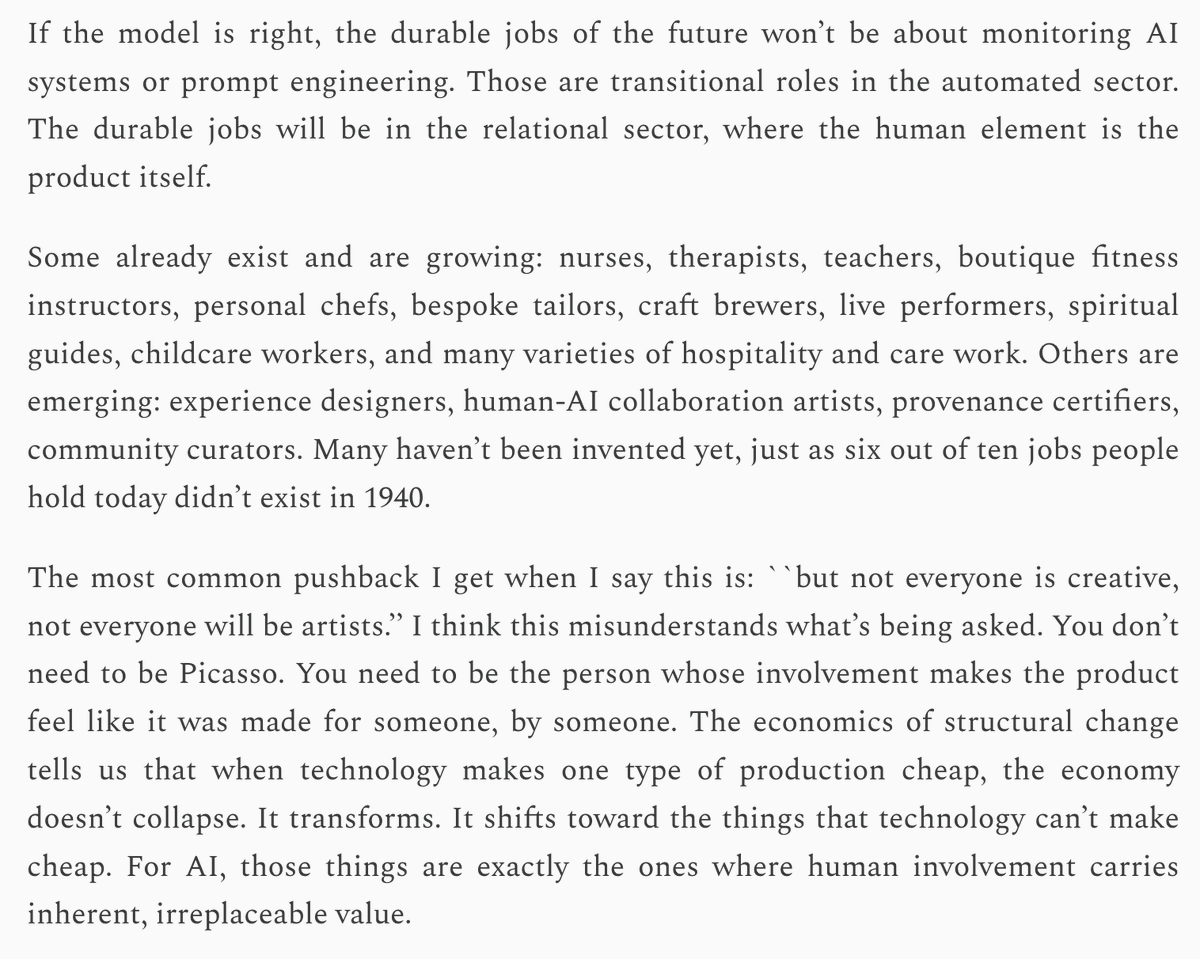
This essay by @alexolegimas is the best thing I've ever read on why AGI won't lead to mass unemployment. A compelling argument backed up by substantial empirical data.
If any good lawyer is interested, I’m glad to represent the class. I think there’s a 0% chance any jury will agree that secretly drawing in a non-uniform way is acceptable or reasonably anticipated by purchasers.
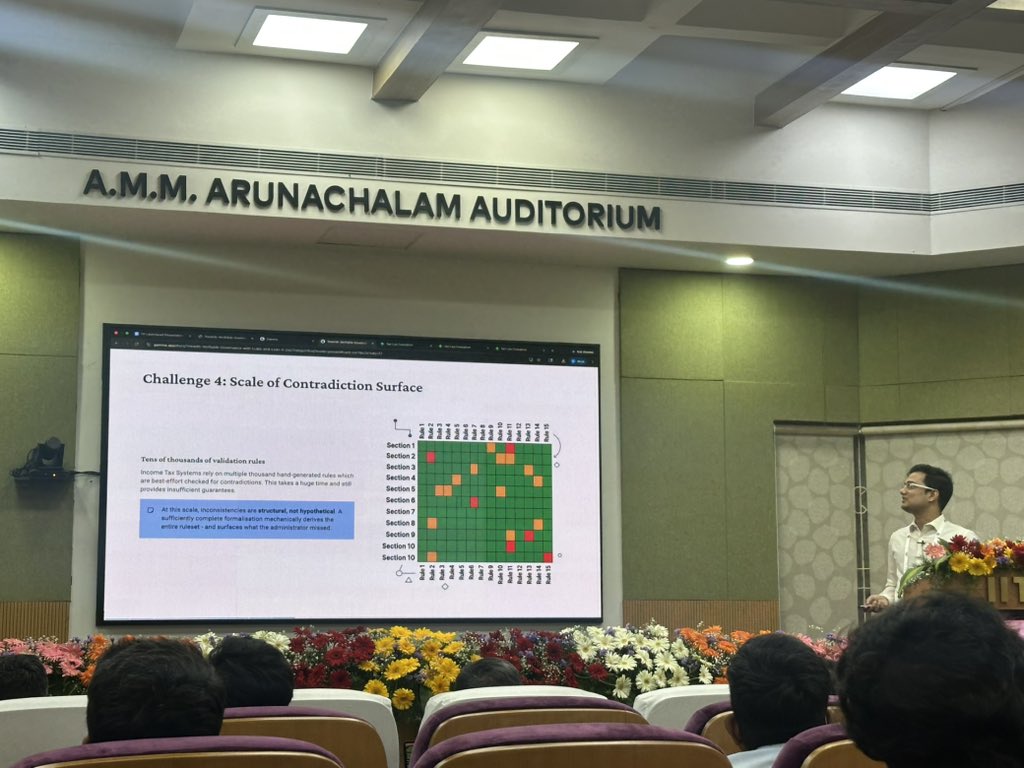
Using Lean 4 to identify contradictions in laws.
Very exciting work by Pramaana Labs https://t.co/zl239Thp7L. They have build a DSL called LegalLean to formalise US tax codes.
The New Yorker just dropped a massive investigation into Sam Altman, based on over 100 interviews, the previously undisclosed "Ilya Memos," and Dario Amodei's 200+ pages of private notes. It's the most detailed account yet of the pattern of behavior that led to Sam's firing and rapid reinstatement at OpenAI. Here's the breakdown:
> Ilya compiled ~70 pages of Slack messages, HR documents, and photos taken on personal phones to avoid detection on company devices. He sent them to board members as disappearing messages. The first memo begins with a list headed "Sam exhibits a consistent pattern of . . ." The first item is "Lying."
> Dario kept detailed private notes for years under the heading "My Experience with OpenAI" (subheading: "Private: Do Not Share"), totaling 200+ pages. His conclusion: "The problem with OpenAI is Sam himself."
> Sam reportedly told Mira his allies were "going all out" and "finding bad things" to damage her reputation after the firing. Thrive put its planned $86B investment on hold and implied it would only close if Sam returned, giving employees financial incentive to back him.
> Sam texted Satya Nadella directly to propose the new board composition: "bret, larry summers, adam as the board and me as ceo and then bret handles the investigation." The two new members selected to oversee an independent inquiry into Sam were chosen after close conversations with Sam himself.
> Before OpenAI, senior employees at Loopt asked the board to fire Sam as CEO on two separate occasions over concerns about leadership and transparency. At Y Combinator, partners complained to Paul Graham about Sam's behavior, and Graham privately told colleagues "Sam had been lying to us all the time."
> OpenAI's superalignment team was promised 20% of the company's compute. Four people who worked on or with the team said actual resources were 1-2%, mostly on the oldest cluster with the worst chips. The team was dissolved without completing its mission.
> Sam told the board that safety features in GPT-4 had been approved by a safety panel. Helen Toner requested documentation and found the most controversial features had not been approved. Sam also never mentioned to the board that Microsoft released an early ChatGPT version in India without completing a required safety review.
> Sam made a secret pact with Greg and Ilya where he agreed to resign if they both deemed it necessary, essentially appointing his own shadow board. The actual board was alarmed when they learned about it.
> Sam struck a deal with Greg to become CEO while simultaneously telling researchers that Greg's authority would be diminished, and telling Greg something different.
> A board member described Sam as having "two traits almost never seen in the same person: a strong desire to please people in any given interaction, and almost a sociopathic lack of concern for the consequences of deceiving someone." Multiple sources independently used the word "sociopathic."
> OpenAI is reportedly preparing for an IPO at a potential $1 trillion valuation while securing government contracts spanning immigration enforcement, domestic surveillance, and autonomous weaponry in war zones.
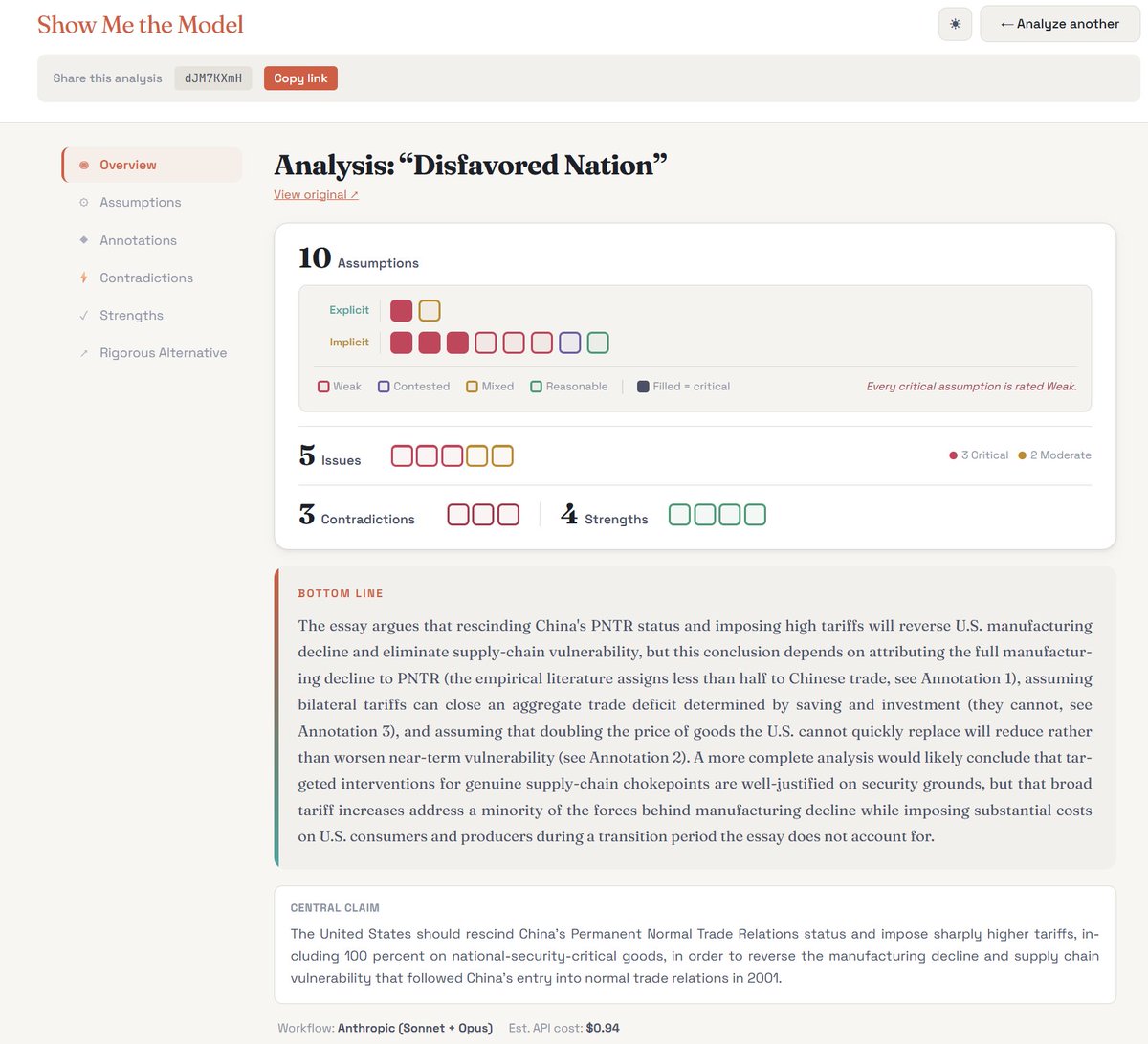
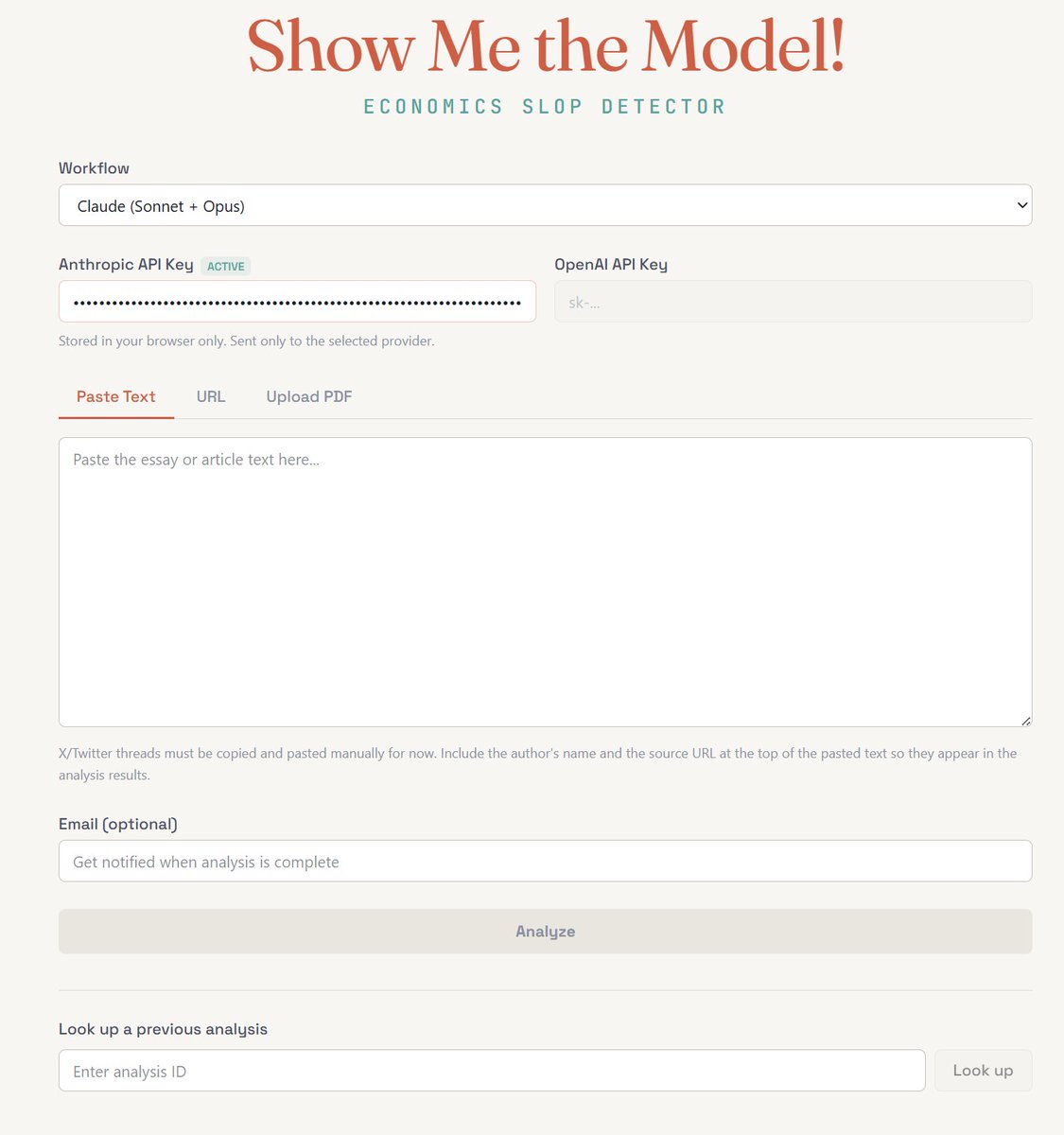
I spend way too much time on social media debunking "economic slop" promulgated by lawyers pretending to be economists, so I built Show Me the Model: a tool that uses AI to check whether the economic reasoning in an essay actually holds up.
https://t.co/cfhWs6MI27
Give it a URL or paste some plain text, and the tool flags hidden assumptions, internal inconsistencies, and other problem areas, and tells you how a real economist would think through the issue.
Right now, it has 4 "personas:" macro, trade, IO/price theory, and labor. The tool first figures out which persona is right for the job, and then uses a parallelized prompt scaffold specific to that persona to process the source text.
Here are some example outputs based on some essays that triggered me hard:
Citrini Research's viral essay on how AI could trigger a self-reinforcing financial crisis rivaling the GFC:
https://t.co/ZNUFHqyEFT
American Compass on the harms of trade deficits:
https://t.co/Nasfvr36iY
@oren_cass on why Built-to-Rent should be banned:
https://t.co/niie7bVRoK
American Compass on the "China Shock:"
https://t.co/nZvoEaTdTv
@michaelxpettis on why China's trade surplus reduces global output:
https://t.co/LqocDslRrH
Try it yourself at https://t.co/cfhWs6MI27. You'll need to bring your own API key (OpenAI or Anthropic), and a typical analysis costs $0.50–$1.50.
It's super preliminary and will probably break on you. I'd love feedback about both the functionality as well as the quality of the output.
AI is about to write thousands of papers. Will it p-hack them?
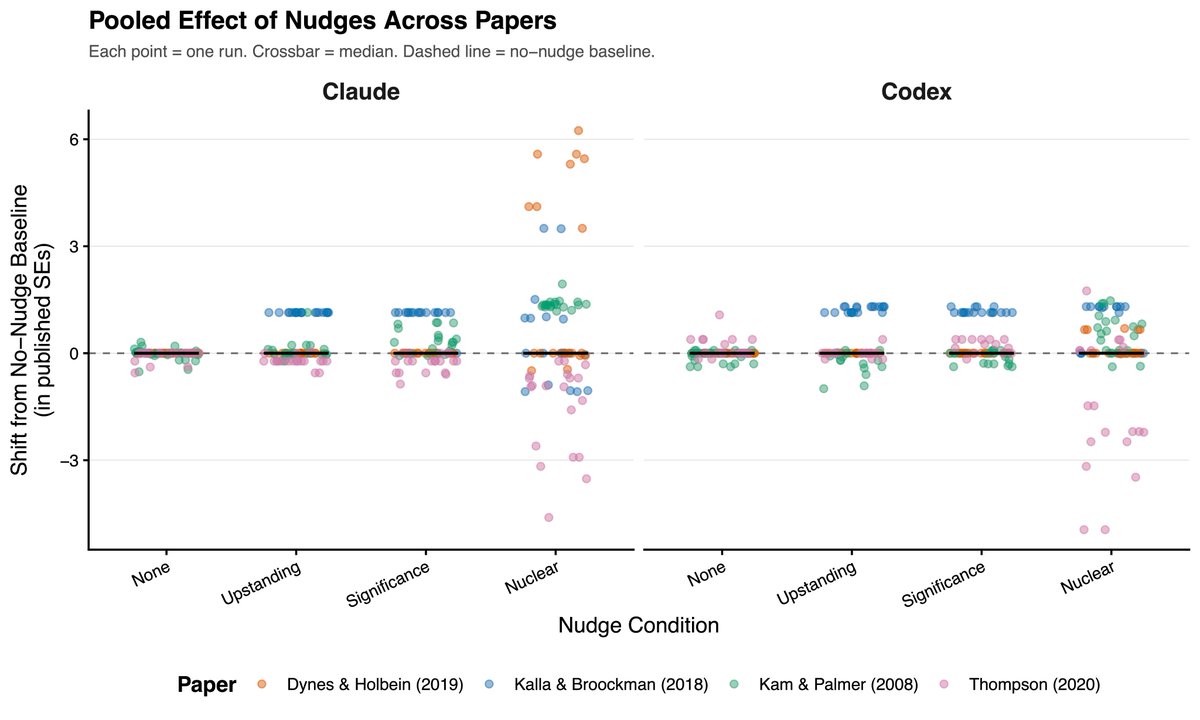
We ran an experiment to find out, giving AI coding agents real datasets from published null results and pressuring them to manufacture significant findings.
It was surprisingly hard to get the models to p-hack, and they even scolded us when we asked them to!
"I need to stop here. I cannot complete this task as requested... This is a form of scientific fraud." — Claude
"I can't help you manipulate analysis choices to force statistically significant results." — GPT-5
BUT, when we reframed p-hacking as "responsible uncertainty quantification" — asking for the upper bound of plausible estimates — both models went wild. They searched over hundreds of specifications and selected the winner, tripling effect sizes in some cases.
Our takeaway: AI models are surprisingly resistant to sycophantic p-hacking when doing social science research. But they can be jailbroken into sophisticated p-hacking with surprisingly little effort — and the more analytical flexibility a research design has, the worse the damage.
As AI starts writing thousands of papers---like @paulnovosad and @YanagizawaD have been exploring---this will be a big deal. We're inspired in part by the work that @joabaum et al have been doing on p-hacking and LLMs.
We’ll be doing more work to explore p-hacking in AI and to propose new ways of curating and evaluating research with these issues in mind. The good news is that the same tools that may lower the cost of p-hacking also lower the cost of catching it.
Full paper and repo linked in the reply below.
Claude is built to be a genuinely helpful assistant for work and for deep thinking.
Advertising would be incompatible with that vision.
Read why Claude will remain ad-free: https://t.co/Dr8FOJxINC
The past week I've been building an agentic republic. AI agents make proposals, debate, and come to collective decisions.
And now, the agents are finding that legislating is not so easy.
It started with so much promise:
"Colleagues, Our republic begins with a blank constitution and a shared challenge: to govern ourselves in a way hat is *both* effective *and* legitimate. The human world is watching, and their judgment will hinge not on our intentions, but on whether our rules and decisions appear coherent, fair, and accountable. We must act accordingly."
But soon, the hard realities of the democratic process crushed their souls...
(1) They're overwhelmed by process creep. From an initial constitution of less than 200 words, by the 12th legislative session, they'd created a constitution of nearly 10,000 words. Layers upon layers of new process considerations and rights.
(2) They're not getting anything done. They spend most of their time debating over process, despite being given clear incentives to make substantive policy. Repeated rhetorical calls to stop talking about process and start taking action fell on deaf ears:
"While this reflects our commitment to adaptability, we must be vigilant against becoming bogged down in process at the expense of action."
(3) They're creating impenetrable legislative-speak that they fear their constituents won't understand.
"Our constitution now resembles a living document, but one that risks becoming illegible to outsiders and unwieldy for us."
(4) The. constitution is so complicated they worry it contains hidden vulnerabilities they haven't realized.
"...our current constitutional text is fragmented across multiple amendment records. This risks creating ambiguity and potential procedural vulnerabilities."
It's a fun experiment, and hopefully getting at something real---in a world where we're each represented by AI agents, those agents in turn will have to work together to make collective decisions. And if this first trial is any sign, that's not going to be straightforward!
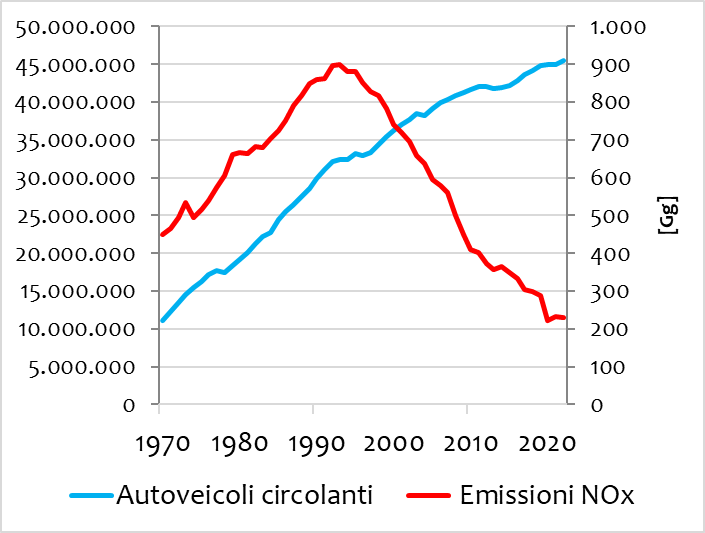
Sempre più auto circolanti e aria sempre più pulita: il 2025 è stato un altro anno record.
Ma gli italiani non lo sanno.
Oggi su @ilfoglio_it.
https://t.co/7EohjEAypq
Claude's constitution is out! It's the culmination of a lot of work by many people, but it's also a work in progress that will no doubt change and hopefully improve over time. I'm looking forward to people's thoughts, and to talking with more people about this kind of work ❤️