1/ Futarchy: The Future of Governance! 🗳️
Futarchy gives voting signals AND lets you hedge your position !
With @VeloraDEX adopting @_futarchy thanks to a @SEEDGov proposal, let’s see how this works🧵
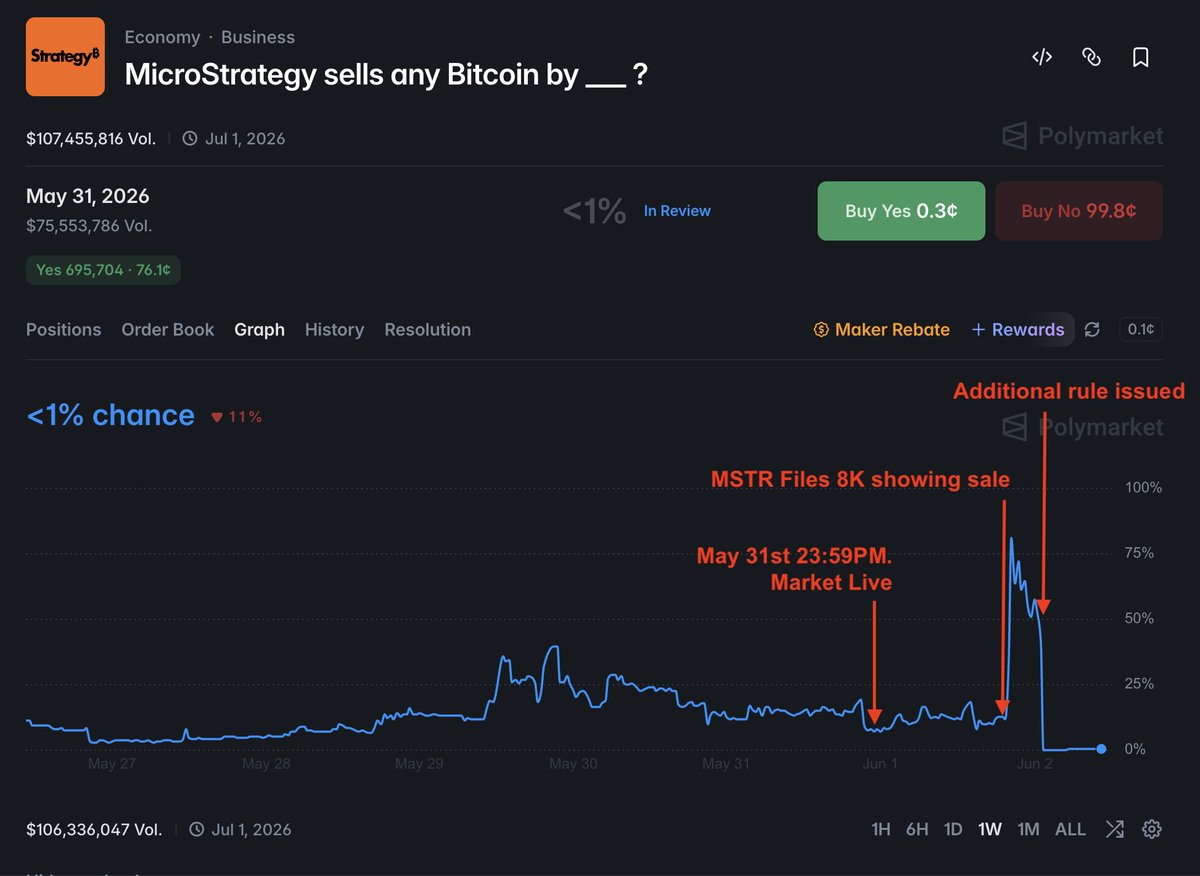
Opportunity for @Polymarket to upgrade its oracle to something slower but far more robust.
When millions are at stake, it's fine to wait a couple weeks for an answer that actually holds up 👇
Subjective oracles are hard and @Kleros_io also suffered from nitpicking attempts. But we've always worked to keep those in check.
Happy to help here. It doesn't need to be Kleros or UMA. We could have oracle aggregation (2/3 systems to determine the outcome).
Polymarket's policy changes and shady resolutions keep piling up.
The fix already exists: prediction markets like @seer_pm and @precogmarkets settle disputes through @Kleros_io — an unbiased, decentralized oracle. No edits. Just verifiable outcomes.⚖️
Before Manifest kicks off, come grab coffee with us.
Precog Markets, @Kleros, and @seer_pm are hosting Forecast & Coffee: a casual meetup for builders, researchers and forecasters.
No panels, just good conversations before a weekend of markets and forecasting.
https://t.co/tMT25iixMZ
Welcome to the future: @PharosWatch Depeg Duration Resolver is now public, in calibration phase
For every depeg recorded on Pharos, the DDR predicts
1. Recovery odds
2. Recovery timeline
Its companion module, the DDRR, evaluate the accuracy of prediction vs observed reality
✍️ Kleros × Enscribe: naming our contracts.
We've adopted ENS-based naming across Kleros's smart contract infrastructure, working with @enscribe_ as part of @ensdomains Contract Naming Season.
User sortition, rewards distributer, and the Court contracts themselves now resolve to human-readable ENS names, verifiable from any wallet or explorer.
Each contract owns its ENS reverse node. Forward (name → address) and reverse (address → name) records both set. Three audiences benefit:
→ Integrators: designating Kleros as arbitrator is now a named operation, legible at the layer it gets signed.
→ Auditors: V1 on @ethereum, V1 on @gnosischain, V2 on @arbitrum become traceable through naming, not institutional memory.
→ Jurors: the contracts you stake into and vote in
This is not an isolated effort. Kleros Curate already maintains identity records for 2.6M+ smart contracts, tokens, and addresses: the dataset @etherscan, @MetaMask, @blockscout, and @Ledger query when they need to confirm an address is what it claims to be.
Naming the contracts that run @KlerosCurate, and the courts behind them, on @enscribe_ brings the protocol users a new layer of security and raises the bar for the industry.
Verifiable identity at the protocol layer is becoming baseline.
Browse the named contracts below ↓
We do. We are keeping the TCR flame alive.
More than 2.6 million entries on Kleros Scout lists.
Stake Curate to keep an eye on the strategy of DeFi vaults. And more to come.
DeFi is risky. @Kleros_io makes it safer with Scout: a decentralized registry of smart contract tags, already trusted by @etherscan, @Ledger, and @MetaMask.
Want this protection for @Morpho markets? Use @monarch_xyz 👇
Monarch is now integrated with Kleros Scout, allowing you to identify contracts that have been curated and verified by the community.
This will help you identify contracts from major protocols with evidence - you can spot them in the position lists on markets that interest you!
AI will undoubtedly shape the future of dispute resolution, but it's far from the whole story 🧐
This chapter by @federicoast@williamhwgeorge@robertgdean is a great look at where things are headed👇
The question is not whether AI will replace human arbitrators. The real question is: which disputes should AI decide, which should go to decentralized juries, and which still require traditional adjudication?
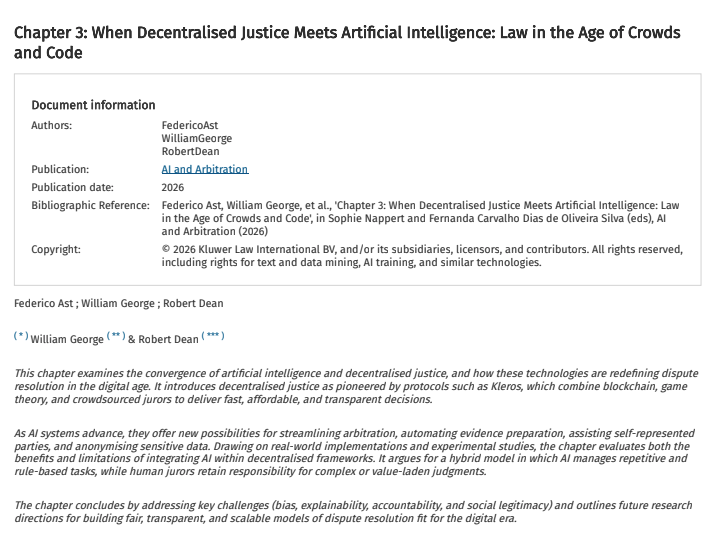
This is the topic of "When Decentralised Justice Meets Artificial Intelligence: Law in the Age of Crowds and Code", a chapter @williamhwgeorge, @robertgdean, and I wrote for "AI and Arbitration", a book edited by Sophie Nappert and Fernanda Carvalho Dias, just published by @Wolters_Kluwer: International Arbitration & Mediation.
The chapter examines the convergence of AI and decentralised justice, and how these technologies are redefining dispute resolution in the digital age.
In this text, we cover the full lifecycle of AI-assisted dispute resolution: how AI can streamline evidence preparation and protect confidentiality, how it "acted as a lawyer" helping level the playing field for users in Kleros's pilot with Argentine fintech @lemonapp_ar (90% retention rate, even in cases users lost), and what happens when LLMs actually sit in the jury box.
This last part involved empirical work. We ran ChatGPT 5, Claude Opus 4.1, DeepSeek v3.2, Mistral LeChat, and Gemini 2.5 Pro through 63 real Kleros cases.
Our conclusion isn't "AI wins" or "humans win." It's a hybrid architecture with AI courts for speed and scale, human panels for nuance, specialist courts for complex cases, and a general community court as the last line of defense against system attacks.
The chapter is available now on Kluwer Arbitration (subscription required), with the print edition coming later this year. 👇
https://t.co/IVnJ1t1Fpr
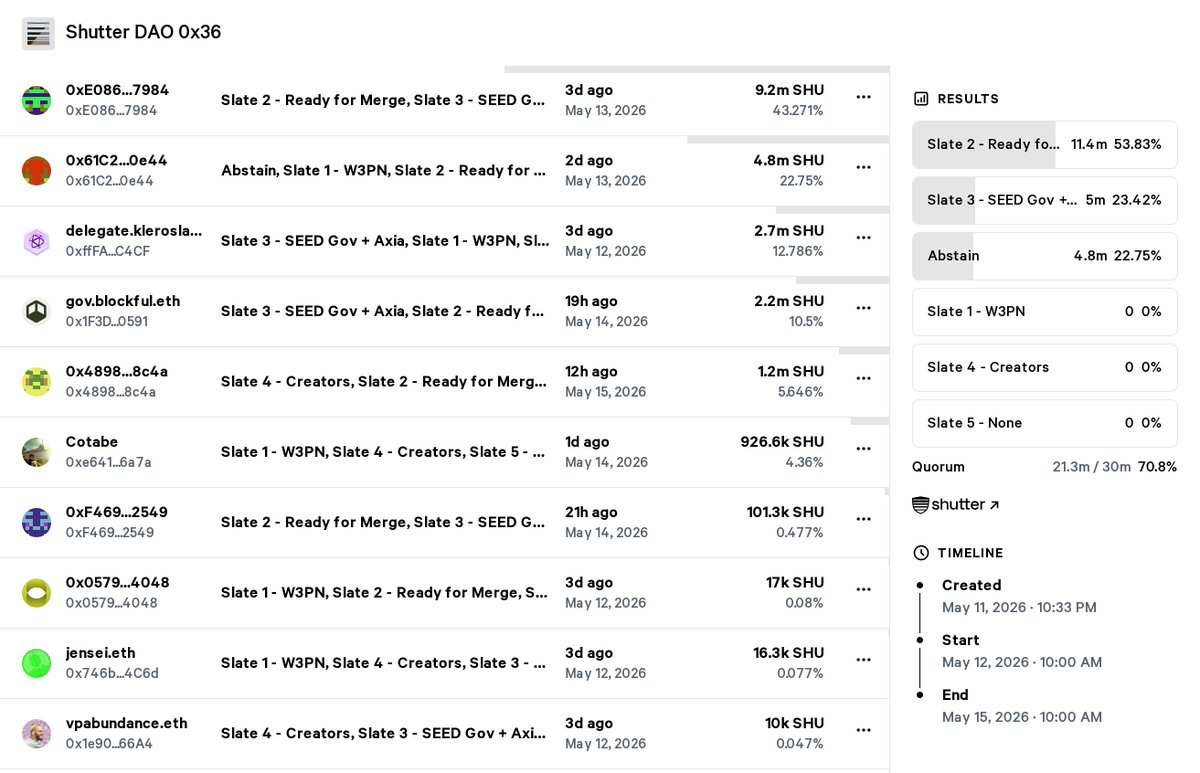
@ShutterNetwork's first Champions grant round (Melee 1 ) closed without a winner. Quorum wasn't met, so the $5,000 in $SHU won't be distributed yet; it rolls into Melee 2, bringing the next round to $10,000.
$SHU holders voted with Shutter's very own encrypted voting, ranking their preferences among four curated slates - each a different ecosystem growth strategy - and the choice to abstain.
Slate 1 - W3PN: embed Shutter at Ethereum's Cypherpunk Congress in Mumbai.
Slate 2 - @ready4merge: fund @christine_dkim's five-part mini-series on DeFi safety, with one episode dedicated to encrypted mempools and Shutter's positioning alongside PBS and inclusion lists.
Slate 3 - @SEEDGov + @AxiaNetwork0x: two complementary governance pilots from experienced delegate teams to improve proposal quality.
Slate 4 - Creators: retroactively pay writers and podcasters who covered Shutter before any grant existed.
@Kleros_io Labs and @blockful_io ranked Slate 3 first; @DAOplomats ranked Slate 1 first.
Two things pushed Slate 2 to the top spot at 53.8%: the largest voter (9.2M VP, ~43% of total cast) had it as #1, and across the rest of the field it was the most common runner-up. Slate 3 took 23.4%, 22.75% abstained.
More news next week on Melee 2. Make sure you don't miss it.
Proposal: https://t.co/NpdXxm6adv
"The Predictive Path of Justice: Can Prediction Markets Solve the Arbitration Efficiency Crisis?"
What if a commercial dispute that would typically take years and cost millions of dollars could be resolved in days... not by a tribunal, but by a prediction market?
International arbitration is facing a legitimacy crisis. Costs are rising, timelines are stretching, and for many parties the cost of pursuing a legitimate claim exceeds what winning it would be worth.
The solution may not lie in yet another procedural reform, but in a mechanism borrowed from finance and forecasting. When experts with real money on the line assess a case and trade on its outcome, a neutral, credible market price emerges as a tool for early settlement.
In this guest post on the @Wolters_Kluwer Arbitration Blog, I explore how prediction markets could transform dispute resolution, and what happens when they converge with AI agents.
Read it here:
https://t.co/Y6fMXT3QSG
Often price is correlated to project success, but not in this proposal (as it would have had the project have left the project with less ressources).
Solution to that:
We could have market cap instead of price (except in proposals creating dilution, here price > market cap).
This was an interesting example of hybrid futarchy system. Here it seemed clear that the proposal would have been good for GNO price. But, probably bad for the Gnosis project. So it looks like people voted again despite knowing it would increase the price.
You are a member of @gnosis_ DAO and want to maximize GNO price for future proposals ?
Follow us and delegate your VP to futarchist.eth a msig from @SnapshotLabs@_futarchy and @Kleros_io
that only Vote based on Futarchy Signals
👉https://t.co/HUIZb8hqxV
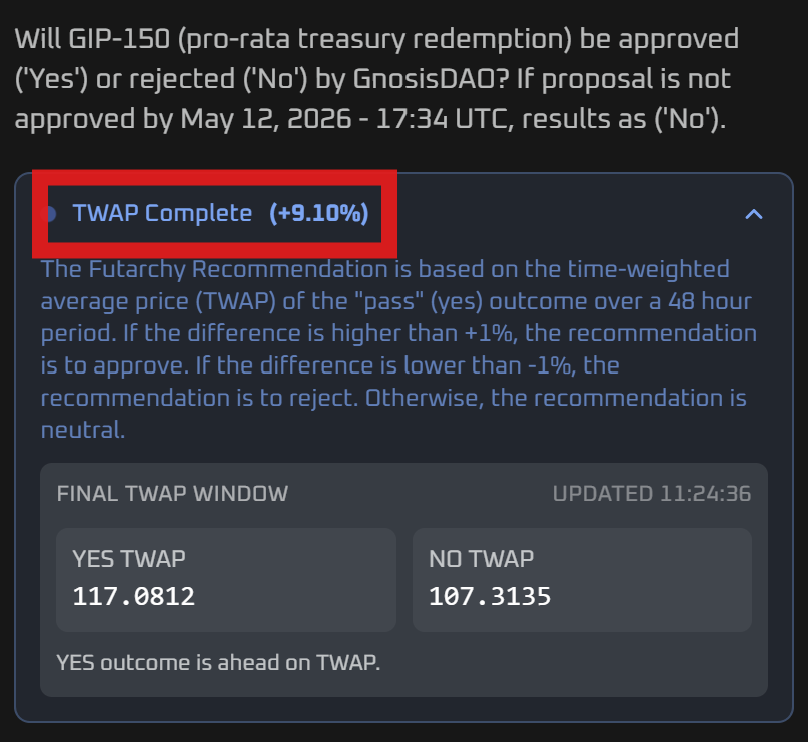
TWAP signal is FINAL 🟢
If we fork the universe right now: GNO trades +9% higher if GIP-150 passes vs. if it fails.
The @_futarchy market has spoken: @Kleros_io Cooperative vote FOR 🗳️
TWAP signal is FINAL 🟢
If we fork the universe right now: GNO trades +9% higher if GIP-150 passes vs. if it fails.
The @_futarchy market has spoken: @Kleros_io Cooperative vote FOR 🗳️
🗳️ GIP-150 may be one of the most consequential vote
@gnosis_ DAO has ever held, and we won't be voting based on our opinions.
A few weeks ago, we committed to delegate our ~29k GNO to decision markets that price the impact of each option.
The rule is strict: 5-day TWAP, YES > NO → we vote FOR. No discretion or exceptions.
If you have a view on GIP-150, the way to move our vote is to trade the market.
@Paul_Glavin@Kleros_io@gnosis_@_futarchy Yes that's a valid point indeed ! @_futarchy start with token price but any objective metrics could be a good fit join us this Thursday at Gnosis Community Call with @azsantosk to discuss more about it
At @Kleros_io we have been a long-time partner of @gnosis_ and we recognize this is a complex setup...
As stated in the Forum, we'll vote based purely on @_futarchy signal, as we believe it's the right tool for efficient governance.
Trade this market, steer our 29k GNO VP👀
Outside activists want to dismantle GnosisDAO (@gnosis_) treasury. The team is fighting them off.
GIP-150 — a one-time pro-rata redemption: GNO for ETH, stables, and a claim on illiquid assets. Redeemed GNO is burned.
Vote closes May 12.