1986: a textbook publisher led roughly 20 teachers against grade-school calculators. Calculators won; arithmetic survived. My AI prediction: bans fade, AI-free exams grow, and “show your work” becomes an authentication protocol. The tool stays; dependency gets regulated.
For the real estate folks who understand this: Cost Segregations that were PUSHED on many newbies entering the real estate market (mainly Airbnb) in 2021-2023 are now becoming the biggest nightmare for those buyers as they try to exit their non performing properties. That massive depreciation they took against their income back in 2021 now needing to be paid back in the form of depreciation recapture.
I know some folks who paid $1.5 million for an Airbnb that did $200K in rental income in 2022. DSCR loan at 7%. 20% down. Borrowed $1.2 million. Did 100% Bonus depreciation with cost seg in year 1. Now rental is doing $100,000/yr. Losing money each and every month now after paying mortgage, electric, gas, internet, etc. Need to sell, house is worth $1.2
million (maybe) now.
They are faced with not only a large loss for the sale but also the depreciation recapture when it sells. You would be SHOCKED at how many people bought Airbnbs not only for “income” reasons but also because they were told by realtors that they could offset their W2 income by a massive amount in the year they made the purchase.
Chickens are coming home to roost.
WSJ: China Is Devastating the Last Stronghold of German Industry - Midsize companies that employ millions of workers are now shedding jobs and relocating overseas to cut costs https://t.co/5uLbb3Bb4t
WATCH: Chinese authorities have recently met with top tech firms about potentially restricting overseas access to China's most advanced AI models, including those yet to be released, three people familiar with the discussions said https://t.co/5JyZUMdRKg
I'm a cardiologist. Let me tell you about the most extraordinary act of patient agency I've ever encountered.
In 2024, a tech founder named Sid Sijbrandij was told by his oncologists that they had nothing left. His osteosarcoma — an aggressive bone cancer in his spine — had returned after surgery, radiation, and chemotherapy so brutal he needed four blood transfusions to survive it. He'd exhausted every standard treatment. He wouldn't qualify for clinical trials. The implicit message: good luck.
Most people accept that verdict. Sijbrandij — co-founder of GitLab, a company worth $6.4 billion built on the principle that information should be open and transparent — decided to treat his cancer the way he'd built his company.
He went founder mode.
He quit his day job. Assembled a dream team. Hired a geneticist named Jacob Stern, formerly of 10x Genomics. And then he did something no cancer patient has ever done at this scale.
He generated 25 terabytes of his own medical data.
Whole genome sequencing. Whole exome sequencing. Bulk RNA-seq. Single-cell RNA-seq across multiple timepoints. Full-body PET/CT scans. Organoid models grown from his own tumor tissue. Immunohistochemistry. Spatial transcriptomics. Every diagnostic modality that exists — run on his specific cancer, at his specific stage, from his specific body.
Then Jacob Stern fed it all to ChatGPT
@bnjmn_marie 1. Is it different from M2.x? If I remember correctly, it was very sensitive to quantization.
2. Does that mean where to use quantization more aggressively (moq) or that REAP has more potential?
As everyone watches the SpaceX IPO today, its worth remembering this advice from Buffett
"The idea that a newly issued security (IPO)—brought to market at a time of the seller's choosing and surrounded by massive hype—is the single best bargain among thousands of global businesses is absolute nonsense.
When an offering carries a ridiculous 7% commission just to incentivize salespeople, it simply cannot be the most attractive investment available.
While people easily get caught up in the excitement of a new launch, look at the reality: you have thousands of existing public companies whose prices are set by a natural auction market, free from aggressive promotion or hidden fees.
It makes no sense to buy a security precisely when an insider decides the timing is perfect to sell. Frankly, it isn't worth spending five seconds thinking about IPOs."
- Warren Buffett
BREAKING NEWS: Anthropic's latest model will NOT help you if it thinks your ML research/ML engineering is interesting, and/or will secretly degrade its IQ so that the average engineer won't notice. We are already seeing Anthropic's latest model's moderation filters our GPU inference research and programming 😭
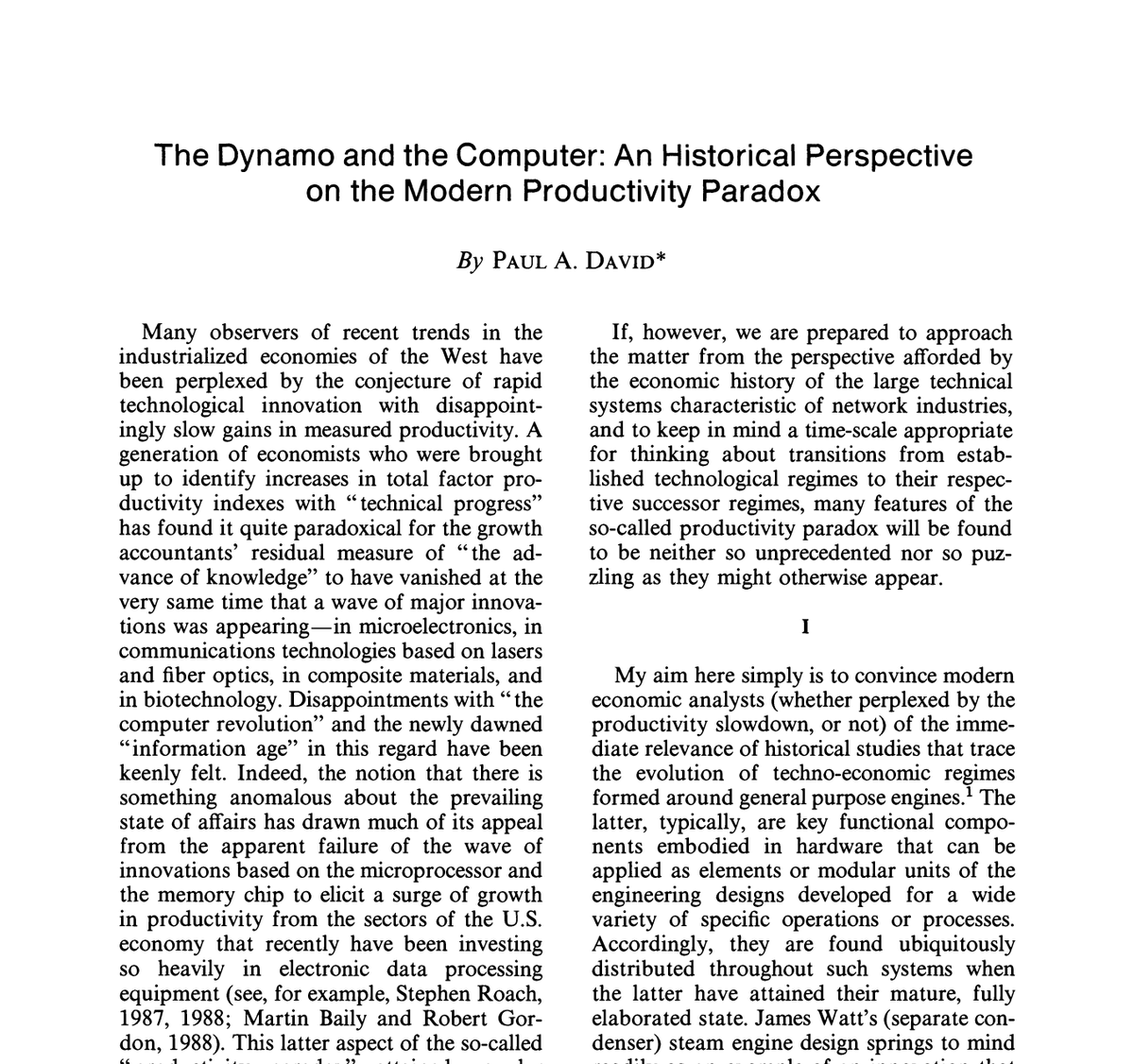
If you've adopted AI at your company but haven't seen any tangible results, read this 1990 article: "The Dynamo and the Computer" by Paul David.
When electricity first arrived, factories that "adopted" it barely got faster. They just swapped the steam engine for an electric one and ran everything else exactly as before: same machine layout, same workflow, same management. Electricity in, no real gains out.
The most common mistake with any new technology is to drop it into the old organization and then declare the transformation done.
The real leap came decades later, when each machine got its own small motor. Suddenly machines no longer had to be lined up around one central drive shaft. They could be rearranged around the actual flow of work.
The productivity gains didn't come from electricity. They came from REDESIGNING THE ENTIRE FACTORY around it.
AI is the same. Bolting it onto your existing process gets you a faster steam engine. The payoff comes when you redesign the work itself.
(link to paper in comments)
@bnjmn_marie @WaleedAhmad1a10 And if you need more, there are communities like BlackwellPerformance that might collaborate with you to get the evals on 2x or 4x... Your work is helping the community
@bnjmn_marie @WaleedAhmad1a10 Oh wow, what system you need to do the evaluation? I meant ds4 flash. If one can run evals on rtx6000pro on wsl, let's chat
This has quietly been a miracle month in medicine.
In the last 5 weeks we’ve got news on:
- retatrutide, the triple agonist GLP-1 from Lilly, basically melting fat and body-wide inflammation at record levels
- RevMed’s new pancreatic cancer drug showing unprecedented abilities to extend life
- small trial of a one-and-done PCSK9 gene editing therapy for slashing LDL cholesterol
- Mayo’s AI-assisted radiology showing vastly improved cancer detection
- this new therapy for metastatic solid tumors
This stuff is at varying levels of evidence. Retatrutide is ~100% on its way, other stuff needs more clinical trial data. But put it together and we’re maybe on the verge of majorly reducing the mortality of heart disease and cancer, the two leading causes of death in America.
The Pope rightly warns that AI must serve human dignity, not become a tool of domination or exclusion.
But if we hand governments sweeping power over AI development in the name of safety, how do we prevent it from being used to censor, surveil, and control citizens — as Orwell foretold in 1984?
This is the real alignment problem.
“Quis custodiet ipsos custodes.” Who will guard the guardians?
“Power tends to corrupt, and absolute power corrupts absolutely.”
The oldest questions of human nature and authority don’t disappear in the AI age. They become newly relevant.
In the Communist Manifesto Marx and Engels promise a future paradise following a rough period of proletarian dictatorship. They never explain how you go from the rough period to the paradise.
Reminds me a little of tech optimism. There will be a rough patch where everyone loses his job, along with it his sense of purpose and meaning. But down the line we're all going to be kicking back, being served by robots, living it up. No one explains how we go from the rough spot to the paradise because no one knows - and that makes me a little nervous.
someone yesterday asked me what i thought high agency meant. i think it’s usually some unholy combination of:
- resourcefulness
- relentlessness
- resilience
this has always been rare, but rn it feels borderline unfair. the world has never had more leverage just sitting around waiting for one person stubborn enough to use it.
If Anthropic has a trillion dollar valuation while Google has a $4.5 trillion valuation, there are only two conclusions to be drawn
Either Anthropic is incredibly overpriced or Google is incredibly underpriced. The trick is to figure out which one is right
There will be no AI jobpocalypse.
The story that AI will lead to massive unemployment is stoking unnecessary fear. AI — like any other technology — does affect jobs, but telling overblown stories of large-scale unemployment is irresponsible and damaging. Let’s put a stop to it.
I’ve expressed skepticism about the jobpocalypse in previous posts. I’m glad to see that the popular press is now pushing back on this narrative. The image below features some recent headlines.
Software engineering is the sector most affected by AI tools, as coding agents race ahead. Yet hiring of software engineers remains strong! So while there are examples of AI taking away jobs, the trends strongly suggest the net job creation is vastly greater than the job destruction — just like earlier waves of technology. Further, despite all the exciting progress in AI, the U.S. unemployment rate remains a healthy 4.3%.
Why is the AI jobpocalypse narrative so popular? For one thing, frontier AI labs have a strong incentive to tell stories that make AI technology sound more powerful. At their most extreme, they promote science-fiction scenarios of AI “taking over” and causing human extinction. If a technology can replace many employees, surely that technology must be very valuable!
Also, a lot of SaaS software companies charge around $100-$1000 per user/year. But if an AI company can replace an employee who makes $100,000 — or make them 50% more productive — then charging even $10,000 starts to look reasonable. By anchoring not to typical SaaS prices but to salaries of employees, AI companies can charge a lot more.
Additionally, businesses have a strong incentive to talk about layoffs as if they were caused by AI. After all, talking about how they’re using AI to be far more productive with fewer staff makes them look smart. This is a better message than admitting they overhired during the pandemic when capital was abundant due to low interest rates and a massive government financial stimulus.
To be clear, I recognize that AI is causing a lot of people’s work to change. This is hard. This is stressful. (And to some, it can be fun.) I empathize with everyone affected. At the same time, this is very different from predicting a collapse of the job market.
Societies are capable of telling themselves stories for years that have little basis in reality and lead to poor society-wide decision making. For example, fears over nuclear plant safety led to under-investment in nuclear power. Fears of the “population bomb” in the 1960s led countries to implement harsh policies to reduce their populations. And worries about dietary fat led governments to promote unhealthy high-sugar diets for decades.
Now that mainstream media is openly skeptical about the jobpocalypse, I hope these stories will start to lose their teeth (much like fears of AI-driven human extinction have).
Contrary to the predictions of an AI jobpocalypse, I predict the opposite: There will be an AI jobapalooza! AI will lead to a lot more good AI engineering jobs, and I’m also optimistic about the future of the overall job market. What AI engineers do will be different from traditional software engineering, and many of these jobs will be in businesses other than traditional large employers of developers. In non-AI roles, too, the skills needed will change because of AI. That makes this a good time to encourage more people to become proficient in AI, and make sure they’re ready for the different but plentiful jobs of the future!
[Original text in The Batch newsletter.]
Life advice nobody told you: Talent and intelligence are overrated. Intelligent people are more likely to overthink, overplan, and overanalyze. They hide behind motion that doesn't create progress. They fear the judgment of others if they're proven wrong. The truth is that talent and intelligence are abundant. Courage is not. The people you admire are the ones who had the courage to act. They aren’t more talented than you. They aren’t smarter than you. They just took action when you didn’t. I often wonder how many extraordinary people wasted their entire lives waiting for permission that never came. Permission isn't granted. It's taken. You get to tap yourself in whenever you want. You can just do things.


![AndrewYNg's tweet photo. There will be no AI jobpocalypse.
The story that AI will lead to massive unemployment is stoking unnecessary fear. AI — like any other technology — does affect jobs, but telling overblown stories of large-scale unemployment is irresponsible and damaging. Let’s put a stop to it.
I’ve expressed skepticism about the jobpocalypse in previous posts. I’m glad to see that the popular press is now pushing back on this narrative. The image below features some recent headlines.
Software engineering is the sector most affected by AI tools, as coding agents race ahead. Yet hiring of software engineers remains strong! So while there are examples of AI taking away jobs, the trends strongly suggest the net job creation is vastly greater than the job destruction — just like earlier waves of technology. Further, despite all the exciting progress in AI, the U.S. unemployment rate remains a healthy 4.3%.
Why is the AI jobpocalypse narrative so popular? For one thing, frontier AI labs have a strong incentive to tell stories that make AI technology sound more powerful. At their most extreme, they promote science-fiction scenarios of AI “taking over” and causing human extinction. If a technology can replace many employees, surely that technology must be very valuable!
Also, a lot of SaaS software companies charge around $100-$1000 per user/year. But if an AI company can replace an employee who makes $100,000 — or make them 50% more productive — then charging even $10,000 starts to look reasonable. By anchoring not to typical SaaS prices but to salaries of employees, AI companies can charge a lot more.
Additionally, businesses have a strong incentive to talk about layoffs as if they were caused by AI. After all, talking about how they’re using AI to be far more productive with fewer staff makes them look smart. This is a better message than admitting they overhired during the pandemic when capital was abundant due to low interest rates and a massive government financial stimulus.
To be clear, I recognize that AI is causing a lot of people’s work to change. This is hard. This is stressful. (And to some, it can be fun.) I empathize with everyone affected. At the same time, this is very different from predicting a collapse of the job market.
Societies are capable of telling themselves stories for years that have little basis in reality and lead to poor society-wide decision making. For example, fears over nuclear plant safety led to under-investment in nuclear power. Fears of the “population bomb” in the 1960s led countries to implement harsh policies to reduce their populations. And worries about dietary fat led governments to promote unhealthy high-sugar diets for decades.
Now that mainstream media is openly skeptical about the jobpocalypse, I hope these stories will start to lose their teeth (much like fears of AI-driven human extinction have).
Contrary to the predictions of an AI jobpocalypse, I predict the opposite: There will be an AI jobapalooza! AI will lead to a lot more good AI engineering jobs, and I’m also optimistic about the future of the overall job market. What AI engineers do will be different from traditional software engineering, and many of these jobs will be in businesses other than traditional large employers of developers. In non-AI roles, too, the skills needed will change because of AI. That makes this a good time to encourage more people to become proficient in AI, and make sure they’re ready for the different but plentiful jobs of the future!
[Original text in The Batch newsletter.]](https://pbs.twimg.com/media/HIIb1VGaUAAZoAB.jpg)





