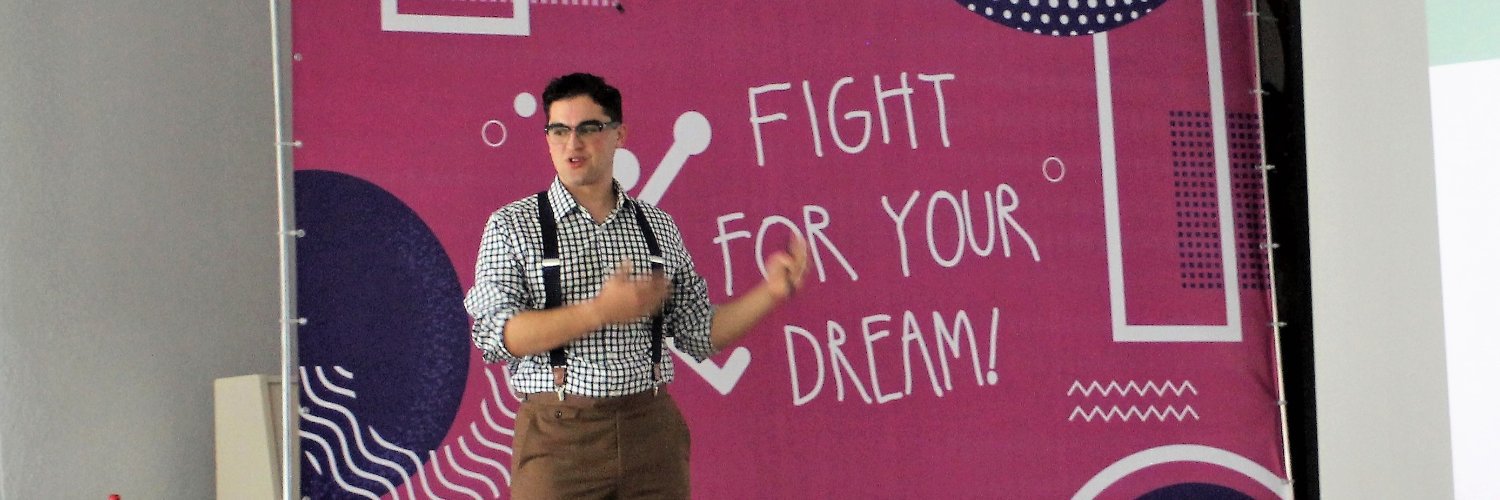
> from Florida
> boss is a real estate developer
> works multiple odd jobs
> DJs on the side
Rubio is the most Cuban-American person in human history
Going into #CERAWeek, I am thinking about emerging market, supply chain resistance, and financing strategies. Recent weeks have brought into focus how important it is to have diverse energy sources Super excited for this week. #energy#resilience#transition#innovation#strategy
Cuba 🇨🇺 BREAKING: protesters set fire to the office of the Communist Party in the town of Moron in the Ciego de Avila province, as anti-regime protests are taking place once again.
@RuhamaFernandez Creo que los jóvenes están muy capases de levantar la economía con la ayuda del mercado abierto. Mi primo se fue de la Universidad de La Habana para empezar a trabajar a la izquierda en el mercado negro y tuvo mucho éxito. El gobierno le quitaron todo. Ahora le va bien en USA.
Myopic selectivism on energy generation spread is strategically short sighted. We need more energy from more sources to maintain a global edge. We need to modernize our transmission infrastructure and harden our security.
#energy#electricity#transmission#competition#USA#NDS
China added more solar capacity in 2025 than America has installed in its entire history.
That's the most important energy chart you'll see today.
And 2025 was also the first year when small-scale distributed solar pulled in more investments than utility-scale solar farms globally.
Considering that the U.S. has hundreds of GW stuck waiting for grid connections, the conditions are aligned to start putting solar + storage on every American home.
My research team put together a Deep Dive on solar, if you want the full breakdown.
Here’s the link: https://t.co/NppxPJDM1s
It is possible to hold to 2 views on controversial issues. For example, I think actively obstructing the lawful arrests of illegal or undocumented persons is problematic for many reasons. Similarly, it’s wrong to kill someone because they tried to block a LE officer. #ice
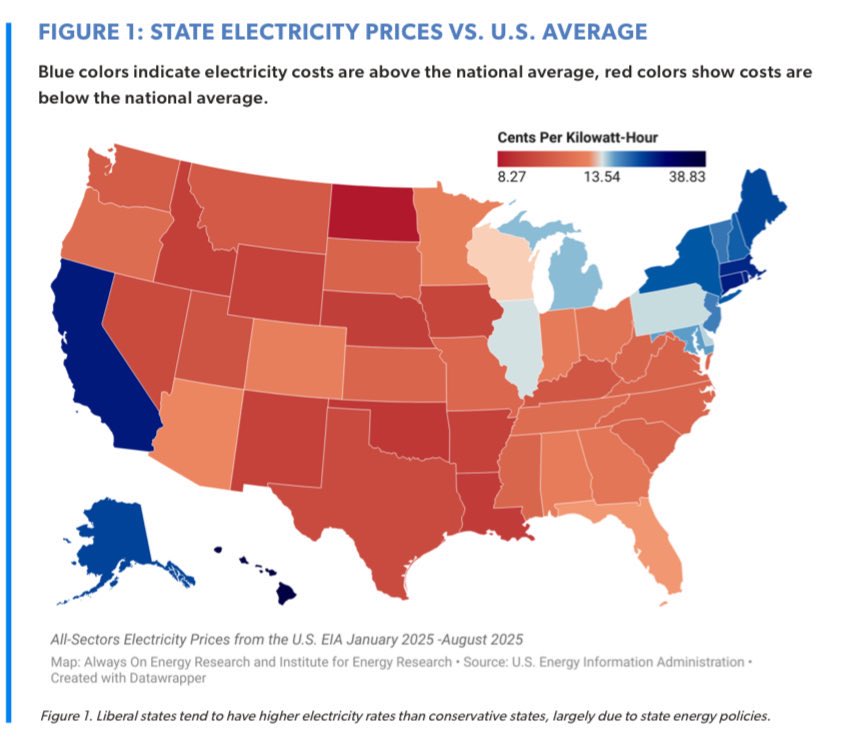
The blue states in the image below have electricity prices that are as much as 4x the electricity rates of the red states.
This is not due to any technological inferiority in those blue states but specific policy decisions that have driven competition out and prices up.
NOW - Citadel's CEO says decisions made under the Biden administration "were so so poorly thought out in terms of economic consequences, it cost the U.S. economy dearly."
How to quickly deter China from invading Taiwan — my interview with Ethan Thornton of Mach Industries
Ethan is one of the brightest, most thoughtful people I've ever met. I believe his ideas on defending the US, including our interests in Taiwan, are urgently needed.
Summary 👇
The US would likely lose a military conflict with China in Taiwan and other crucial areas in the Pacific—even though we spend far more money than China does.
• We face a vastly underrated economic threat (not to mention human rights) if we cannot deter China from seizing Taiwan.
• China has published plans to have military readiness for a Taiwan invasion by 2027.
• We depend on Taiwan for almost all high-performance semi-conductors, which are at the base of all modern industry.
• Taiwan had made clear as a deterrent that it’s prepared to destroy its semiconductor facilities in the event of an invasion, but China’s increasing semiconductor manufacturing makes the threat worse for the US than China.
• It’s now an open secret that the US loses most or all of its wargames in a conflict with China over Taiwan, Japan, or South Korea.
• How our Navy loses to China: If we can get our ships to the Pacific, we’ll quickly run out of ammo, but the more likely scenario is that our ships—including aircraft carriers—mostly don’t get there thanks to unmanned systems and hypersonics.
• How our Air Force loses to China: The Air Force has limited planes and even more limited munitions, but the increasingly bigger problem is the planes won’t take off thanks to China’s hypersonic missiles and other unmanned systems that can destroy available runways in the Pacific.
• How our Army loses to China: The Army is still planning to rely on tanks, rifles, and the fighting styles of the 2010s, even though Ukraine has shown ground wars depend on drones and other mobile, decentralized, difficult-to-target assets. Example: Ukraine is actually refusing to bring gifted M1 Abrams tanks to the front line as they would be quickly destroyed by drones.
• The US’s failure to have an unequivocally superior military to China is not a funding issue, given that the US spends some 3 times on defense what China does. It’s an issue of how money is spent.
US weapons procurement has been fundamentally stagnant for 30 years while war has rapidly evolved based on unmanned systems.
• The US’s extreme military vulnerability to China is due to us mostly spending money on the wrong things given how war has evolved. We’re still basically procuring the same weapons we were 30 years ago.
• The most important evolution in warfighting is unmanned systems, which are powerful but cheap and thus scalable and decentralizable.
• Large numbers of unmanned weapons distributed widely make large, expensive, centralized assets increasingly vulnerable (non-survivable).
• Large numbers of unmanned weapons distributed widely are hard to counter since just some of them need to survive in order to inflict huge damage.
• Yet our trillion-dollar defense budget is largely spent on manned systems that are very unlikely to survive a real conflict.
• Even insofar as the US is procuring unmanned systems, its rate of evolution is way too slow. Unmanned systems evolve like consumer electronics, yet we have long procurement cycles (more than 5 times slower than China’s).
To address the China threat we need to take advantage of our innovativeness to create stockpile of superior, strategic unmanned weapons systems that will deter them.
• We cannot win a protracted war against China, given their superiority in manufacturing, and we don’t want such a war. But we can and want to deter them from attacking Taiwan, which controls the high-performance semiconductors our economy depends on.
• Our big advantage is over China that we are better at innovating than China due to our political system and culture. They can make things at much larger scales, but we are much better at inventing new things.
• The US’s superior innovation ability means that we can make superior weapons with huge cost-performance asymmetry compared to China’s.
• These weapons need to be Strategic: can cripple China’s ability to wage war. (Ethan elaborates)
• Given the time it takes to make weapons systems and the speed at which wars now start and end, we need to create a large stockpile of unmanned weapons systems—think tends of thousands—to deter China. If government procures weapons using standards of cost-effectiveness this can be done very cheaply.
Government weapons spending must move as quickly as possible toward the standards of cost-effectiveness, scalability, and survivability.
• Big picture, US weapons spending and procurement needs explicit standards to decide what to invest in.
• Fundamentally the standard of weapons procurement must be cost-effectiveness: How much does it cost to have a given amount of effect in the expected environment?
• Part of cost-effectiveness is scalability: We need to be able to produce sufficient units now and in an ongoing conflict.
• Part of cost-effectiveness is survivability: Our weapons systems need to be able to by pass or handle enemy interference, which most legacy systems can’t.
• If government can start allocating even $10 billion by these standards we can afford to build the stockpile superior unmanned weapons systems that will deter China from invading Taiwan.
Our Lithium Refinery ushers in energy independence for North America
Regionalized access to critical battery minerals brings jobs, cuts emissions & helps accelerate our mission