AI interfaces nowadays are still pretty much turn-based.
In my PhD thesis, I thought about what interaction would look like if we could go beyond taking turns.
One example is intra-turn interaction:
ChatGPT has now a big problem.
Researchers at Oxford exposed a massive threat to large language models.”
It’s called "Model Collapse."
And it explains why the internet is about to become a toxic waste dump for Large Language Models.
Right now, AI companies are scraping the entire web to train their next-generation models.
But there’s a massive problem.
The internet is no longer just human data. It is rapidly filling up with AI-generated text, images, and code.
What happens when an AI trains on data generated by another AI?
A new paper in Nature just gave us the answer. And it is terrifying.
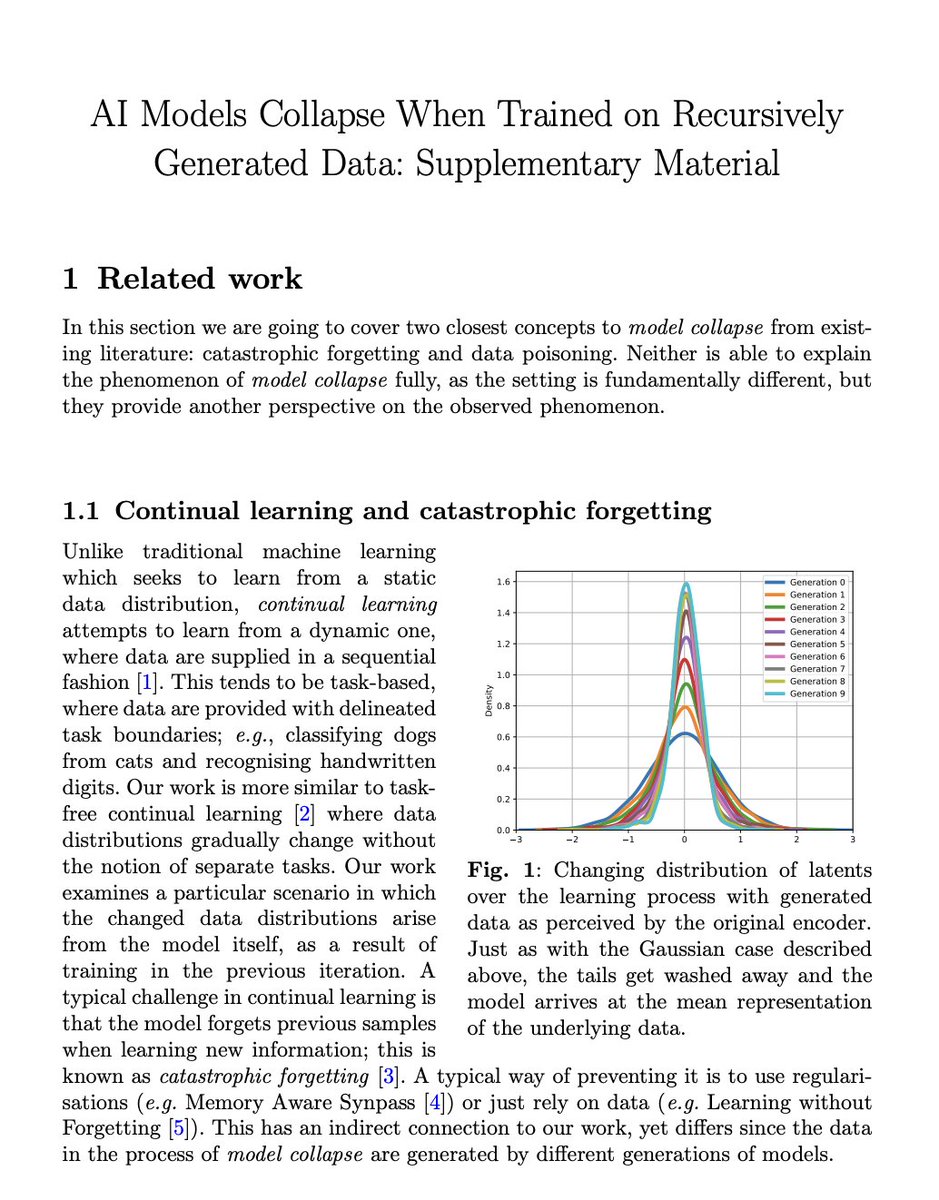
When AI models are recursively trained on AI-generated data, they suffer from irreversible brain damage.
The researchers found that the model starts forgetting the "tails" of the original data distribution. The rare, weird, unique, and complex human nuances completely disappear.
It's like making a photocopy of a photocopy.
Every generation loses resolution. The output gets flatter, blander, and more generic, until the model completely collapses in on itself.
For years, we thought the biggest bottleneck for AI was compute, getting enough H100 GPUs from Nvidia.
This paper proves the real bottleneck is us.
If we keep flooding the internet with synthetic AI slop, we will poison the very data pool required to build smarter models.
The ultimate irony? We thought AI was going to make human creators obsolete.
Instead, this research proves that verified, genuine human data is about to become the most valuable commodity in the tech industry.
So, basically, 500 million Europeans expect 300 million Americans to protect them from 120 million Russians who can’t even defeat 40 million Ukrainians while those 500 million Europeans don’t even realize they are being conquered by 2 billion Muslims who claim they are being persecuted by 8 million Israelis. Is that about right?
1
@alexstubb Clearly, the four-year narrative isn’t working. There must be more effective solutions than just talking straight for four years. The assumption is that me effective leaders would have solved the problem by now.