I’ve recently been spending time on a tertiary education business in Australia called EDU Holdings ($EDU.AX).
I don’t think I’ve ever come across a company growing this quickly, generating this much cash, and still trading at what looks like a ridiculously cheap price.
Over the past few weeks, I’ve been trying to understand this disconnect. I spoke with students, education agents, visited campuses, and had the opportunity to meet the management team at their recent AGM earlier this month.
EDU Holdings ($EDU.AX) is an education group that owns and operates two tertiary education institutes in Australia.
Ikon — higher education provider serving domestic + international students
ALG — vocational education provider focused on international students
The core asset is Ikon (~80% of Revs, ~90% of EBITDA).
Here’s why I think it's a compelling opportunity:
1) Ikon is the market leader in Early Childhood Education amongst for-profit higher education institutes in Australia (>25% share)
2) The business is growing rapidly, revenue grew 95% YoY to ~A$82m and Adj. EBITDA grew ~353% YoY to ~A$22m
3) Ikon offers the same accredited degrees as public universities at a significantly lower cost for international students, with greater flexibility than government-backed alternatives
4) Deep network of >290 education agents both onshore and offshore, who trust Ikon and recruit students on their behalf. As more students successfully secure visas and jobs post-graduation, those outcomes reinforce agent confidence in Ikon, creating a compounding loop of trust, referrals and incentives that becomes harder for competitors to displace
5) Recent regulatory changes are impacting the international student market, but EDU is proactively managing this by diversifying its recruitment channels, adapting its agent model, broadening course offerings and student mix, with multiple growth levers working in its favour. Ikon represents only ~2% of the broader education market and has continually taken share from universities, leaving significant runway ahead
6) Multiple intakes per year and ~3-year course durations create layered student cohorts, giving EDU strong revenue and earnings visibility. Even if Ikon's enrolled student base were to remain flat at ~5,300 students (T1 '26), revenue would grow ~39% in 2026 as students who enrolled partway through 2025 contribute a full year of fees
7) Highly profitable business model, with a portion of tuition fees paid prior to each trimester commencing, leading to adj. EBITDA margins of ~27% and cash conversion of ~80%
8) Asset-light business, with minimal reinvestment requirements that generates high returns on capital (~78% ROIC and ~348% ROIIC)
9) The business trades at a deeply discounted valuation, ~4.2x 2026F Adj. EBITDA and ~6x 2026F Owners earnings, despite private M&A for comparable higher education assets taking place at double-digit EBITDA multiples, including the sale of Laureate's ($LAUR) ANZ assets to Strategic Education ($STRA) at ~12.5x, with $STRA itself trading at ~6.2x 2026F EBITDA
10) The company has been aggressively buying back shares, retiring ~26% of outstanding shares since September 2024
If the above piques your interest, my full deep-dive on the company can be found here:
https://t.co/HE3ET7bFBi
From what I understand, the changes to the National Code (agent commission ban), came into effect on 1 April 2026. So T2 2026 should be the first trimester post changes.
On ARPU, it's hard to say without the full mix data, domestic is growing faster (lower fee) but postgrad was 45% of T2 NSEs and are higher fee than bachelors.
Agree on margin, hard to say where that'll end up given the investment in headcount, but I think some compression is fair.
An overall positive print today. Keen to see how this flows through to H1 numbers.
I’ve recently been spending time on a tertiary education business in Australia called EDU Holdings ($EDU.AX).
I don’t think I’ve ever come across a company growing this quickly, generating this much cash, and still trading at what looks like a ridiculously cheap price.
Over the past few weeks, I’ve been trying to understand this disconnect. I spoke with students, education agents, visited campuses, and had the opportunity to meet the management team at their recent AGM earlier this month.
EDU Holdings ($EDU.AX) is an education group that owns and operates two tertiary education institutes in Australia.
Ikon — higher education provider serving domestic + international students
ALG — vocational education provider focused on international students
The core asset is Ikon (~80% of Revs, ~90% of EBITDA).
Here’s why I think it's a compelling opportunity:
1) Ikon is the market leader in Early Childhood Education amongst for-profit higher education institutes in Australia (>25% share)
2) The business is growing rapidly, revenue grew 95% YoY to ~A$82m and Adj. EBITDA grew ~353% YoY to ~A$22m
3) Ikon offers the same accredited degrees as public universities at a significantly lower cost for international students, with greater flexibility than government-backed alternatives
4) Deep network of >290 education agents both onshore and offshore, who trust Ikon and recruit students on their behalf. As more students successfully secure visas and jobs post-graduation, those outcomes reinforce agent confidence in Ikon, creating a compounding loop of trust, referrals and incentives that becomes harder for competitors to displace
5) Recent regulatory changes are impacting the international student market, but EDU is proactively managing this by diversifying its recruitment channels, adapting its agent model, broadening course offerings and student mix, with multiple growth levers working in its favour. Ikon represents only ~2% of the broader education market and has continually taken share from universities, leaving significant runway ahead
6) Multiple intakes per year and ~3-year course durations create layered student cohorts, giving EDU strong revenue and earnings visibility. Even if Ikon's enrolled student base were to remain flat at ~5,300 students (T1 '26), revenue would grow ~39% in 2026 as students who enrolled partway through 2025 contribute a full year of fees
7) Highly profitable business model, with a portion of tuition fees paid prior to each trimester commencing, leading to adj. EBITDA margins of ~27% and cash conversion of ~80%
8) Asset-light business, with minimal reinvestment requirements that generates high returns on capital (~78% ROIC and ~348% ROIIC)
9) The business trades at a deeply discounted valuation, ~4.2x 2026F Adj. EBITDA and ~6x 2026F Owners earnings, despite private M&A for comparable higher education assets taking place at double-digit EBITDA multiples, including the sale of Laureate's ($LAUR) ANZ assets to Strategic Education ($STRA) at ~12.5x, with $STRA itself trading at ~6.2x 2026F EBITDA
10) The company has been aggressively buying back shares, retiring ~26% of outstanding shares since September 2024
If the above piques your interest, my full deep-dive on the company can be found here:
https://t.co/HE3ET7bFBi
@golden_ray_cap Thanks sir.
I'm also cautiously optimistic on ARPU, but didn't want to include any generous assumptions.
One could also make the case that mix shift towards domestic students may taper this, but that could certainly be negated by the pricing power they have + more postgrad.
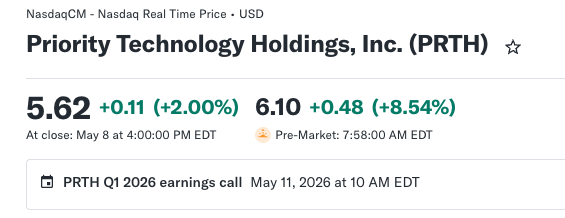
Strong Q1 from Priority ($PRTH).
Revenue +11%, Adj. EBITDA +13%, with both Payables and Treasury continuing to grow double digits. Leverage continues to trend down.
Price is now trading above the low-end of the take-private offer in pre-market.
You’d be amazed at the inconsistencies you can uncover if you actually read a company’s filings.
This is even more true in small/micro-caps, where fewer people are doing the work.
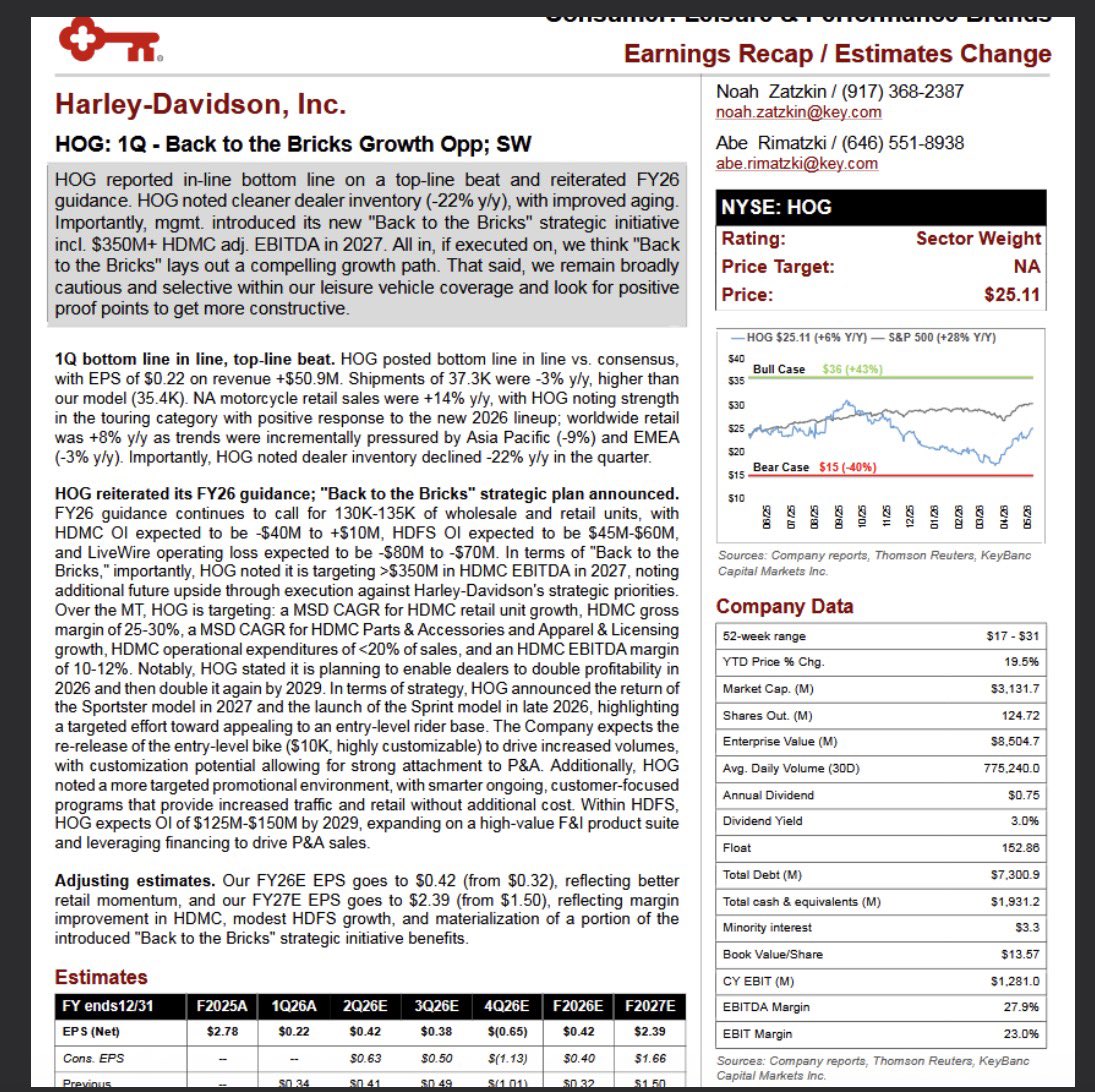
These sell side idiots are using wrong enterprise value and the WRONG SHARE COUNT on $HOG.
KeyBanc claiming 125mm shares outstanding. Off by 20%.
UBS says 114mm - still 9mm too high.
They are an embarassment to their parents.
The gap between private and public tech valuations is as wide as I’ve seen.
Take two companies, both in financial infrastructure:
@Airwallex (private) crossed $1bn in annualised revenue run-rate in Oct '25, growing 90% YoY and recently turned EBITDA profitable. Last valued at ~$8bn (Series G, Dec '25).
@PriorityTechno1 (public) is expected to cross $1bn in revenue this year, growing ~8% YoY, and is already substantially profitable with ~$225m in EBITDA, ~$112m run-rate FCF. Market cap: ~$390m (the business carries ~$1bn of debt).
Priority is growing much slower.
But is a business generating ~$112m in run-rate free cash flow really worth ~20x less?
I’ve published a follow-up piece on Priority, a company I covered a few months back. The business is compounding at ~18% and trades ~30% below a take-private bid from its founder and majority shareholder.
For those curious, here’s the link: https://t.co/Q1ZFI470rT
$PRTH
I recently revisited an idea I wrote up a few months ago, that's been caught up in the SaaSpocalypse sell-off.
The business operates payments and treasury infrastructure, compounds at 18%, and trades 30% below a take-private bid from its founder.
https://t.co/mnNmM40fVB
$PRTH
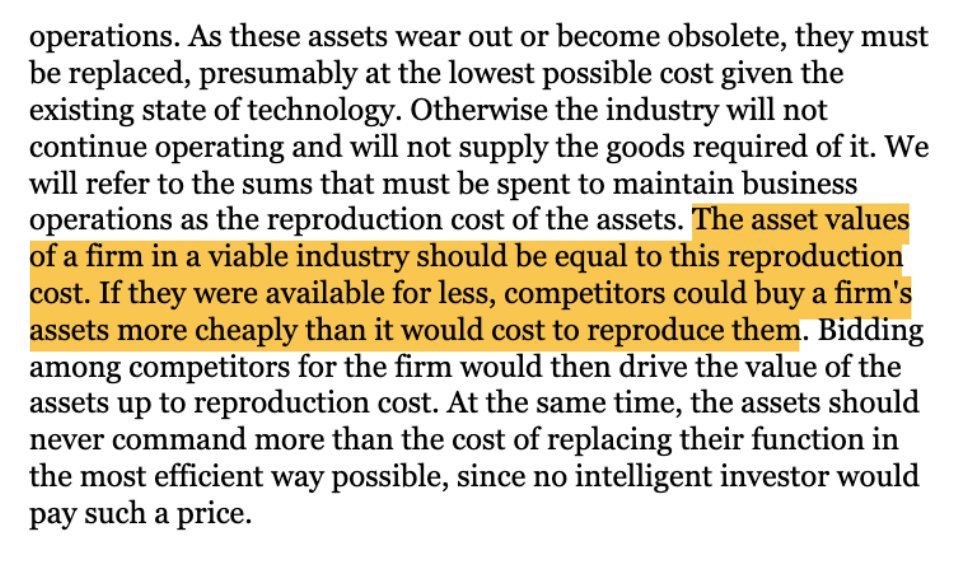
On replacement cost, and how it determines the price of future competition.
The $RIG / $VAL transaction is a good example of this framework in action. Acquiring a competitor's assets for far less than it would cost to reproduce them.
From Graham to Buffett and Beyond, p.118
@weary_centurion They don’t mention any of the retail stores in their S1 at all, it doesn’t hurt to give context, even if it’s not material to the business.
I hope you are right, because the business looks phenomenal on surface. Something feels off though.
@OddityOddballs
Yesterday, $RIG announced an all stock deal to acquire $VAL, a company I wrote up in Dec.
Thanks to my fair share of good fortune, I now face the pleasant problem of whether to realize a sizeable gain (337% IRR), or to roll my equity.
Original article:
https://t.co/mXycAQVJ8C
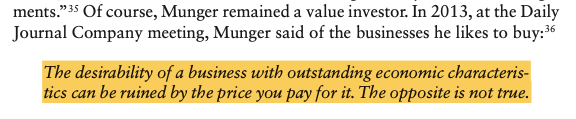
@leevalueroach I think intelligent people are naturally wired to seek out complexity. They equate 'harder to understand' with 'greater edge,' but from exp. that's rarely true.
Value investing is simple, but definitely not easy. Requires a level of patience that most people just don't have.