Alex R. DeCasien, PhD will receive the BoSD-OSSD 2024 Early Career Award for research in “Sex differences in the human brain: a roadmap for more careful analysis and interpretation of a biological reality” at #OSSD2025@OSSDtweets!
It's clear that many do not understand what @NIH-funded research does to improve health. It's time to revive a study published 10 years ago that provides incredible information about this. link in the comment
Every single new drug approved by the FDA from 2010–2016 was built on NIH-funded research—that’s all 210 drugs. But what the public sees is just the tip of the iceberg.
Pharma takes credit for the final product, but beneath each drug developed, there are ~20 years of basic research, and 90% of the cost is from basic research funded by the NIH, which discovers drug targets, understands disease mechanisms, and creates life-saving treatments.
Figuring out how cancer evades the immune system, how addiction rewires the brain, and how heart disease develops is the role of the NIH, creating the foundation for the breakthrough drugs that come 20 years later, and the NIH does all that with only 0.8% of the US budget.
Without NIH, there would be no cancer immunotherapy, no anti-overdose medication, no anti-heart attack or stroke medication, no cutting-edge treatments.
If NIH funding is cut, the iceberg will melt. That means fewer cures, more suffering, and more lives lost.
The science beneath the surface keeps us afloat.
Invest in NIH. Invest in life
I’m thrilled & honored to be starting a new lab @ the NIA!! 🤩🥹
The Computational & Evolutionary Neurogenomics Unit focuses on:
• neurodegenerative diseases 🧓🏽
• sex-biased 🧠 aging
• comparative neurobio 🐒🐁
We’re looking for postdocs! 👀
Pls RT! DM me for more info ☺️
We’re growing & still hiring! ✨
DM me if the following combo sounds like your jam:
• honing your bioinformatics skills 💻
• focusing on neurogenetics 🧠 🧬
• dissecting disease mechanisms 🔍
• combating discrimination 🌈✌🏼
I’m thrilled & honored to be starting a new lab @ the NIA!! 🤩🥹
The Computational & Evolutionary Neurogenomics Unit focuses on:
• neurodegenerative diseases 🧓🏽
• sex-biased 🧠 aging
• comparative neurobio 🐒🐁
We’re looking for postdocs! 👀
Pls RT! DM me for more info ☺️
Beyond happy to see this work published! We show that developmental timing of social brain areas correlates with social and behavioral milestones in marmosets and, as in humans, extends into adulthood. https://t.co/FzX6Ovi0nr
(1/11🧵) Echoes of fetal development etched into the adult brain 🧠 - Excited to share our new preprint!
“A bipolar taxonomy of adult human brain sulcal morphology related to timing of fetal sulcation and trans-sulcal gene expression gradients”
https://t.co/TOo9ArvBgU
New preprint alert!🚨
Do you often find yourself thinking “what’s up with those genes that have (non-recombining) copies on the X & Y chromosomes?!”🧬👀
Probably not…but @bogglecapture & I think about these “gametolog” gene pairs quite a bit!🤔
(1/11)
https://t.co/4Fkn2AEIQB
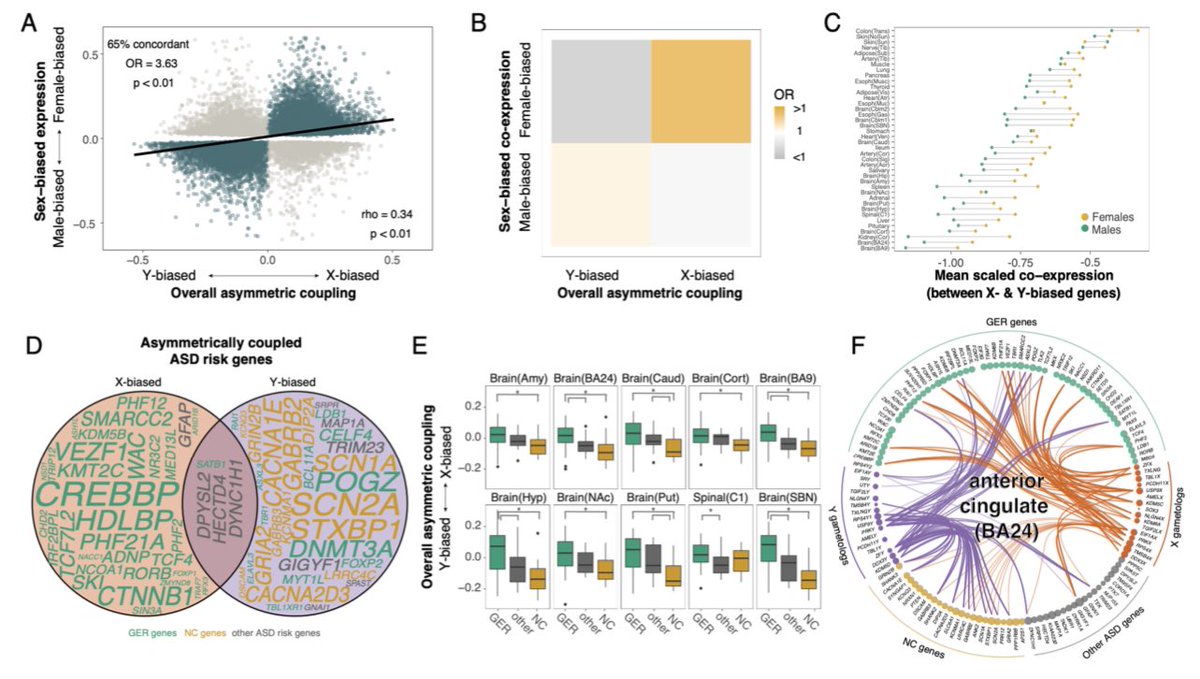
#6: Finally, we find that subclasses of ASD risk genes show diff patterns of co-exp. to X vs Y gametologs (bottom panel):
regulation-related ASD genes ��� X-biased
synapse-related ASD genes 🟰 Y-biased
➡️maybe these co-exp. patterns contribute to sex-biased ASD risk? 👀
(9/11)
Limits/gaps include:
1) bulk gene expression data (missing cell type specific and protein-level info) 🫠
2) evolutionary mechanisms driving X vs Y diffs (positive vs relaxed selection) 🐒🦧🦍
3) environmental/social factors that lead to sex/gender diffs 👩🏼🦰👨🏽👱🏽👩🏾🦱👵🏼🧔🏻🧔🏽♀️
(10/11)
#5: We predicted (& confirmed ✅) that genes with stronger co-exp. to X (vs Y) gametolog genes ➡️ higher exp. & co-exp. in XX👤 (vs XY👤) (top panel of fig)
a.k.a. genes co-regulated with X (vs Y) gametologs tend to be more highly exp. and co-exp. in XX👤 (vs XY👤)❕
(8/11)
We then reasoned that:
⏺️ if diff. X vs Y co-exp. 🟰 each gene’s co-regulation with &/or regulation by X vs Y gametolog genes…
➡️ sex diffs in exp. & co-exp. may be partly organized by gametologs 👀 (in addition to other factors e.g., hormones) 🧩
(7/11)
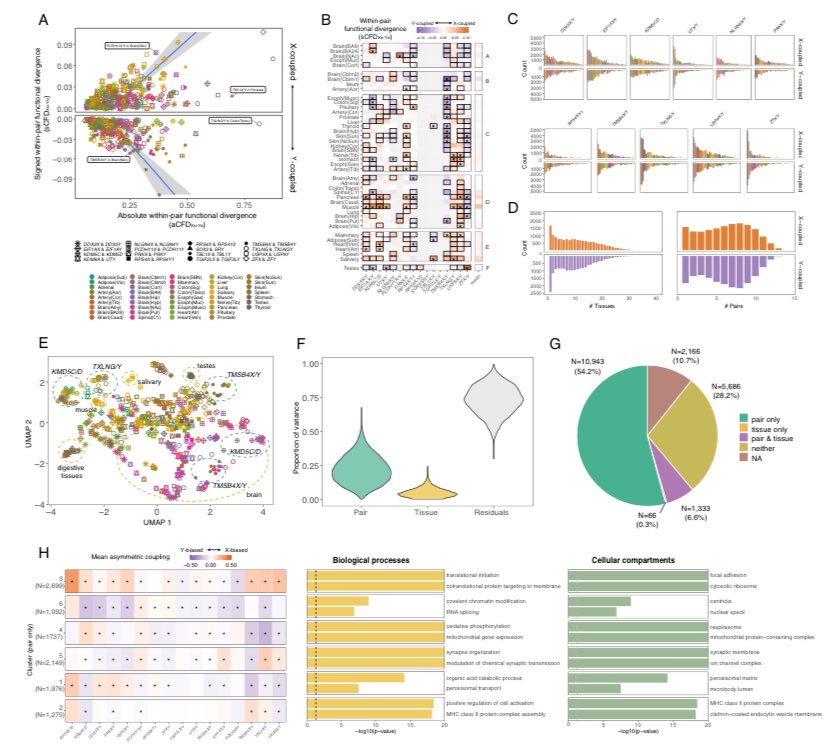
#4: We also ranked all autosomal genes by their differential co-exp. w/ the X vs Y member of each pair in each tissue (in XY👤) ◼️◾️▪️
➡️patterns differ across pairs > tissues
➡️groups of genes with similar functions (e.g., synaptic) have similar diff. co-exp. patterns
(6/11)