Our paper is now out in Neuron! @NeuroCellPress (details from preprint thread below, now with more results and containerized pipeline!) w/ @bogglerapture @edbullmore @petra_vertes and amazing coauthors
https://t.co/EFoaylbu1f
(1/11🧵) Echoes of fetal development etched into the adult brain 🧠 - Excited to share our new preprint!
“A bipolar taxonomy of adult human brain sulcal morphology related to timing of fetal sulcation and trans-sulcal gene expression gradients”
https://t.co/TOo9ArvBgU
So so so happy to share that my first, first-author paper from my time at @NIMHgov is now available online at Journal of Neurodevelopmental Disorders!
https://t.co/Mr9ggo9Uw1
See below for a 🧵of key findings... 1/
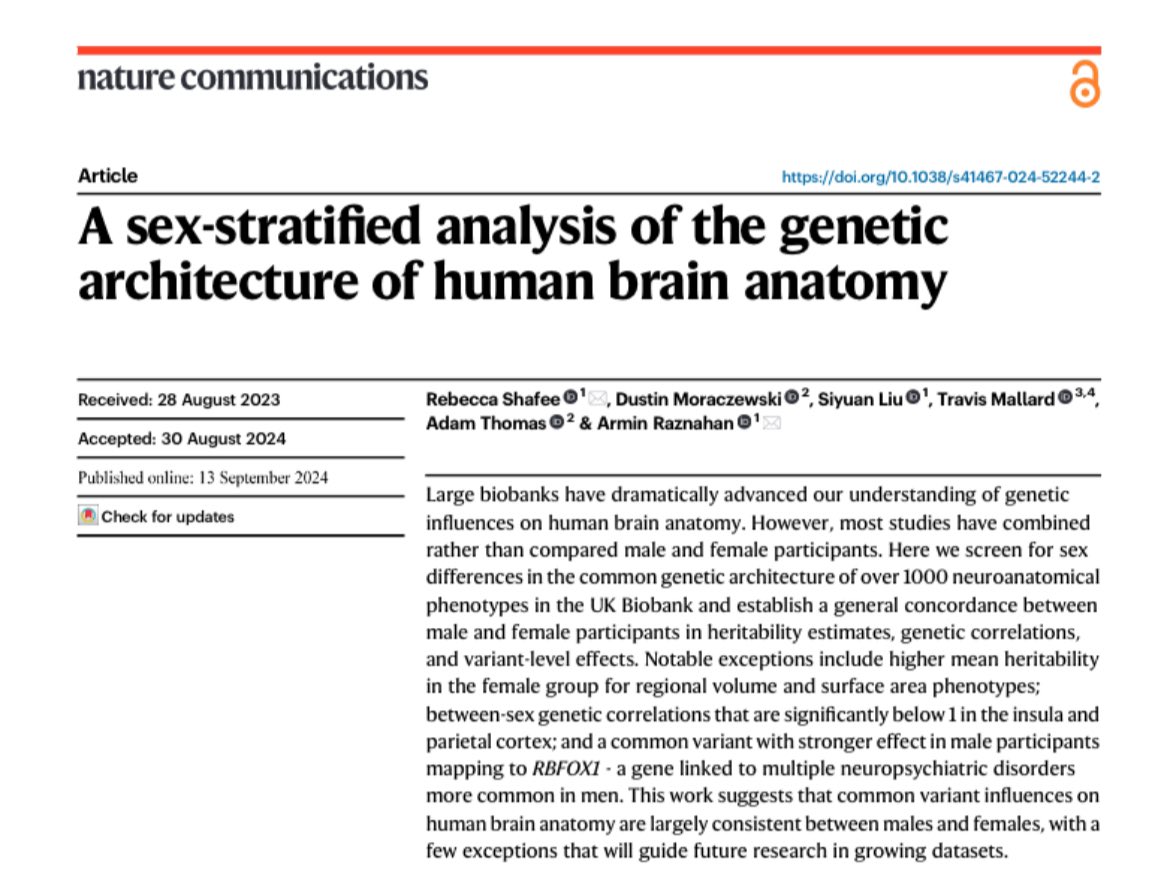
Our paper (@bogglerapture@damadam, @dmoracze , Siyuan Liu, @wakeworksleep) on sex differences in the genetic architecture of the human brain anatomy is now out in @NatureComms@SpringerNature !
https://t.co/1x4wjimJ9d
Please see original post below for details…
I’m thrilled & honored to be starting a new lab @ the NIA!! 🤩🥹
The Computational & Evolutionary Neurogenomics Unit focuses on:
• neurodegenerative diseases 🧓🏽
• sex-biased 🧠 aging
• comparative neurobio 🐒🐁
We’re looking for postdocs! 👀
Pls RT! DM me for more info ☺️
Our paper is now out in Neuron! @NeuroCellPress (details from preprint thread below, now with more results and containerized pipeline!) w/ @bogglerapture @edbullmore @petra_vertes and amazing coauthors
https://t.co/EFoaylbu1f
(1/11🧵) Echoes of fetal development etched into the adult brain 🧠 - Excited to share our new preprint!
“A bipolar taxonomy of adult human brain sulcal morphology related to timing of fetal sulcation and trans-sulcal gene expression gradients”
https://t.co/TOo9ArvBgU
@James_Cobbie If you were to build the roads of a country from scratch, one good idea would be to lay down the highways (long + straight) first and backroads (complex / meandering) thereafter. It looks like the roadmaps (fold creases) of the human brain form in that same pattern before birth!
(1/11🧵) Echoes of fetal development etched into the adult brain 🧠 - Excited to share our new preprint!
“A bipolar taxonomy of adult human brain sulcal morphology related to timing of fetal sulcation and trans-sulcal gene expression gradients”
https://t.co/TOo9ArvBgU
(10/11) In sum, we show strong correspondences between adult cortical patterning, fetal sulcation timing, and gene expression gradients. Different sulci may be formed by different processes, such as cytoarchitecture-induced buckling (linear) or “crumpling” constraints (complex)
(9/11) Finally, we used dense expression maps of cortical gene expression to identify genes that transition from low to high expression across sulcal borders – GO enrichments found that linear sulci are mechanistically underpinned by cytoarchitecture + developmental genes
(8/11) Remarkably, adult sulcal complexity showed strong correlation (r>0.73) with milestones of sulcal development in the independent fetal dataset. Variability in sulcal complexity showed unexpected constraints on ~both~ early and late sulcation (inverted-U curve)
(7/11) To test if these patterns of adult sulcal shape were grounded in fetal development, we generated high temporal resolution growth curves of fetal sulcation (with a nice example animation for linear sulci here thanks to code from @StuartJOldham ! https://t.co/jZ3W48yEBM)
(5/11) PCA of the mean SPN revealed a linear-to-complex axis of human cortical folding (eigen-fold index [EFI]), with sulci clustered near the poles of the axis, and with the most polar linear and complex sulci having constrained shape (low inter-individual variability)
(6/11) Linear sulci were more heritable, thinner (in gray matter), and more often found in unimodal cortex than complex sulci found in transmodal cortex that exhibited greater relative surface area expansion with increasing brain volume
(4/11) We defined sulcal phenotype networks (SPNs) in adult brains from pairwise similarity between sulci, with group mean SPN showing a clear clustering of sulci into two groups: linear (deep / straight) and complex (shallow / fractal)
(3/11) To assess sulcal shape, we constructed a new suite of sulcal morphometrics derived from BrainVISA, measuring sulci about radial and tangential dimensions of the cortex, generating 5 sulcal phenotypes for each of 40 sulci identifiable in each adult brain









![will_snyder98's tweet photo. (5/11) PCA of the mean SPN revealed a linear-to-complex axis of human cortical folding (eigen-fold index [EFI]), with sulci clustered near the poles of the axis, and with the most polar linear and complex sulci having constrained shape (low inter-individual variability) https://t.co/X3bvq0cT3z](https://pbs.twimg.com/media/GB1CVJQa0AACtyy.jpg)


