Nvidia “paused” gaming GPUs because the math made the decision for them.
In Q3 fiscal 2026, Nvidia’s data center revenue was $51.2 billion. Gaming was $4.3 billion. That means gaming is 7.5% of total revenue. Five years ago, gaming was Nvidia’s largest segment. Today it rounds to a rounding error.
Here’s where it gets interesting. Every GDDR7 chip Nvidia allocates to an RTX 5080 sells a $999 GPU at ~60% margin. That same memory routed to a Blackwell AI accelerator goes into a system selling for tens of thousands of dollars at 75%+ margin. Per gigabyte of memory allocated, the AI path generates roughly 10x the revenue.
Gigabyte’s CEO said the quiet part out loud weeks ago: Nvidia’s strategy is now “revenue per gigabyte.” They’re not optimizing for units shipped. They’re optimizing for dollars extracted per chip of memory consumed.
This is the first year in three decades Nvidia won’t release a new gaming GPU. AMD and Intel have also pushed next-gen gaming GPUs to 2027. The entire consumer GPU market is being starved simultaneously because every fab and every memory supplier is making the same calculation Nvidia is.
The Rubin gaming GPUs (RTX 60 series) won’t hit mass production until end of 2027 at the earliest, which means consumer launch in 2028. That’s a three-year gap between GPU generations. The longest in the history of discrete graphics.
Nvidia is no longer a gaming company that does AI. It’s a $130 billion AI company that maintains a legacy gaming business as brand marketing. And this is the quarter that math became undeniable.
To celebrate the release of our game #MIO: Memories in Orbit, we’re giving away 5 keys on the platform of your choice! 💫🎉
To enter:
- follow our account
- RT and like this post
- reply using #MIO: Memories in Orbit
Winners will be picked later today. Good luck!! 🍀
If you have a story, lessons learned the hard way, ideas you’re excited about, or questions we should explore together, we’d love to hear from you.
Speaker applications for #ETHCluj2026 are now open.
Wondering where your talk fits?
Here are our conference tracks.👇
We’re building the 2nd edition of ETHCluj “Ethereum for Everyone”, 13–14 May and we need your help.
If your team wants to build a long-term presence in a growing regional ecosystem & support our work to create a wholesome event & meaningful impact, apply to sponsor #ETHCluj 2026
Ethereum itself must pass the walkaway test.
Ethereum is meant to be a home for trustless and trust-minimized applications, whether in finance, governance or elsewhere. It must support applications that are more like tools - the hammer that once you buy it's yours - than like services that lose all functionality once the vendor loses interest in maintaining them (or worse, gets hacked or becomes value-extractive). Even when applications do have functionality that depends on a vendor, Ethereum can help reduce those dependencies as much as possible, and protect the user as much as possible in those cases where the dependencies fail.
But building such applications is not possible on a base layer which itself depends on ongoing updates from a vendor in order to continue being usable - even if that "vendor" is the all core devs process. Ethereum the blockchain must have the traits that we strive for in Ethereum's applications. Hence, Ethereum itself must pass the walkaway test.
This means that Ethereum must get to a place where we _can ossify if we want to_. We do not have to stop making changes to the protocol, but we must get to a place where Ethereum's value proposition does not strictly depend on any features that are not in the protocol already.
This includes the following:
* Full quantum-resistance. We should resist the trap of saying "let's delay quantum-resistance until the last possible moment in the name of ekeing out more efficiencies for a while longer". Individual users have that right, but the protocol should not. Being able to say "Ethereum's protocol, as it stands today, is cryptographically safe for a hundred years" is something we should strive to get to as soon as possible, and insist on as a point of pride.
* An architecture that can expand to sufficient scalability. The protocol needs to have the properties that allow it to expand to many thousands of TPS over time, most notably ZK-EVM validation and data sampling through PeerDAS. Ideally, we get to a point where further scaling is done through "parameter only" changes - and ideally _those_ changes are not BPO-style forks, but rather are made with the same validator voting mechanism we use for the gas limit.
* A state architecture that can last decades. This means deciding, and implementing, whatever form of partial statelessness and state expiry will let us feel comfortable letting Ethereum run with thousands of TPS for decades, without breaking sync or hard disk or I/O requirements. It also means future-proofing the tree and storage types to work well with this long-term environment.
* An account model that is general-purpose (this is "full account abstraction": move away from enshrined ECDSA for signature validation)
* A gas schedule that we are confident is free of DoS vulnerabilities, both for execution and for ZK-proving
* A PoS economic model that, with all we have learned over the past half decade of proof of stake in Ethereum and full decade beyond, we are confident can last and remain decentralized for decades, and supports the usefulness of ETH as trustless collateral (eg. in governance-minimized ETH-backed stablecoins)
* A block building model that we are confident will resist centralization pressure and guarantee censorship resistance even in unknown future environments
Ideally, we do the hard work over the next few years, to get to a point where in the future almost all future innovation can happen through client optimization, and get reflected in the protocol through parameter changes. Every year, we should tick off at least one of these boxes, and ideally multiple. Do the right thing once, based on knowledge of what is truly the right thing (and not compromise halfway fixes), and maximize Ethereum's technological and social robustness for the long term.
Ethereum goes hard.
This is the gwei.
I've never felt this much behind as a programmer. The profession is being dramatically refactored as the bits contributed by the programmer are increasingly sparse and between. I have a sense that I could be 10X more powerful if I just properly string together what has become available over the last ~year and a failure to claim the boost feels decidedly like skill issue. There's a new programmable layer of abstraction to master (in addition to the usual layers below) involving agents, subagents, their prompts, contexts, memory, modes, permissions, tools, plugins, skills, hooks, MCP, LSP, slash commands, workflows, IDE integrations, and a need to build an all-encompassing mental model for strengths and pitfalls of fundamentally stochastic, fallible, unintelligible and changing entities suddenly intermingled with what used to be good old fashioned engineering. Clearly some powerful alien tool was handed around except it comes with no manual and everyone has to figure out how to hold it and operate it, while the resulting magnitude 9 earthquake is rocking the profession. Roll up your sleeves to not fall behind.
ETHCluj has always been about people - the ones who show up, build collaboratively, and share a moment together🌿
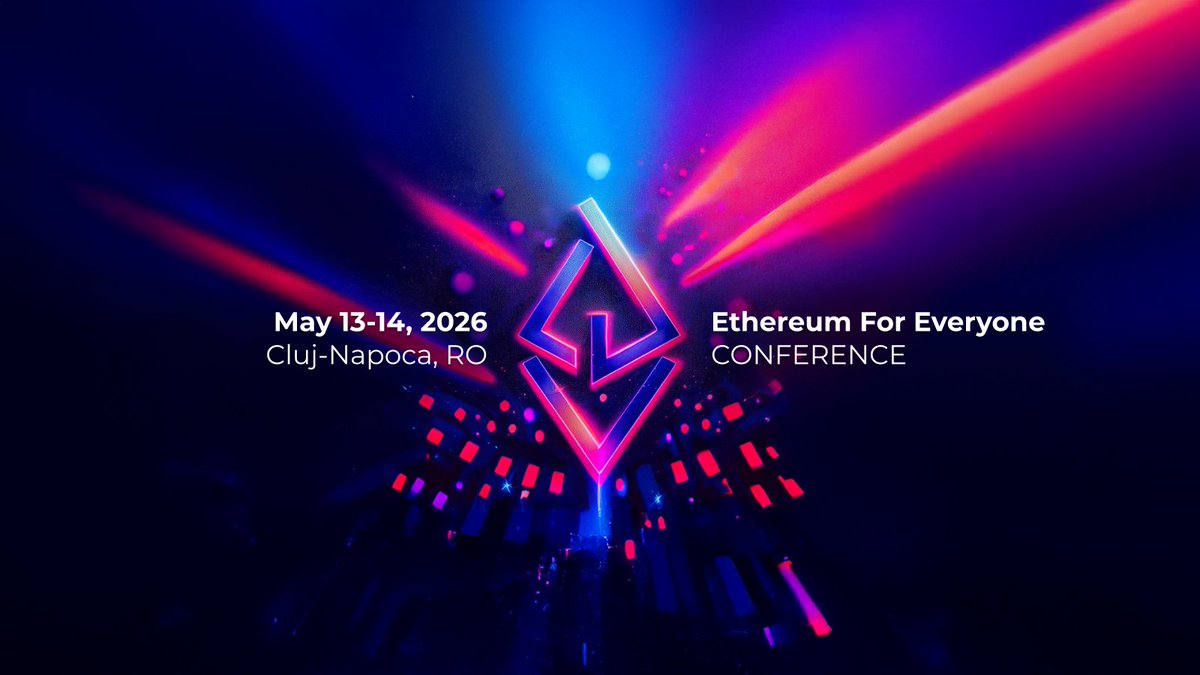
Next May we meet again.
Mark you calendars for
🗓️May 13-14, 2026
The venue’s still a little secret, but we can’t wait to tell you. Share the news & see you soon!
@safe For them to lose retail must first get burned by centralized entities in order to pivot. Too few get drawn to use the decentralized stack without a prior slap in the face or without being curious to new tech. Maybe the next generations will be native to decentralization ^^
Aave V4 will be one of the major DeFi events in 2025
It introduces a Hub-and-Spoke architecture, risk-priced borrowing, better risk management, a new liquidation engine, and more.
This is what you should know about @aave V4 🧠🧵