@FundamentEdge@TheLAPurchaser Websearch is such a tricky feature for any investing related work. You want it to fetch primary information (product releases,exec appointments,press releases) but not opinion or untraceable financials.
@ryxcommar The fact that there's so much resistance to video game prices going up amazes me. Forces all publishers to come up with weird, creative ways (dlc, battle pass, microtransaction) to juice the revenue per eyeball.
The real case study on this must be which companies managed to do this in post-Covid inflation without losing market share and getting negative press. And who can reduce package sizes or portion sizes without customers caring about it.
The dollar stores ($DG, $DLTR) discussed their ability to recuce package size for branded items already on last Qs earnings calls, so they may be well positioned.
We just launched guidance tracking on Marvin Labs. Guidance tracking automatically extracts all forward-looking statements from company reports, earnings calls, press releases, and other primary sources.
These statements range from formal guidance like “We expect revenue for next quarter to be $10B,” to more casual but telling remarks like “We’re on track to surpass a $5B revenue run rate this year.”
They come in many forms: numeric targets, vague references like “double-digit growth,” or comparative phrases like “similar to the current quarter.” And they span all metrics: revenue, margins, users, installs, and more.
Here’s what we do:
1️⃣Extract: We identify forward-looking statements across all company materials.
2️⃣ Structure: We convert each into a testable assertion—pinpointing the metric, timeframe, and expected outcome.
3️⃣ Evaluate: Once the forecasted period arrives, we assess whether the company hit, exceeded, or missed its stated expectations.
Why this matters:
Academic research (e.g., Baik, Farber & Lee, 2019) shows that executives who make accurate public forecasts tend to run better businesses and their companies outperform the market.
High-quality forecasting reflects two things:
🎯 Analytical rigor: the ability to synthesize internal and external data effectively
🎯 Judgment: knowing which forecasts are confident enough to share publicly
So we don’t just track formal guidance—we capture every public prediction. Because disciplined, high-conviction forecasting is a signal investors can’t afford to ignore.
You can now explore this across our coverage universe of 350+ companies. Rolling out over the next few days on Marvin Labs.
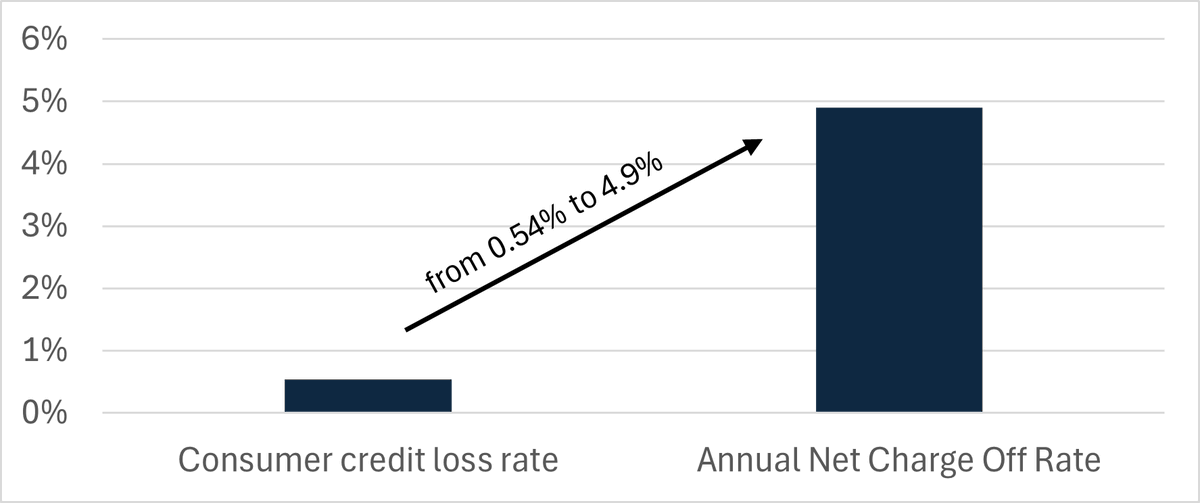
An example in the beauty of making up your own metrics. #KLARNA reports the non-standard metric "consumer credit loss rate" which they define as credit losses divided by GMV. As of 1Q25, the ratio stands at 54bps, up from 51bps for 1Q24.
The @FT comments that this ratio is "relatively low", and it does look quite low optically. After all, this metric looks a bit like a net charge-off rate that most banks report, and even if you mentally multiply it by four to annualize it, a ~2% net charge-off rate for effectively unsecured, undocumented consumer loans is pretty good. For reference, current annualized net charge off rates on US credit card loans are at 4.69% for 4Q24.
However, the ratio very much is not a charge-off ratio. Klarna's loans have an average duration of ~40 days only, something they report only in their annual report and fail to disclose in the quarterly report. With this duration, the "consumer credit loss rate" becomes an annual charge-off rate of 4.91%.
Not sure if the @FT would consider this to be relatively low still.
@Tintincapital Also, some data might look wonky for a bit. March tends to have higher volumes coupled with substantial pre tariff acceleration will probably lead to data looking better than it is initially and then falling off the cliff
Realistically, most major operators will have a serious chunk of business on the west coast. If you are doing a survivor trade then you want to look for:
Net Cash
Asset operators even those with debt on the balance sheet
On balance an older fleet which means you van shed assets more quickly and probably pick up some bargain assets
Some history of acquisitions of larger fleets, M&A integration tends to be hairy here
@jeuasommenulle The amount of hoops they jump through to keep the debt break in name only but set up / access special funds for adventurous purposes is amazing.
Whoever comes up with these increasingly creative ideas can have a good career at a bank's regulatory arbitrage desk.
@jobergum Even if you buy into the need for vector storage there's a very hard trade off of having data sit in another database vs just adding a vector column to postgres or Mongo. It's a serious step up in complexity with very benefits that are not immediately obvious.
AI is becoming core infrastructure in wealth management.
Leaders are cutting costs, scaling personalization, and increasing advisor productivity—all without compromising compliance or service quality.
AI isn’t a feature - It’s financial infrastructure.
* 25% better cost-to-income ratios for AI-first banks
* 15–20% of tech budgets now go to AI in wealth management
* 40% operational cost reduction from AI deployment
* 65% more client touchpoints using AI-generated content
Leading firms are reducing non-advisory headcount and reinvesting in AI.
The result: scalable personalization, embedded compliance, and consistent messaging—without sacrificing margins.
Clients expect relevant insights. Advisors need more time for relationships. AI delivers both.
#WealthManagement #AIinFinance #DigitalAdvisory #InvestmentResearch #OperationalEfficiency4o
Going live today at 3pm London / 11am New York 🎥
Excited to join John Goddard and James Yerkess to talk about scaling investment advice with AI — and what it means for the future of client service in banking and wealth management.
If you're curious about how we can reduce costs without reducing quality, this one's for you.
🚨 LIVE today at 3pm London / 11am NY 🚨
Scaling Investment Advice: AI, Banking & the Future of Client Service
How can banks deliver personalised, high-quality investment advice at scale?
Join Alex Hoffmann, John Goddard & James Yerkess for a bold conversation on AI’s role in transforming wealth management.
#AI #WealthManagement #Banking #Fintech #LinkedInLive
James Mitchell of Tencent quite clearly laying out the bear case for $NVDA - DeepSeek's innovations mean fewer GPUs needed vs. what Tencent previously thought, despite the explosion in AI usage. @doodlestein
"There was a period of time last year when there was a belief that every new generation of large language model required in order of magnitude more GPUs. That period of time ended with the breakthroughs that DeepSeek demonstrated.
And now the industry and we, within the industry, are getting much higher productivity on a large language model training from existing GPUs without needing to add additional GPUs at the pace previously expected.
.... (later)
In general, the China tech companies are spending less on CapEx as a percentage of revenue than some of their Western peers. But we believe for some time, that's because the Chinese companies are generally prioritizing efficiency and utilization -- efficient utilization of the GPU servers and that doesn't necessarily impair the ultimate effectiveness of the technology that's being developed. And I think DeepSeek's success really sort of symbolized and solidified demonstrated that, that reality."
The market is overestimating AI costs & underestimating Meta’s AI inference advantage.
With falling inference costs & rising ad efficiency, $META is poised for higher margins & revenue upside.
🔗 Read my latest analysis (linked below)