@KumbongHermann@IddahMlauzi@HazyResearch@Azaliamirh@simran_s_arora I imagine the VQ Vae part was hard to get right. Congrats! I worked on a project with similar idea but not with diffusion. Took an embedding model to discretize concepts in tiny stories, then simply pretrained with these extra concept tokens prepended to context of fine tokens.
@YueSong48287250 Cool stuff am wondering: usually activations growing is correlated with lm loss at least for short horizons. In your experience rotations are enough? Also when you rotate, do you also enforce the magnitude to stay fixed?
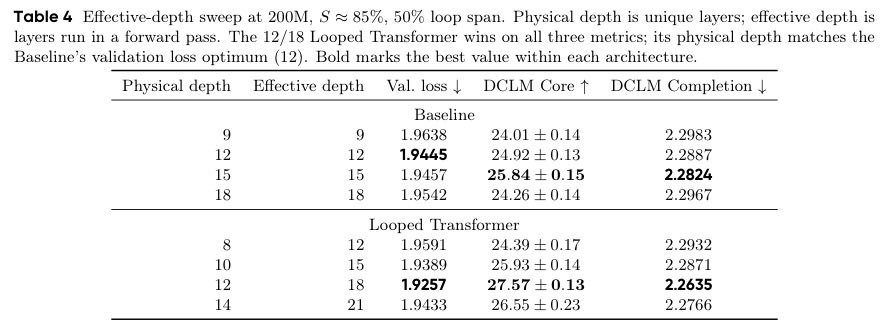
@wangsw5653 Hey, very through interesting paper. I was wondering though: why do you think the ublooped depth 18 experiment you did hit higher loss than the depth 12 unlooped baseline? Were they trained on different token counts? otherwise more flops feels like it should have performed better
@industriaalist Cool work. So from my understanding the boundary operator innovation is what allows you to increase depth even further, both in the looping and unlooped case?
@Dorialexander Yeah ofc very dependent on the synthetic pipeline. But assuming some fixed relatively optimal pipeline (optimal prompts even etc), there must be a compute optimal ratio. Were you able to tune it?
@Dorialexander Wow ~40% FLOPs budget spent on synthetic data gen. Did you tune this ratio? Have been thinking about whether a compute optimal ratio exists.