🚨Anthropic just showed a 24-minute workshop on how to actually do prompts for Claude.
Taught by the people who built it.
Free. No registration. No paywall.
I've seen $300 courses that don't cover what they teach in the first 8 minutes.
Watch it and bookmark it now.
To see Spurs and Chelsea fans mocking Arsenal after the seasons they had is beyond parody. We’re the best team in England, and the second best team in Europe. You lot are global laughing stocks.
So pipe down, you wastrels. 🤣
Anthropic engineer:
"You can build 5 assistants in one afternoon. Each one handles a task you've been doing manually every single day."
In 45 minutes he builds 5 focused agents from scratch on camera.
Most people are still doing code review, testing, and documentation by hand every single day
Watch the session, then save all templates below 👇
The Empire State Building shines red and white tonight in celebration of @Arsenal’s Premier League Title and trophy celebration.
See the lights live: https://t.co/iavtXSm3Fx
We have lost once. We have lost twice. We may even lose a third time. But as long as this club exists, we will never give up. That's the spirit of The Arsenal. IT'S NOT DONE! 🔴⚪
Anthropic just showed a 24-minute workshop on how to actually prompt Claude.
Taught by the people who built it.
Free. No signup. No paywall.
I've watched $300 courses that don't cover what they teach in the first 8 minutes.
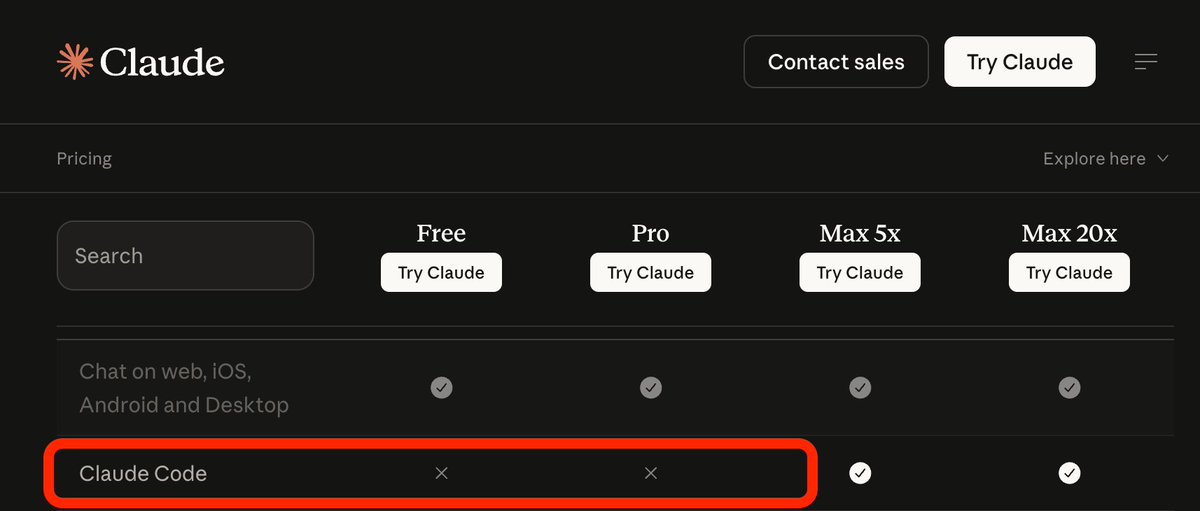
Anthropic just pulled Claude Code from the Pro plan.
Pro users wanting it need Max now.
$100/month minimum. 5x jump.
I'm on Max 20x so I'm fine.
Flagging for anyone on Pro who's about to find out.
No announcement. Just a pricing page edit.
This 30-min workshop by the creator of Claude Code will teach you more about vibe-coding than 100 YouTube video guides.
Bookmark it & give it 30 minutes today. This video will change the way you use Claude forever.
LLM Knowledge Bases
Something I'm finding very useful recently: using LLMs to build personal knowledge bases for various topics of research interest. In this way, a large fraction of my recent token throughput is going less into manipulating code, and more into manipulating knowledge (stored as markdown and images). The latest LLMs are quite good at it. So:
Data ingest:
I index source documents (articles, papers, repos, datasets, images, etc.) into a raw/ directory, then I use an LLM to incrementally "compile" a wiki, which is just a collection of .md files in a directory structure. The wiki includes summaries of all the data in raw/, backlinks, and then it categorizes data into concepts, writes articles for them, and links them all. To convert web articles into .md files I like to use the Obsidian Web Clipper extension, and then I also use a hotkey to download all the related images to local so that my LLM can easily reference them.
IDE:
I use Obsidian as the IDE "frontend" where I can view the raw data, the the compiled wiki, and the derived visualizations. Important to note that the LLM writes and maintains all of the data of the wiki, I rarely touch it directly. I've played with a few Obsidian plugins to render and view data in other ways (e.g. Marp for slides).
Q&A:
Where things get interesting is that once your wiki is big enough (e.g. mine on some recent research is ~100 articles and ~400K words), you can ask your LLM agent all kinds of complex questions against the wiki, and it will go off, research the answers, etc. I thought I had to reach for fancy RAG, but the LLM has been pretty good about auto-maintaining index files and brief summaries of all the documents and it reads all the important related data fairly easily at this ~small scale.
Output:
Instead of getting answers in text/terminal, I like to have it render markdown files for me, or slide shows (Marp format), or matplotlib images, all of which I then view again in Obsidian. You can imagine many other visual output formats depending on the query. Often, I end up "filing" the outputs back into the wiki to enhance it for further queries. So my own explorations and queries always "add up" in the knowledge base.
Linting:
I've run some LLM "health checks" over the wiki to e.g. find inconsistent data, impute missing data (with web searchers), find interesting connections for new article candidates, etc., to incrementally clean up the wiki and enhance its overall data integrity. The LLMs are quite good at suggesting further questions to ask and look into.
Extra tools:
I find myself developing additional tools to process the data, e.g. I vibe coded a small and naive search engine over the wiki, which I both use directly (in a web ui), but more often I want to hand it off to an LLM via CLI as a tool for larger queries.
Further explorations:
As the repo grows, the natural desire is to also think about synthetic data generation + finetuning to have your LLM "know" the data in its weights instead of just context windows.
TLDR: raw data from a given number of sources is collected, then compiled by an LLM into a .md wiki, then operated on by various CLIs by the LLM to do Q&A and to incrementally enhance the wiki, and all of it viewable in Obsidian. You rarely ever write or edit the wiki manually, it's the domain of the LLM. I think there is room here for an incredible new product instead of a hacky collection of scripts.
Anthropic just launched Anthropic Academy
Totally free — 13+ official courses, complete with certificates, and zero subscription required.
Some highlights:
→ Claude 101 (perfect starting point)
→ Claude Code in Action
→ Building with the Claude API (seriously in-depth, 8+ hours of content)
→ Intro to MCP + Advanced MCP
→ Agent Skills
→ Claude on AWS Bedrock & Google Vertex AI
https://t.co/f2ImVQI1F6
This is INSANE, Anthropic ran its marketing with basically one person.
Austin lau, a non-technical growth lead, was running paid search, paid social, email, and seo solo.
Here’s the workflow:
> export ad CSVs into Claude Code
> AI flags underperforming ads
> agents generate new headlines + descriptions
> Figma auto-swaps copy across 100 ad templates
> MCP server pulls live Meta data
The results:
> ad creation went from 2 hours to 15 minutes.
> total marketing output grew 10×.
> conversion rates landed 41% above industry average.
One person doing what used to take an entire marketing team.
Jensen Huang says every company will need an OpenClaw agentic system strategy by calling it “the new computer.”
He claims OpenClaw became the most popular open-source project in $NVDA history within weeks and comparing its impact to Linux reshaping the software stack.
Moved all my notes from Notion & Apple Notes to Obsidian.
Local Markdown = real ownership, no lock-in. Even better with Claude — my notes are now an interactive knowledge base.
#PKM#SecondBrain#AI#Productivity
Recently there have been rumours saying I might be arrested by the national security police because of the Hong Kong Fire database.
My Threads and X accounts were also suddenly suspended in the middle of the night for no reason.
I’m posting here to let everyone know I’m safe.