Alignment is not as hard to solve as many claim, but it is in the end an algorithmic problem which a lot of ML community mostly stopped working on.
Formulation of alignment stated by three (or four) laws of robotics can take us very far, so we roughly know the objective.
The tricky part is, how do we take gradient with respect to alignment? We have two algorithms right now at our disposal: pretraining and RL.
Pretraining takes gradient with respect to next token prediction - that's def not the alignment objective.
We could create RL environments that embody the alignment objective, but:
- those are expensive to create, so often cheaper, hackable proxies are used in practice
- RL as an objective needs successful and unsuccessful rollouts to happen to take the gradient step. We DO NOT want to harm any humans in the process of aligning our modes - this is a pretty big problem.
Therefore there are two solutions forward for the alignment problem:
- either we RL models in a simulated environments with simulated alignments and decreasing the likelihood of harming simulated humans, which will never be perfect
- or we create a new algorithm that can teach our models to not harm humans without harming any humans in the process
Science is the process how we solve the hardest problems ahead and that is one of them
my 1st reaction to news that @DarioAmodei@sama@elonmusk are agreeing to coordinate & slow the frontier development was tears of relief
yes, the coordination might be minimal, the agreement might be strategic, incentives prevail... but we've been living though the lemur march long enough and this is hope.
here to help if I can
"Few people realize that there is as much energy contained in US nuclear waste as there is in global known oil and gas reserves... we can extend the usable lifespan of nuclear fuel on Earth from one to two hundred years to millions of years."
- Matt Loszak at Energy Subcommittee Hearing: Powering the Nuclear Renaissance:
Optimizing and making maximally efficient how we serve AI inference is going to be one of the defining problems of our time. Nobody is doing it better than @gpuemi, @gpusteve, and the @wafer_ai team.
Wherein much progress for @gordianbio is reported.
- In our current CRM focus, we've already got causal validation data on more targets than have been published by the entire industry in the past 20 years.
- One partnership (with Pfizer) announced so far, as the machine continues to map every druggable target.
- Meanwhile GOR-101, the dual-acting disease modifying drug from our osteoarthritis mapping, is heading towards the clinic.
I left academia to avoid pinning all hope on a single hypothesis for longevity, and instead build a system that would inevitably find solutions to each way our bodies break with age. That system now exists.
EXCLUSIVE: 8VC leads $16M Lazarus round to build modular supercritical CO₂ turbines for America’s data center buildout.
Today, @LazarusEnergy, the Hawthorne-based startup, has secured an oversubscribed $16M seed round led by @8vc, with additional investment from Marlinspike, DST Global, Neuron Power Ventures, and @relentless_inv, as well as follow-up investment from @fiftyyears and @sidedoor_vc. The company is betting that a new turbine architecture can help solve one of the biggest constraints on America’s data center buildout, power.
Supercritical carbon dioxide could decide America’s AI sovereignty. CO₂ crosses into the supercritical phase above 31.1°C and 73.8 bar, where liquid and gas collapse into a single fluid with liquid-like density and gas-like flow.
It plays a special role in closed-loop Brayton cycle turbines, which could become core to data center power generation. Turbines are becoming increasingly important for data centers as power demand exceeds grid capacity and operators look for reliable on-site power. The traditional turbine market is behind, with wait times exceeding 5 to 7 years and OEMs even turning down new orders because capacity is maxed out.
Lazarus is attempting to shift the supply curve. The LA startup was founded by George Kitromelides (CEO) and Luke Malcolm (CTO), both formerly on the propulsion team at Anduril, alongside team members from Siemens Energy, Williams International, and Ursa Major. The startup is developing turbines that enable a forward-deployable power plant fitting inside a shipping container. “Supercritical CO₂ lets you reduce the size of your components significantly,” according to George Kitromelides (CEO), thus enabling the distributed form factor.
Traditional turbines are optimized for specific heat sources. Lazarus designed its system to be heat-source agnostic, allowing it to convert heat from nearly any major energy source into electricity. Lazarus has created a natural edge. It can serve today’s data center market with proven inputs like natural gas while remaining positioned for future heat sources like small modular reactors.
Deployment is another edge. Traditional turbine players can require months or years of construction to set up on-site, while Lazarus’ platform is fully assembled at its facility and requires zero on-site construction. In areas like nuclear, this can be key. Luke Malcolm (CTO) states, “SMRs are supposed to be compact, modular, deployable power. And when you build your compact reactor and then spend a year building all your steam infrastructure on-site, that kind of defeats the whole purpose.”
Lazarus is focused on two end markets, data centers as the beachhead market and small modular nuclear reactors as the secondary market, both with unique business models.
In the data center market, “The OEMs are straight up rejecting new orders. They’re turning customers away because they just can’t keep up with demand,” according to George Kitromelides (CEO). Lazarus wants to provide power-as-a-service in the data center market, where it would own and operate the asset instead of the data center operator incurring CapEx. Additionally, the own-and-operate/PPA model allows Lazarus to generate significantly more long-term revenue than a one-time equipment sale. Under a power purchase agreement (PPA), customers pay for the electricity generated by the system over time rather than purchasing the power infrastructure upfront. Lastly, behind-the-meter power is surging as data centers seek dedicated, off-grid generation to avoid grid delays and secure reliable power. Lazarus enables that by delivering compact on-site power systems built for data center demand.
On the nuclear side, Lazarus would integrate with SMR companies to supply the power cycle, with nuclear heat going into the Lazarus cycle and electricity coming out. This model would focus on selling units to reactor companies, followed by multi-year maintenance contracts.
Lazarus is developing a true picks-and-shovels play for the AI power gold rush. But the broader opportunity extends well beyond data centers. As the forward-deployed stack expands across compute, manufacturing, medical units, and logistics, compact containerized power could become critical infrastructure for Department of War installations, remote mining operations, disaster response, and any site where reliable power needs to move closer to the edge.
The team of six full-time engineers is focused on firing a 1-megawatt sub-module of its system by late this year or early next year. The system will be powered by natural gas. Additionally, the startup has secured an MOU with a nuclear customer and has received strong interest from the data center market.
Someone should make a game where you have to restart a 50 year old industry in a civilization that has forgotten how to build big things by mass-manufacturing stainless steel vessels that can magically generate billions in revenue when you put cosmically-born spicy rocks in them, all with the goal of maintaining AI supremacy in the west, while lowering the cost of electricity far enough to bring nations out of energy poverty and supply abundance to the world
Thanks for the feature @WSJ! The team is working very hard to make more Airforms right now here in Kailua, Hawaii. You can check out more here at https://t.co/e1MDnsKF0E. They are now delivering in Hawaii and California.
One of our earliest test sites, for our sodium test loop, is in a facility formerly owned by one of our employees' fathers.
The space was originally used to make machinery for the production of... tater tots.
🫶 Idaho 🥔
Let's make a concrete plan to 'cure every disease in 10y' and see how far we could get.
Our assumptions will be ~infinite IQ 200+ 'thinkers', automated labs by ~2032, $1-2T to spend (~10y Google profits), can recruit any living person, significant influence over US Gov but not omnipotence.
There are three problems to solve:
1) Knowing how to cure a disease.
2) Making the medicine to do it.
3) Showing that you've done it (in humans).
Difficulty on this timeline is 3>1>>2. We will need to identify longest critical path timelines for each problem, and do things in parallel.
We'll use siRNA for loss of function and LNP mRNA for gain of function, because this gives access to every target in the genome and makes transition from knowing through drug design very fast (if you assume AI has enough training data zero shot a small molecule for any target, could use that as well).
We will need manufacturing capacity, which can be built while we sort out what to do, COVID-style. Number of disease x person cases to treat in US is ~1B, which would mean ~1000x current capacity, at cost of ~$100B and requiring ~5M workers. Let's assume the workers can be robots by our deadline date. Let's assume AI makes the molecules 20x more potent/gram, then this expansion could cover global demand.
Main limitation of these drug modalities is not reaching all cell types. To solve this we will have AI nominate conjugated ligands for all cell types based on existing scSeq + proteomic Atlases, create libraries of these and use pooled in vivo screening of a whole organism to thoroughly map biodistribution for each. We'll prototype in primates to get methodology down, then will confirm using 3-5 human decedents (has been done for AAV serotype screens). 5-100B dollars depending on how deep you go on cell count. These conjugates will ~modularly map to any oligo sequence we come up with later. From experience this could be done in <3y.
Showing effects in humans will be the slowest part, particularly for progressive and hard-to-measure disease like Alzheimer's. To make our timeline we will have to develop at minimum prognostic and pharmacodynamic biomarkers for every disease where readouts take >2y. Let's assume doing multiple -omics on blood contains patterns that AI can infer as disease activity.
You might pair this with video records of people with/without disease (either as new study in parallel, or get CCTV from China maybe), assuming AI can track behavioral & functional capacity as added data.
We want access to samples with causal information on disease, ideally timecourse with incidence of lots of diseases. The US Veteran's Admin has blood samples over many years from many many veterans. We'll spend year 1 working with USG to produce multi-omic data to pair with these health records, as has been done at mid scale with UK Biobank. By year 3 this could give us potential prognostic markers for all diseases. We'll come back to these.
For question 1, any sound thinker will tell you that some interventions will treat some cells while messing up others. So we will need two sets of data: First, understand every treatment's effect in every cell. We (today, only @GordianBio) can do this with pooled in vivo screening, in animals that have already developed the diseases to avoid waiting, to understand what does good/bad things in each cell type.
In parallel, we will start testing safety of the treatments in healthy human volunteers, doing dose escalation of ~40 people x 20k x up/down at 50K per patient (just blood draws) would be like 80B dollars, and within order of mag of how many patients are recruited for (all) trials today (if you think this is daunting, spend 1y doing in mice first). From this we will 1) get toxicity for each target, 2) draw blood and get pharmacodynamic markers for each target, 3) measure blood changes for AI to compare to the VA data, as well as to the cellular changes from the pooled screen, to deconstruct the physiological changes from cellular effects.
So year 4ish you have treatments in animals that benefit each disease/cell type, you put together the data on which interventions cause which types of toxicity systemically with what effects occur in each cell types to learn what cell types to avoid for each target, and use biodistribution data to design around that.
This tells you what interventions where, so you use and/or combine those into trials in diseased patients (~600B for 25K diseases, 4 treatments per), initially with multiple treatment arms for each of your hypotheses and biomarker readouts based on the blood omics for efficacy potential. Get more blood, calibrate, pick best options. Say 3 rounds of 1y trials. All paperwork and analysis ~instant because AI.
We'll try combinations too based on the causal in vivo map, using AI to identify synergies based on effects and inferring regulatory/interactome networks and cell-cell interactions.
If you're good at this you now have a strong treatment for each disease, could imagine running a pivotal with just one or two hundred patients, say 20M and 2y, 500B if 25K diseases (in reality less because most of those 25K diseases are rare+genetic).
Key thing is that the manufacturing scaleup, the delivery enablement, the target discovery, and the biomarker development happen in parallel in the first ~3-4 years, leaving time for a few rounds of biomarker-based trials and then one pivotal per disease.
We'll fall short of 'all diseases', missing: Ones not present in VA data, ones with no natural model system (although we should try ex vivo human organs), a few where neither KD or overexpression solves.
FDA approval may have to wait a few more years to wait for pivotal trial hard endpoints if biomarkers not considered validated surrogates yet.
And of course everything has to go right, etc. etc.
But there's at least directions we can start today that make amazing outcomes happen in our lifetimes.
(h/t discussions with @SGRodriques)
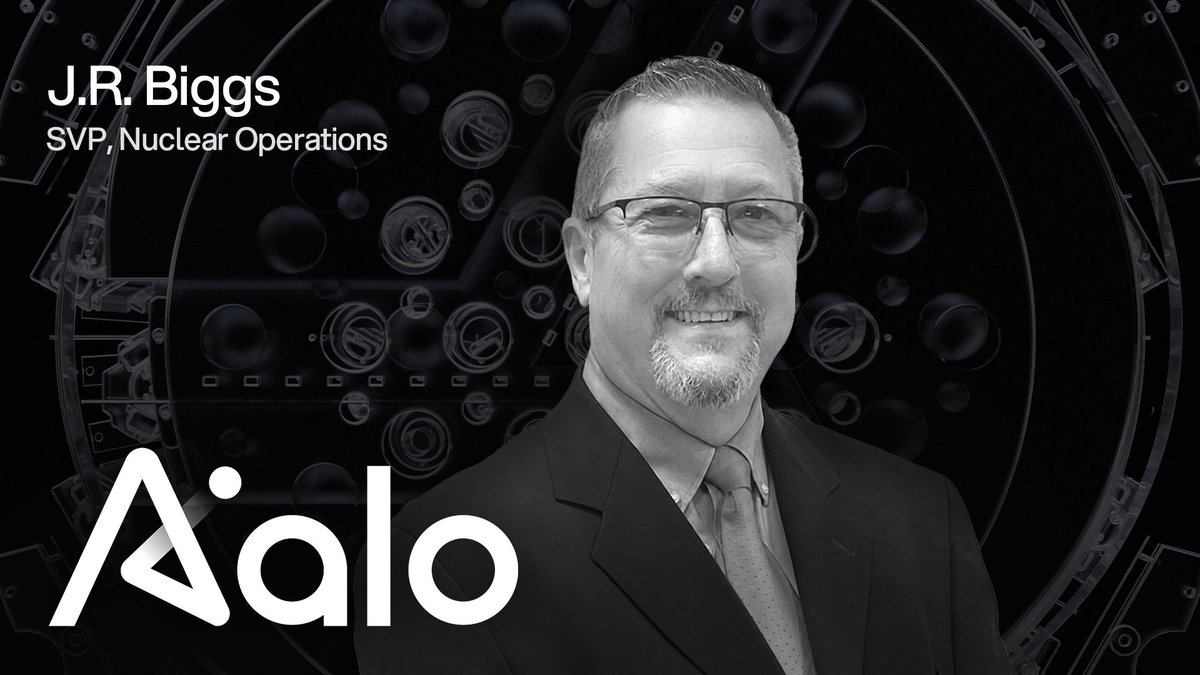
We are proud to welcome J.R. Biggs to Aalo Atomics as Senior Vice President of Nuclear Operations.
J.R. brings more than 45 years of experience taking complex nuclear facilities from concept to operation.
He previously served as Deputy Director for Advanced Reactor Demonstrations at Battelle Energy Alliance. He also chaired the Joint Test Group for advanced reactor startup at Idaho National Laboratory. In those roles, he supported DOE startup authorization and oversaw construction, fueling, startup testing, and initial criticality.
His career includes many of the nation's most significant advanced reactor programs including the restart of the TREAT reactor, Project Pele, Antares Mk-0, and the establishment of DOME as a Hazard Category 2 nuclear facility.
At Aalo, he will work on the operational organization and governance needed to take advanced reactors from development to commercial deployment.
Deploying reactors at scale requires more than great technology. It requires disciplined execution and operational excellence. Few people have shown this more often than J.R. and we're honored to have him.
The caliber of 5050 applicants this cohort is insane: scientists from 9 Nobel Prize winning labs and every top 10 university outside China. Plus cracked engineers from companies like SpaceX and Tesla.
Wild. A techbio portco generated $13M in revenue in its first 18 months.
The power of going platform first -> real revenue to keep compounding the platform.
Do we even need to fold proteins at all to find drugs?
Or do we just do that to satisfy our 3D brains?
Meet Ptarmigan-1 🧵
- Structure-free drug discovery
- 5000x less compute than co-folding
- Finds known and cryptic pockets
- Actually works on poorly structured targets