Do we even need to fold proteins at all to find drugs?
Or do we just do that to satisfy our 3D brains?
Meet Ptarmigan-1 🧵
- Structure-free drug discovery
- 5000x less compute than co-folding
- Finds known and cryptic pockets
- Actually works on poorly structured targets
Unlocking hard drug targets means searching massive chemical spaces
Since opening a structure-free discovery model 2 weeks ago (Ptarmigan-1), users have already tested 2M+ compounds for free
This would have taken years of compute with co-folding models
Today we’re opening our structure-free AI drug discovery model for all to use!
Ptarmigan-1 predicts which small molecules bind a protein, and where, without building a 3D protein structure. It learns from multiple kinds of data, including measurements of proteins at work inside living human cells.
This is the culmination of a long and winding path to get here
In my first week of grad school, I sat in a lecture hall where generations of chemists had trained and Nobel Prizes hung on display. One of the most accomplished chemists in the world introduced us to the word “undruggable,” describing targets that so many had given up on.
I remember sitting there feeling so indignant. Of course all targets are impossible to drug until the right technology lets you drug it.
Thankfully I found my people in @jaybradner's lab, where the T-shirts said “nothing is undruggable”, and got to work
We focused on gene regulators there, proteins that control which genes turn on and off and can drive cancer. Most are poorly structured, making them difficult targets for traditional tech that focus on a well-defined binding pocket.
Gene regulators are not the only disordered proteins though. Roughly 40% of the human proteome has significant disorder, and these targets remain out of reach while discovery for structured proteins gets faster every year.
With Ptarmigan-1, we’re giving researchers a way to search for molecules against these targets without first having to solve their structure.
I’m grateful to the team and supporters that brought us here. Now we get to see what the community does with it.
Try it and tell us what you think. Link below.
thanks! sometimes the nuance gets lost in the summary. of course these proteins have some structure in the cell, but they're hard to purify, crystalize, etc.
They tend to be dynamic, or require cofactors, or sometimes they have "intrinsic disorder", but even these IDPs still make productive interactions within their complexes or phase separated domains.
Let's remove 'undruggable' when the work is finished and we have the drugs in hand
Today we’re opening our structure-free AI drug discovery model for all to use!
Ptarmigan-1 predicts which small molecules bind a protein, and where, without building a 3D protein structure. It learns from multiple kinds of data, including measurements of proteins at work inside living human cells.
This is the culmination of a long and winding path to get here
In my first week of grad school, I sat in a lecture hall where generations of chemists had trained and Nobel Prizes hung on display. One of the most accomplished chemists in the world introduced us to the word “undruggable,” describing targets that so many had given up on.
I remember sitting there feeling so indignant. Of course all targets are impossible to drug until the right technology lets you drug it.
Thankfully I found my people in @jaybradner's lab, where the T-shirts said “nothing is undruggable”, and got to work
We focused on gene regulators there, proteins that control which genes turn on and off and can drive cancer. Most are poorly structured, making them difficult targets for traditional tech that focus on a well-defined binding pocket.
Gene regulators are not the only disordered proteins though. Roughly 40% of the human proteome has significant disorder, and these targets remain out of reach while discovery for structured proteins gets faster every year.
With Ptarmigan-1, we’re giving researchers a way to search for molecules against these targets without first having to solve their structure.
I’m grateful to the team and supporters that brought us here. Now we get to see what the community does with it.
Try it and tell us what you think. Link below.
Today, we'll resume charging for requests our safeguards block before Claude responds. This only applies in categories with low false positive rates: biology, distillation attacks, and frontier LLM development. We've seen some coordinated attacks on our systems in recent weeks, and this is one layer of defense.
In recent testing, 99.7% of accounts using Claude Code, Claude.ai, or Cowork did not hit any of these newly "billable blocks." The classifiers behind the blocks we’re resuming charging for today are tuned to have a <0.1% false positive rate. We know that's not 0%, and we're going to keep improving them so they interrupt your work less often. If you think a request has been blocked incorrectly, please report it with /feedback in Claude Code. https://t.co/uX6JhvN6He
We’re hearing two kinds of voices on the potential of AI to cure all disease:
One says AI will cure everything, but without a concrete path to get there.
The other says biology is too complex to ever tame, but underestimates the power of the tools that will unlock the full potential of frontier intelligence.
At Manifold Bio, we see a path and we’re already building it: a high-throughput interface into living system biology. Millions of protein designs, measured directly in vivo, to learn how molecules behave in the body and ultimately predict what they’ll do before they reach a patient.
Today we share mBER-2, the latest iteration of our AI protein design model that is a core piece of this mission.
We’re hearing two kinds of voices on the potential of AI to cure all disease:
One says AI will cure everything, but without a concrete path to get there.
The other says biology is too complex to ever tame, but underestimates the power of the tools that will unlock the full potential of frontier intelligence.
At Manifold Bio, we see a path and we’re already building it: a high-throughput interface into living system biology. Millions of protein designs, measured directly in vivo, to learn how molecules behave in the body and ultimately predict what they’ll do before they reach a patient.
Today we share mBER-2, the latest iteration of our AI protein design model that is a core piece of this mission.
This is fun.
1. Mango Banana - banana on the outside, mango on the inside. Enough said.
2. Plant machine interfaces - we should be able to trade plants N,P,H2O for reduced carbon compounds. Do to them what they did to chloroplasts
3. Solution phase self assembly of 3D memory chips using designed self-assembly of macromolecules - do we really get protein design
4. A brain the size of a building. - what would it be thinking?
5. A five assed monkey - bc South Park
6. Self growing housing - the rent is too damn high
7. Obviously brain machine interfaces - I will judge this by when I can browse the web by thinking about it.
8. Dinosaurs.
9. Cats with dog personalities.
10. A nice smelling microbiome
1/
What could we discover if we had a binder for every protein in the human proteome?
We are excited to introduce the Bindome, an open and free resource of over 300,000 designed protein binder candidates against over 8,000 human target proteins.
🧵
When you actually look at global biotech companies, the number of interesting molecules is very thin. Discovery and early stage has been disregarded for so long because of the biotech bear market. In the end, the funnel has to be better broadly distributed and early stage assets/novel targets are where the big wins are at. Both for patients and profits. $XBI
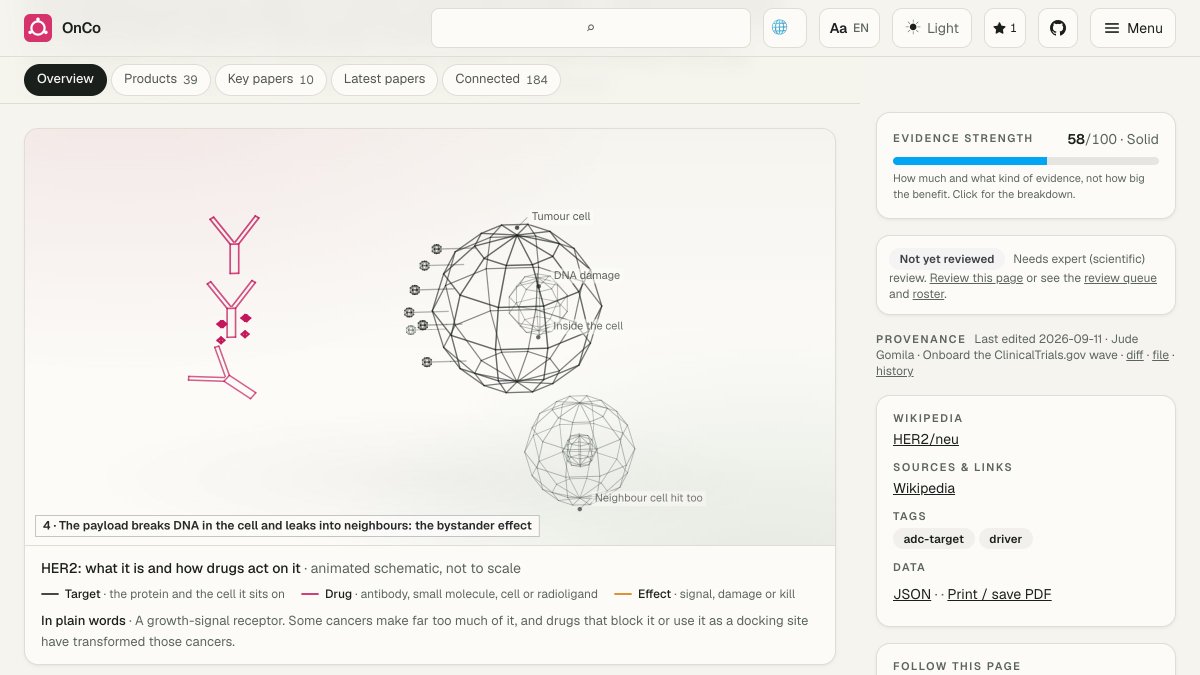
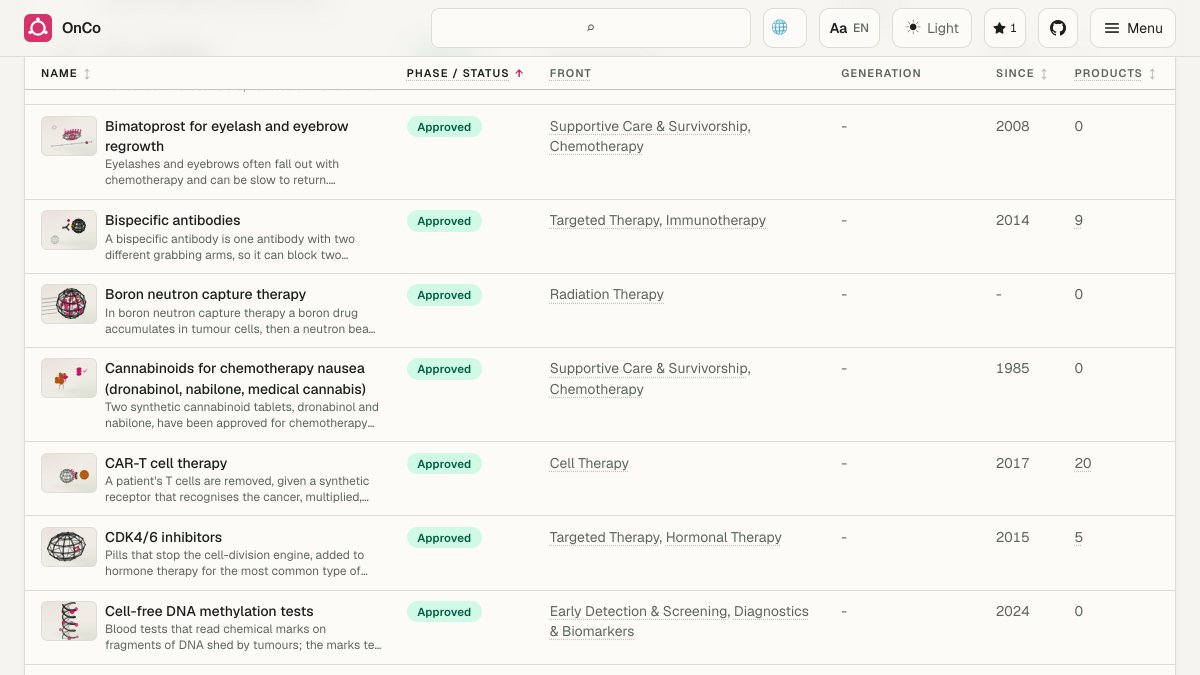
I've attempted to map everything in oncology in a public website and open source repo for all.
The site is trying to get all cancers, products, technologies, bottlenecks, people, startup opportunities with 1000+ ideas for upgrading the field.
If you have a loved one with cancer and you are technical or can engineer, go take a look, file improvement requests or bugs or help with the open repo and make this the best open and free info resource for individuals, researchers and educational use.
This should save people time, aid AI oncology projects and generate positive action. If you are not technical just complain in this thread about broken or annoying or things you want and I'll fix them live.
Some of the interesting pages:
Treatments: https://t.co/EJEOhMppoB
A gallery of the molecules being used https://t.co/EV6ZitrVqm
And targets: https://t.co/CgkjuF8nR2
The technologies in oncology: https://t.co/lNaieWYRKH
1100 ideas for helping oncology: https://t.co/iQA6Z5SvRA
Bottlenecks on oncology: https://t.co/WND44055WD
Open questions (LETS GO RESEARCH PEOPLE) https://t.co/wSbphQ0IBg
Startup requests (LETS GO STARTUP PEOPLE) https://t.co/PphztuLihP
Mechanics of cancer: https://t.co/cMUyVObzZi
Battlefronts: https://t.co/PlSZitVd50
Isotope supply: https://t.co/2Pcl4tTuPv
Key papers: https://t.co/YK0dW1XJj0
Pipeline funnels: https://t.co/xYcbSCSyBg
Cancer by type: https://t.co/d9k8Yyzdk7
Institutional rankings: https://t.co/VepXcKHhaa
The startups: https://t.co/whXKg5dPzb
Heros and heroines : https://t.co/uLDmhRjE36
Key medical people: https://t.co/JWhDZ0rC73
Here is the project roadmap: https://t.co/UtbbuOsdA5
Models and data sets: https://t.co/bim0tjiWOj
There are other views as well, take a browse.
Try making a PR if you have an upgrade to this on the repo here: https://t.co/2Dw0ufEJ3z
If you are biologically/medically minded and something is wrong, file a bug as well or say on the thread and we will get it fixed live.
If this is a useful project star the repo and help get it calibrated.
I've tried to add some other languages but I cannot speak them so tell me if that doesnt work well.
I believe we will crack oncology and having total information dominance is key to the problem.
Let the feedback flow!
Unlocking 0-to-1 targets won't fix clinical decision making on its own
What it does is open territory that was completely inaccessible before
Our job is to hand trialists genuine first-in-class molecules instead of wasting patient populations on the 15th me-too for the latest hot target
https://t.co/G2i76BNw7Q
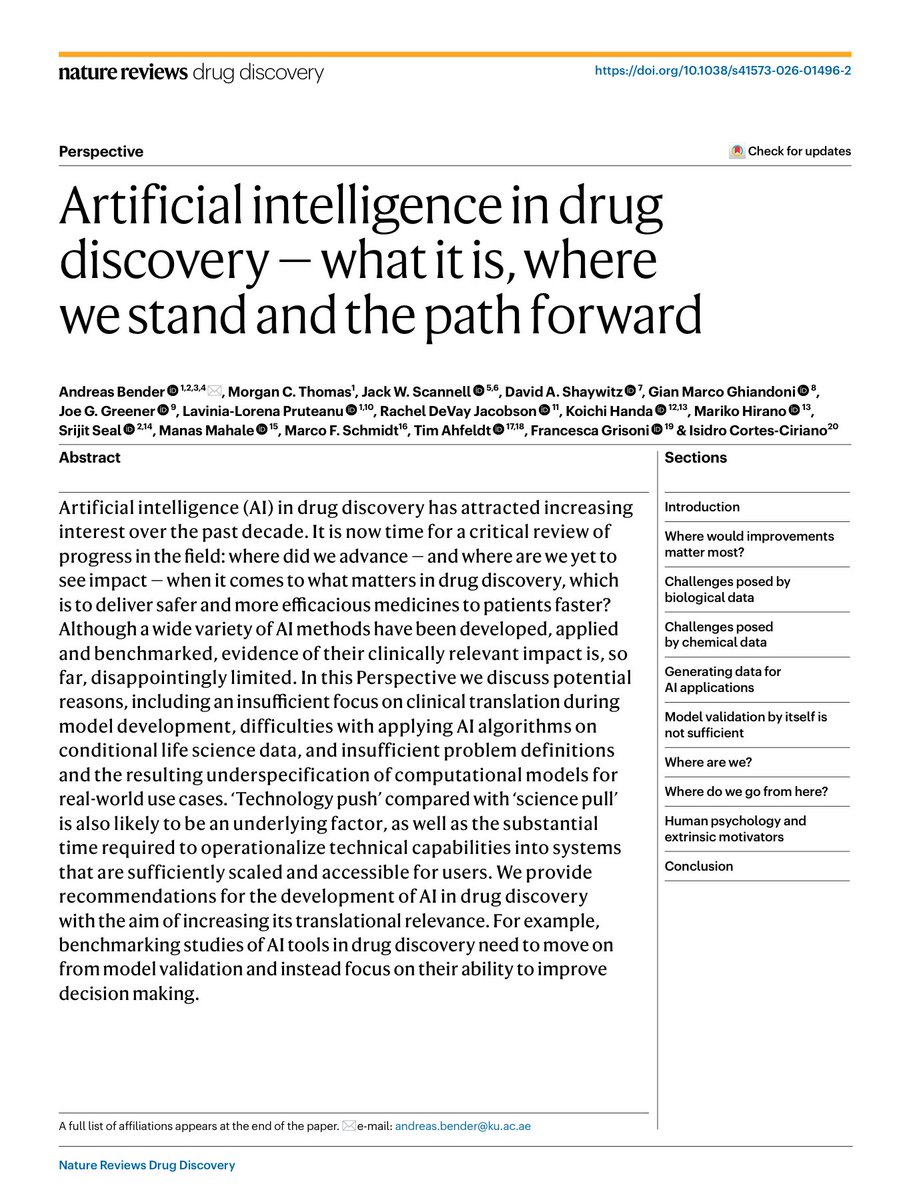
Bender, Scannell, Shaywitz and colleagues in NRDD: a decade of AI in drug discovery, clinically relevant impact still limited. Their fix is right. Stop benchmarking model accuracy; benchmark whether the tool changes a real Go/No-Go. We proved translation is possible with Rentosertib. https://t.co/ZaSpPN2RuA
Every tech VC wants to believe that drug discovery is now a function of compute. They think if we throw enough H100s at the problem, tokenize enough dead sequences, and scale virtual cells, biology will be 'solved'.
They are wrong.
Drug discovery is not a function of compute. It is a function of measurement.