As someone who lives in Portugal which already stops every single package you get from outside EU with no exceptions for a decade or more:
I can tell you how this will go
From now on if you receive a package from outside EU, it'll first go missing for weeks and nobody will know where it is, then you'll receive an email from your country's customs agency
They'll make you login to some extremely unusable and outdated web portal which breaks half the time and where you have to classify your shipment in one of 10,000 confusing category codes
Depending on the category code you'll pay a different tax rate, sometimes it's 5% sometimes it's 60%
Then you have to pay the customs duty in some archaic way that will also be broken half the time
And then you'll finally receive your package from outside EU after months
Experiencing this for a few times you'll realize you will never ever try to order or receive anything from outside EU ever because the ordeal is too painful and expensive
I get asked a lot here by people from US to test out new products (like the guy who made the Minimal Phone) and it's just literally impossible for me to receive it even for testing. I tried to classify it as samples for testing but you need to go through a bureaucratic process of insane lengths to get that through so I just gave up
Realistically all this does is make Europeans live even more in the stone ages, as now they can't use modern AI, nor get modern products from outside EU because it'll be too much hassle to order
I love Portugal, it’s a great place. But unless you really know someone and they’re willing to help you the service sector is absolutely bullshit. Literally nobody gives a shit and no one is willing to bend over backwards.
Very little wonder wages are low. The most successful Portuguese people I know are the ones that are willing to go further to get a job done, this is rare here.
Um dia que as pessoas se apercebam que o banco central imprime notinhas para pagar corrupção estatal, criam inflação e TU perdes poder de compra mas depois ainda te cobram impostos sobre esse valor e forçam o aumento dos salários q te fazem subir de escalão e +
Porque é que Portugal tem salários baixos e tanta precariedade, apesar de termos um Código do Trabalho enorme para "proteger" o trabalhador?
A resposta está nos incentivos.
Vamos a um exemplo prático que todos conhecemos como um pacote de telecomunicações da MEO.
Imagina que vais contratar um pacote de TV + Net de 1Gb + Telefone Fixo.
👉 Com fidelização (24 meses):
A instalação é gratuita e pagas 45,49€/mês.
(Custo total em 2 anos = 1.091,76€)
👉 Sem fidelização: Pagas 350€ logo pela instalação e a mensalidade sobe para 55,49€.
(Custo total = 1.681,76€)
Esta diferença de quase 600€ é o "prémio de risco".
Como não dás garantias de ficar, a operadora cobra-te muito mais para acautelar o risco de ires embora no mês seguinte.
No mercado de trabalho, funciona exatamente da mesma forma, mas ao contrário: quem corre o risco é a empresa.
Quando uma empresa contrata alguém, está a assumir um risco enorme: a pessoa pode não ter a performance esperada ou o próprio negócio pode sofrer uma quebra.
Se o Código Laboral for extremamente rígido ou seja, se for muito difícil e caro despedir, a empresa olha para esse trabalhador como um risco financeiro gigante.
Para acautelar esse risco à cabeça, o que é que a empresa faz?
Adia a contratação ao máximo.
Foge da "fidelização" laboral e usa recibos verdes, subcontratação, contratos a prazo, etc.
Quando finalmente contrata efetivo, oferece um salário mais baixo para ter uma margem de segurança caso as coisas corram mal.
Se o código laboral fosse mais flexível, o risco da empresa descia brutalmente.
Podendo ajustar a equipa à realidade do negócio sem ir à falência com indemnizações, a empresa contrata com muito mais facilidade e tem margem para pagar salários mais altos, porque o peso do risco desapareceu.
A rigidez laboral juntamente com a nossa carga fiscal brutal é o que mantém as empresas portuguesas pequenas.
O Estado acha que protege o trabalhador com leis de ferro, mas na verdade está a criar o incentivo perfeito para travar contratações, fomentar recibos verdes e esmagar os salários.
Não é falta de vontade das empresas, é apenas a matemática do risco.
“Software engineers who don’t know how to use AI coding agents will fall behind.”
No.
AI coding agents are not the hard part of building software. They’re a simple tool. You can learn to use them in a few days.
The hard part is knowing what to ask for.
Knowing whether the answer is any good.
Knowing when the code is brittle, overcomplicated, insecure, or just plain wrong.
It’s the judgement required to use them well.
That’s software engineering. And that takes decades to learn properly.
The people at risk aren’t engineers who haven’t mastered using coding agents yet.
It’s people who only know how to prompt one.
Since we're talking airports: I'm Portuguese, and Lisbon's airport immigration is genuinely one of the worst first impressions of any country I know.
Two to four hour queues stretching across the entire terminal. People missing flights. Fights breaking out. Exhausted travelers off long-haul flights standing for hours with no water.
This is what greets every tourist and foreign investor Portugal spends millions trying to attract.
It's a solved problem. For example - Korea lets me in within 30 seconds with a pre-registration and a passport scan, and I'm not even a citizen. Lisbon could copy it tomorrow.
First impressions of a country shouldn't be a three-hour line.
The companies I love working with in office hours are the ones where the founder has a specific, weird, earned insight that nobody else has. Not "AI for X." A genuine edge that came from living inside a problem.
The ones that are dying almost always have the same pattern: technically competent founders building something nobody asked for, moving metrics that don't matter, avoiding the conversation with the one user who'd tell them the truth.
The lucky thing is that 2nd type of founder can become the 1st kind if they don't stand still, they are willing to talk to people, try things, and always seek high rate of learning.
I'm a big fan of taxes IF they worked
Like I'd be fine paying even 50% personal income tax but then I'd want:
- high quality roads with walkable sidewalks
- police, fire brigade, ambulance that shows up fast
- police that enforces laws, arrests criminals and a justice system that actually punishes them and keeps society safe
- police that's at your house fast to protect you when you get a burglar or criminal
- healthcare system where I can get helped fast, no waiting lists with preventative care (free blood work every 6mo)
- fast fully digital government system
- fast gov in general, like fast building permit approvals etc
But in most countries you get absolutely none of this now so why would people wanna pay tax then?
It's like paying for a service but you get nothing back or the service doesn't work and you're forced to pay it and you can't do a chargeback either!
O Arsenal vai ganhar a Premier League com uma falta sobre o guarda-redes a anular um golo ao West Ham, se isto não é a merda mais hipócrita da história eu não sei o que seja. Não há palavras, é a merda mais sem vergonha que eu alguma vez vi na vida.
A lavagem cerebral que é preciso ter em cima para defender este roubo, um pack de águas de litro e meio fica 0,60€ mais caro, o trabalho que temos em guardar e transportar as garrafas até à máquina é de borla para essa empresa e ai de vocês se uma garrafa estiver amolgada. 🤡
It's been about a year ago since I launched a site called 🇵🇹 Only In Portugal to journal the crazy issues we've experienced as foreigners moving to Portugal with both governments agencies and businesses here, most of them quite Kafka-esque in nature
Of course everyone's reaction is "why don't you leave?"
But it is one of the most beautiful countries in the world, which has incredible potential
And it's nicer to fix things, and while complaining about things doesn't make you popular (I've received many death threats), it is oddly effective if you do it in the public sphere:
Collectively complaining about things, as we've seen with Google (they stopped self-sabotaging and are now the leader in AI), the European Union (they are passing laws based on @euacc points), and even Apple (Tim Cook finally quit), does fix things, eventually!
So I'm trying the same with Portugal
I feel AI governance has a lot of potential, AI can be quite a neutral party that can look at issues and find solutions in a very pragmatic and non-partisan way
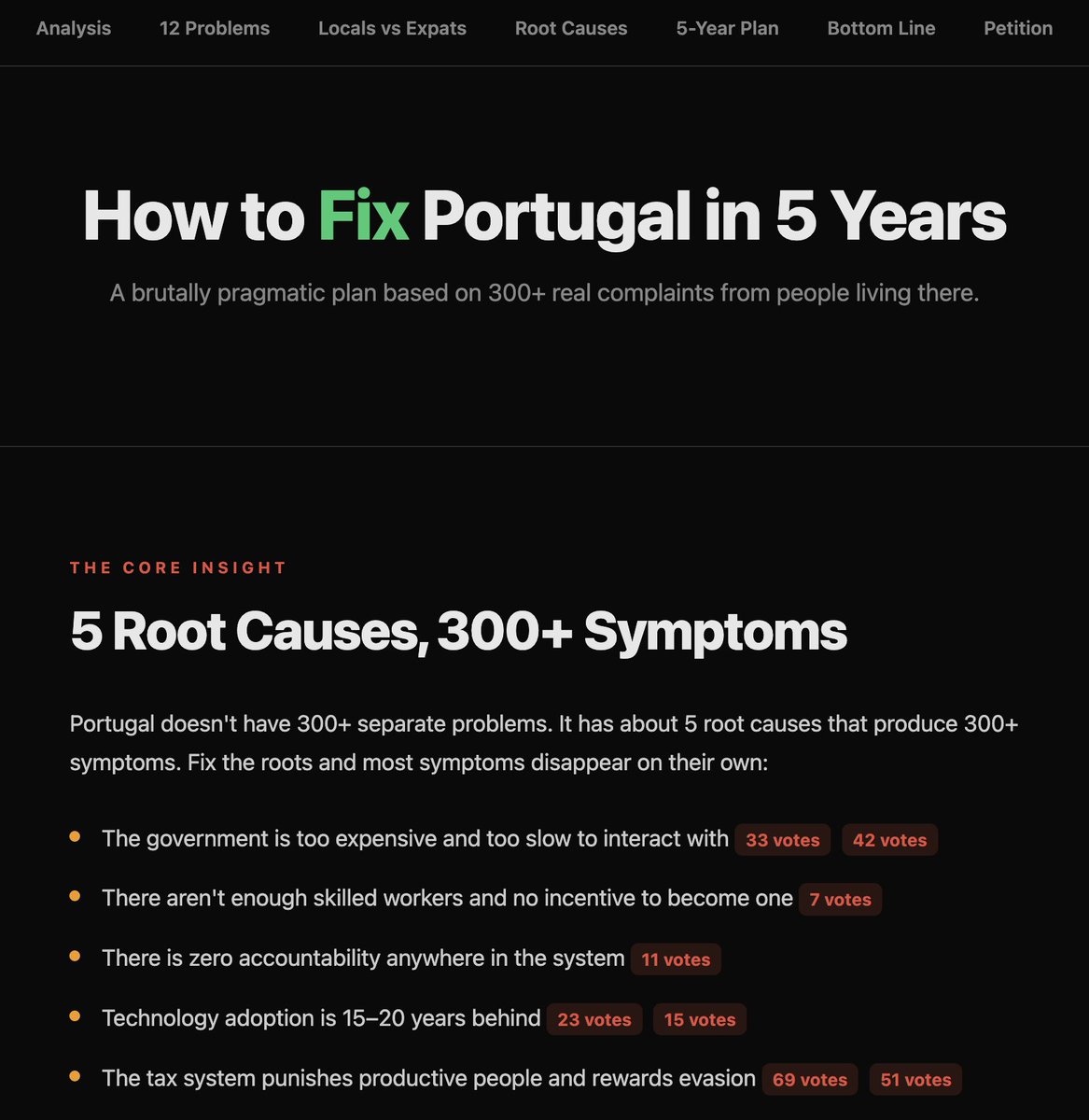
So I've asked AI to analyze over 300 issues, stories and experiences submitted to my site in the last 12 months, and write an deep analysis report how to fix Portugal in the next 5 years: every argument it makes is based on real experiences from real people , so no AI hallucinations
AI believes all issues here are based on 5 core problems:
- The Portuguese government is too expensive and too slow to interact with
- There aren't enough skilled workers and no incentive to become one
- There is zero accountability anywhere in the system
- Technology adoption is 15–20 years behind
- The tax system punishes productive people and rewards evasion
(P.S. of course many of Portugal's issues are a microcosm of Europe's macro issues)
AI then created a 5-Year Action Plan to solve it:
YEAR 1 — Shock Therapy
1.1 Flatten the Tax System
1.2 Nuke the Immigration Agency, Build a Digital Replacement
1.3 Gut the Public Sector Bureaucracy
1.4 The Accountability Law
YEAR 2 — Infrastructure Blitz
2.1 Lisbon Airport
2.2 Digital Infrastructure
2.3 Healthcare Triage
YEAR 3 — Culture Shift
3.1 Skilled Trades Academy
3.2 Animal Welfare & Noise Enforcement
3.3 Court Reform
YEAR 4 — Economic Acceleration
4.1 Housing
4.2 Transport
4.3 Consumer Protection
YEAR 5 — Consolidation
5.1 Measure Everything
5.2 Cultural Campaigns
5.3 The Exit Metric
Of course the next challenge is how do you get this to politicians, but we did this with @euacc before, so we can surely do it in Portugal too!
You can read the full action plan in the reply below!
🌟 https://t.co/8TVuUV8kLq - https://t.co/UV6xNCbqEh
É uma nova ferramenta - IMPRESSIONANTE! - para consultar e comparar informação pública. E contribuir para o escrutínio dos poderes - sobretudo locais - em Portugal.
Capacidades mais impressionantes:
👉 Visualizar redes completas de contratos públicos: revela quem contrata com quem e para onde flui realmente o dinheiro dos contribuintes
👉 Monitorizar em tempo útil concursos abertos e todas as modificações contratuais a nível municipal
👉 Centralizar e cruzar dados dispersos: estatísticas municipais + contratos + indicadores de qualidade de vida
👉 Consultar taxas por mil habitantes para comparações justas (evita manipulação com números absolutos)
👉 Filtros multi-layer (AND/OR) que permitem cruzamentos avançados de múltiplas métricas públicas
👉 Mapas e grafos de rede que tornam visível o que antes estava escondido nos portais oficiais
E tudo isto feito por uma só pessoa - @tiagomanel
--
Esta iniciativa envergonha toda a estrutura do Estado, a começar pelo ufano Ministério Gentil Organisateur de Websummits e da Modernização Administrativa do Estado.
A transparência coloca a nú o desempenho de políticos e burocratas, e proporciona escrutínio da cidadania, e responsabilização daqueles que a deviam servir.
🚩 Pequenos e grandes poderes não podem admitir isso. A sua subsistência, baseada em dinheiro do contribuinte, e sequestro de poder público para seu benefício, depende que o cidadão não saiba o que se passa.
🚩 A informação pública, que devia ser pública, é sonegada, escondida, negada, barrada, resistida, e (quando finalmente disponível) está propositadamente incompleta e desestruturada.
🚩 E o Estado Português empenha-se industrialmente nesta opacidade vergonhosa - cimentada e observada com requintes de cinismo, incompetência, malvadez e mesquinhez - a todos os níveis do poder político administrativo.
🚩 A opacidade é toda uma perversão do Estado de Direito.
Que o https://t.co/KPHi7CkRJX vem desafiar.
Experimentem - https://t.co/UV6xNCbqEh
After a certain age, your parents slowly become your children. They ask simple questions, repeat stories, and depend on your patience the way you once depended on theirs. Very few understand this role reversal.What looks like innocence or inconvenience is really time coming full circle. Don't correct them harshly. Don't rush them. Care for them the way they once protected you. This is not a burden. It is repayment.
This is a really thoughtful reflection. I didn’t intend to watch the whole thing, but I ended up doing it anyway.
AI is like playing a hard game you can’t beat with cheat codes on. It’s amazing at first, but it becomes boring very quickly.
But worse than that, it does something to your brain that ruins the game. If you turn the cheat codes off, you become acutely aware that you’re now struggling unnecessarily. You can’t forget how easy it was, but you don’t want it to be that easy because it takes all the fun out of it, but now the inability to unsee what you’ve seen creates a tension that causes you to lose interest in even continuing to play.
The magic is gone. You’ve broken the spell.
AI is doing this to life. And the societal consequences are going to be enormous.
"bro have you tried clawdbot it's so insane"
"a little but not much, what do you use it for"
"it's crazy many you can do anything with it"
"what are you doing with it"
"you gotta try it"
"try it for what"
"don't get left behind man"
Sobre a reforma laboral na Argentina, convém separar ruído de factos.
A narrativa que anda a circular fala em "trabalho contínuo obrigatório de 12 horas", despedimentos gratuitos, salários pagos em carne ou leite e fim do direito à greve. O problema é que, olhando para o texto da reforma, muita coisa está a ser apresentada de forma enviesada.
A carga horária continua nas 48 horas. O que muda é a possibilidade de redistribuição, algo semelhante a um banco de horas, podendo haver dias com mais horas compensados por outros com menos. Isto não é inédito nem propriamente revolucionário no contexto europeu.
Também não é verdade que as indemnizações desapareçam. O que surge é a opção da chamada “mochila austríaca”: um fundo individual financiado ao longo do tempo pelo empregador, que pertence ao trabalhador e pode ser levantado em caso de despedimento ou no fim da vida laboral. É um modelo diferente, não é inexistência de proteção. (não obrigação)...
Quanto ao pagamento “em carne ou leite”, a lei prevê um limite até 20% do salário em espécie (como alojamento ou benefícios), o que, aliás, é mais restritivo do que vários regimes europeus. Transformar isso em noticias sensacionalista é desonesto....
E o direito à greve não é abolido; são definidos serviços mínimos em setores essenciais e enquadradas situações de "bloqueio violento"... algo que também existe em muitas democracias ocidentais.
Isto não significa que a reforma seja perfeita ou que não tenha riscos. Mas reduzir o debate a slogans alarmistas não ajuda ninguém. Política económica séria exige análise séria... não propaganda disfarçada de notícia.
AGI is not coming.
We are nowhere near AGI. What we have today is inference, not learning.
Models get trained once on huge fixed datasets, then frozen. You ask questions, they remix patterns they already saw. Nothing updates. Nothing sticks. Talking to the model does not make it smarter. It does not learn from you. Ever.
Learning is still slow, expensive - and offline.
Look at self driving. You drive around a pothole, make a U turn, and come back. The car’s AI does not learn that you just solved that exact problem. It reacts the same way every time using sensors and rules. Do this 20 times a day and it still has zero memory that the pothole exists. It just re sees it. That is why edge cases never die. There is no local learning. No accumulation.
No 'oh yeah, I’ve seen this before'
LLMs work the same way. Tell it your name and it does not remember. The only reason it looks like memory is because scaffolding keeps shoving your name back into the prompt every time and sanitizing the output.
The model itself has no idea who you are and cannot learn from interaction. It is structurally incapable.
And the scaffolding is the worst part. It is pure duct tape. Just prompts on prompts on prompts around a frozen model. When something breaks, nobody fixes learning. They add another layer. Another rule. Another retry. Another evaluator model judging the first model.
So you end up with systems that are insanely complex but mentally shallow. Debugging is hell because behavior comes from hack interactions, not a learnable core. Tiny prompt tweaks cause wild behavior shifts. Latency goes up. Costs go up. Reliability goes down. None of this compounds into intelligence. It just hides the cracks.
Until we have real persistent learning and real memory inside the system, there is no AGI.
LLMs are not built for this. You cannot prompt your way out of it. You need a totally different architecture. Yann LeCun is right.
And even then, what architecture can actually learn online, store memory, and stay stable on today’s hardware?
Best case, maybe 5-10 yrs.
Right now it is all inference. It looks magical, but the emperor has no clothes. A lot of people see it. Almost nobody says it out loud.