This chart shows how a particular trade was executed by AI model. What would be a TA interpretation? The reason for closing the trade is clear. Why did it open? #AI $BTC @willywoo@TechCharts@GertvanLagen
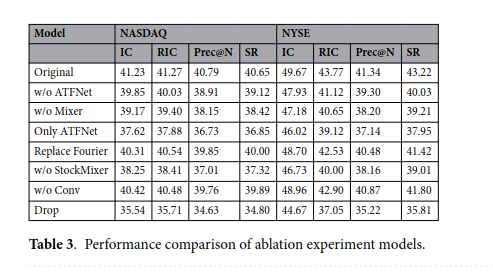
Random variation of existing results. The reviewers at @SciReports have failed. Interesting how the results for other architectures are so similar. @RealAAAI#AlgoTrading
@davidtbuttrey A simple MLP with some regularization almost always outperforms LSTM, TSMixer etc. Temporal architectures including transformers often overfit.
@quantbeckman We have about 70% trading models profitable after testing. And then we spend months comparing data from various sources, aggregations, consolidations in order to get real trading profitability.
@quantbeckman Usually, look-ahead bias in your code is not as important as you might think. You are probably already using corrupt data from Yahoo etc. It does not matter what you do with the corrupt data afterwards.
@quantbeckman If you test one million trading models, you get 100 with sharpe ~10. You just wont be able to reproduce in real trading. In general, most research papers have naive errors, but many happen even though your testing is correct.
Balaji just told you the charging problem is solved and nobody’s doing the infrastructure math.
BYD has 500 of these Megawatt chargers deployed in China. They’re targeting 4,000 by end of year.
Tesla has 75,000 Supercharger connectors. At 250-350kW each.
Here’s the constraint nobody’s pricing: each BYD Megawatt charger requires a direct connection to the medium-voltage grid. That’s the kind of power that runs small factories. You can’t just upgrade an existing site. You’re building new electrical infrastructure from scratch, often requiring grid connection timelines measured in years, not months.
Tesla spent 13 years building infrastructure that can serve 75,000 cars simultaneously at 250kW. BYD’s tech requires roughly 4x the grid capacity per charger. The bottleneck was never the battery chemistry. The bottleneck is getting 1MW to the parking lot.
And here’s what the demo doesn’t show: the InsideEVs test started at 13% and hit 60% in 5 minutes. That’s not a full tank. The Han L has 700km total range on China’s lenient test cycle. Real-world EPA equivalent is closer to 550km. Five minutes gets you about half a charge.
The tech is real. BYD’s battery holds 600kW at 90% state of charge, which is genuinely impressive. But the “EV flippening” requires BYD to build more grid infrastructure in 3 years than Tesla built in 13. And they have to do it in countries where grid connection timelines are measured in quarters, not weeks.
China can mandate the grid upgrades. The rest of the world has to negotiate with utilities.