I keep realizing things flip so fast in AI you really can't predict who will win or lose
Claude Code was leading for every dev, Anthropic were the good guys, OpenAI were becoming the bad guys buying up all the RAM
I even switched from ChatGPT considering how ugly I felt the Times New Roman style serif font was
Then OpenClaw shows up, becomes the most popular project since the new AI wave and instead of celebrating it, Anthropic decides to DMCA @steipete, this annoys him and he starts (or continues?) to promote OpenAI's Codex instead of Claude Code
Then @sama and @finkd try to buy him and he goes with OpenAI and that's it and now OpenAI owns the narrative again
The real story here is worse than a fumble. It’s a three-step own goal.
January 9: Anthropic locks Claude Code OAuth tokens, killing every third-party tool that built on Claude subscriptions. OpenClaw, which recommended Claude Opus 4.5 as its default model, wakes up to a broken integration. No warning. No partner outreach.
January 27: Anthropic’s legal team sends the cease-and-desist over “Clawdbot” sounding too similar to “Claude.” Steinberger complies at 5 AM on a Discord call. During the 10-second window where he releases the old GitHub and X handles, crypto scammers hijack both accounts and run a $16M pump-and-dump scheme. The chaos reflects on the entire Claude ecosystem.
February 15: Steinberger announces he’s joining OpenAI.
So Anthropic had the fastest-growing open source project in AI history (145K+ GitHub stars, 2 million visitors in a single week), built by a guy who sold his last company for ~€100M, whose tool literally recommended Claude as the default model to millions of new users.
Their response was to cut off his API access and send lawyers.
Steinberger spent last week in San Francisco meeting with every major lab. He explicitly said he could have built OpenClaw into a massive company but chose OpenAI because he wanted “the fastest way to bring this to everyone.” Meanwhile OpenClaw has already spread to China, with Baidu planning direct integration into its main app.
This is a project that was essentially a free distribution channel for Claude. Millions of developers installing a tool that defaults to your model. The growth marketing team at Anthropic should have been sending gift baskets, not legal notices.
Sam Altman just got handed an open-source agent framework with global distribution and a brilliant founder, because Anthropic’s legal department moved faster than their partnerships team.
OpenClaw reveals something fundamental about startups in the AI era:
One-person team. Coding agents as employees. 3 months. And you can build something that shifts the world.
Of course, Peter’s taste and agency are elite. Years of coding experience. He can both build and sell. That makes him unstoppable.
Congrats to @steipete on the OpenAI acquisition. Now I’m curious how OpenAI will handle open source, and what personal agents they will build. My bet: OpenClaw embedded in the Jony Ive openai device.
One guy, coding alone at 5am, built the fastest-growing GitHub repo in history. 194,000 stars. Faster than React, Linux, and Kubernetes combined.
OpenAI, with thousands of engineers and billions in compute, couldn’t build it first. Steinberger connected Claude’s API to WhatsApp in an hour one night in November 2025. He called it a toy. Three months later, Meta’s Zuckerberg is DMing him on WhatsApp and Altman is offering Cerebras compute to win him over.
The math tells the whole story. Steinberger was spending $10,000-$20,000 a month of his own money, operating at a loss, routing sponsorship dollars to dependencies instead of his own pocket. OpenAI spent $13 billion of Microsoft’s money. And the solo dev’s agent framework went more viral than anything OpenAI shipped.
Sam calling him “a genius with a lot of amazing ideas” is doing a lot of heavy lifting. This is an acqui-hire of a project that proved OpenAI’s biggest vulnerability: the agent layer doesn’t need to be built by the model provider. Any developer with an API key and a messaging app could build a more compelling agent experience than the companies training the models. Steinberger proved it.
“OpenClaw will live in a foundation as an open source project” sounds reassuring until you remember that Chrome technically has Chromium too. Steinberger himself made the comparison. The open source version gets maintenance. The real agent capabilities get folded into ChatGPT’s product roadmap.
Sold his last company PSPDFKit for $100M+. Spent three years doing ayahuasca and traveling. Came back, failed at 43 projects, then built the most important open source AI agent on project 44.
OpenAI hired the guy who proved you don’t need $10B to build the agent future. You just need to ship faster than the committee can approve a product spec.
Andrej Karpathy just shared a complete GPT in 243 lines of Python.
Training loop, inference, optimizer, attention, the whole architecture. The only imports are os, math, random, and argparse. He hand-rolled a scalar-valued autograd engine in about 40 lines that calculates gradients through basic operations: addition, multiplication, exponentiation, log, exp. That's the entire algorithmic backbone of every LLM on the planet, running in a single file a first-year CS student can read top to bottom in an hour.
This is the fifth iteration in a six-year compression arc. micrograd in 2020 (autograd engine). minGPT in 2020 (PyTorch GPT). nanoGPT in 2023 (production-grade training). llm.c in 2024 (raw C/CUDA, no frameworks). Now microgpt in 2026: the algorithm and nothing else.
Each step removed a layer of abstraction. This one removed all of them.
The industry is spending $400 billion on AI data center infrastructure this year. Training GPT-4 cost over $100 million. Gemini Ultra ran $191 million. The entire conceptual engine powering those hundred-million-dollar training runs fits in fewer lines than a terms-of-service page.
This tells you where the real moat in AI sits. The algorithm is a commodity. The original Transformer paper's math cost $900 to train in 2017. What separates a $900 experiment from a $191 million production run is compute, data pipelines, parallelism across thousands of GPUs, and the engineering to keep them all synchronized. Every line of code beyond these 243 is optimization for hardware that the algorithm itself knows nothing about.
Karpathy keeps calling these "art projects." They're closer to existence proofs. He can keep compressing the algorithm because the algorithm was never the hard part. The hard part is the $400 billion in power infrastructure, cooling systems, and chip supply chains that make the algorithm useful at scale.
And that infrastructure is on a compression curve of its own. Inference costs fell 280x between 2020 and 2024. Open-source models are closing the gap on frontier performance every quarter. The companies whose entire moat is "we spend more on GPUs" are watching both curves converge.
This week's podcast is all about ads.
Asad Awan, one of the leads behind ads at OpenAI, joins @AndrewMayne to share how we came up with our ad principles and how ads in ChatGPT free and Go tiers expand AI access for all.
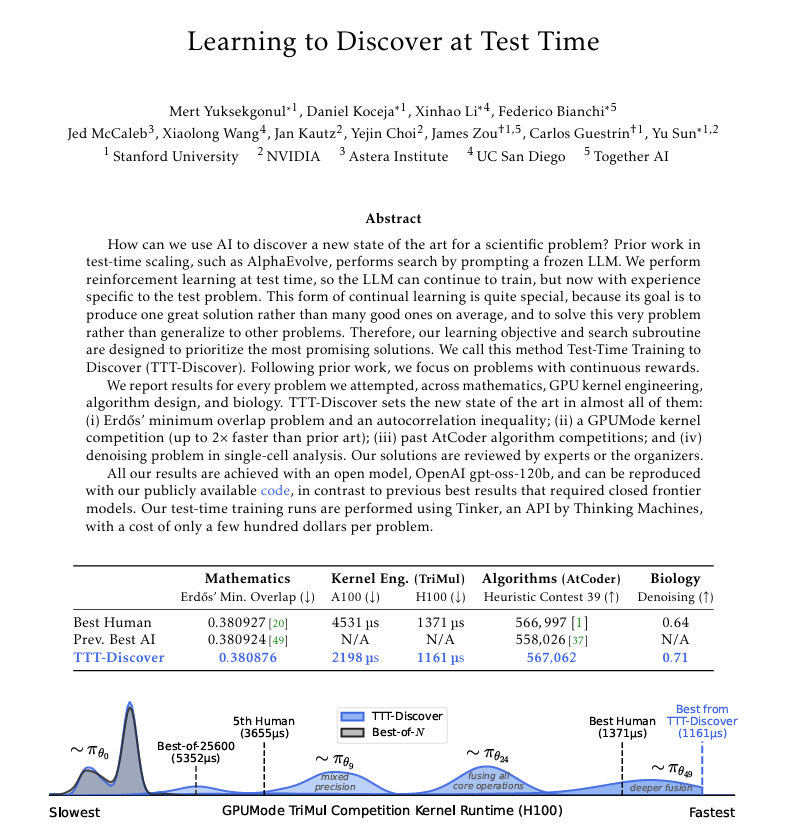
New Stanford and NVIDIA's paper that really worth your attention
They introduced Test-Time Training to Discover (TTT-Discover), which lets models keep learning at inference time, using RL to find breakthrough solutions.
It’s a new way to effectively solve scientific problems.
TTT-Discover already achieved SOTA results in:
- Classic math problems (like Erdős’ minimum overlap)
- GPU kernel optimization (up to 2× faster)
- AtCoder programming tasks
- Single-cell biology denoising
Here is how it works:
It smooths over contradictions, edits memories, and supplies neat reasons after the behavior has already happened. That story feels like self-awareness, so most people stop digging.
@thegautamkamath Hard disagree. When a respected engineer like Andrej shares such feelings aloud, it actually *relieves* the pressure from many readers ("I thought I was just stupid/lazy, but Andrej struggles with FOMO and catch-up to AI tools too!")
Andrej Karpathy posted about the new programmable layer developers need to master: agents, subagents, prompts, contexts, memory, hooks, MCP. He said it came with no manual and everyone has to figure out how to hold it.
This video is part of that manual. Hooks are one of the most underused features in Cursor and Droid, and they're what separate intentional AI-assisted development from hoping it works in production.
After file edit: If the agent touches Rust code, hooks automatically regenerate TypeScript types for the frontend. If it touches TypeScript, ESLint runs with autofix. If it touches backend code, cargo clippy runs.
On stop: When the agent finishes, it runs cargo check to validate the build before I even look at the output.
00:00 The problem: manually verifying AI-written code
00:31 Introducing hooks to automate tasks when files change
01:53 How hooks regenerate types for the frontend
02:24 How to set up the cursor.hooks.json file
04:44 Reviewing a more comprehensive hooks plan
05:48 Comparing FactoryDroid hooks vs Cursor hooks
06:45 Implementing the equivalent hooks in FactoryDroid
07:50 AI agent fixes a bug in the build command
08:27 How scaffolding makes the AI agent appear smarter
09:08 Demonstrating the successful hook implementation
09:53 Final insight: It's about providing guardrails, not a smarter AI
DeepSeek was a side project at High-Flyer Quant.
Qwen was a side project at Alibaba.
Twitter was a side project at Odeo.
Mac was a side project at Apple.
Meanwhile:
Windows Phone was a core project at Microsoft.
Metaverse was a core project at Facebook.
Google Glass was a core project at Google.
Apple Intelligence is a core project at Apple.
taste, passion, agency > roadmaps.
Claude Code was a side project at Anthropic.
ChatGPT was a side project at OpenAI.
PyTorch was a side project at Meta.
Gmail was a side project at Google.
Side projects are the only place where taste, curiosity, and agency fully compound.