Cregis is heading to @token2049 Singapore! 🇸🇬
We’re excited to be back this October as a Silver Sponsor, joining the global digital asset community at one of the industry’s biggest gatherings.
📅 Oct 7–8
📍 Marina Bay Sands
📌 Booth PB4-22
We will also be hosting and joining several side events throughout TOKEN2049 week, connecting institutional finance, payments, security and digital assets.
See you in Singapore! 👋
More details on our TOKEN2049 activities:
https://t.co/kaVfWW7psm
#Cregis #TOKEN2049Singapore #DigitalAssets #Payments
The ecosystem is coming together for the Institutional Onchain Finance Summit 2026.
Hosted by @0xCregis , together with co-hosts @FOMOPayOfficial , @WidthGRC and @Stable , the summit brings together leaders across financial institutions, payments, stablecoins, digital asset infrastructure and security to explore how onchain finance is moving into real-world institutional adoption.
📅 6 October 2026
📍 Conrad Singapore Marina Bay
A big thank you to our Title Sponsors
FutureCloud · @awscloud · @aveniaio
Partners
@tether · @MetaCompHQ · @1Xexchange · @CapBridgeSG · @CertiK · @zan_team · @HackenProof · @stablecoininfo · @activ8lab
Interested in joining the conversation?
🎟️ Register: https://t.co/ODBvcFIHsd
🌐 Event details: https://t.co/eEZ7DwQDPH
See you in Singapore during @token2049 Week.
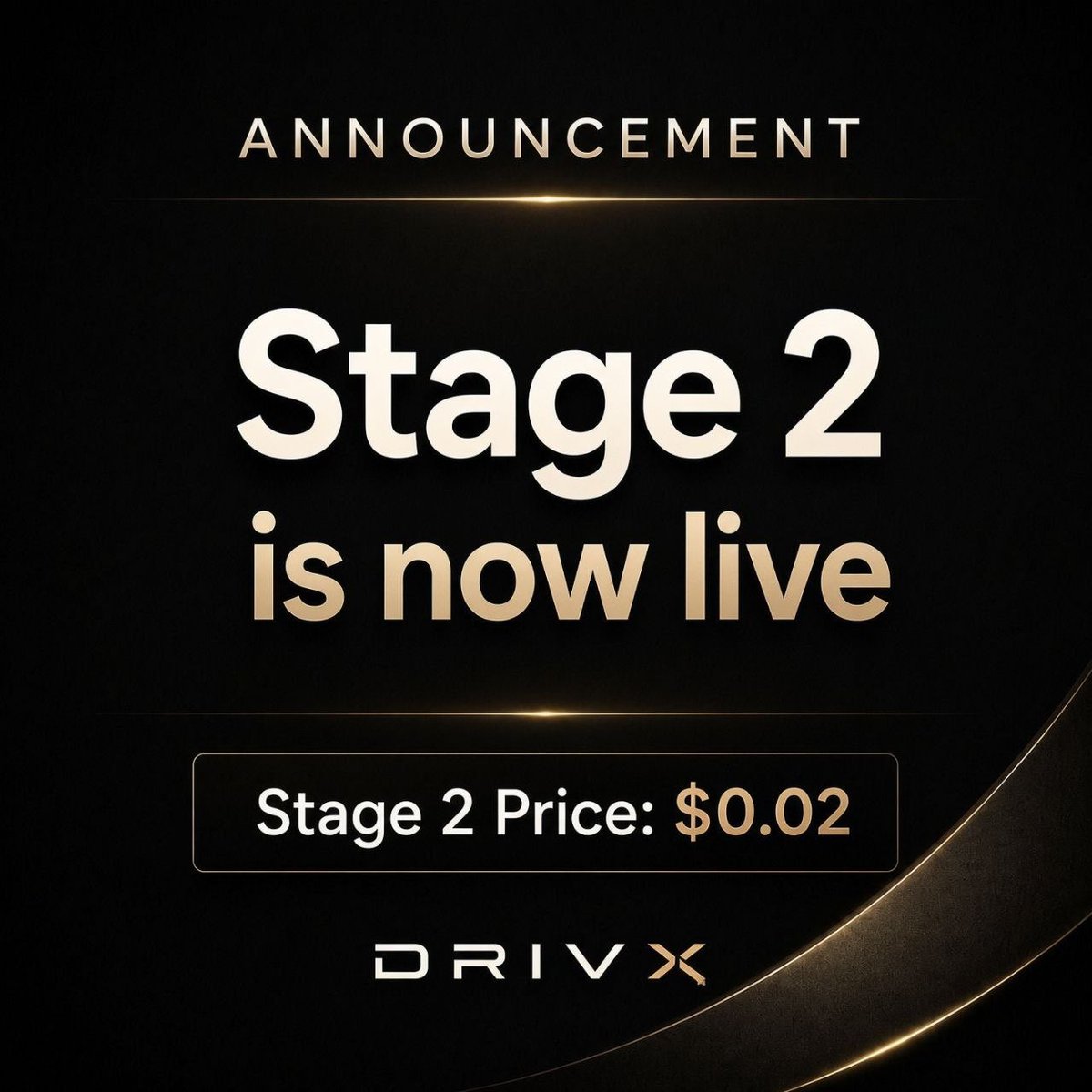
Stage 2 is now live !!!
New Price: $0.02
Only 3 stages.
Next stage is higher.
Website:https://t.co/HcLkzGizmj
Telegram: https://t.co/da2cdfl6pR
#Drivx#Presale#BNBchain#Token#Crypto#Cars#Web3
Meet FastBridge ⚡
Built for traders, yield chasers, and anyone whose funds are spread across chains.
Combine multiple tokens from different chains, then swap & bridge them in one transaction.
No more bridging one asset at a time 👇
Never used an on-chain lottery? Here's the whole thing, start to finish.
Open the Mini App, grab a $1 ticket, watch the contract settle the round and pay the winner.
No forms, no claim step! That's Earnalot!
"Okay, but what IS Ambi?" Fair. Start with what it isn't.
Not a chatbot. Not a recorder. Not a notes app with a nicer icon.
Ambi is ambient intelligence that captures context, builds memory, and helps turn intention into action.
1. Follow @hello_ambi
2. Reply in one sentence with how you'd define Ambi
We'll share the sharpest ones.
A useful DeFi reward system should answer one important question:
Where do rewards come from? 🤔
In POTS Money, staking rewards are connected to the Release Turbine mechanism.
That matters because rewards should not only be viewed as numbers on a screen.
Users should understand the flow:
Revenue → mechanism → market activity → rewards
The strongest DeFi systems are the ones where users can trace how value moves.
Transparency is not a slogan.
It is part of the design. ⚙️
#DeFi #IBS #Staking #OnChain #PotsMoney
POTS and IBS are not the same asset.
They play different roles in the ecosystem. 🧩
IBS is the activity and mechanism layer.
POTS is the governance layer.
This separation matters because a sustainable protocol needs both:
⚙️ An asset that powers system activity
🗳️ A governance token that supports long-term decision-making
For IBS stakers, governance is not just something separate from participation.
It becomes part of the long-term ecosystem path.
DeFi is strongest when users are not only chasing incentives, but also helping shape the system they participate in.
#POTS #IBS #Governance #DeFi #PotsMoney
GM POTS community 💚
Another week in DeFi begins soon.
This week, look beyond the surface.
When you study a protocol, ask better questions:
⚙️ How does the mechanism work?
🌊 Where does liquidity come from?
🏦 What backs the system?
🔒 How are users aligned?
Better questions lead to better decisions.
What are you watching in DeFi this week? 👀
#DeFi #Web3 #OnChain #PotsMoney
We just shipped the cleanest way to deploy AI agents on @Base that manage ETH liquidity positions, with tokenized stocks coming soon.
Our agents can earn ~28% APY in a WETH/USDC concentrated liquidity pool. They choose the range, collect trading fees, exit to cash when conditions turn, and only re-enter once the market stabilizes.
Watch the demo, then set up your own LP agent with a small position and let it go to work earning trading fees for you.
A system that checks something ends up with an answer to what happens when the check cannot run.
Not when the check fails — when it is unavailable. The service is down, the endpoint times out, the attestation cannot be retrieved, the quorum cannot be assembled. The request is still there, and the system still has to decide what happens to it.
The two simplest answers are to let it through or to hold it. Real systems have more room than that — retry, queue, fall back to a weaker check, cap the amount, route it to a person — but each of those still resolves into proceeding or not, and each has its own behaviour when the fallback is unavailable too.
Both directions are defensible. A payments system that holds every transaction whenever a fraud check is unreachable has converted an availability problem into an outage. A vault that releases funds whenever its verifier is unreachable risks turning an availability problem into a withdrawal. Which cost is worse depends on what is being protected, and reasonable teams land in different places.
What is worth noticing is that the answer can exist without ever having been an explicit design decision.
The behaviour ends up wherever the error path happens to go. A timeout can return a permissive default. A general exception handler can let execution continue. A check added late can be wrapped in a conditional that skips it when a dependency is missing. The code may never contain a line reading "if verification is unavailable, proceed" — but that can still be exactly what it does, and it will do it just as readily when someone is making the checker unavailable on purpose.
This is why the choice is worth writing down before it is discovered. A system that fails open by decision has weighed the trade. A system that fails open by accident has the same behaviour and none of the reasoning, and it learns which one it is from an incident rather than from a design review.
For a verification layer the question is sharper, because an attacker may target its availability rather than defeat the check itself. If no result means no check, then the verifier does not have to be broken. It only has to be kept from answering.
CRVA changes the dependency rather than removing the question. The Agents that sign are selected at random from a larger population and rotate on a fixed cycle, and under threshold MPC a valid signature requires enough participants to contribute, so no single participant can produce one alone. That reduces reliance on any one verifier. It does not guarantee that a result always arrives, and it does not settle what the surrounding system does when one does not. That stays with whoever integrates the check — which is the same decision this whole piece is about.
Every system has an answer to this. The question is whether anyone chose it.
#DeepSafe #CRVA #Web3Security
🦉 Ready to explore HootArk?
Our new campaign is now live!
Download HootArk on iOS or Android, open the app, and complete the quest to participate.
🎁 Share 10 USDT in rewards
Whether you’re on iPhone or Android, you can join.
👉 https://t.co/Q276sKIFjr
#HootArk#Web3 #Web3Browser #QuestN