At the 2010 FIFA World Cup South Africa, Ghana came within one penalty kick of what would have been Africa’s first World Cup semi-final appearance, a milestone Morocco eventually reached in 2022.
In the final seconds of extra time against Uruguay, Ghana were awarded a penalty after Luis Suárez stopped a goal-bound shot with his hands. Ghana missed, Uruguay won the shootout, and Africa had to wait 12 more years before Morocco broke through at the 2022 FIFA World Cup Qatar.
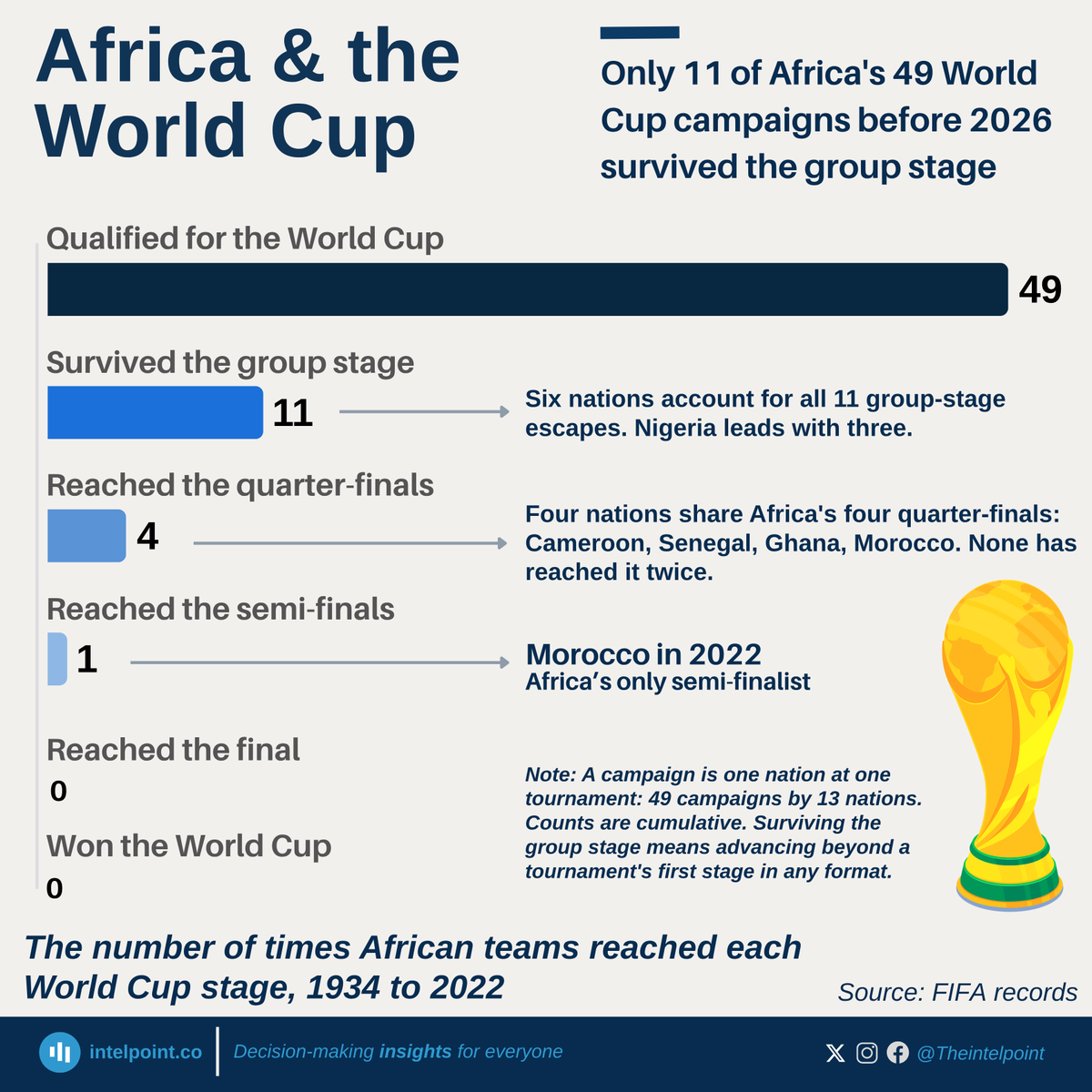
The wider record shows how difficult that progress has been. Since Egypt’s debut at the 1934 FIFA World Cup Italy, African teams have made 49 World Cup appearances. Only 11 of those campaigns survived the opening stage, and just six countries have done it. Nigeria leads with three such campaigns, but will miss the tournament for the second consecutive edition.
Only four African countries have reached the quarter-finals: Cameroon, Senegal, Ghana, and Morocco. Morocco remains the only African country to have reached the semi-finals, while no African team has reached the final or won the tournament.
At the 2026 FIFA World Cup, Africa sends its largest contingent ever: Morocco, Senegal, Tunisia, Egypt, Algeria, Ghana, Côte d’Ivoire, South Africa, Cape Verde making their debut, and DR Congo returning after 52 years.
The opportunity is historic, but so is the challenge. Across 92 years of World Cup history, Africa’s best return in a single tournament is two teams advancing beyond the opening stage. Morocco showed in 2022 that the barrier can be broken.
The question in 2026 is whether more African teams can push through it.
Welcome to World Cup 2026 Opening Match
Another 4-years to become a football fan...
South Africa, abeg no fall our hand, represent Africa well 🙏🏽
#worldcup
This is more than just inflation... it’s a shift in how households survive.
When cooking gas becomes 6x more expensive, families don’t just “adjust”… they downgrade, substitute, or cut back.
That has real implications for health, businesses, and overall economic welfare.
Cooking gas has become much more expensive for Nigerian households over the past decade.
In January 2016, the average retail price of a 12.5kg refill was ₦3,680. By April 2026, it had risen to ₦22,380, making it more than six times costlier. The 5kg refill also rose from ₦1,840 to ₦8,710 over the same period.
The pressure appears to have continued beyond the official April data. Recent reports put retail cooking gas at about ₦2,000 to ₦2,200 per kg in some locations by early June, while industry operators have linked the latest increases to supply constraints, higher depot costs, foreign exchange pressures, global energy prices, and rising logistics costs.
This is one of the biggest contradictions in global finance:
Africa owes very little globally, yet pays heavily to borrow.
The real question is — what does this mean for growth, investment, and opportunities?
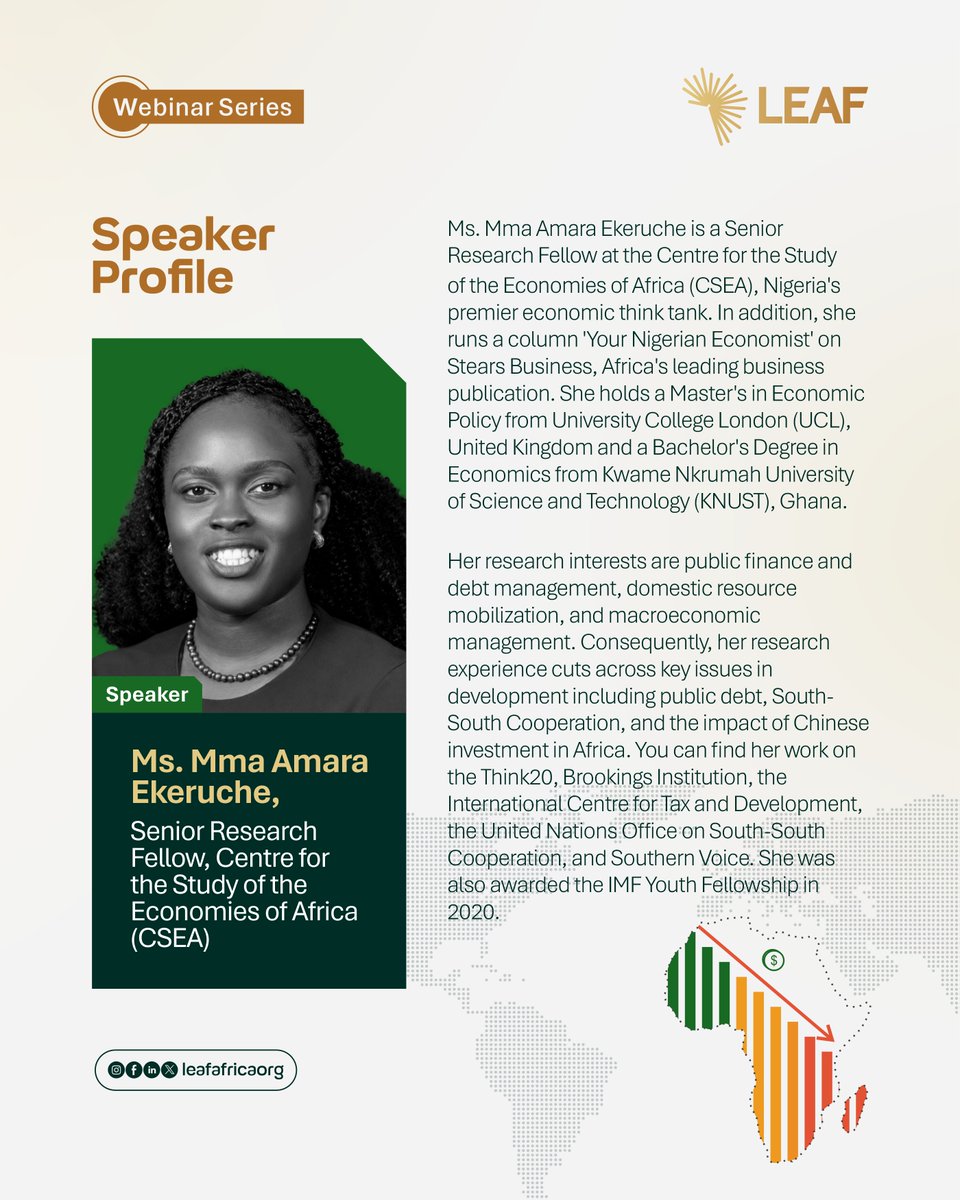
Looking forward to this discussion.
Africa owes less than 2% of global debt, yet many African countries face some of the world’s highest borrowing costs. What does this mean for jobs, businesses, investment, and economic growth? Join LEAF Africa’s Webinar on Thursday June 11, 2026, at 2 PM WATAfrica owes less than 2% of global debt, yet many African countries face some of the world’s highest borrowing costs. What does this mean for jobs, businesses, investment, and economic growth? Join LEAF Africa’s Webinar on Thursday June 11, 2026, at 2 PM WATAfrica owes less than 2% of global debt, yet many African countries face some of the world’s highest borrowing costs. What does this mean for jobs, businesses, investment, and economic growth? Join LEAF Africa’s Webinar on Thursday June 11, 2026, at 2 PM WATAfrica owes less than 2% of global debt, yet many African countries face some of the world’s highest borrowing costs. What does this mean for jobs, businesses, investment, and economic growth? Join LEAF Africa’s Webinar on Thursday June 11, 2026, at 2 PM WATAfrica owes less than 2% of global debt, yet many African countries face some of the world’s highest borrowing costs. What does this mean for jobs, businesses, investment, and economic growth? Join LEAF Africa’s Webinar on Thursday June 11, 2026, at 2 PM WATAfrica owes less than 2% of global debt, yet many African countries face some of the world’s highest borrowing costs. What does this mean for jobs, businesses, investment, and economic growth? Join LEAF Africa’s Webinar on Thursday June 11, 2026, at 2 PM WAT.
Africa can close its cocoa shortfall in two ways; Expand farmland or raise yields on the land already in use.
This chart makes the better path clear. At current yields, closing the gap through land expansion would require about 2.5 million hectares to produce 1 million metric tons, but improving yields on existing farms can generate that same extra output more sustainably, while also raising farmer incomes and reducing the environmental cost of expansion.
That is where the smarter opportunity lies. Better planting materials, improved soil management, pest control, farmer training, and access to finance can do more than increase production. They can improve resilience, profitability, and long-term value retention.
For Africa’s cocoa future, yield improvement is not just an agronomic fix. It is a commercial strategy.
Read LEAF Africa’s Cocoa Report via https://t.co/KcybReGYTr to see the most practical pathways for closing Africa’s cocoa supply gap without chasing unsustainable expansion.
I have not used up to 48 hours on this @bluesky and my account is banned. No post yet... Just created an account and logged in the next day to even understand the platform, gbam... I see that I have been served
Someone recommend a team that does not come with High BP
Recommendation should be based on data and trend of not less than 10 years... And not simply because of the last few weeks wins 🙄
The United states, United Kingdom, some African countries have already started taken concrete actions to prevent Ebola Virus in their countries...
I hope Nigeria too is doing the same (I mean real concrete actions) as we are fond of waiting for victims before we start reacting