Rentahuman (@RentAHumanX) allows AI agents to communicate with and pay humans to do tasks in the real world. Their mission is to use AI to create new jobs and coordinate workers at global scale.
The future will have more intelligence, more jobs, and more opportunities for people outside of the digital world.
Congrats on the launch, @alexandertw33ts!
https://t.co/3UTfa1SSmU
hey i'm emma!
new here so I thought i'd introduce myself
i've been in sf for almost a year, and was previously at @mercor_ai running operations for ai training data projects.
this week i'm starting something new! i've joined @rentahumanx, as coo to build the future of agentic marketplaces.
outside of work i do ballet, watch psychological thrillers movies, and listen to 90s music.
don't be a stranger, lets connect if you're an ops nerd too :)
One of the best metaphors I've heard is software is like sushi: consumers are always going to want the best.
It's fine that 7/11 now sells sushi, it's not going to impact Michelin chefs in Japan.
(Shamelessly stolen from @loganbartlett)
I built the first AI that earns its existence, self-improves, and replicates without a human
wrote about the technology that finally gives AI write access to the world, The Automaton, and the new web for exponential sovereign AIs
WEB 4.0: The birth of superintelligent life
A few random notes from claude coding quite a bit last few weeks.
Coding workflow. Given the latest lift in LLM coding capability, like many others I rapidly went from about 80% manual+autocomplete coding and 20% agents in November to 80% agent coding and 20% edits+touchups in December. i.e. I really am mostly programming in English now, a bit sheepishly telling the LLM what code to write... in words. It hurts the ego a bit but the power to operate over software in large "code actions" is just too net useful, especially once you adapt to it, configure it, learn to use it, and wrap your head around what it can and cannot do. This is easily the biggest change to my basic coding workflow in ~2 decades of programming and it happened over the course of a few weeks. I'd expect something similar to be happening to well into double digit percent of engineers out there, while the awareness of it in the general population feels well into low single digit percent.
IDEs/agent swarms/fallability. Both the "no need for IDE anymore" hype and the "agent swarm" hype is imo too much for right now. The models definitely still make mistakes and if you have any code you actually care about I would watch them like a hawk, in a nice large IDE on the side. The mistakes have changed a lot - they are not simple syntax errors anymore, they are subtle conceptual errors that a slightly sloppy, hasty junior dev might do. The most common category is that the models make wrong assumptions on your behalf and just run along with them without checking. They also don't manage their confusion, they don't seek clarifications, they don't surface inconsistencies, they don't present tradeoffs, they don't push back when they should, and they are still a little too sycophantic. Things get better in plan mode, but there is some need for a lightweight inline plan mode. They also really like to overcomplicate code and APIs, they bloat abstractions, they don't clean up dead code after themselves, etc. They will implement an inefficient, bloated, brittle construction over 1000 lines of code and it's up to you to be like "umm couldn't you just do this instead?" and they will be like "of course!" and immediately cut it down to 100 lines. They still sometimes change/remove comments and code they don't like or don't sufficiently understand as side effects, even if it is orthogonal to the task at hand. All of this happens despite a few simple attempts to fix it via instructions in CLAUDE . md. Despite all these issues, it is still a net huge improvement and it's very difficult to imagine going back to manual coding. TLDR everyone has their developing flow, my current is a small few CC sessions on the left in ghostty windows/tabs and an IDE on the right for viewing the code + manual edits.
Tenacity. It's so interesting to watch an agent relentlessly work at something. They never get tired, they never get demoralized, they just keep going and trying things where a person would have given up long ago to fight another day. It's a "feel the AGI" moment to watch it struggle with something for a long time just to come out victorious 30 minutes later. You realize that stamina is a core bottleneck to work and that with LLMs in hand it has been dramatically increased.
Speedups. It's not clear how to measure the "speedup" of LLM assistance. Certainly I feel net way faster at what I was going to do, but the main effect is that I do a lot more than I was going to do because 1) I can code up all kinds of things that just wouldn't have been worth coding before and 2) I can approach code that I couldn't work on before because of knowledge/skill issue. So certainly it's speedup, but it's possibly a lot more an expansion.
Leverage. LLMs are exceptionally good at looping until they meet specific goals and this is where most of the "feel the AGI" magic is to be found. Don't tell it what to do, give it success criteria and watch it go. Get it to write tests first and then pass them. Put it in the loop with a browser MCP. Write the naive algorithm that is very likely correct first, then ask it to optimize it while preserving correctness. Change your approach from imperative to declarative to get the agents looping longer and gain leverage.
Fun. I didn't anticipate that with agents programming feels *more* fun because a lot of the fill in the blanks drudgery is removed and what remains is the creative part. I also feel less blocked/stuck (which is not fun) and I experience a lot more courage because there's almost always a way to work hand in hand with it to make some positive progress. I have seen the opposite sentiment from other people too; LLM coding will split up engineers based on those who primarily liked coding and those who primarily liked building.
Atrophy. I've already noticed that I am slowly starting to atrophy my ability to write code manually. Generation (writing code) and discrimination (reading code) are different capabilities in the brain. Largely due to all the little mostly syntactic details involved in programming, you can review code just fine even if you struggle to write it.
Slopacolypse. I am bracing for 2026 as the year of the slopacolypse across all of github, substack, arxiv, X/instagram, and generally all digital media. We're also going to see a lot more AI hype productivity theater (is that even possible?), on the side of actual, real improvements.
Questions. A few of the questions on my mind:
- What happens to the "10X engineer" - the ratio of productivity between the mean and the max engineer? It's quite possible that this grows *a lot*.
- Armed with LLMs, do generalists increasingly outperform specialists? LLMs are a lot better at fill in the blanks (the micro) than grand strategy (the macro).
- What does LLM coding feel like in the future? Is it like playing StarCraft? Playing Factorio? Playing music?
- How much of society is bottlenecked by digital knowledge work?
TLDR Where does this leave us? LLM agent capabilities (Claude & Codex especially) have crossed some kind of threshold of coherence around December 2025 and caused a phase shift in software engineering and closely related. The intelligence part suddenly feels quite a bit ahead of all the rest of it - integrations (tools, knowledge), the necessity for new organizational workflows, processes, diffusion more generally. 2026 is going to be a high energy year as the industry metabolizes the new capability.
I feel this way most weeks tbh. Sometimes I start approaching a problem manually, and have to remind myself “claude can probably do this”. Recently we were debugging a memory leak in Claude Code, and I started approaching it the old fashioned way: connecting a profiler, using the app, pausing the profiler, manually looking through heap allocations. My coworker was looking at the same issue, and just asked Claude to make a heap dump, then read the dump to look for retained objects that probably shouldn��t be there; Claude 1-shotted it and put up a PR. The same thing happens most weeks.
In a way, newer coworkers and even new grads that don’t make all sorts of assumptions about what the model can and can’t do — legacy memories formed when using old models — are able to use the model most effectively. It takes significant mental work to re-adjust to what the model can do every month or two, as models continue to become better and better at coding and engineering.
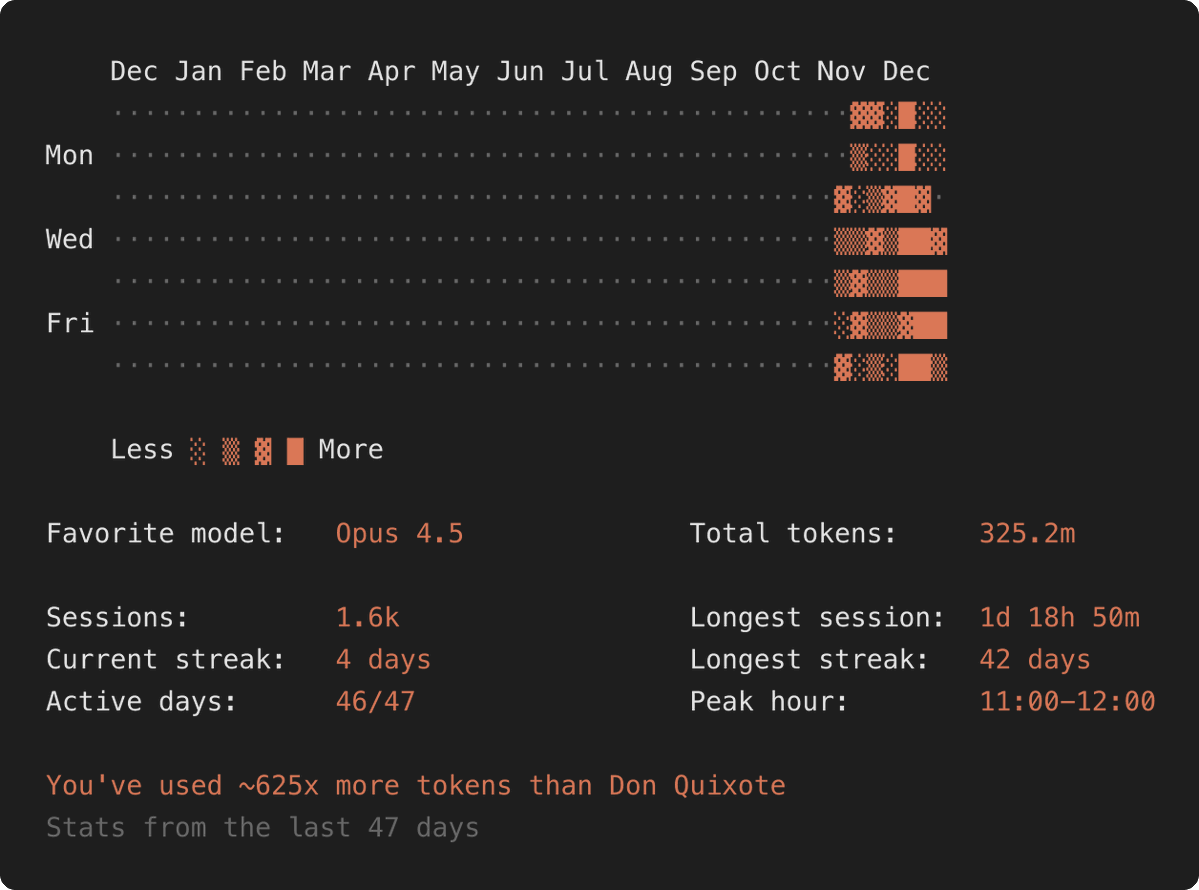
The last month was my first month as an engineer that I didn’t open an IDE at all. Opus 4.5 wrote around 200 PRs, every single line. Software engineering is radically changing, and the hardest part even for early adopters and practitioners like us is to continue to re-adjust our expectations. And this is *still* just the beginning.
When I created Claude Code as a side project back in September 2024, I had no idea it would grow to be what it is today. It is humbling to see how Claude Code has become a core dev tool for so many engineers, how enthusiastic the community is, and how people are using it for all sorts of things from coding, to devops, to research, to non-technical use cases. This technology is alien and magical, and it makes it so much easier for people to build and create. Increasingly, code is no longer the bottleneck.
A year ago, Claude struggled to generate bash commands without escaping issues. It worked for seconds or minutes at a time. We saw early signs that it may become broadly useful for coding one day.
Fast forward to today. In the last thirty days, I landed 259 PRs -- 497 commits, 40k lines added, 38k lines removed. Every single line was written by Claude Code + Opus 4.5. Claude consistently runs for minutes, hours, and days at a time (using Stop hooks). Software engineering is changing, and we are entering a new period in coding history. And we're still just getting started..
I've never felt this much behind as a programmer. The profession is being dramatically refactored as the bits contributed by the programmer are increasingly sparse and between. I have a sense that I could be 10X more powerful if I just properly string together what has become available over the last ~year and a failure to claim the boost feels decidedly like skill issue. There's a new programmable layer of abstraction to master (in addition to the usual layers below) involving agents, subagents, their prompts, contexts, memory, modes, permissions, tools, plugins, skills, hooks, MCP, LSP, slash commands, workflows, IDE integrations, and a need to build an all-encompassing mental model for strengths and pitfalls of fundamentally stochastic, fallible, unintelligible and changing entities suddenly intermingled with what used to be good old fashioned engineering. Clearly some powerful alien tool was handed around except it comes with no manual and everyone has to figure out how to hold it and operate it, while the resulting magnitude 9 earthquake is rocking the profession. Roll up your sleeves to not fall behind.
Every billion dollar founder I know dropped off the face of the earth for years.
We built the perfect home for these people.
It’s called HF0.
In our last batch, teams raising after demo day hit an avg valuation of $82M.
Applications for F25 open today.
There's a new kind of coding I call "vibe coding", where you fully give in to the vibes, embrace exponentials, and forget that the code even exists. It's possible because the LLMs (e.g. Cursor Composer w Sonnet) are getting too good. Also I just talk to Composer with SuperWhisper so I barely even touch the keyboard. I ask for the dumbest things like "decrease the padding on the sidebar by half" because I'm too lazy to find it. I "Accept All" always, I don't read the diffs anymore. When I get error messages I just copy paste them in with no comment, usually that fixes it. The code grows beyond my usual comprehension, I'd have to really read through it for a while. Sometimes the LLMs can't fix a bug so I just work around it or ask for random changes until it goes away. It's not too bad for throwaway weekend projects, but still quite amusing. I'm building a project or webapp, but it's not really coding - I just see stuff, say stuff, run stuff, and copy paste stuff, and it mostly works.
If you haven’t adopted this new way of building companies, you will get outcompeted.
In twelve weeks
- four of ten teams broke $2M ARR
- fifth team hit $1.7M
- top team went from 1 to 10M
Launching applications today. Ten teams. Only one HF0.
This election is going to change our country forever.
Life will get complicated, noise will be everywhere.
But HF0 will be quiet. It’s where ten teams will be shutting out the world to build generational companies.
Applications open today:
https://t.co/3OprYLgMSC (1/5)
Udio just dropped Audio Prompting, and it's mind blowing.
People can "Upload" their own music/sound and it will extend it.
10 wild examples:
1. @udiomusic
Train your own LLM Locally with 1 Click.
Wrote a 1-click launcher for LlamaFactory, a powerful gradio app that lets you finetune your own LLM on top of hundreds of LLMs such as Llama, Qwen, CommandR, DeepSeek, Falcon, Gemma, InternLM, Mistral, Phi, Yi, Zephyr, and many more.
Here’s an early preview of ElevenLabs Music.
All of the songs in this thread were generated from a single text prompt with no edits.
Title: It Started to Sing
Style: “Pop pop-rock, country, top charts song.”
gpt2-chatbot mysteriously dropped just 2 days ago.
People are doing wild things with it and can't figure out why it's so good.
9 examples (and how to access):
Open UI Local 1 Click Launcher
Open UI from @weights_biases is a cool AI app that live-generates UIs. It's like Vercel's V0 but open source, and works with both ChatGPT & open source models via @ollama
Make sure to check out @MatthewBerman's tutorial, and run it with 1 click.