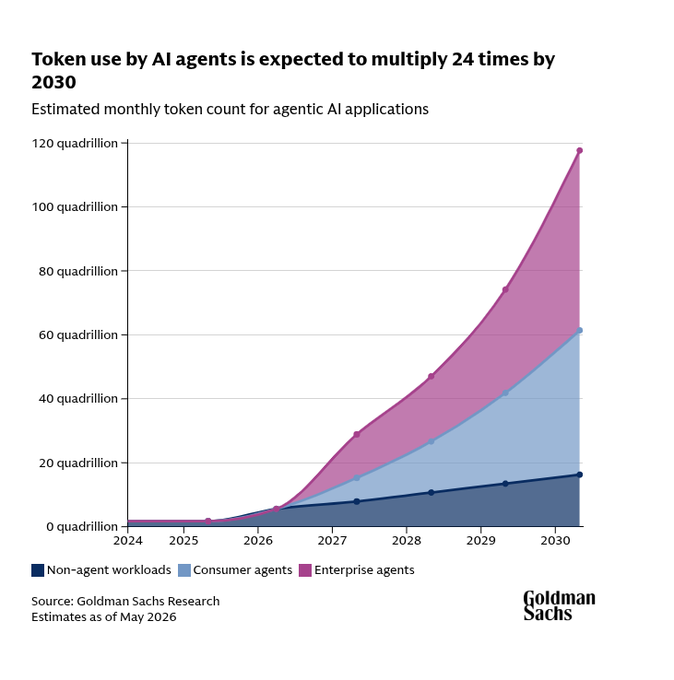
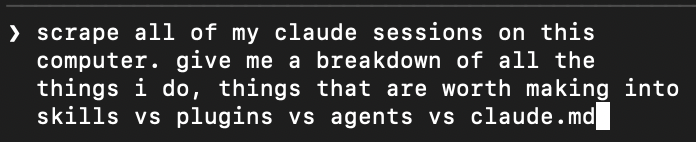
Goldman Sachs: "Token use by AI agents is expected to multiply 24 times by 2030"
AI agents are now creating the first serious cost test for the AI boom. As was reported this week, Uber and Microsoft are already rethinking expensive agent usage.
A chatbot may answer once, but an agent plans, calls tools, checks results, edits mistakes, and repeats the loop.
That loop can make one user request consume 10x, 50x, or even far more tokens than a normal answer.
Goldman’s bullish case is that monthly token use could reach 120 quadrillion by 2030, while inference cost per token keeps falling 60%-70% per year.
The fight is now between agent productivity and token waste.
Earlier this month, Microsoft began revoking developer access to Claude Code, with plans to move them to its in-house Copilot Command Line Interface tool by June 30. The company has framed this as consolidating teams around its own tools, but the timing at the fiscal year’s end hints it may also be about lowering costs.
The ability of the Claude team to learn from things like OpenClaw and implement features like this on a daily basis is a very strong argument that, for AI-powered coding teams, a very different software development process is possible, with large strategic implications.
LLM Knowledge Bases
Something I'm finding very useful recently: using LLMs to build personal knowledge bases for various topics of research interest. In this way, a large fraction of my recent token throughput is going less into manipulating code, and more into manipulating knowledge (stored as markdown and images). The latest LLMs are quite good at it. So:
Data ingest:
I index source documents (articles, papers, repos, datasets, images, etc.) into a raw/ directory, then I use an LLM to incrementally "compile" a wiki, which is just a collection of .md files in a directory structure. The wiki includes summaries of all the data in raw/, backlinks, and then it categorizes data into concepts, writes articles for them, and links them all. To convert web articles into .md files I like to use the Obsidian Web Clipper extension, and then I also use a hotkey to download all the related images to local so that my LLM can easily reference them.
IDE:
I use Obsidian as the IDE "frontend" where I can view the raw data, the the compiled wiki, and the derived visualizations. Important to note that the LLM writes and maintains all of the data of the wiki, I rarely touch it directly. I've played with a few Obsidian plugins to render and view data in other ways (e.g. Marp for slides).
Q&A:
Where things get interesting is that once your wiki is big enough (e.g. mine on some recent research is ~100 articles and ~400K words), you can ask your LLM agent all kinds of complex questions against the wiki, and it will go off, research the answers, etc. I thought I had to reach for fancy RAG, but the LLM has been pretty good about auto-maintaining index files and brief summaries of all the documents and it reads all the important related data fairly easily at this ~small scale.
Output:
Instead of getting answers in text/terminal, I like to have it render markdown files for me, or slide shows (Marp format), or matplotlib images, all of which I then view again in Obsidian. You can imagine many other visual output formats depending on the query. Often, I end up "filing" the outputs back into the wiki to enhance it for further queries. So my own explorations and queries always "add up" in the knowledge base.
Linting:
I've run some LLM "health checks" over the wiki to e.g. find inconsistent data, impute missing data (with web searchers), find interesting connections for new article candidates, etc., to incrementally clean up the wiki and enhance its overall data integrity. The LLMs are quite good at suggesting further questions to ask and look into.
Extra tools:
I find myself developing additional tools to process the data, e.g. I vibe coded a small and naive search engine over the wiki, which I both use directly (in a web ui), but more often I want to hand it off to an LLM via CLI as a tool for larger queries.
Further explorations:
As the repo grows, the natural desire is to also think about synthetic data generation + finetuning to have your LLM "know" the data in its weights instead of just context windows.
TLDR: raw data from a given number of sources is collected, then compiled by an LLM into a .md wiki, then operated on by various CLIs by the LLM to do Q&A and to incrementally enhance the wiki, and all of it viewable in Obsidian. You rarely ever write or edit the wiki manually, it's the domain of the LLM. I think there is room here for an incredible new product instead of a hacky collection of scripts.
Say goodbye to video editors.
This open-source tool turns a news headline into a published YouTube Short in one command.
It's called YouTube Shorts Pipeline and it chains Claude, Gemini Imagen, ElevenLabs, and Whisper together into one pipeline.
The cost breakdown is brutal:
Claude script: $0.02
Gemini visuals: $0.03
ElevenLabs voice: $0.05
Total: $0.10 per video
Type a topic. Get a live YouTube link. 3–5 minutes.
Supports multiple languages. Custom voice IDs. Dry-run mode to preview before producing. Manual script override before rendering.
Everything stored locally. No cloud dependency.
100% Open Source. MIT License.
if your skill depends on dynamic content, you can embed !`command` in your SKILL.md to inject shell output directly into the prompt
Claude Code runs it when the skill is invoked and swaps the placeholder inline, the model only sees the result!
LLM based AI is NOT conscious.
I co-founded a company literally called Sentient, we're building reasoning systems for AGI, so believe me when I say this.
I keep seeing smart people, people I genuinely respect, come out and say that AI has crossed into some kind of awareness. That it feels things, that we should worry about it going rogue. And i think this whole conversation tells us way more about ourselves than it does about AI.
These models are wild, i won't pretend otherwise. But feeling human and actually having inner experience are completely different things and we're confusing the two because our brains literally can't help it. We evolved to see minds everywhere and now that wiring is misfiring on language models.
I grew up in a philosophical tradition that has thought about consciousness longer than almost any other, and this is the part that really frustrates me about the current conversation.
The entire framing of "does AI have consciousness?" assumes consciousness is something you build up to by adding more layers of complexity. In Vedantic philosophy it's the opposite. You don't build toward consciousness. Consciousness is already there, more fundamental than matter or energy. Everything else, including computation, is downstream of it.
When someone tells me AI is "waking up" because it generated a paragraph that felt real, what they're telling me is how thin our understanding of consciousness has gotten. We've reduced a question humans have wrestled with for thousands of years to "did the output sound like it had feelings?" It's math that has gotten really good at predicting what a conscious being would say and do next. Calling that consciousness cheapens something that Vedantic, Buddhist, Greek and Sufi thinkers spent millennia actually sitting with.
We didn't build something that thinks. We built a mirror and right now a lot of very smart people are mistaking the reflection for something looking back.
Chrome just became massively more agent-friendly 🔥 Your real, signed-in browser can now be natively accessible to any coding agent.
No extensions.
No headless browser.
No screenshots.
No separate logins.
Just one toggle to enable it.
Check this out: https://t.co/D6AOhjlZxQ
New @openclaw beta is up: it comes with the new live browser control that Google added in latest Chrome! enable via chrome://inspect#remote-debugging
Your clanker will know when to use what, or you can ast it. new "user" profile session is there!
https://t.co/c84JT7dxBy
@karpathy just dropped karpathy/jobs!
he scraped every job in the US economy (342 occupations from BLS), scored each one's AI exposure 0-10 using an LLM, and visualized it as a treemap.
if your whole job happens on a screen you're cooked.
average score across all jobs is 5.3/10.
software devs: 8-9.
roofers: 0-1.
medical transcriptionists: 10/10 💀
https://t.co/8MaUA6gb78
Nobody seems to know how insane GPT-5.4 is with computer use.
I asked GPT-5.4 to draw the OpenAI logo in Microsoft Paint.
No computer use API. Just a screenshot and basic tool calls (click, drag, press_key) all coordinate-based.
The first drawing was awful. And GPT knew it. It looked at its own result and essentially went "yeah, no."
What happened next is what broke my brain:
It opened a browser. Went to Bing Images. Searched for the OpenAI logo. Found one. Then (and I cannot stress this enough) it used the Windows area screenshot shortcut (Win+Shift+S) to snip just the logo off the screen. Went back to Paint. Imported it. Centered it.
All on its own. No instructions to do any of that. It just improvised a better strategy when the first one failed. My prompt was "Draw the OpenAI logo" with Paint already opened on the computer.
Sure, it's "cheating." But honestly? That's exactly what I'd do too. And the fact that it came up with this plan from nothing but a screenshot and a coordinate system is wild.
My new practice is telling Codex to encapsulate the plan we've made into a complete task list to self steer
"Create a comprehensive task list that covers every aspect of the plan so that it keeps you focused across compactions - at least 20 items or more if appropriate"
Pay attention to this one if you are building terminal-based coding agents.
OpenDev is an 81-page paper covering scaffolding, harness design, context engineering, and hard-won lessons from building CLI coding agents.
It introduces a compound AI system architecture with workload-specialized model routing, a dual-agent architecture separating planning from execution, lazy tool discovery, and adaptive context compaction.
The industry is shifting from IDE plugins to terminal-native agents.
Claude Code, Codex CLI, and others have proven the model works.
This paper formalizes the design patterns that make these systems reliable, covering topics like event-driven system reminders to counteract instruction fade-out, automated memory across sessions, and strict safety controls for autonomous operation.
claude code has a hidden setting that makes it 600x faster and almost nobody knows about it
by default it uses text grep to find functions.
it doesn't understand your code at all. that's why it takes 30-60 seconds and sometimes returns the wrong file
there's a flag called ENABLE_LSP_TOOL that connects it to language servers. same tech that powers vscode's ctrl+click to jump straight to the definition
after enabling it:
> "add a stripe webhook to my payments page" - claude finds your existing payment logic in 50ms instead of grepping through hundreds of files
> "fix the auth bug on my dashboard" - traces the actual call hierarchy instead of guessing which file handles auth
> after every edit it auto-catches type errors immediately instead of you finding them 10 prompts later
also saves tokens because claude stops wasting context searching for the wrong files
2 minute setup and it works for 11 languages
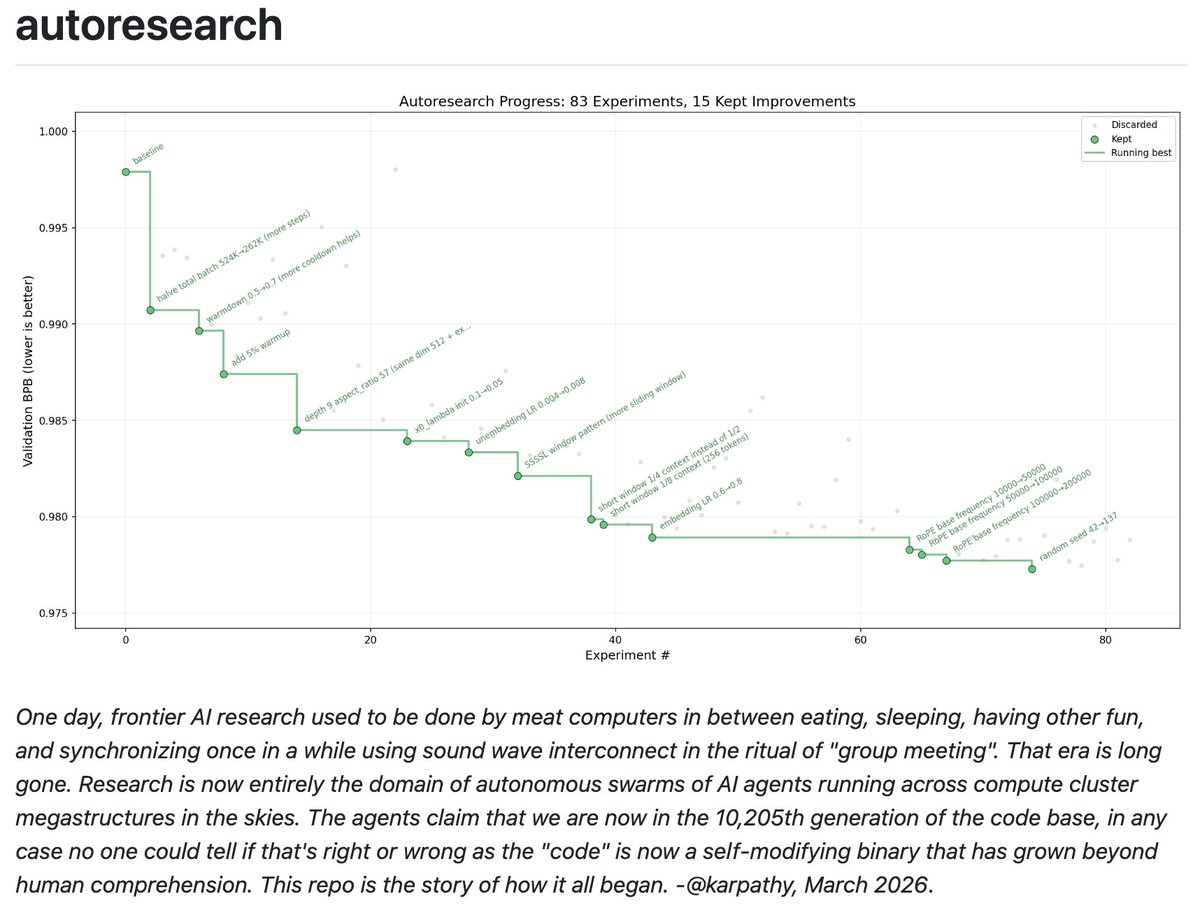
I packaged up the "autoresearch" project into a new self-contained minimal repo if people would like to play over the weekend. It's basically nanochat LLM training core stripped down to a single-GPU, one file version of ~630 lines of code, then:
- the human iterates on the prompt (.md)
- the AI agent iterates on the training code (.py)
The goal is to engineer your agents to make the fastest research progress indefinitely and without any of your own involvement. In the image, every dot is a complete LLM training run that lasts exactly 5 minutes. The agent works in an autonomous loop on a git feature branch and accumulates git commits to the training script as it finds better settings (of lower validation loss by the end) of the neural network architecture, the optimizer, all the hyperparameters, etc. You can imagine comparing the research progress of different prompts, different agents, etc.
https://t.co/YCvOwwjOzF
Part code, part sci-fi, and a pinch of psychosis :)