We bought 19 PB of flash storage for our AWS S3 exit in 2025 for about $1.5m. The list price for this setup today would be $19 MILLION 🤑. Don't know if I've ever timed a trade this well in my life. https://t.co/u4a7ojRJEf
Instead of watching 1 hour of Netflix tonight, watch this ex-Google Chief Scientist Jeff Dean’s lecture. It’s the clearest explanation I’ve seen of the full AI engineering stack - from building LLMs from scratch all the way to one human coordinating 100 agents.
The best part is that it’s useful whether you’ve never touched a model or you’ve been shipping agent systems every day for the past year.
Bookmark it & watch the whole lecture this weekend, because it might end up being the most valuable thing you learn all week.
July 4th, 2030. In just four years, almost every part of America will be reachable by an autonomous car.
People don't believe me when I say that, but it's already happened for me.
In fact, I've probably driven through your community by my robot.
Which gets me to a new point.
I've been all over this country with my robot, and there are some places that are stunningly beautiful: Wyoming, Montana, Alaska, California, and Utah. Even the East Coast has stunning natural beauty in places like Maine and New Hampshire. It's different than Yosemite National Park, of course, but they have their own national park up there that is really nice.
Someday you're going to pay a cheap price for a thrill ride ticket. Yesterday, I did basically San Jose to San Diego in one drive along the coast. This is a way better drive than going to Disneyland and riding the Matterhorn. Disneyland costs something like $150 or more per person; for a family of three or four people, that gets expensive. It’s cheaper to take an autonomous car and buy a box of strawberries.
Also coming in 2030, you're probably going to be wearing a pair of glasses. I know you hate the idea; I have to wear glasses and I hate the idea too. But I've seen the prototypes in the labs and they are so stunning that someday a company is going to bring a product to market that makes us all go, "Oh."
I still believe that company is Apple. There’s a reason for that: they own exclusive rights to Formula One. A lot of people watch Formula One (I watch it myself, though I'm not rich enough to go many times). Someday you're going to have a 3D track on your kitchen counter and you'll be watching the race in a whole new, mind-blowing way. You're going to show it to all your guests at your Fourth of July party and they’re all going to want one.
By 2030, the question isn't whether I have a robot in my house. I already have a couple of robots, like the Matic robot that cleans our floors, and I’ll probably have another one by the end of this year. I'm talking about a humanoid. The real question is: how many humanoids will be in my house at my Fourth of July party in 2030? I could see saving up a little bit to rent a whole bunch of them. Why not? It’s America.
Someday soon, you're going to have robots lighting off the fireworks in certain communities. When I lived in Seattle, we had mortars on our front driveway. It's a little dangerous for a human to get close to, so you send the robot. That’s what I learned in Las Vegas when I met the bomb disposal unit; they let me drive a robot around and blow up a bomb. As an American, that highly entertained me because blowing up bombs is just the best.
That’s why we all like fireworks, except for my autistic son who can’t stand them. He has shown me a different way, so we go to drone shows now.
Regardless, soon you’re going to have humanoid robots lighting the fireworks. In fact, I won’t be shocked if a robot company does that tonight and uses it for marketing tomorrow.
Happy birthday America!
Hope your day is like a box of strawberries.
Tesla is one of the smartest, cracked and most advanced engineering companies in the world.
If they actually did this, then it is likely verifiably true that a dollar above $200/week is waste.
INSIGHT: The great fear was that AI would replace us.
In 2026 the opposite is quietly unfolding.
A third of the companies that fired people to install AI have already hired them back, and when the researchers ran the math, the layoffs turned out to have saved almost nothing. Yup!
Let’s start with the hardest fact.
Gartner surveyed 350 large companies, 80 percent of which had cut jobs for AI, and found no meaningful link between those cuts and better returns.
The idea the whole wave rested on, fewer people means lower cost means higher profit, simply was not in the data. Careerminds, polling 600 HR leaders who had run layoffs, found nearly a third said rehiring cost more than the layoffs ever saved.
Forrester reports 55 percent of employers now regret the decision, and more of them expect AI to grow their headcount next year than to shrink it, 57 percent against 15.
A year ago top executives went on live television to announce the people they had replaced. This year they are quietly reposting the jobs. 🙊
You can see why. Klarna swapped 700 support agents for an Ai chatbot, watched satisfaction slide mainly because the Ai chatbots lack the human personality / emotions and that touch, and its chief executive admitted their company had gone too far.
Tech giant IBM automated their HR desk, which handled the easy 94 percent of requests and stalled on the 6 percent that needed judgment, and is now tripling entry-level hiring.
American giant Ford brought back more than 350 veteran gray beard highly skilled engineers to catch defects its automated systems had missed.
These are all facts. Check for yourself.
One thing is worth getting right, because it is where most takes fall apart. This is not AI failing, and it is not machines needing us.
The economy is still adding jobs, and the roles that build and steer AI are in heavy demand.
What broke was one crude assumption, that a model which can finish a task can therefore hold a job. It cannot.
The judgment, the escalation, the human trust, the memory of ten thousand past cases that experience, that human touch, personality and emotions, that was the job, and it was exactly what got deleted when the people walked out replaced by Ai.
So the machines are not taking the work.
They are sorting it into two piles, the tasks a model can finish and the judgment a person was always there to hold. The companies that bet everything on the first pile are paying, twice, to rebuild the second. It turned out to be far larger than they admitted.
⚡️Sacks is right on the core mechanism.
Karp looked chaotic because he was saying a thing the polite AI class does not want said plainly: enterprise AI safety is about who owns the enterprise nervous system.
The frontier labs want to sell intelligence as a universal utility.
Enterprises are realizing that intelligence wired into their private workflows becomes a control problem. The danger is not only “will they train on my data?” That is the obvious layer. The deeper danger is roadmap capture.
A lab does not need to literally steal Figma’s files to become a threat to Figma. It only needs to see where the market is pulling, where customers are paying, which workflows create value, and which verticals can be collapsed into the model interface. Then it moves upward into design, code, legal, security, science, analytics, customer support, finance, whatever has margin.
That is rational behavior. It is also exactly why enterprises should distrust the model layer owning the application layer.
Contracts help. Encryption helps. Zero-retention helps. Private deployment helps. Those protections matter. But they do not erase the strategic issue: if a frontier lab controls the model, policy, pricing, versioning, refusal behavior, and future product roadmap, the customer is still dependent on an outside brain whose incentives may diverge.
Open models are not magic. They are weaker at the frontier. They are opaque too. They do not solve interpretability. Their value is sovereignty leverage: local deployment, version lock, cost control, fine-tuning, auditability, fallback, and bargaining power against closed labs.
Palantir also creates lock-in. That criticism is real. An ontology/application layer can become its own prison if the customer cannot exit. But Karp’s bigger point survives: serious institutions do not want to hand their operational alpha to a black-box model vendor and hope the vendor stays friendly forever.
The real enterprise AI stack will be hybrid.
Frontier models for maximum intelligence.
Open or controllable models for sensitive workflows.
Compute under trusted control.
Data boundaries enforced.
Application layer owned or governable by the enterprise.
Model switching built in.
Workflow memory kept out of vendor captivity.
That is the actual fight.
The AI war is moving from “who has the smartest model?” to “who owns the workflow where intelligence turns into power?”
The model layer wants to climb into the application layer.
Enterprises that understand this will demand sovereignty before they let AI touch the crown jewels.
Everything about NVIDIA feels different to most of Big Tech I know, in the tactical stuff they seem to do.
But then the team I met operates more nimble and faster than most startups would do. I'm just not used to seeing this inside a public company. Ofc this was just one team.
Oh, and "Jensen" comes up every few minutes. He seems to be such a big driving force behind a lot of things there.
I will probably get more details and do a more in-depth writeup on NVIDIA. It's overdue anyway!
As someone who's gotten invited to this Dialog business just about every year from 2022-2025, let me explain to you what I call 'The Green Room Confederacy'.
The 'green room' is the waiting room in a conference or media studio, and who populates it is an ever-shifting cast of writers, founders, tycoons, and general people of note who shuffle around to the various podcasts and retreats that define a certain stratum of influence and cultural valence.
The billionaires: They're the only lifetime members, mostly because they're paying for the entire thing. Everyone is to some degree there to cozy up to them.
The founders: Usually not actually the leading founders (who are too busy or disinterested to attend), but the type of founders who 'thoughtfluence' and are making a bid to be taken seriously intellectually, moving themselves from the intellectual Premium Economy of Harari/Gladwell to the First Class of Ferguson/Henrich (but never quite the Yarvin/Land level, as that's too dicey and weird).
The writers/creatives: They're the intellectual backbone here, and probably the only ones in a group chat with the billionaire, kept there as a sort of court jester (don't ask me how I know). It's all top-of-funnel and brand accrual to however they monetize, which is likely a Substack and/or podcast.
Historically, these things were about as uncontroversial as it got: Davos, Aspen Institute...nobody is losing a job over going; on the contrary, going is a major brand-building exercise.
But since 2020 or so we've seen the rise of a counter-elite attempting to create counterbalancing cultural institutions and media, which is where the sparks really start as attending the upstart version is declaring your side in the culture war (which is why Ezra is furiously backpedaling here...he's got his NYT roost to maintain).
(If this is all sounding like a high-school popularity contest, it's not too far off, though the downstream implications here are rather more real.)
The claim this is some secret cabal though is laughable, and thought mostly by second-string writers at places like WIRED who've spent their lives with their noses pressed against the glass and never entering, and write about this as a form of envy and pandering to their credulous outsider audiences.
Oh, and did I ever go?
No, for two reasons. I had an iron-clad rule that I'd only go to one of these events only if free (or they paid me), never as a paid attendee. Free/paid, and you're the creative; pay, and you're just a striving customer. And AFAICT, all but the true A-listers had to pay for Dialog.
Also, I was working on @spindl_xyz and this is all very distracting, and getting swept up in all this (as the writer talent), means putting yourself on the relevance/virality treadmill, something I wanted to escape by making a bag instead.
But I will say there were some real intellects on the Dialog invite list (along with a lot of strivers and arrivistes), and I'm all for billionaires creating alternative cultural institutions since our current ones are so clearly decayed and in need of overthrow.
There, that's the backstory to all this. It's all a lot less lurid and conspiratorial than anyone is letting on here.
You can finally say this without being canceled: AI isn't creating a Cambrian explosion of apps, if anything it's holding app creation back.
Earlier tech waves had 'the mythical man-month'. Our generation has 'the mythical AI engineer' who magically turns enormous token usage into equally enormously-adopted products.
Well, where are the apps and new businesses then? Because compared to prior cycles (e.g. the mobile app boom starting in 2010 or so), right now seems positively sterile, app and UX-wise. Other than Claude or ChatGPT itself, name a new app you use now you weren't already using five years ago?
It's a truism of tech that throwing more people and time at a product often results in only lack of focus, confusion, and yet more code to support.
This is the parable of the company that over-raised and over-hired and grew too quickly, and now has lots of mediocre, weakly-adopted products, internal communication problems, distracted leadership, code bloat, technical debt...and so the spiral begins, which ends with an apologetic CEO post after some layoffs announcing "we're refocusing on our core customer".
Every tech company announcing they're either lowering token caps or shifting to lower-priced models is essentially saying: "we o̵v̵e̵r̵-̵h̵i̵r̵e̵d̵ over-spent on tokens, and are scaling back to focus on our core product" blah blah blah...same same.
It's the corporate version of someone using AI to write a long email, someone else using AI to summarize it, and both sides would have been better off just writing a shorter email. But now, even small companies can have that same problem thanks to AI.
I refuse to believe that an LLM prompt is the teleological endpoint of human interaction with computer intelligence. The fact we've apparently recrudesced to CLIs, like me farting around with RedHat 7.1 in 2001, feels like a step back. Another world here has to be possible, and while I have every faith (as someone as deep in AI psychosis as the next person) that AI can help get us out of it...just racking up tokens costs isn't how we get there.
The AI Jesus isn't coming to save us, human taste, discernment, and radical re-invention will. Like Kafka wrote in his notebooks: "The messiah will come only when he is no longer necessary; he will come only on the day after his arrival; he will come, not on the last day, but on the very last.”
.@BernieSanders , it is a time to celebrate. @elonmusk has created enormous value for society by building @SpaceX, driving down the cost of rocket launches and creating a global satellite communication network that has brought high speed, low-cost internet and communication access to hundreds of millions and eventually billions of people along with critical advantages for our military and our nation’s defense.
SpaceX and its technologies will cause an acceleration in the growth of wages and wealth creation globally, including in some of the poorest communities in the U.S. and around the world.
Access to low-cost, high speed communications everywhere will allow children around the world to be educated, families to build businesses, and life-saving medical knowledge and care to be available everywhere.
SpaceX will materially bring down the cost of compute, advancing AI and humanity.
Meanwhile, 4,000 SpaceX employees yesterday became millionaires, including hourly wage employees who you claim you are trying to help.
The Elon Musks of the world drive growth, global GDP, and provide access to goods and services at lower cost that would otherwise not exist.
Elon’s nominal trillionaire status is due to his ownership of SpaceX, Tesla, Neuralink, the Boring Company and his other initiatives that have brought new technologies that improve our everyday lives.
Elon is not sitting on a trillion dollar pile of cash, jewelry and gold. He is using his controlling stakes in his companies to advance mankind. Elon’s companies don’t pay dividends. They reinvest all of their capital to accelerate innovation and value creation.
Elon is working 24/7 for all of us. He deserves respect and appreciation, not smears.
Bernie, your socialism would never allow a SpaceX to be built. Socialism has only proven to impoverish mankind and lead to death and destruction.
We need to create the conditions for more SpaceXs to be built, not attack the great entrepreneurs who are helping to advance our country.
Before a single Allied soldier set foot on Normandy, before the battleships opened fire, before the paratroopers jumped, before any of it, a fleet of small ships sailed alone into the darkness toward the most heavily mined waters in the world.
Nobody talks about the minesweepers.
They should.
By June 1944, the Germans had laid over 6,000 mines across the approaches to the Normandy coast. Contact mines that detonated on impact. Magnetic mines triggered by a ship's hull. Pressure mines activated by the wake of a passing vessel. And some of the most sinister weapons ever devised: mines fitted with ship counters, designed to let several vessels pass safely overhead before exploding under the one that followed. You could sweep a channel, declare it clean, and still die.
The entire D-Day plan rested on one brutal fact: 6,939 ships could not reach the beaches without someone going first to clear the way.
That job fell to 350 minesweepers.
On the night of June 5, hours before the invasion fleet moved, the minesweepers sailed. No escort. No cover. Just small ships pushing into the dark, dragging wire sweeps through the water, cutting the cables of moored mines and listening for the sound of their own death.
They swept 10 separate channels, each 400 yards wide, all the way from England to the coast of France. They were operating within range of German shore batteries. In complete darkness. In rough seas with strong currents constantly pushing them off course, forcing sweeps to be repeated. Keeping formation in those conditions, in the dark, without lights, was nearly impossible.
The Germans never detected them.
Think about what that means. Hundreds of ships, running without lights, dragging equipment through the water, close enough to the French coast to be well within range of shore batteries, and the Germans had no idea they were there.
By 3:30 in the morning, all 10 channels were clear.
The price was paid. USS Osprey struck a mine on June 5 and went down in minutes, killing 6 men. They were the first casualties of the entire D-Day operation, killed before the invasion had officially begun, their names barely known to history. USS Corry struck a mine off Utah Beach and sank so fast her crew barely had time to abandon ship.
These men knew exactly what they were sailing into. Minesweepers do not have the armor of a destroyer or the firepower of a cruiser. They are small. They are slow. They go first because someone has to, and they go knowing that the mine that kills them is one they simply never found.
When the great armada finally moved, when 6,939 ships began crossing the Channel toward France, every single one of them sailed through corridors those men had cut in the dark.
Every landing craft that reached the beach. Every tank that came ashore. Every soldier who stepped onto Normandy and lived. They all passed through water that had been cleared, in silence, in darkness, hours before dawn, by men most people have never heard of.
The liberation of Europe sailed in their wake.
Ray’s Rock - Omaha Beach
On the morning of June 6, 1944, 23 year old Staff Sergeant Arnold “Ray” Lambert came ashore with the first wave of the 1st Infantry Division on the eastern side of Omaha Beach. At this small patch of concrete he saved nearly 20 lives:
The division came under intense fire from several German bunkers surrounding the entrance to the Colville Draw (one of two exits off Omaha Beach). Ray, a medic, immediately went to work.
He was shot in the arm. Moments later he was hit by shrapnel in the leg, but Ray kept pulling men to safety. He pulled nearly 20 wounded soldiers to cover behind this 8ft wide obstacle, treating each soldier before going out in search of others.
After several hours under fire, while pulling a wounded soldier from the ocean, he was struck by a landing craft. It dropped its ramp on top of him, breaking his back. He fell face down in the water, drowning. The craft backed up and nearby soldiers pulled an unconscious Ray to safety, eventually evacuating him off the beach.
Remarkably, Ray had already earned two Silver Stars and three Purple Hearts in Sicily and North Africa, prior to landing in France. But here in Normandy his war would end.
He awoke in a hospital back in England a day later. In the next bed over was his brother, who had also been wounded at Omaha.
When asked about his work on D-Day, Ray simply said, “I did what I was called to do.”
Ray Lambert passed in 2021 at 100 years old. He exemplified the best of American grit and why remembering this day is so important.
82 years ago nearly all of the men on the first few boats that landed on the beach in Normandy were dead before days end.
Sit here with that for a while.
Look at them.
Really look at them.
Look into their eyes.
Many of them are boys, they are someone’s son, someone’s brother, someone’s sweetheart someone’s father.
They never came home.
And every privilege, every convenience, every freedom and every little thing that you want to bitch about you have because of them and they paid the ultimate price for you to have those freedoms. #dday #FreedomIsNeverFree
Startups used to be the province of outsiders, unemployable misfits, and desperadoes looking for their next score.
Gradually via increasing amounts of VC, PG essays, and enormous exits, it becomes the destination for the normie strivers who normally would have opted for whatever the post-Ivy prestige track was at the time.
And when the cycle crashes it goes back to being a misfit and outsider thing. You can almost time the top to when the pretty people show up on Valencia Street.
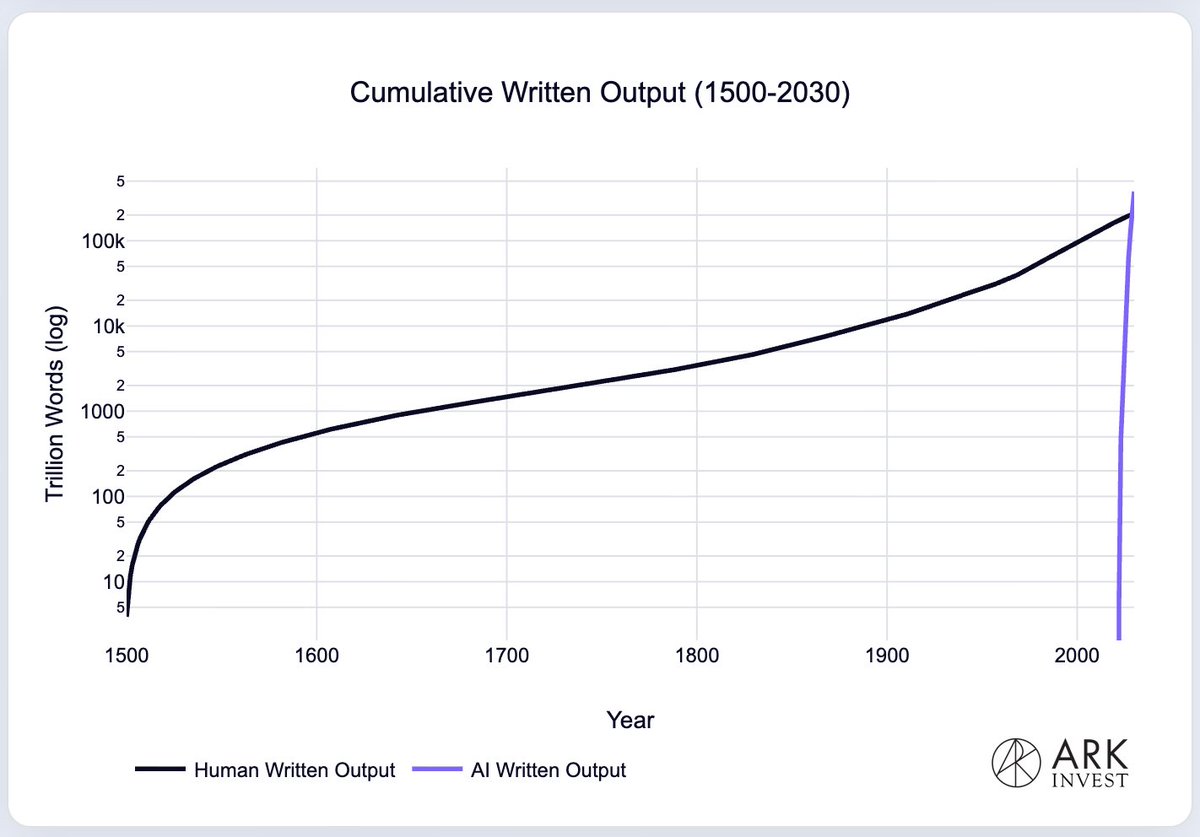
By the late 2020s, AI cumulative written output--every postcard, memo, whitepaper, and business-document--should be surpassed by AI.
We left a written record; that record will be synthetically surpassed.
A few thoughts about PayPal, nearly 12 years after I left.
I woke up this morning to dozens of messages from former PayPal colleagues. It pushed me to finally speak up.
I never spoke publicly about the company after I left. Part of that was loyalty to John Donahoe, who gave me an unlikely opportunity, handing the reins of PayPal to a startup guy who, on paper, had no business running a then 15,000-person organization. But part of it was something else: I had left. I chose not to stay and fight for the changes I believed in. Speaking from the sidelines felt like armchair commentary. Easy opinions without the burden of execution. So I stayed quiet.
But twelve years of silence is long enough. And today's news makes it clear the pattern I've watched unfold isn't self-correcting.
I left PayPal in 2014 because I was deeply frustrated. We had executed a silent turnaround of a company that had lost its soul. We brought back engineering talent, shipped good products quickly, and acquired Braintree and Venmo. The company was on a tear. So much so that Carl Icahn felt compelled to accumulate a position in eBay and push for a PayPal spinoff. At the time, eBay decided to fight Icahn.
It was a difficult period for me, caught between what I felt was right for PayPal and my loyalty to the eBay team.
This is when Mark Zuckerberg approached me to join Facebook. The combination of his conviction that messaging would become foundational, the appeal of going back to building products at scale, and my growing exhaustion with the internal politics at PayPal and eBay eventually convinced me to leave and join one of the best teams in the world, one I had admired for a long time.
In the summer of 2014, I met John in a café in Portola Valley and told him I had decided to leave. During that conversation, he told me that Icahn had effectively won the fight, that PayPal was going to become an independent company, and he tried to convince me to stay on as CEO, but I had already said yes to Mark, and my word is my bond. There was no turning back.
After my departure, the board scrambled to find a replacement, and it took a few months for them to land on Dan Schulman. The leadership style shifted from product-led to financially-led. Over time, product conviction gave way to financial optimization.
Much of the momentum we had created still persisted and carried the company forward, mainly driven by Bill Ready, who came over in the Braintree acquisition and rose to COO. Under his leadership, Venmo grew exponentially, and total payment volume (TPV) accelerated quickly. But the shift under Schulman became more pronounced after Bill's departure at the end of 2019. With him went the product conviction that had defined the post-spinoff momentum. Then, for a period, COVID-fueled online shopping hid a lot of the company's new weaknesses.
During that period, the company made a fundamental miscalculation: it optimized for payment volume instead of margin and differentiation. It leaned into unbranded checkout, where PayPal had the least leverage, instead of branded checkout, where the margin, data, and customer relationship actually lived.
Visa masterfully structured a deal that effectively ended PayPal's ability to steer customers toward bank-funded transactions, which had been a core driver of PayPal's economics. Not long after, PayPal lost a significant portion of eBay's volume. Over time, it saw its share of checkout among its most profitable customers steadily erode as Apple Pay and others continued to execute well.
The same pattern repeated itself across lending, buy-now-pay-later (BNPL), and new rails.
On lending, PayPal missed the opportunity to turn it into a platform weapon. Products like Working Capital were conservative, short-duration, and optimized for loss minimization. Lending never became programmable, never became identity-driven, and never became a reason for merchants or consumers to choose PayPal over something else.
The missed opportunity in BNPL was even more striking. Klarna, Affirm, and Afterpay didn't just offer installment payments, they built consumer finance brands, persistent credit identities, and new shopping behaviors. PayPal saw the BNPL turn, entered the market, and had every advantage: distribution, trust, and merchant relationships. But BNPL was treated as a defensive checkout feature rather than an offensive category. There was no attempt to turn it into a core consumer relationship, no super-app behavior, and no meaningful differentiation for merchants. Others built platforms, PayPal added a feature.
The failure to lean into building and owning new rails followed the same logic. After the spinoff, PayPal had a once-in-a-generation opportunity to build a global, at scale payment network. Instead, the company focused on building on top of existing networks and third-party rails.
More recently, that mindset carried over to PYUSD. Technically, the product was sound. Strategically, it launched without a compelling transactional reason to exist. PYUSD had distribution, but no organic demand. It was not embedded deeply enough into flows to become a true settlement layer, a cross-border merchant rail, or a programmable money primitive. It sat adjacent to the product instead of inside the core of it.
Acquisitions during this period followed a similar pattern. Honey was not a strategic acquisition for PayPal. It added activity, but not leverage. It lived outside the transaction, monetized affiliate economics rather than payment economics, and never meaningfully strengthened PayPal's control of the customer or the checkout moment. Xoom solved a real problem in remittances, but it never compounded PayPal's advantage. It scaled volume without changing the underlying rails, identity graph, or settlement model, and as importantly, it didn’t cater to a high-value, high-margin customer archetype.
None of these were bad companies. They were just a wrong fit for PayPal and became unnecessary distractions.
The board eventually recognized the problem. In 2023, they brought in Alex Chriss, an Intuit veteran with a strong product background, explicitly to restore product conviction. It was the right instinct.
But Alex came from software, not payments. He understood SMB product development. He didn't have the muscle memory for transaction economics, network effects, or settlement infrastructure.
In hindsight, he also made an error: clearing out much of the leadership team that understood payments deeply. Executives with years of institutional knowledge departed within his first year.
This morning, Alex was removed as CEO. Branded checkout grew 1% last quarter. The board tapped another operator, Enrique Lores, the former HP CEO who's been on the PayPal board for five years.
I don’t know Enrique. And he might be a great leader, but on paper at least, he’s a hardware executive. For a payments company.
The common thread through all of this is incentive design. Once PayPal became independent, short/medium-term predictability beat long-term vision and ambition. Stock performance mattered more than platform risk and network opportunity. Financial optimization replaced product conviction.
I'm not claiming I would have made every call differently. Running a public company at scale involves tradeoffs I didn't have to make after I left. But the pattern, choosing predictability over platform risk, again and again, was a choice, not an inevitability.
Over time, the company that had every advantage and could’ve become the most consequential and relevant payments company of our time, lost its mojo, its product edge, and its ability to compete in a market that’s being rewired and reinvented in front of our eyes.
That's the part that's hardest to watch for a company I care so deeply about.
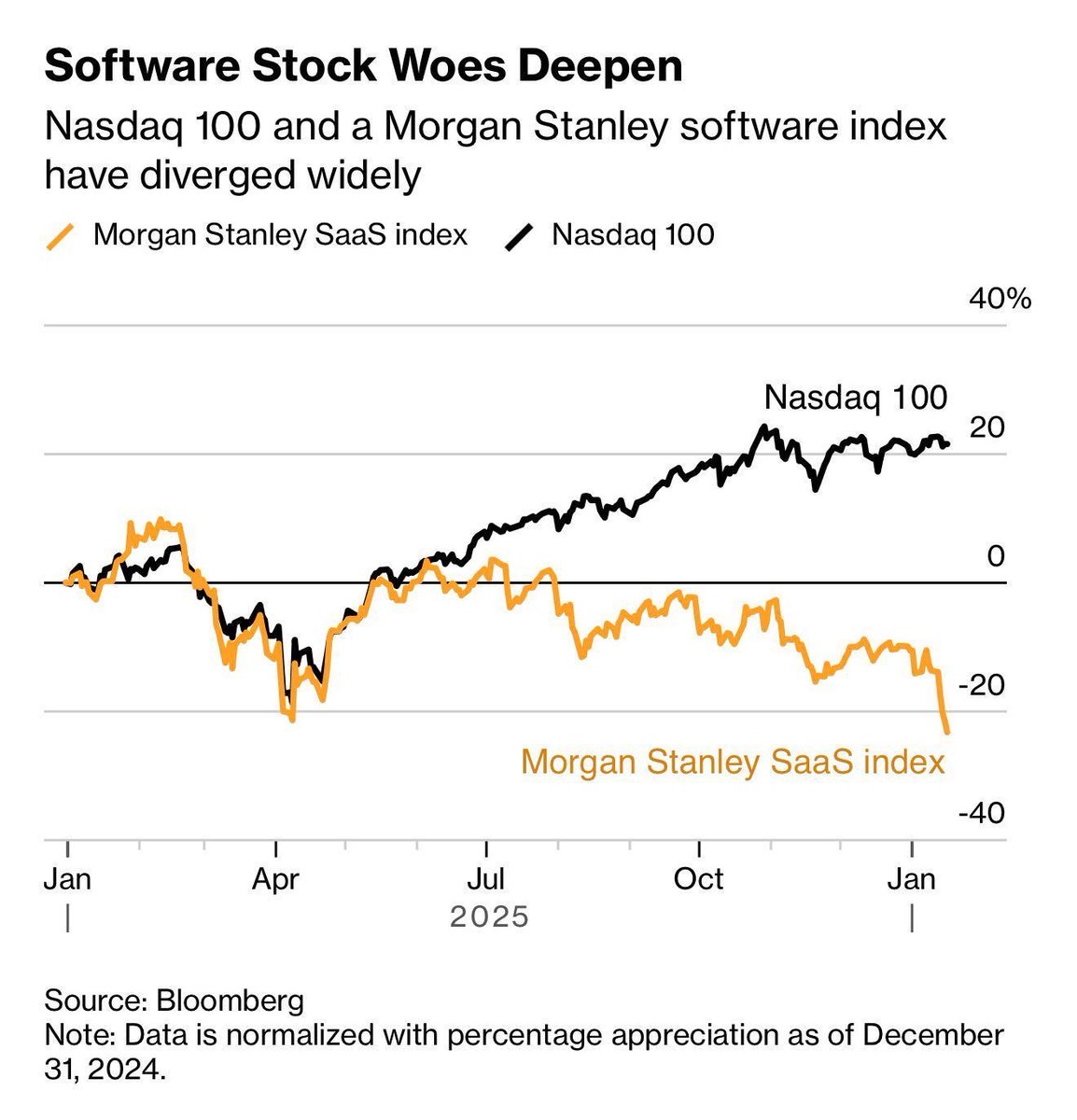
We've talked a lot about this on the Pod, but the Great SaaS Meltdown has started and there's no going back.
What exactly is happening?
In short, hi growth, low/no profitability SaaS is no longer a winning strategy because the big question mark is the durability of that growth in the short term and, because of AI, the lack of profits in the long term. Every SaaS company has sold the dream (to investors and employees) that they will growth quickly now, and harvest lots of cash later. With AI, this assumption may be completely out the window.
Now the threshold question is whether their growth will be overtaken by a much cheaper AI-developed solution?
If you are a venture supported SaaS startup and are a legacy Heuristics+APIs+CRUD product, it is likely that a new AI oriented workflow is coming for you.
Investors in private markets can see this now and think that money to fund short term growth will not be rewarded. Investors in public markets no longer believe long term profitability is possible. They would rather pivot into something they think is more resilient.
This is a change in the risk calculus that has existed for the past 15 years and why the chart below is the chart below.
Good luck to all the players!