@kevin2kelly I prefer to start in the city, soon after head out. Then returning to the city it actually feels a bit like home. Tokyo for the second time was magic, after visiting the countryside.
@kevin2kelly Agree in part, but that's a bit like running from a bright room outside and expecting to see the stars. The faraway place is usually more subtle, and a bit of time can help you to see it with good eyes. On day 1 you'll miss it.
@torybruno@blueorigin Beauty. Simpler than it looks. I studied the Apollo hatch design in some detail years ago. What are some of the main differences here?
Inspiring watching the astronauts fly behind the moon, describing part of it as "looking like a large healing wound".
See! Wound care is a universal problem! @swiftmedical
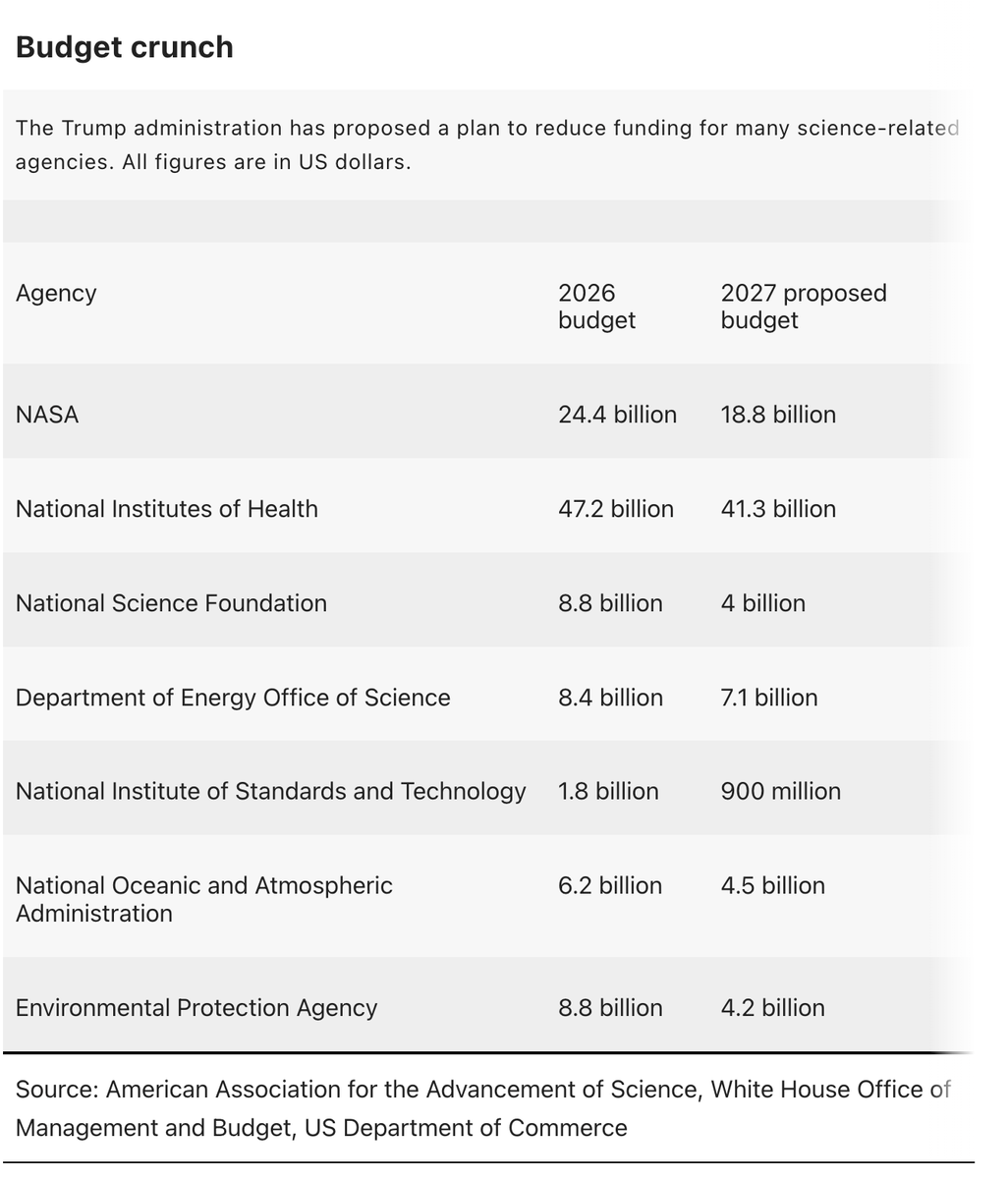
NEWS: Massive budget cuts for US science proposed again by Trump administration
"It's an extinction-level event for science".
The US government is proposing massive cuts to almost every branch of science, from NASA to the National Institutes of Health. NSF would completely eliminate the social, economic and behavioral sciences directorate.
This would decimate the world's leading scientific system.
https://t.co/QtRa7L7Vo4
@tobi@sandeeptodi Government loves to specify esoteric workflow and output, rather than adapt process to existing and bulletproof software. Often the same for large orgs as well.
The transistor, Unix, nylon, Teflon and the laser all have one thing in common: They were a result of the golden age of corporate R&D. In 1985 IBM had 400,000 employees but only 8 called "Wild Ducks." They could break all the rules, pull people off other projects, get budget on demand, and reported directly to the CEO. Bell Labs alone produced 11 Nobel laureates and 28,000 patents. Its budget came from American phone bills. Fortune 500 companies won 41% of America's top innovation awards in the 1970s. By 2006, that number dropped to 6%. Here's what killed American R&D:
1. The hostile takeover wave of the 1980s pushed executives toward short-term results
2. The AT&T breakup gutted Bell Labs from 26,000 to 19,000
3. Venture capital gave the best researchers a better deal than staying inside a corporation
4. Offshoring broke the feedback loop between making things and understanding them
5. Jack Welch turned GE from an industrial research company into a financial engineering shop and donated RCA's research lab to a nonprofit
6. The 2017 tax law penalized R&D spending so aggressively that some companies faced 4x higher tax bills for doing more research
Today the U.S. spends nearly $1 trillion a year on R&D, but two-thirds of it goes to incremental product improvement. The labs that built modern America are gone. I'm reverse-engineering what made them work. And what a modern skunkworks looks like.
@mtavitschlegel@ID_AA_Carmack Super interesting work. Is this essentially equivalent to separation of objective state abstractions in the same way that GNC loops close around relevant dynamics operating over relevant time horizons and at relevant frequency/bandwidth?