everyone's sleeping on how absurdly good 2026 is to start a company (even compared to 2024)
one person can now:
- ship full apps without engineers (cursor, replit)
- design without being a designer (v0, Claude Design)
- turn one video into 10 clips (opus, descript)
- push those clips to millions (X, Linkedin, TikTok)
- replace a support team (chatbase, intercom)
- literally watch exactly what their users do (Posthog)
- find + target perfect leads on autopilot (origami)
This is such a rare window. I just can’t imagine it being this easy ever again
Today a crazy quantum story just got wilder.
On March 31, the Google Quantum AI team published a landmark result on Shor's algorithm for elliptic curve cryptography. Technically, the paper was a bombshell: a dramatic 10x improvement over the state-of-the-art. As a stunt and wakeup call to the blockchain space, those optimisations were illustrated on secp256k1, the elliptic curve underlying Bitcoin and Ethereum signatures.
But perhaps the most striking part of the paper was sociological, not technical. Instead of following standard academic process, the optimisations were kept secret, hidden behind a zero-knowledge (ZK) proof. Google's accompanying blog post mentions they "engaged with the U.S. government". The ZK proof demonstrates the existence of algorithmic improvements without leaking details. Academic censorship with ZK, a historic first!
As a co-author of the Google paper I witnessed some of the context surrounding this censorship. To be honest, multiple aspects of that context don't sit well with me. As much as I believe the general public ought to know more, I am limited in my ability to whistleblow. Though let me be clear about one thing: the Google team's professionalism has been absolutely exemplary, and they deserve nothing but praise.
Censorship has a way of backfiring. The Streisand effect, where an attempt to bury something only draws more attention to it, is exactly what's unfolding today. First, Google's key optimisation has been rediscovered by the French. And in a thrilling turn of events, a collaborative Shor-at-home challenge just launched. The initiative, available at ecdsa[.]fail, breached a new Shor world record in a matter of hours.
Let's start with the rediscovery. Just two months after Google's paper, French quantum expert André Schrottenloher cracks the main secret optimisation. His paper, titled "Optimized Point Addition Circuits for Elliptic Curve Discrete Logarithms", landed on the arXiv today. Big congrats to André, who beat several other nerdsnipped experts to it. In a blog post also published today, Craig Gidney, the world expert on Shor optimisations, revealed that he'd been sitting on this very optimisation for a whole year under censorship pressure.
Interestingly, André missed a handful of minor optimisations, both from Google's original publication and from improvements found since. It's plausible there's still plenty of juice left to squeeze out of Shor, and this is exactly what the ecdsa[.]fail challenge is about. The verifier program developed for the ZK proof does double duty, automatically filtering for valid submissions. Dozens of compounding small and micro improvements are rolling in. As of the time of writing there's an 8.4% improvement to Google's circuit, as measured by the product of logical qubit count and Toffoli gate count. Nice!
The nerdsnipping ran deeper than anyone expected. Over the last few weeks it became clear it extended well beyond André and other quantum experts. Behind the scenes, a small army of amateurs quietly got to work. Inspired by Karpathy-style autoresearch, they turned AI on Shor. Ironically, the verifier program for the ZK proof makes an ideal reward function for AIs. The barrier to entry for this modern style of research is refreshingly low, with several non-experts, even a teenager, finding nice optimisations. Get in touch if you'd like to join a Telegram group with fellow autoresearchers :)
Part 2: neutral atoms and qday
The story doesn't end with Google. On the same day Google went public, a stealthy startup called Oratomic published its own Shor paper in a coordinated release. It made a splash, ultimately becoming the most upvoted paper on scirate[.]com, a website ranking arXiv papers.
Oratomic's claim was wild. By building on Google's logical optimisations and applying custom physical optimisations for neutral atoms, they claimed just 10K physical qubits were sufficient to run Shor's algorithm on secp256k1. That number is mind-bogglingly low.
Knowing essentially nothing about neutral atoms when Oratomic's paper landed, I was intrigued and decided to learn more about the tech. I fell straight down the rabbit hole and spent a couple hundred hours on the topic. I got a little obsessed and watched every YouTube video I could find and spoke to a bunch of experts.
My conclusion? The tech is real, very real. Even Google recently decided to start a neutral atom lab, a notable pivot from their sole focus on superconducting qubits. If you care about qday, i.e. the day a quantum computer will break the first piece of cryptography in production, neutral atoms demand your attention. I shared some of my learnings on Shor and neutral atoms in a 30min talk at the ZKProof cryptography conference. You can find it on YouTube by searching "zkproof neutral atom".
Here's an interesting observation about this duo of breakthrough papers: neither Google nor Oratomic say a word about what their results mean for qday. No timelines. Zero. Nada. That is especially baffling given that the whole point of whitehat quantum cryptanalysis is to inform qday estimations and help the general public make good decisions.
So let me attempt to partially fill the silence, similarly to what Scott Aaronson did in his April 29 post. Given everything I know, including scary non-public information, I now put the odds of qday by 2032 at 50%. 10% by 2030.
Anecdotally, the US government has its own date: 2035. Originating at the NSA and later adopted by NIST, it's when branches of the US government will be disallowed from using quantum-vulnerable cryptography. In plain language: with hindsight, that date is a joke and should be discounted entirely. I don't see how NIST avoids being forced to pull it forward by years.
Part 3: post-quantum cryptography
There are good reasons to sound the alarm today, but please do not panic. Rushing carelessly towards immature post-quantum cryptography is a recipe for disaster. IMO a good target date for migration is 2029, roughly 3.5 years out. 2029 happens to be the date selected by Google, Cloudflare, and the Ethereum Foundation.
These days most of my time goes to safely migrating Ethereum towards post-quantum cryptography as part of the broader lean Ethereum effort. There's a lot to do. We need to rip out and replace BLS signatures at the consensus layer, KZG commitments at the data layer, and ECDSA signatures at the execution layer.
The plan to get there is compelling, and is based on hash-based cryptography. Within the Ethereum Foundation we've developed a Swiss army knife called leanVM (github[.]com/leanEthereum/leanVM) powered by the magic of hash-based SNARKs. Thanks to truly exceptional work by Emile, Thomas, and others, its performance is derisked. Regarding security, leanVM is a jewel, a minimal zkVM crafted for end-to-end formal verification and maximum security.
Want to help? There are two $1M initiatives. First, the Proximity Prize (proximityprize[.]org). Solve a long-standing mathematical conjecture in coding theory, improve hash-based SNARKs, and go home a millionaire. Second, the Poseidon Initiative (poseidon-initiative[.]info), offers $1M for breaking Poseidon, the SNARK-friendly hash function.
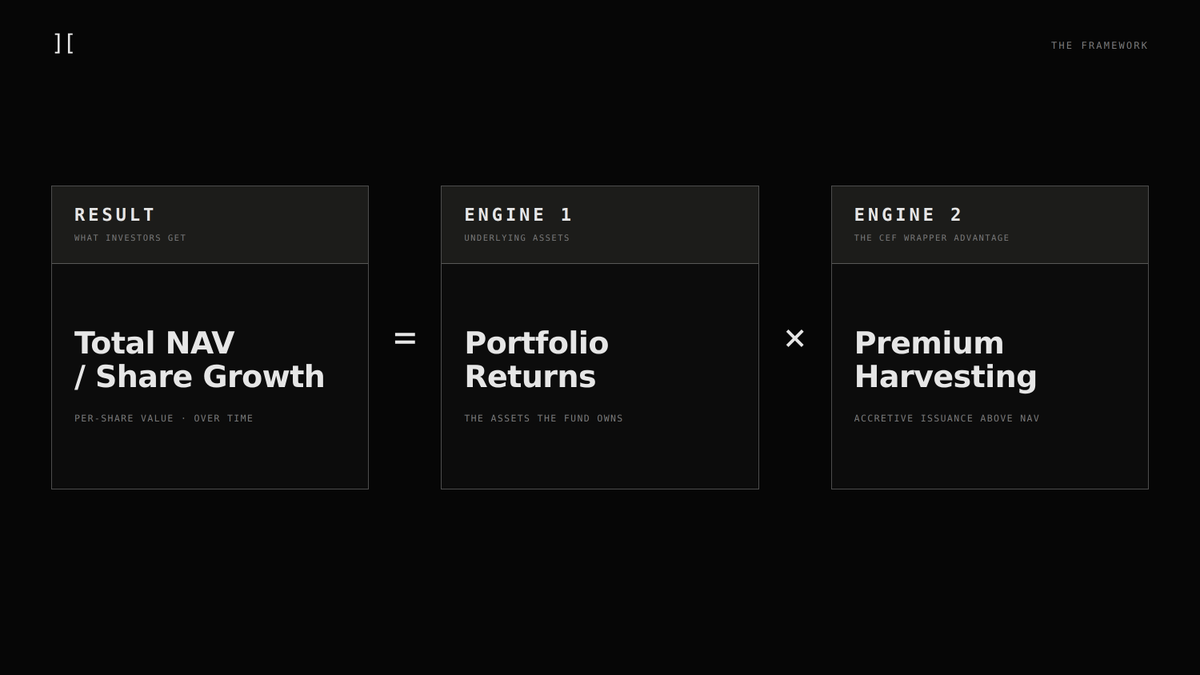
MicroStrategy for Robotics - How does RoboStrategy's capital markets model work?
Public capital raised at scale, redeployed into leading private companies in robotics.
A primer on how a publicly-listed vehicle can compound NAV per share over time via accretive share issuance:¹
Fantastic breakdown. Would add:
- There’s a class of builders in remittance and cross border payments that will start to eat up a lot of incumbents. Over 30% of the booths were focussed on this market
- On chain defi yield is dead. Lending still needs a home.
Just got back from @consensus2026 Miami. Some unfiltered thoughts on the vibes:
The industry has clearly grown up. The degens are gone, the allocators are wearing suits, and your @Uniswap booth has been replaced by a JP Morgan activation with 50 year old boomers. Cautiously optimistic with a distinctly institutional aftertaste. This was not a bull market conference.
Key takeaways:
1) CLARITY Act has serious momentum. Everyone at the conference basically agrees it's getting done before summer. The urgency is real, people are done waiting. And the regulatory window feels genuinely unprecedented: CLARITY Act, GENIUS Act, a CFTC chair actively engaging with the industry, this combination has never existed simultaneously before. The institutional urgency you're seeing everywhere is directly correlated to this window feeling time-limited. Miss it and you're explaining to your board why you sat on your hands during the most favorable crypto regulatory environment in history.
2) Institutions are not dabbling anymore. They are ALL IN on tokenization and terrified of missing it. No one is debating whether blockchain rails are useful. The debate is now who gets the mandate. And quietly @coinbase , @krakenfx , @RobinhoodApp and @Bullish and others are being seen more as competitors than potential partners by a lot of these TradFi players.
3) TradFi M&A is going to keep ripping. @krakenfx just grabbed Reap for $600M. Visa, Mastercard, Swift etc they can't miss the train and they're willing to overpay for the ticket.
4) Crypto VC is consolidating fast. @a16z and @katie_haun just announced $2.2B and $1B funds respectively. Meanwhile the boutique VCs are either pivoting to AI or quietly closing shop. Same playbook is happenign as traditional VC, the big platforms eat everything and the small guys scramble. Seed and pre-seed is basically a ghost town right now. Late stage and pre-IPO is where the action is.
5) Investment themes were aggressively consensus (no pun intended): Stablecoins, tokenization, vertically integrated neo-banks, regulated or permissioned DeFi. Literally everyone is trying to be a tokenization platform. Issuance, management, settlement, curation, pick your lane, slap tokenization on it, try to raise money.
6) Building in crypto is genuinely hard now. Your competition isn't some scrappy new L1 or GMX, it's @tether , @Anchorage , and @Securitize. there are now many crypto businesses running 200M+ annual Rev with serious management teams and deep pockets. The barbarians are now the establishment. New entrants are going to have a very bad time.
7) Pure token-only plays have become extremely contrarian. Controversial take but I think the biggest returns will come from a handful of tokens that can credibly signal in a compliant way that the token remains the only value accruing asset going forward.
8) A lot of teams are in a genuinely weird spot on the token/equity dynamics. Decent products, decent teams, but a complete stakeholder clusterf*** that nobody can untangle. Many of these will simply not survive.
9) The agentic finance and agentic commerce crowd was loud. The actual substance was not. A lot of big claims, very little to show for it. Feels very early and mostly vibes. Color me skeptical for now.
10) @Bullish acquiring Equinity for $4.2B was the boldest move of the conference. @ThomasFarley and @BonannoDavid now have a full-stack RWA proposition: issuance, transfer agency, tokenization, exchange and settlement under one roof. Massive move. Very positive for the industry regardless of whether you think the price or the move were right.
11) @BitMNR and @fundstrat are apparently tired of winning and has decided to let your grandma keep her ETH... for now. The pace of accumulation is slowing. Tom, we await your next allocation with bated breath.
12) DeFi apps are moving up the stack and getting smarter about it. They don't want to be the commodity infrastructure layer getting squeezed by exchanges that own distribution. Some genuinely interesting announcements, @buffalu__ at @jito_sol launching JTX being the highlight.
13) Nobody at the conference was talking about retail coming back. The entire conversation was institutional. That's either a sign of maturity or a sign that the industry has quietly given up on mainstream consumer adoption for now and is betting the next cycle gets pulled by institutional flows rather than retail FOMO. Probably both.
14) The L1 debate is officially dead. Nobody and I mean nobody was arguing SOL vs ETH or pitching their shiny new L1. The crowd that used to religiously defend their chain of choice has either grown up, cashed out, or both. Institutions don't care about your consensus mechanism. They care about settlement finality, compliance rails and liquidity. The L1 wars were fun while they lasted. RIP.
15) DATs are a mess. Had some genuinely productive conversations with a few of them but let's be honest most are an absolute clusterf*** operationally and very few are running anything resembling a legitimate business. The structure is a disaster at the stakeholder level and the governance makes your average startup cap table look clean. That said, the permanent capital vehicle concept is still genuinely compelling and I think a handful of these will turn out to be absolute home runs. The model isn't broken, most of the teams just are.
Bottom line: Consensus 2026 felt like the moment crypto stopped being a movement and started being an industry. Whether that's exciting or depressing probably depends on when you got in.
A day in the life of Bitcoin’s 17th year:
✅ $1.4 trillion, 90-year-old firm releases new BTC product
✅ Energy exporter demands payment in BTC
✅ NYT still can’t figure out who Satoshi is
✅ Fortune 500 company rolling out BTC payments for 4M merchants
How we doing fam?
Self recommending must-read for Canadians.
“The path Canada is on, economically and culturally, is no longer sufficient to make us a flourishing world class nation.”