Controversial take: if you EVER, EVER feel like you're more excited about looking forward to Monday than Saturday, then you should absolutely lean into that...lean into that. Whatever it is...a job, a business etc.
You've probably heard of the Sunday scaries; well, this is the Friday scaries. This is because it's a strong sign that you're onto something big and meaningful, and I can guarantee you that this is not a feeling that many people get, so double down, triple down, do whatever you have to do to keep this feeling alive.
I'm not saying you shouldn't take the w/e off to reset (please do!), but all I'm saying is that you've got something good here, and it's now your job to figure out how to compound on this over the long term...
Crazy observation: everyone wants to leave their dead end job, but nobody wants to put in the work to make it happen. The silver lining is that for those who put the energy in, the greater separation they'll create between those who chose not to act.
The biggest lie that you're told is that your career should follow a linear path.
You go to school, you graduate, you get a job that you may or may not like, and then you continue climbing the corporate ladder until retirement. The problem is that this puts you into a false sense of security because you're led to believe this is the only path towards stability and success.
The good news is that right now is the best time to follow a non-linear path. Career paths that seemed too risky 5-10 years ago are now becoming viable options to build a meaningful life. It doesn't mean you have to start a business or join a startup, but it just means you can be more flexible with your choices. You have permission to experiment and see what works - you can start building things and ship them in just a few days. The game has changed, and it's really up to you to take action and build the life that you want.
Underrated mindset: be obsessively curious
The best founders and operators are the ones who are obsessively curious about the world, but the trick is that you have to be ok feeling like a beginner. This is because you have to abandon comfortable assumptions and just feel stupid for some amount of time. It's why kids are so good at it. They're just constantly absorbing and don't care how they're perceived.
But as you get older, things start to change. This is partly why most adults don't want to do it cause it means they have to be a beginner, and that feels like an ego hit. It usually happens when they start gaining expertise, reputation, and status. They don't want to go back to the drawing board. But the people who stick at it and just keep learning are the ones who level up the most
There is another side of curiosity, and it's called diversive curiosity.
Diversive curiosity is really good if you just want to randomly explore your interests over a weekend because it helps you discover niche areas, and over time you'll be able to find patterns and join the dots. A good e.g. is going down the Wikipedia or YouTube rabbit hole, bingeing on intellectually stimulating content.
But where it gets unproductive is if you use it as an avoidance mechanism -- you're trying to move the needle on your business or your career, and you're trying to explore all of these "what if" scenarios.
It feels productive but it's not. It's also a fear of commitment, cause it's a way to avoid the grueling part of mastering the thing because it stops feeling like play, and you have to start doing the work now
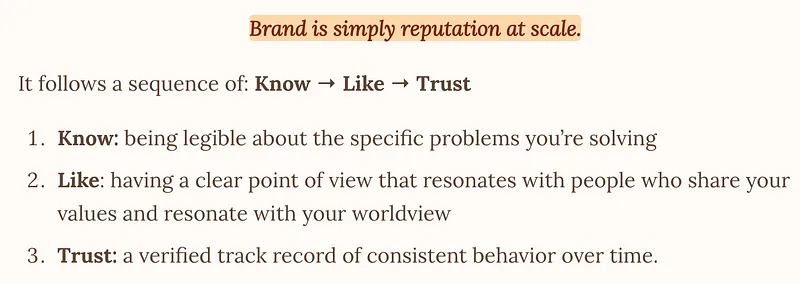
This is why tell aspiring founders to build their brand as early as possible, even before they take the leap. It’s a good entry point to start building a high-trust network. It also doesn’t matter if your following is small (for now). It’s probably better because you can experiment and test what works to get the reps in to practice.
The biggest lie that you're told is that your career should follow a linear path.
You go to school, you graduate, you get a job that you may or may not like, and then you continue climbing the corporate ladder until retirement. The problem is that this puts you into a false sense of security because you're led to believe this is the only path towards stability and success.
The good news is that right now is the best time to follow a non-linear path. Career paths that seemed too risky 5-10 years ago are now becoming viable options to build a meaningful life. It doesn't mean you have to start a business or join a startup, but it just means you can be more flexible with your choices. You have permission to experiment and see what works - you can start building things and ship them in just a few days. The game has changed, and it's really up to you to take action and build the life that you want.
There's a big confusion between what freedom and work actually mean in today's world
The problem is that most people think freedom is all about taking vacations, lying on the beach, and not "working" at all. But that couldn't be further from the truth. It's actually the opposite.
Freedom is all about being able to work on the things you want, and it's actually about doing more of those things that you want to do, not less.
This is an important mindset shift because it allows you to reframe what work actually means to you in a positive way. It forces you to look for new paths that get you to a place where work is something you want to do instead of something you're being forced to do.
Once you understand that, the whole game changes
The founder of TSMC got no equity in the company. He was 56 years old. He's worth ~$10B today from buying TSMC stock with his own money.
Ben Thompson called him "a one of one" who belongs on the Mount Rushmore of the greatest tech executives of all time.
This is his story.
Morris Chang was born in Ningbo, China in 1931 and spent much of his childhood fleeing war. At 18, he arrived at Harvard as the only Chinese student in a freshman class of over 1,000.
In 1955 he had two job offers, one from Ford and one from a transistor maker that paid $1 more per month. Ford refused to match, so Chang took the other job.
He spent the next 25 years at Texas Instruments (TI) and eventually rose to run its worldwide semiconductor business. Then his ascent stalled.
TI moved him out of semiconductors and into a job he later described as being "put out to pasture." Two years later, he quit.
He landed next at General Instrument in New York, living on the 53rd floor of Trump Tower, where Donald Trump was his neighbor. The job lasted about a year.
It was there, in 1984, that Gordon Campbell asked him for $50 million to start a chip company. A few weeks later, Campbell called back and said he only needed $5 million. Why? "I'm not going to build a fab."
Taiwan had been trying to recruit Chang for years, determined to move beyond cheap plastics and running shoes and build a high-tech economy.
The government had asked him outright to run its industrial research institute, ITRI, back in 1982, while he was still at TI, and he'd said no. After General Instrument let him go, it asked again. In 1985, he said yes.
Donald Lee-Brown, who runs research at Positive Sum, likes to say the very best entrepreneurs can divine where the puck is going.
Chang saw that chip design and chip manufacturing were going to split, and someone would need to do the manufacturing for everyone else.
On his second day at ITRI, he inherited requests from three chip companies, each asking the institute to help fund its own fab.
Instead of building three factories, Chang proposed building one they could all share. That idea became TSMC.
Taiwan put in $70 million for 48% of the company. Philips invested $40 million, and private investors contributed another $35 million. Chang, despite founding and running it, got none of the equity.
Intel, TI, Motorola, AMD, Panasonic, and Sony all passed on funding it.
TSMC grew revenue 49% annually for its first decade. By 2000, most of its revenue came from fabless companies like Qualcomm, Broadcom, and Nvidia.
In 1997 Chang got a letter from the CEO of a four-year-old company that was facing bankruptcy and whose calls TSMC's sales office had been ignoring. Chang called the number printed on the stationery.
Jensen Huang picked up amid a bunch of shouting, then said to his team, "Quiet, Morris Chang is calling me."
Chang stepped down as TSMC's CEO in 2005. Four years later, at 77, he came back. One of the first problems waiting for him was Nvidia.
A manufacturing failure had damaged the relationship, and TSMC's management had refused Jensen’s request for compensation.
Chang emailed Jensen and told him he would be at his house at six. Salad and pizza at 6:30. Business at eight sharp. In Jensen's study he offered more than $100 million, good for 48 hours, no negotiating.
Jensen accepted it in two days.
Back in the CEO seat, Chang nearly tripled capital spending in a single year to own the 28-nanometer node.
In his memoir he quotes Shakespeare on the decision, "there is a tide in the affairs of men which, taken at the flood, leads on to fortune." The tide turned out to be the smartphone.
And then Apple literally showed up at his front door. Chang's wife, Sophie, is the second cousin of Foxconn founder Terry Gou.
One evening in 2010, Gou invited himself to dinner and brought Apple’s COO, Jeff Williams. Eventually, over lunch at Apple, Tim Cook told Chang: "Intel just does not know how to be a foundry."
Today, TSMC manufactures the A- and M-series processors at the heart of Apple's iPhones, iPads, and Macs.
When Chang founded TSMC, the global semiconductor market was about $26 billion. Last year it reached $795 billion. Roughly 30x since 1987.
Philips did even better. Chang estimated that by the time Philips sold its final TSMC shares in 2008, it had earned 135x its original investment.